Rinnai Tankless Water Heater Error Codes: The Complete Guide
Every Rinnai tankless error code explained by factory-trained Rinnai PROs in Southern California — what each code means, whether it's serious, and what to do next. Call (877) 798-7487.

Every Rinnai tankless error code explained by factory-trained Rinnai PROs in Southern California — what each code means, whether it's serious, and what to do next. Call (877) 798-7487.
By the Certified Technicians at THE Water Heater Company
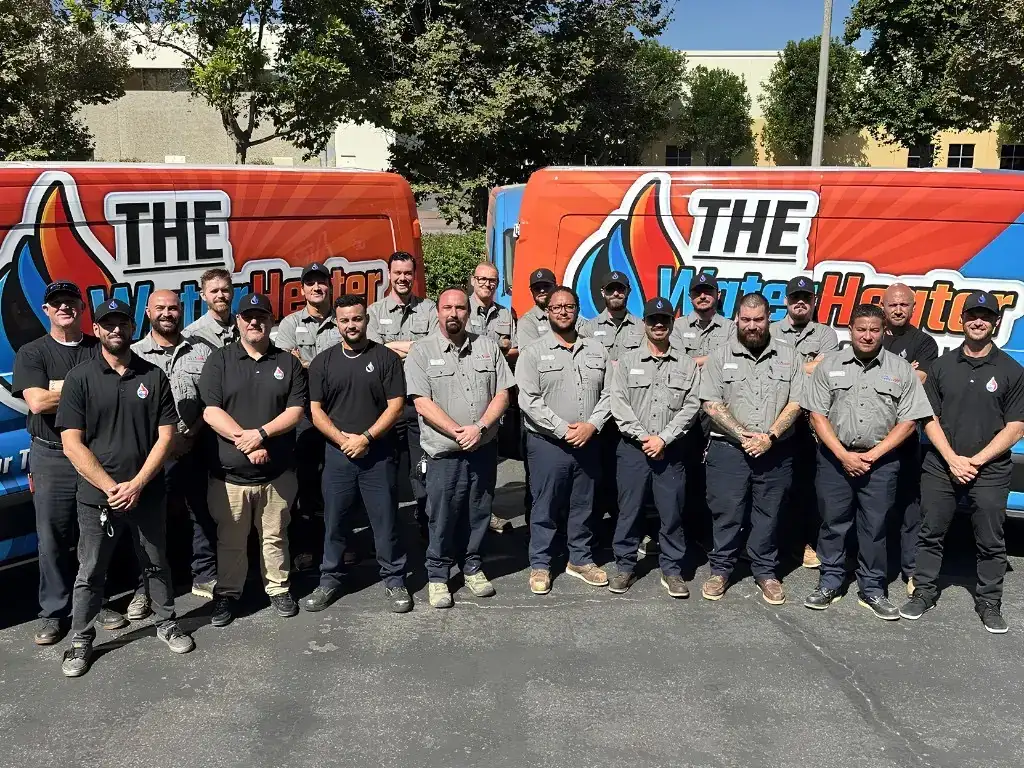
Rinnai PROs — Factory-Trained Authorized Rinnai Service Providers | Three Locations Serving Ventura County, Los Angeles County, Orange County & Santa Barbara Since 2018
Last Updated: July 2026
Your Rinnai Is Talking to You. Here's How to Understand What It's Saying.
You walked over to your Rinnai tankless water heater and saw a code flashing on the display. Maybe you have no hot water. Maybe the unit is beeping. Either way, you want to know: What does this mean? Is it serious? And what do I do next?
You are in the right place.
This is the most complete guide to Rinnai tankless water heater error codes available anywhere. We are THE Water Heater Company — Rinnai PROs, Rinnai's designation for factory-trained authorized service providers — with three locations across Southern California, serving Ventura County, Los Angeles County, Orange County, and the City of Santa Barbara. Our certified technicians work on Rinnai units every single day from Camarillo to Van Nuys to Santa Ana. We wrote this guide using Rinnai's own official troubleshooting documentation, our factory training, and years of real-world field experience.
We will explain every major error code in plain English — what it means, what is causing it, and what needs to happen next.
But before we get to the codes, there is something important you need to understand first.
⚠️ A Critical Safety Warning Before You Read Any Further
Rinnai tankless water heaters are not simple appliances. They are sophisticated systems that sit at the intersection of four potentially dangerous forces inside your home:
1. Natural Gas or Propane — A gas leak or improper gas pressure is not something you can safely troubleshoot without professional training and the right tools. Gas leaks can cause fires, explosions, and carbon monoxide poisoning.
2. High-Voltage Electricity — Rinnai units use electronic control boards, sensors, solenoids, and wiring that carry live electrical current. Working inside the unit without proper training can cause serious injury or death.
3. Pressurized Water — The water moving through a tankless heater is under pressure. Incorrect handling of connections, valves, or components can cause water damage or scalding burns.
4. Combustion Exhaust — Tankless water heaters produce exhaust gases, including carbon monoxide, that must be properly vented out of your home. A blocked or damaged vent is a life-safety emergency.
This combination of gas, electricity, water, and exhaust is why Rinnai tankless water heaters should only be diagnosed and repaired by a licensed, trained professional. Rinnai's own service documentation states that only trained and qualified professionals are permitted to perform these procedures, and warns that failing to follow the instructions exactly can result in fire or explosion. This is not a DIY appliance in the same way that changing a light switch might be.
This guide is written to help you understand what is happening with your unit — not to guide you through a repair. Think of it the same way you would think of a medical reference guide: knowing what a diagnosis means is helpful and important, but it does not replace a trained doctor performing the actual procedure.
One more thing from Rinnai's own safety instructions worth repeating: if you smell gas anywhere near your water heater, do not try to light it, do not touch any electrical switch, and do not use a phone inside the building. Leave, and call your gas company from a neighbor's phone.
If you are in Ventura County, Los Angeles County, Orange County, or the Santa Barbara area and your Rinnai unit is showing an error code, call THE Water Heater Company at (877) 798-7487. We are factory-trained Rinnai PROs with three locations across Southern California, our phones are answered by a live person 24/7/365, and we are here to help.
How Do Rinnai Error Codes Work?
When something goes wrong with your Rinnai tankless water heater, the unit's control system detects the problem and displays a diagnostic code on the temperature controller — the small digital display panel, either on the unit itself or on a wall-mounted remote. Most Rinnai codes are two-digit numbers (like 10, 11, or 79). A few use letters (LC, SS, FF).
These codes are a helpful feature — your Rinnai is designed to tell you when something is wrong before that something turns into a much bigger and more expensive problem.
A note on resetting: for many temporary conditions, pressing the ON/OFF button on the controller twice will clear the code. If a code clears and stays gone, the condition may have been momentary. If the same code keeps coming back, the underlying problem is still there — and that is your signal to call a professional. Rinnai's own troubleshooting guidance follows the same logic: for some codes, if the error returns after multiple resets, a component has failed and needs professional replacement.
The Most Important Thing to Understand: Soft Lockouts vs. Hard Lockouts
This is something most guides do not explain — and it is one of the most important things to understand about your Rinnai unit.
Not all error codes are equal.
Note: Rinnai does not use the terms "soft lockout" and "hard lockout" in their publicly available documentation. The following classification is based on THE Water Heater Company's field experience servicing Rinnai units across Southern California, applied to how each code actually behaves.
What Is a Soft Lockout?
A soft lockout means the unit detected a problem, but the problem may be temporary. In some cases, the unit keeps running. In others, you can press the ON/OFF button twice and the unit starts working again — at least for now.
The critical thing to understand about soft lockouts: they do not go away on their own. The underlying problem is still there. If the same soft lockout code happens repeatedly without being fixed, the unit will eventually lock itself out completely.
Here is a real Rinnai example — and it is the most Southern California example possible. Rinnai's scale codes (LC, and LC0 through LC9) appear when hard-water scale is building up inside the heat exchanger. Per Rinnai's own documentation, you can temporarily keep the unit running by pressing the ON/OFF button five times — but the LC code will return, it will count upward, and repeated LC codes will eventually lock out the water heater entirely. The unit is literally counting down to its own shutdown while the scale keeps building.
The takeaway: A soft lockout is a warning. Do not ignore it just because the unit seems to be working. Call a professional before it escalates into a full lockout — usually on the coldest morning of the year, because that is how these things go.
What Is a Hard Lockout?
A hard lockout means the unit detected a condition where continuing to operate would not be safe — things like failed ignition, flame loss, overheating, or a water leak inside the cabinet. The unit shuts down and will not restart until the underlying problem is found and fixed. A simple reset either will not work or will only lead to the same code returning immediately.
Hard lockouts are your Rinnai protecting your home. Do not fight the safety system. Call a professional.
Quick Reference: Rinnai Error Codes at a Glance
| Code | What It Means | Lockout Type |
|---|---|---|
| 02 | No burner operation during freeze protection mode | Soft |
| 03 | Power interruption during Bath Fill mode | Soft (reset: ON/OFF twice) |
| 05 | Bypass flow control device fault | Hard |
| 07 | Pump operation fault (RH180 hybrid model) | Hard |
| 10 | Air supply or exhaust blockage | Hard |
| 11 | No ignition | Hard |
| 12 | Flame failure (flame lost during operation) | Hard |
| 14 | Thermal fuse / overheat protection triggered | Hard |
| 16 | Over-temperature warning | Hard |
| 19 | Electrical grounding fault | Hard |
| 25 | Condensate drain issue (condensing models) | Hard |
| 31 | Burner sensor fault | Hard |
| 32 | Outgoing water temperature sensor fault | Hard |
| 33 | Heat exchanger outgoing temperature sensor fault | Hard |
| 34 | Combustion air temperature sensor fault | Hard |
| 51 | Inlet water temperature thermistor fault | Soft (unit may keep running) |
| 52 | Modulating solenoid valve signal fault | Hard |
| 61 | Fan motor fault | Hard |
| 65 | Water flow control fault | Hard |
| 70 | PC board (control board) fault | Hard |
| 71 | Gas solenoid valve circuit fault | Hard |
| 72 | Flame sensing device (flame rod) fault | Hard |
| 73 | Burner sensor circuit fault | Hard |
| 79 | Water leak detected inside the unit | Hard |
| SS (55) | Service reminder — maintenance due | Service reminder |
| LC, LC0–LC9 | Scale buildup in heat exchanger — flush needed | Soft → escalates to lockout |
| No code | Unit unresponsive / no power | — |
Rinnai's official diagnostic manual lists additional model-specific codes (including 13, 15, 17, 21, 30, 35, 38, 41, 54, 57, 58, 63, FE, FF, and SE). If your unit shows a code not detailed below, call us at (877) 798-7487 and we will tell you exactly what it means for your model.
The Codes, One by One
What Does Rinnai Error Code 02 Mean?
Rinnai Code 02 means the burner did not operate while the unit was in freeze protection mode. Your Rinnai runs a self-protection cycle in cold conditions; this code says that cycle could not fire the burner.
Lockout type: Soft.
Common causes: gas supply interruption, blocked exhaust, or a fan issue during the freeze-protection cycle.
What you should do: verify your gas is on, then reset the unit. If Code 02 returns, call a professional — even in Southern California, our cold snaps are exactly when you need freeze protection working.
What Does Rinnai Error Code 03 Mean?
Rinnai Code 03 means power was interrupted while the unit was in Bath Fill mode, and water will not flow when power returns. This is a safety behavior, not a malfunction — the unit refuses to resume filling a tub unsupervised.
Lockout type: Soft. Per Rinnai's documentation: turn off all hot water fixtures and press the ON/OFF button twice to reset.
What you should do: reset as above. Rinnai's guidance is that if the code reappears after three resets, the control board has a fault and needs professional service.
What Does Rinnai Error Code 05 Mean?
Rinnai Code 05 means the bypass flow control device — the internal valve that blends water temperature — has a fault.
Lockout type: Hard.
Common causes: failed bypass valve or servo, wiring fault, or (in our experience) scale interfering with the valve's movement.
What you should do: this is an internal component diagnosis with live electrical testing. Call a professional.
What Does Rinnai Error Code 07 Mean?
Rinnai Code 07 applies to the RH180 hybrid tank-tankless model and means the internal pump is not operating correctly.
Lockout type: Hard.
Common causes: water supply pressure below 30 PSI, a clogged inlet filter, scale-clogged heat exchanger, or a failed pump or pump wiring.
What you should do: check that your water supply is on; beyond that, this is professional territory.
What Does Rinnai Error Code 10 Mean?
Rinnai Code 10 means the unit detected a blockage in its air supply or exhaust. Your Rinnai needs to breathe — in and out — and something is in the way.
Lockout type: Hard. ⚠️ This code involves combustion exhaust. Treat it seriously.
Common causes: clogged or frozen condensate line backing up into the unit, a dirty intake air filter, blocked or improperly installed vent piping, debris or insects in the vent, a restricted fan, or vent terminations too close to walls and overhangs.
What you should do: do not keep resetting a Code 10. A unit that cannot exhaust properly is a safety issue, not an inconvenience. Call a professional the same day.
What Does Rinnai Error Code 11 Mean?
Rinnai Code 11 means the unit tried to ignite and failed. No ignition, no flame, no hot water.
Lockout type: Hard.
Common causes: a closed gas valve, an empty propane tank, low inlet gas pressure, an undersized gas line, air in the gas line after new installation, a failed igniter, or loose flame rod and electrode components. Rinnai's own service documentation notes that loose flame rods or electrodes commonly lead to Code 11 or 12.
What you should do: check the obvious first — is your gas on? Did other gas appliances stop working too (which points to the gas supply, not the water heater)? Beyond that, ignition diagnosis involves gas pressure testing and live electrical checks. Call a professional.
A Southern California note: we see Code 11 on units whose gas lines were never properly sized for a tankless conversion. A tankless heater needs far more gas at full fire than the tank it replaced. If your Code 11 appeared soon after a budget conversion, the gas line is the first thing we check.
What Does Rinnai Error Code 12 Mean?
Rinnai Code 12 means the flame was lost during operation. The unit lit successfully, then the flame went out or the unit could no longer detect it.
Lockout type: Hard.
Common causes: marginal gas pressure that collapses under full demand, wind or exhaust recirculation blowing out the flame, carbon buildup on the flame rod, or a loose flame rod.
What you should do: intermittent flame loss is one of the trickiest faults to pin down, and it involves gas and combustion systems. Professional diagnosis, always.
What Does Rinnai Error Code 14 Mean?
Rinnai Code 14 means the thermal fuse triggered — the unit detected overheating.
Lockout type: Hard. This is a last-line safety device doing its job.
Common causes: scale buildup causing hot spots in the heat exchanger (very common in Southern California hard water), restricted water flow, or venting problems raising internal temperatures.
What you should do: never bypass or "just reset" an overheat code. The overheating has a cause, and in our region that cause is usually scale. Call a professional.
What Does Rinnai Error Code 16 Mean?
Rinnai Code 16 is an over-temperature warning — the water inside the unit got hotter than it should.
Lockout type: Hard.
Common causes: scale buildup, low flow through the heat exchanger, or short-cycling in a recirculation setup.
What you should do: like Code 14, this is heat where heat should not be. Professional diagnosis — and expect a conversation about descaling.
What Does Rinnai Error Code 19 Mean?
Rinnai Code 19 means the unit detected an electrical grounding fault — electricity going somewhere it should not.
Lockout type: Hard. ⚠️ Electrical fault codes are never DIY.
Common causes: a component shorting to ground, damaged wiring, or moisture in electrical connections.
What you should do: call a professional. Electrical faults inside a gas appliance need trained hands.
What Does Rinnai Error Code 25 Mean?
Rinnai Code 25 means there is a condensate drainage problem on condensing models — the acidic water these high-efficiency units produce is not draining away properly.
Lockout type: Hard.
Common causes: clogged condensate line, full condensate reservoir, failed condensate pump, or a blocked neutralizer.
What you should do: the unit shuts down to prevent condensate spilling into the cabinet. Professional service — and if your unit has a condensate neutralizer, this is a good time to have it checked.
What Does Rinnai Error Code 31 Mean?
Rinnai Code 31 means the burner sensor is giving a faulty reading.
Lockout type: Hard.
Common causes: failed sensor, damaged sensor wiring, or scale on the sensor.
What you should do: sensor diagnosis requires resistance testing per Rinnai's specifications. Call a professional.
What Do Rinnai Error Codes 32, 33, and 34 Mean?
These are temperature sensor faults: Code 32 is the outgoing water temperature sensor, Code 33 is the heat exchanger outgoing temperature sensor, and Code 34 is the combustion air temperature sensor. In each case, the control board is getting a reading it cannot trust, so it shuts down rather than guess.
Lockout type: Hard.
Common causes: a failed thermistor, damaged wiring — or, very often in our service area, scale buildup coating the sensor so it can no longer read water temperature accurately. Rinnai's own troubleshooting for these sensors includes cleaning scale off the sensor.
What you should do: professional diagnosis. And if scale killed the sensor, scale is also attacking your heat exchanger — ask about descaling and scale protection while the technician is there.
What Does Rinnai Error Code 51 Mean?
Rinnai Code 51 means the inlet water temperature thermistor is disconnected or has failed. The display typically alternates between the code and your set temperature.
Lockout type: Soft — the unit may continue operating, but it is now guessing at incoming water temperature, which affects accuracy and efficiency.
What you should do: schedule professional service. "Still working" is not "working correctly."
What Does Rinnai Error Code 52 Mean?
Rinnai Code 52 means the modulating solenoid valve — the valve that fine-tunes gas flow — is sending an abnormal signal.
Lockout type: Hard.
What you should do: gas valve diagnosis is strictly professional work. Note that Rinnai's warranty is void if the internal gas valve is adjusted — one more reason this is not a DIY code.
What Does Rinnai Error Code 61 Mean?
Rinnai Code 61 means the combustion fan motor has a fault. No fan, no safe combustion, no hot water.
Lockout type: Hard.
Common causes: failed fan motor or bearing, damaged fan wiring harness, or debris restricting the fan wheel.
What you should do: call a professional for fan inspection and replacement.
What Does Rinnai Error Code 65 Mean?
Rinnai Code 65 means the water flow control device has a fault — the servo that regulates how much water moves through the unit is not responding correctly.
Lockout type: Hard.
Common causes: failed flow servo, wiring fault, or scale binding the mechanism.
What you should do: professional diagnosis and likely component replacement.
What Does Rinnai Error Code 70 Mean?
Rinnai Code 70 means the PC board — the unit's brain — has a fault.
Lockout type: Hard.
What you should do: control board diagnosis and replacement is professional work; on newer units a replaced board also requires a data-transfer process to be completed correctly. Call us.
What Does Rinnai Error Code 71 Mean?
Rinnai Code 71 means there is a fault in the gas solenoid valve circuit — the electrical control side of the valves that admit gas to the burner.
Lockout type: Hard. ⚠️ Any code touching the gas valve system is professional-only, full stop.
What you should do: call a licensed professional.
What Does Rinnai Error Code 72 Mean?
Rinnai Code 72 means the flame sensing device (the flame rod) has a fault — the unit either "sees" flame when there is none or cannot verify the flame it lit.
Lockout type: Hard.
Common causes: carbon buildup on the flame rod, a flame rod not positioned in the flame, damaged flame rod wiring, or debris in the burner chamber.
What you should do: flame rod service — cleaning, repositioning, or replacement — plus a combustion check. Professional work. (This is also one of the components cleaned during a proper annual maintenance visit, which is why well-maintained units rarely show this code.)
What Does Rinnai Error Code 73 Mean?
Rinnai Code 73 means there is a fault in the burner sensor circuit.
Lockout type: Hard.
Common causes: failed sensor, cracked or corroded sensor wiring, or a loose control board connection.
What you should do: professional diagnosis with Rinnai's resistance specifications.
What Does Rinnai Error Code 79 Mean?
Rinnai Code 79 means water has been detected at the bottom of the unit — there is a leak inside the cabinet.
Lockout type: Hard. ⚠️ Water plus gas plus electronics is a same-day service call.
What you should do: per Rinnai's documentation, turn off the water supply to the unit. Then call a professional immediately. Internal leaks do not fix themselves, and every hour of drip is working on your walls, your floor, and the unit's electronics.
What Does Rinnai Code SS (or 55) Mean?
Rinnai Code SS is a service reminder — it means scheduled maintenance is due. It is a time-based indicator set during installation, and Rinnai's documentation ties it directly to flushing the heat exchanger to prevent scale damage.
Lockout type: None — service reminder. The unit keeps running.
What you should do: do not just clear it and move on. The reminder exists because of exactly the water conditions we have in Southern California. Schedule your annual descale.
What Do Rinnai Codes LC and LC0–LC9 Mean? (The Southern California Special)
Rinnai LC codes mean scale is building up in your heat exchanger, and the unit needs to be flushed. This is the single most Southern California error code in Rinnai's entire catalog.
Lockout type: Soft — but it escalates. Here is exactly how Rinnai describes the behavior: you can temporarily keep the unit operating by pressing the ON/OFF button five times, but the code will return as scale continues building — and repeated LC codes will eventually lock out the water heater. The unit gives you LC0, then keeps counting. It is a countdown, and hard water is the clock.
Why this matters here: most of our service area — from Simi Valley to Santa Clarita to Santa Barbara — has genuinely hard water. Rinnai's own documentation states plainly that hard water must be treated to prevent scale buildup or damage to the heat exchanger. In our region, an unflushed tankless unit is not a maybe; it is a schedule.
What you should do: schedule a professional descale now, while it is still a maintenance visit and not a heat exchanger replacement. And ask about scale protection (a scale-prevention filter or water softener) so the LC clock stops running in the first place. You can look up your own community's water hardness in our water quality library — we maintain profiles for 99 Southern California communities.
What If There Is No Code at All?
A dead display usually means the unit has no power. Check your breaker and, on units with one, the power connection. If power is present and the display is still dark, the issue is internal — call a professional. Never operate a unit that has been under water; per Rinnai's safety instructions, a flooded unit must not be used.
Frequently Asked Questions About Rinnai Error Codes
How do I reset a Rinnai error code?
For many codes, pressing the ON/OFF button on the temperature controller twice clears the code. For LC scale codes, Rinnai's documented temporary reset is pressing ON/OFF five times. If a code returns after resetting, the underlying problem still exists — stop resetting and call a professional at (877) 798-7487.
What is the most common Rinnai error code in Southern California?
Scale-related codes — LC and the sensor/overheat codes that scale causes (14, 16, 32, 33). Our region's hard water is the reason. Annual descaling prevents most of them.
Is it safe to keep using my Rinnai with an error code showing?
If the unit is running with a soft lockout or service reminder (like SS or an early LC), it will operate temporarily — but the problem is progressing. Hard lockout codes shut the unit down for safety reasons; never try to force a unit past a hard lockout.
Why does my Rinnai keep showing the same code after I reset it?
Because resets clear the display, not the problem. A returning code means a real fault — gas supply, venting, a sensor, scale — that needs diagnosis.
Do Rinnai error codes mean I need a new water heater?
Usually not. Most codes point to a specific repairable fault or to maintenance. The exception is a unit with years of untreated scale damage — which is exactly what the LC code exists to prevent. Catch it early and you are flushing a heat exchanger, not replacing one.
Does hard water really affect my Rinnai that much?
Yes — and this is not our opinion, it is Rinnai's. Their documentation states hard water must be treated to prevent scale buildup or heat exchanger damage, and repeated scale codes will lock the unit out. In Southern California, scale management is the difference between a 10-year unit and a 20-year unit.
The Honest Truth: Most of These Codes Are Preventable
Look back through this guide and notice a pattern. Scale causes LC codes. Scale causes overheat codes (14, 16). Scale kills temperature sensors (32, 33). Scale binds valves (05, 65). A dirty flame rod causes Code 72. A clogged condensate line causes Code 25. A dirty air filter contributes to Code 10.
Every one of those is addressed in a single annual maintenance visit: a professional descale of the heat exchanger, pre-filter cleaning, flame rod cleaning, and a full safety inspection. That is not a coincidence — it is the entire reason annual tankless maintenance exists, and why Rinnai builds a service reminder (SS) into the unit itself.
If your Rinnai is in Ventura County, Los Angeles County, Orange County, or the Santa Barbara area, ask us about THE Tankless Protection Plan — annual eco-friendly descale, pre-filter cleaning, flame rod cleaning, a free water test and heat exchanger inspection, priority scheduling, and a $0 diagnostic visit each year. It is how you make this entire article irrelevant to your household.
What Does Rinnai Error Code Service Cost?
We believe in transparent pricing — it is written into THE Fair Price Guarantee on every invoice. The honest answer is that error code service depends entirely on what the diagnosis finds: a descale is very different from a fan motor, and a flame rod cleaning is different from a control board. What we can promise: a flat diagnostic visit with the price told to you up front, a written quote before any work begins, and no surprises on the invoice — ever. Call (877) 798-7487 or build your project online, and you will know your number before we start.
Rinnai Showing a Code? Your Local Rinnai PROs Are Minutes Away.
THE Water Heater Company's factory-trained Rinnai PROs service Rinnai tankless water heaters every day across all of Southern California:
- Ventura County — 808 Calle Plano, Camarillo, CA 93012 (headquarters)
- Los Angeles County — 13615 Victory Blvd #108, Van Nuys, CA 91401
- Orange County — 630 S Grand Ave #109, Santa Ana, CA 92705
Serving Ventura County, Los Angeles County, Orange County, and the City of Santa Barbara — with same-day service available 7 days a week and phones answered by a live person 24/7/365.
Call (877) 798-7487 — THE Water Heater Company. Your Trusted Water Heater Authority.
Related Reading: More Guides from THE Water Heater Company
- Rheem Tankless Water Heater Error Codes: The Complete Guide
- Noritz Tankless Water Heater Error Codes: The Complete Guide
- Navien Tankless Water Heater Error Codes: The Complete Guide
- Bradford White Water Heater Status Light Codes: The Complete Guide
- A.O. Smith Tankless Water Heater Error Codes: The Complete Guide
- Takagi Tankless Water Heater Error Codes: The Complete Guide
- Water quality profiles for 99 Southern California communities
- The State of Hot Water 2026 report
Sources
- Rinnai America Corporation, Troubleshooting Tankless Water Heater Diagnostic Codes (Document 100000652) — official diagnostic code manual covering SENSEI™ and Non-SENSEI™ series
- Rinnai Tankless Water Heater Installation and Operation Manual safety instructions (rinnai.us)
- Field experience: THE Water Heater Company certified technicians, Southern California service area
About the Author

Anthony Hamilton
Co-Founder & CEO, THE Water Heater Company
Co-Founder and CEO of THE Water Heater Company, a water heater specialty company built on one clear mission: to be THE trusted name in water heating across Southern California.
Our story started with a simple idea: combine industry-leading expertise with a passion for people. Today, that idea has grown into a company recognized as Your Trusted Water Heater Authority, serving homeowners across Los Angeles, Ventura, Orange County, and Santa Barbara with unmatched quality, care, and transparency.
We believe excellence is not an act. It is a habit. Every member of our team lives by our Core Values: People First, Genuine Care, Raise the Bar, Total Transparency, and Better Every Day.
As a leader, I am driven by growth: of people, of teams, and of impact. My role is to create clarity, alignment, and opportunity so great people can do their best work and live their best lives.
Keep Reading
Related Articles


Ready for hot water?
Ready to Get Started?
Whether you need a repair, maintenance, or new installation — our experts are here to help.