Upgrading from a 40-Gallon to a 50-Gallon Tank: Space Constraints in Los Alamitos Condos
Modern 50-gallon water heaters are wider than older models and frequently fail to fit inside older Los Alamitos condo closets. Find out how to solve this spatial math without tearing down walls.

Modern 50-gallon water heaters are wider than older models and frequently fail to fit inside older Los Alamitos condo closets. Find out how to solve this spatial math without tearing down walls.
The Hidden Spatial Math of Upgrading Your Condo's Water Heater
Your current water heater is struggling to keep up with your family's daily routine, and you know that upgrading from a 40-Gallon to a 50-Gallon Tank: Space Constraints in Los Alamitos Condos aside, is the logical next step. You notice the hot water running out faster than it used to, leaving someone with a cold shower every morning. Many homeowners assume upgrading their water capacity is a simple swap—pull the old unit out and slide the new one in. However, modern tanks hide a significant dimensional secret that catches many property owners off guard.
Homeowners in older multi-family buildings often discover on installation day that a new 50-gallon tank physically cannot fit through their utility closet door. The physical width and diameter differences due to modern insulation requirements mean that a standard 50-gallon tank is significantly bulkier than the units installed just a decade ago. When you face this spatial bottleneck, your decision comes down to two choices: endure a costly, disruptive structural modification to the closet, or pivot to alternative equipment profiles that meet your capacity needs. Understanding this spatial math upfront prevents sudden demolition requirements and keeps your project on track. For comprehensive guidance, you can explore water heater replacement services in Los Alamitos to ensure your upgrade goes smoothly.
The 2015 NAECA Mandate: Why Modern Tanks Are Wider
To understand why a new water heater will not easily slide into your existing closet, you have to look at federal energy regulations. The Department of Energy rolled out the National Appliance Energy Conservation Act (NAECA) update in 2015, which mandated much stricter energy efficiency standards for residential water heaters. The goal was to reduce standby heat loss, meaning the tank keeps your water hotter for longer without constantly firing up the burner or heating elements.
To meet these rigorous new standards, manufacturers had to fundamentally redesign their equipment. They added significant layers of dense polyurethane foam insulation to the tank interiors. This extra insulation increased the standard diameter of tanks by approximately two inches and pushed the vertical height up by as much as two inches.
The Physical Impact on Your Utility Space
Because of these physical width and diameter differences due to modern insulation, a modern 50-gallon standard tank is drastically bulkier than a pre-2015 40-gallon tank. This dimensional shift immediately throws off historical closet measurements. A space that was perfectly framed for a 1990s or 2000s era 40-gallon unit will suddenly be far too narrow for today's equivalent, let alone a 50-gallon upgrade.
| Tank Era & Profile | Typical Diameter | Insulation Standard | Fit in Older Condo Closets |
|---|---|---|---|
| Pre-2015 40-Gallon (Baseline) | ~18 to 20 inches | Standard fiberglass/thin foam | Perfect fit |
| Modern 50-Gallon Standard | ~22 to 24 inches | Thick NAECA-compliant foam | Rarely fits without modification |
| Modern 50-Gallon Tall | ~20 to 22 inches | NAECA-compliant (vertical offset) | Usually fits |

California Plumbing Code: Navigating Clearance Rules
Physical space isn't just about whether the metal tank can squeeze through the door frame. Title 24 and the California Plumbing Code dictate specific, non-negotiable clearances from combustible materials. Depending on the manufacturer's exact specifications, local building codes often require a minimum of two inches of breathing room all the way around the unit.
Cramming a wider tank into an old space doesn't just risk physical damage to the drywall or the appliance; it actively violates building codes. The physical width and diameter differences due to modern insulation mean that a tank that technically touches the walls is a severe hazard. Proper clearance is absolutely required for safe operation, ensuring adequate airflow for combustion and preventing the surrounding framing from overheating.
Why Inspections Matter
Failing the code test: Failing to account for these code-mandated gaps means a tank that technically "fits" still cannot be legally installed. Maintenance access is another major factor. Technicians need room to reach the drain valve, inspect the temperature and pressure relief (T&P) valve, and service the burner assembly. If the closet is too tight, future maintenance becomes impossible, and your installation will fail local municipal inspections. For a deeper dive into regional requirements, check out our Southern California water heater installation guide.
The Unique Architecture of Local Multi-Family Housing
When looking specifically at Los Alamitos condos, the architectural constraints become even more apparent. Many local multi-family developments were built decades before modern insulation standards were even conceived by regulators. Builders maximized living space by framing utility closets tightly around the exact dimensions of older, uninsulated 40-gallon units.
While the mild Southern California climate means inlet water isn't freezing during peak summer heat, the architectural trend of tight, unventilated indoor condo closets creates strict clearance and airflow challenges for wider modern tanks. These closets are often tucked into hallways, behind laundry units, or nestled against shared structural walls.
The HOA Hurdle
When condo owners realize a standard 50-gallon tank won't fit, their first thought is often to just widen the closet. However, Homeowners' Associations (HOAs) typically have strict guidelines preventing the expansion of utility closets. These structural and bureaucratic hurdles make traditional expansions nearly impossible for condo owners:
- Shared firewalls: You cannot cut into walls that separate your unit from a neighbor's.
- Common area restrictions: Expanding outward into a hallway often violates HOA floor plan rules.
- Architectural review boards: Any structural change requires months of approvals, drawings, and permits.
- Load-bearing constraints: Moving framing around a utility closet can compromise the building's structural integrity.
The Solution: Standard vs. Tall Water Heater Models
Instead of breaking down walls and fighting with your HOA, you can opt for a specific equipment profile designed precisely for tight spaces. The industry recognized the crisis caused by the NAECA regulations and developed alternative footprints. The most effective solution for upgrading capacity in a constrained closet is choosing between a 50-gallon tall vs. standard tank.
A "tall" 50-gallon water heater features a narrower diameter that mimics older 40-gallon footprints. To achieve the 50-gallon capacity while maintaining a skinny profile, the manufacturer offsets the volume by increasing the vertical height of the unit. Comparing the exact diameter of a standard 50-gallon tank against a tall 50-gallon tank reveals how the latter easily slides into pre-2015 closets without violating California's clearance codes.
Evaluating Your Space for a Tall Tank
If you are considering this pivot, you need to verify your space using a specific sequence:
- Measure the door frame: Ensure the narrowest point of entry is at least one inch wider than the tall tank's diameter.
- Check the interior width: Confirm you have enough side-to-side space to maintain the required two-inch combustible clearance.
- Verify vertical clearance: Measure from the floor to the ceiling (or overhead shelving). You must leave room for the draft hood and venting.
- Assess the plumbing connections: Ensure the existing water lines can reach the slightly higher connection points on a tall model.
Verifying vertical clearance is usually the only remaining step, as most local Los Alamitos condo closets have adequate ceiling height even if floor space is severely limited.
Evaluating Tankless Alternatives for Small Spaces
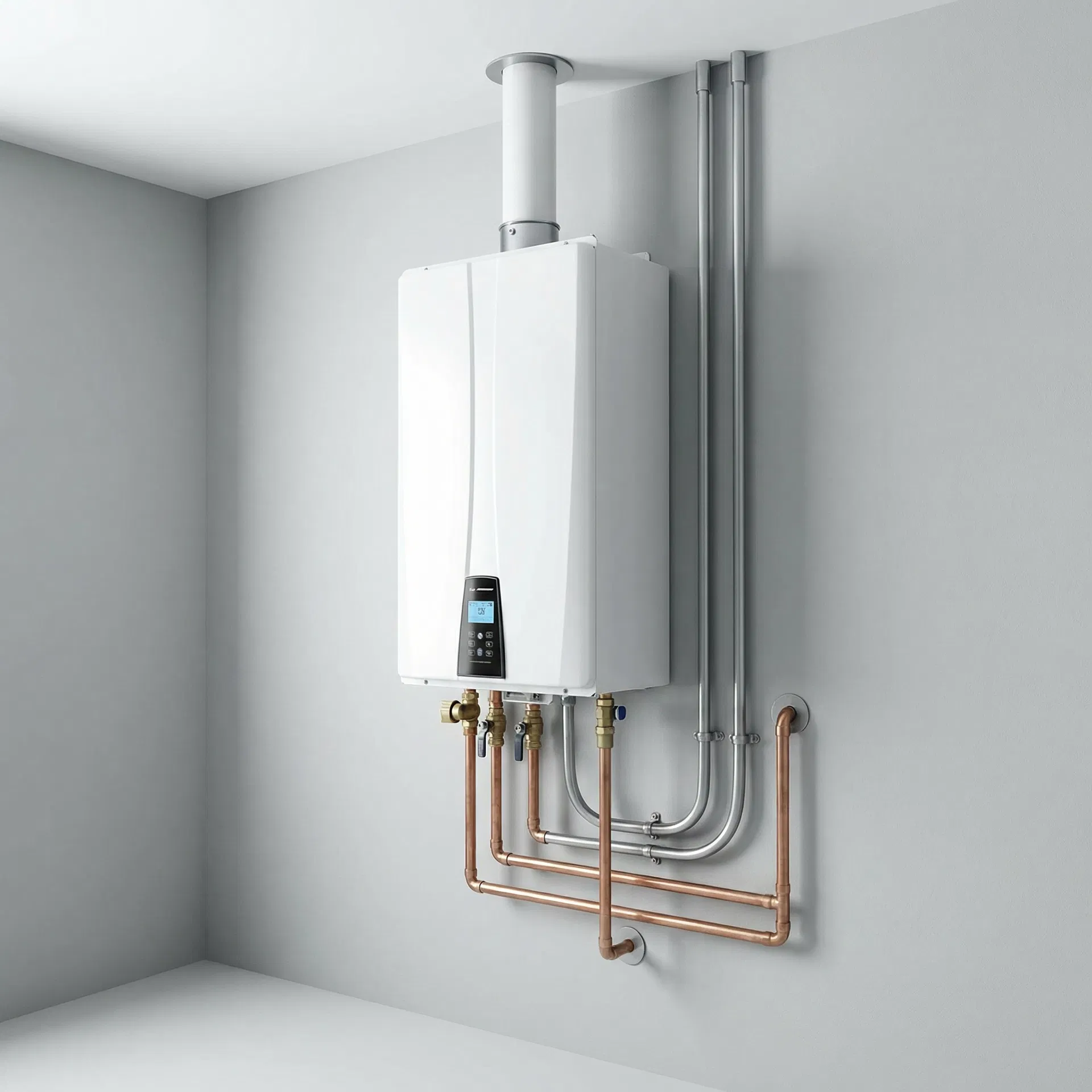
If your condo's utility closet cannot accommodate even a tall/narrow tank while maintaining legal clearances, you still have options. Switching to a tankless system reclaims significant square footage and completely bypasses the bulky insulation problem. Tankless units mount directly to the wall, eliminating the need for a large storage footprint entirely.
For Los Alamitos condos, this transition requires a thorough evaluation of the building's existing infrastructure. Tankless water heaters demand a higher volume of gas upfront to heat water on demand. You will need a professional to evaluate the condo's existing gas line sizing—often requiring an upgrade from a 1/2-inch to a 3/4-inch line—and assess venting compatibility with your HOA rules.
Performance During Peak Demand
During peak summer demand, these systems provide endless hot water without the standby energy loss of a traditional tank. Because they only fire when you open a hot water tap, they are incredibly energy efficient. While the upfront installation requires more technical adaptation regarding venting and gas lines, the spatial freedom and endless capacity make tankless units a premium solution for restrictive multi-family architecture.
Avoiding Demolition: The Value of Pre-Installation Math
Selecting the right unit requires precise measurements of the closet door frame, interior width, and vertical clearance before you ever purchase a new appliance. A professional assessment maps out the spatial math before the old unit is even disconnected, preventing mid-project crises where a homeowner is left with a drained tank and a new unit sitting uselessly in the hallway.
One local homeowner reached out just thirty minutes before closing when their water heater completely failed. Technician Anthony arrived quickly, educated the homeowners on the nuances of modern tank dimensions, and facilitated a replacement that fit their exact space. The homeowners felt fully informed and confident in their choice, rather than taken advantage of during an urgent situation. This highlights our specialized local expertise in navigating Los Alamitos condo spatial constraints, building codes, and HOA guidelines to prevent installation-day disasters.
The Importance of Due Diligence
Getting it right the first time: Educating homeowners on their specific options—whether deciding on a 50-gallon tall vs. standard tank or executing a tankless pivot—ensures they make informed, stress-free decisions. Navigating local HOA guidelines smoothly relies entirely on this upfront due diligence. If you find yourself in a sudden no-hot-water situation, knowing your spatial limits is critical. We provide emergency water heater replacement in Los Alamitos that accounts for these exact architectural challenges.
Frequently Asked Questions About Upgrading Condo Water Heaters
Will a 50 gallon water heater fit where a 40 gallon was?
Often, a standard modern 50-gallon tank will not fit due to increased insulation requirements. The 2015 NAECA regulations forced manufacturers to add thicker foam, making standard tanks significantly wider. Choosing a tall/narrow profile is usually required to match the old footprint. Always measure your specific closet dimensions before attempting this upgrade.
How much wider is a modern 50-gallon water heater?
Due to 2015 NAECA regulations, modern tanks are typically 2 or more inches wider in diameter than older models. This extra width comes from dense polyurethane insulation designed to prevent heat loss. While two inches sounds minimal, it is often enough to prevent the tank from passing through an older utility closet door.
What are the clearance requirements for a water heater in a closet?
California Plumbing Code generally requires specific clearances from combustible materials, often around two inches, depending on manufacturer specs. This clearance ensures safe operation, proper airflow, and prevents surrounding drywall or framing from overheating. Failing to maintain this gap will result in a failed municipal inspection.
What is the exact difference between a standard and tall water heater?
A tall heater holds the same volume but uses a narrower diameter and taller height to fit into tight utility closets. While a standard 50-gallon might be 22 to 24 inches wide, a tall model shrinks that diameter down to roughly 20 inches. This vertical offset allows homeowners to gain capacity without widening their floor space.
How do HOA rules impact water heater replacement in a multi-family building?
HOAs restrict structural modifications to shared walls, making it crucial to find a unit that fits the existing space rather than expanding the closet. You generally cannot cut into firewalls or expand into common hallways to accommodate a wider tank. Therefore, selecting a tall tank or a tankless unit is often the only compliant upgrade path.
Making the Right Choice for Your Condo's Space
Upgrading your capacity shouldn't require a stressful and expensive closet remodel. The physical width and diameter differences due to modern insulation don't have to ruin your renovation plans. By understanding the spatial math and exploring practical alternatives like the 50-gallon tall vs. standard tank, you can achieve the hot water supply your family needs without tearing down walls.
Consult with a local professional to measure your space, evaluate your venting, and explore code-compliant options tailored to your home's unique architecture. Working with a trusted water heater company in the Los Angeles area ensures your new system meets all safety regulations, fits perfectly, and provides reliable comfort for years to come.
About the Author

Anthony Hamilton
Co-Founder & CEO, THE Water Heater Company
Co-Founder and CEO of THE Water Heater Company, a water heater specialty company built on one clear mission: to be THE trusted name in water heating across Southern California.
Our story started with a simple idea: combine industry-leading expertise with a passion for people. Today, that idea has grown into a company recognized as Your Trusted Water Heater Authority, serving homeowners across Los Angeles, Ventura, Orange County, and Santa Barbara with unmatched quality, care, and transparency.
We believe excellence is not an act. It is a habit. Every member of our team lives by our Core Values: People First, Genuine Care, Raise the Bar, Total Transparency, and Better Every Day.
As a leader, I am driven by growth: of people, of teams, and of impact. My role is to create clarity, alignment, and opportunity so great people can do their best work and live their best lives.
Keep Reading
Related Articles

Ready for hot water?
Ready to Get Started?
Whether you need a repair, maintenance, or new installation — our experts are here to help.