Your Local Water Profile: Buena Park
This profile explains what the applicable water provider reported for Buena Park, what those results may mean throughout a home, and where property-specific testing or inspection may still be needed.

First, confirm your water provider.
Water service can vary by address. Confirm the provider shown on your water bill before applying provider-specific results.
What the official water report says
Your water at a glance
Golden State Water Company
The report lists hardness as 237 mg/L; this is very hard on the USGS scale.
USGS hardness scale: 0–60 soft; 61–120 moderately hard; 121–180 hard; >180 very hard, in mg/L as CaCO3.
City of Buena Park — compliance, as reported
No overall compliance statement was extracted from the reviewed report.
West Orange County Water System — compliance, as reported
The report states: “YOUR WATER MEETS ALL CURRENT FEDERAL AND STATE REQUIREMENTS [p. 8, West Orange County Water System – Source Water Quality]”
Violations or advisories, as reported: In 2025, GSWC sampled groundwater sources in the West Orange County System for PFAS. Some sources had detections above the current notification levels. Notification letters were sent out to all local governing bodies, State Water Resources Control Board’s Division of Drinking Water and California Public Utilities Commission. [p. 9, Laboratory Analyses]
Suburban Water System - Whittier — compliance, as reported
The report states: “We are proud to report that again Suburban’s water meets or exceeds all standards. [section: Suburban Water Systems 2025 Annual Water Quality Report Available Online]”
The Three C's — 1 of 3
Chemistry
What does this water tend to do in a home?
City of Buena Park
General mineral and treatment characteristics were not itemized in this provider's reviewed report. The official report link in the Sources section below is the authoritative record.
West Orange County Water System
Hardness [as CaCO3]
The utility reported: 13.8 grains/gal
Other Parameters · report p. 8 · official report
Total Dissolved Solids
The utility reported: 412 mg/L
Secondary Standards - Aesthetic · report p. 8 · official report
Chloride
The utility reported: 44.9 mg/L
Secondary Standards - Aesthetic · report p. 8 · official report
Sulfate
The utility reported: 92.7 mg/L
Secondary Standards - Aesthetic · report p. 8 · official report
Lead
The utility reported: Not detected at the report's stated reporting limit µg/L
Lead sampling in schools and residential plumbing · report p. 9 · official report
Chlorine [as Cl2]
The utility reported: 1.4 mg/L
Disinfection Byproducts and Disinfectant Residuals · report p. 9 · official report
Suburban Water System - Whittier
General mineral and treatment characteristics were not itemized in this provider's reviewed report. The official report link in the Sources section below is the authoritative record.
The Three C's — 2 of 3
Contaminants
What was reported, and what do the applicable standards mean?
Legal limit — maximum contaminant level (MCL)
The highest level legally allowed in public drinking water under the applicable rule. Do not use MCL as a generic label for goals, action levels, notification levels, or independent guidelines. It is different from a non-enforceable health goal.
California health goal — public health goal (PHG)
A non-enforceable health-protective target developed for standard-setting context. It is not the California legal limit.
Federal health goal — maximum contaminant level goal (MCLG)
A non-enforceable EPA public-health target used in setting standards. It is not the legal limit.
Legal disinfectant-residual limit — maximum residual disinfectant level (MRDL)
The highest level of a drinking-water disinfectant allowed under the applicable rule. It is not an MCL for a contaminant.
City of Buena Park — regulated contaminants reported as detected (0)
No itemized regulated-detection records were extracted from this provider's reviewed report. That is a limit of the extraction, not a claim that nothing was detected — the official report linked below is authoritative.
West Orange County Water System — regulated contaminants reported as detected (15)
Turbidity Highest single measurement of the treated surface water
The utility reported: 0.05 NTU
TT: 1.0
Violation per report: No
Typical source, per the report: Soil runoff
Primary Standards - Health Based · report p. 8 · official report
Turbidity Lowest percent of all monthly readings less than 0.3 NTU
The utility reported: 100% %
TT: 95
Violation per report: No
Typical source, per the report: Soil runoff
Primary Standards - Health Based · report p. 8 · official report
Arsenic
The utility reported: 2.4 µg/L
Reported range: ND - 4.1
Legal limit (MCL): 10 · Health goal (PHG (MCLG)): 0.004 — not an enforceable limit
Violation per report: No
Typical source, per the report: Erosion of natural deposits; runoff from orchards; glass and electronics production wastes
Primary Standards - Health Based · report p. 8 · official report
Chromium, Hexavalent
The utility reported: 0.8 µg/L
Reported range: ND - 2.9
Legal limit (MCL): 10 · Health goal (PHG (MCLG)): 0.02 — not an enforceable limit
Violation per report: No
Typical source, per the report: Erosion of natural deposits; transformation of naturally occurring trivalent chromium to hexavalent chromium by natural processes and human activities, such as discharges from electroplating factories, leather tanneries, wood preservation, chemical synthesis, refractory production, and textile manufacturing facilities.
Primary Standards - Health Based · report p. 8 · official report
Fluoride
The utility reported: 0.5 mg/L
Reported range: 0.4 - 0.8
Legal limit (MCL): 2.0 · Health goal (PHG (MCLG)): 1 — not an enforceable limit
Violation per report: No
Typical source, per the report: Erosion of natural deposits; water additive that promotes strong teeth; discharge from fertilizer and aluminum factories
Primary Standards - Health Based · report p. 8 · official report
Nitrate [as N]
The utility reported: 1.5 mg/L
Reported range: ND - 4.5
Legal limit (MCL): 10 · Health goal (PHG (MCLG)): 10 — not an enforceable limit
Violation per report: No
Typical source, per the report: Runoff and leaching from fertilizer use; leaching from septic tanks and sewage; erosion of natural deposits
Primary Standards - Health Based · report p. 8 · official report
Perchlorate
The utility reported: 1.1 µg/L
Reported range: ND - 3.2
Legal limit (MCL): 6 · Health goal (PHG (MCLG)): 1 — not an enforceable limit
Violation per report: No
Typical source, per the report: Perchlorate is an inorganic chemical used in solid rocket propellant, fireworks, explosives, flares, matches, and a variety of industries. It usually gets into drinking water as a result of environmental contamination from historic aerospace or other industrial operations that used or use, store, or dispose of perchlorate and its salts.
Primary Standards - Health Based · report p. 8 · official report
Gross Alpha Activity
The utility reported: 5.17 pCi/L
Reported range: ND - 17.1
Legal limit (MCL): 15(a) · Health goal (PHG (MCLG)): (0) — not an enforceable limit
Violation per report: No
Typical source, per the report: Erosion of natural deposits
Radioactive Constituents · report p. 8 · official report
Gross Beta Activity
The utility reported: 5.70 pCi/L
Reported range: ND - 17.1
Legal limit (MCL): 50(b) · Health goal (PHG (MCLG)): (0) — not an enforceable limit
Violation per report: No
Typical source, per the report: Decay of natural and manmade deposits
Radioactive Constituents · report p. 8 · official report
Uranium
The utility reported: 6.71 pCi/L
Reported range: ND - 21.9 (c)
Legal limit (MCL): 20 · Health goal (PHG (MCLG)): 0.43 — not an enforceable limit
Violation per report: No
Typical source, per the report: Erosion of natural deposits
Radioactive Constituents · report p. 8 · official report
Bromate
The utility reported: 2.4 µg/L
Reported range: ND - 8.4
Legal limit (MCL): 10 · Health goal (PHG (MRDLG)): 0.1 — not an enforceable limit
Violation per report: No
Typical source, per the report: Byproduct of drinking water disinfection
Disinfection Byproducts and Disinfectant Residuals · report p. 9 · official report
Chlorine [as Cl2]
The utility reported: 1.4 mg/L
Reported range: 0.1 - 3.8
MRDL: (4.0) · Health goal (PHG (MRDLG)): (4) — not an enforceable limit
Violation per report: No
Typical source, per the report: Drinking water disinfectant added for treatment
Disinfection Byproducts and Disinfectant Residuals · report p. 9 · official report
HAA5 [Sum of 5 Haloacetic Acids]
The utility reported: 6.0 µg/L
Reported range: ND - 7.2
Legal limit (MCL): 60
Violation per report: No
Typical source, per the report: Byproduct of drinking water disinfection
Disinfection Byproducts and Disinfectant Residuals · report p. 9 · official report
TTHMs [Total Trihalomethanes]
The utility reported: 30 µg/L
Reported range: 1.6 - 35
Legal limit (MCL): 80
Violation per report: No
Typical source, per the report: Byproduct of drinking water disinfection
Disinfection Byproducts and Disinfectant Residuals · report p. 9 · official report
Copper
The utility reported: 0.25 mg/L
Reported range: None of the 51 samples collected exceeded the action level.
AL: 1.3 · Health goal (PHG (MCLG)): 0.3 — not an enforceable limit
Violation per report: No
Typical source, per the report: Internal corrosion of household plumbing systems; erosion of natural deposits; leaching from wood preservatives
Inorganic Constituents · report p. 9 · official report
West Orange County Water System — unregulated monitoring and secondary (aesthetic) records (8)
Unregulated means monitored without an applicable enforceable legal limit (MCL) — it does not mean unimportant or illegal. Secondary records address aesthetic, cosmetic, or technical effects such as taste, odor, staining, or scale, and are not automatically primary health standards.
Chloride
The utility reported: 44.9 mg/L
Reported range: 12.0 - 99.0
Typical source, per the report: Runoff/leaching from natural deposits; seawater influence
Secondary Standards - Aesthetic · report p. 8 · official report
Specific Conductance
The utility reported: 647 µS/cm
Reported range: 363 - 987
Typical source, per the report: Substances that form ions when in water; seawater influence
Secondary Standards - Aesthetic · report p. 8 · official report
Sulfate
The utility reported: 92.7 mg/L
Reported range: 34.4 - 218
Typical source, per the report: Runoff/leaching from natural deposits; industrial wastes
Secondary Standards - Aesthetic · report p. 8 · official report
Total Dissolved Solids
The utility reported: 412 mg/L
Reported range: 204 - 625
Typical source, per the report: Runoff/leaching from natural deposits
Secondary Standards - Aesthetic · report p. 8 · official report
Turbidity
The utility reported: 0.1 units
Reported range: ND - 1
Typical source, per the report: Soil runoff
Secondary Standards - Aesthetic · report p. 8 · official report
Perfluorohexanesulfonic Acid (PFHxS)
The utility reported: 4.0 ng/L
Reported range: ND - 10.3 (e)
Typical source, per the report: Discharge from manufacturing and industrial chemical facilities, use of certain consumer products, occupational exposures, and certain firefighting activities.
Unregulated Drinking Water Constituents · report p. 8 · official report
Perfluorooctanoic acid (PFOA)
The utility reported: 3.0 ng/L
Reported range: ND - 8.3 (e)
Typical source, per the report: Discharge from manufacturing and industrial chemical facilities, use of certain consumer products, occupational exposures, and certain firefighting activities.
Unregulated Drinking Water Constituents · report p. 8 · official report
Perfluorooctane Sulfonate (PFOS)
The utility reported: 5.8 ng/L
Reported range: ND - 16.4 (e)
Typical source, per the report: Discharge from manufacturing and industrial chemical facilities, use of certain consumer products, occupational exposures, and certain firefighting activities.
Unregulated Drinking Water Constituents · report p. 8 · official report
Suburban Water System - Whittier — regulated contaminants reported as detected (0)
No itemized regulated-detection records were extracted from this provider's reviewed report. That is a limit of the extraction, not a claim that nothing was detected — the official report linked below is authoritative.
The Three C's — 3 of 3
Corrosion
What conditions could influence pipes, fixtures, and a water heater?
City of Buena Park
Corrosion-related inputs (such as pH or alkalinity) were not itemized in this provider's reviewed report.
West Orange County Water System
Chloride
The utility reported: 44.9 mg/L
Secondary Standards - Aesthetic · report p. 8 · official report
Sulfate
The utility reported: 92.7 mg/L
Secondary Standards - Aesthetic · report p. 8 · official report
Lead
The utility reported: Not detected at the report's stated reporting limit µg/L
Lead sampling in schools and residential plumbing · report p. 9 · official report
Gross Alpha Activity
The utility reported: 5.17 pCi/L
Reported range: ND - 17.1
Typical source, per the report: Erosion of natural deposits
Radioactive Constituents · report p. 8 · official report
Suburban Water System - Whittier
Corrosion-related inputs (such as pH or alkalinity) were not itemized in this provider's reviewed report.
Whole-Home Relevance
What this may mean throughout your home
Local conditions can be relevant to equipment and fixtures — actual effects depend on your property.
Water heater (tank and tankless)
- What the local report can tell us
- The report's hardness and mineral values above are the system-level inputs most relevant to scale and sediment where water is heated.
- What a homeowner may notice
- Hardness minerals can contribute to scale on heating surfaces, sediment in tanks, and more frequent flushing or descaling needs.
- What the report cannot tell us
- Property-specific outcomes — actual effects depend on temperature, use, equipment design, installation, maintenance, and property plumbing.
- Responsible next step
- Inspect the actual water heater and plumbing when symptoms involve hot-water odor, scale, sediment, corrosion, flow, noise, or repeated service demand.
Dishwasher and washing machine
- What the local report can tell us
- Reported hardness and secondary (aesthetic) records are the relevant system-level context for spotting and residue.
- What a homeowner may notice
- Hard water can change soap behavior and may contribute to spotting on dishes and residue in laundry.
- What the report cannot tell us
- Property-specific outcomes — actual effects depend on temperature, use, equipment design, installation, maintenance, and property plumbing.
- Responsible next step
- Inspect the actual water heater and plumbing when symptoms involve hot-water odor, scale, sediment, corrosion, flow, noise, or repeated service demand.
Pipes, fixtures, faucets, and supply lines
- What the local report can tell us
- The corrosion-related inputs above (such as pH) describe the water entering the property — not the condition of any specific plumbing.
- What a homeowner may notice
- Mineral deposits can appear on aerators and fixtures; corrosion outcomes depend on materials, age, and water conditions together.
- What the report cannot tell us
- Property-specific outcomes — actual effects depend on temperature, use, equipment design, installation, maintenance, and property plumbing.
- Responsible next step
- Inspect the actual water heater and plumbing when symptoms involve hot-water odor, scale, sediment, corrosion, flow, noise, or repeated service demand.
Drinking and cooking water
- What the local report can tell us
- The contaminant records above show what the utility reported for the system and period, with each benchmark type labeled.
- What a homeowner may notice
- Taste, odor, or aesthetic preferences can be noticeable even when health-based standards are met.
- What the report cannot tell us
- Property-specific outcomes — actual effects depend on temperature, use, equipment design, installation, maintenance, and property plumbing.
- Responsible next step
- Inspect the actual water heater and plumbing when symptoms involve hot-water odor, scale, sediment, corrosion, flow, noise, or repeated service demand.
Decision Pathways
Treatment pathways to evaluate
Treatment is a decision pathway, not a product conclusion — no equipment can be responsibly chosen from city-level data alone.
The evaluation sequence we follow, in order:
- 1Define the concern
- 2Verify utility-level and home-specific evidence
- 3Choose point of treatment
- 4Verify the exact certified reduction claim for the exact model
- 5Review tradeoffs and maintenance
Water filtration
- Objective it can address
- Specific substances or aesthetic conditions (taste, odor, chlorine character).
- Point of treatment
- Point of entry or point of use, depending on the objective.
- Limitations to verify
- A filter works only for the conditions and reduction claims its exact design and certification support — filtration does not soften water.
Certification note: a standard number alone doesn't prove a product reduces every contaminant — the exact model's certified claim must match your objective.
Water softening
- Objective it can address
- Hardness minerals (calcium and magnesium) and the scale they can contribute to.
- Point of treatment
- Typically point of entry, confirmed by evaluation.
- Limitations to verify
- Softening primarily exchanges hardness minerals — it is not a universal contaminant-removal device.
Certification note: a standard number alone doesn't prove a product reduces every contaminant — the exact model's certified claim must match your objective.
Reverse osmosis
- Objective it can address
- Specified dissolved substances at a dedicated outlet, commonly drinking and cooking water.
- Point of treatment
- Typically point of use.
- Limitations to verify
- Produces a reject-water stream and needs pressure and maintenance; verify the exact NSF/ANSI 58 reduction claims for the exact model. It is not automatically the best system for every home.
Certification note: a standard number alone doesn't prove a product reduces every contaminant — the exact model's certified claim must match your objective.
When testing is the right next step
Use a certified laboratory when the concern is tap-specific, property-specific, or not resolved by the utility report.
When inspection is the right next step
Inspect the actual water heater and plumbing when symptoms involve hot-water odor, scale, sediment, corrosion, flow, noise, or repeated service demand.
Evidence You Can Check
Official reports, sources, and methodology
Official report — City of Buena Park
Consumer Confidence Report Certification Form · data year 2025 · Current 2025 monitoring cycle
View the 2025 City of Buena Park Consumer Confidence ReportOfficial report — West Orange County Water System
Consumer Confidence Report on Water Quality for 2025 · data year 2025 · Current 2025 monitoring cycle
View the 2025 West Orange County Water System Consumer Confidence ReportSource water, per the report: Water delivered to customers in the West Orange County System is a blend of treated groundwater pumped from the Orange County Groundwater Basin and imported water from the Colorado River Aqueduct and the State Water Project (imported and distributed by the Metropolitan Water District of Southern California).
Official report — Suburban Water System - Whittier
Suburban Water Systems 2025 Annual Water Quality Report · data year 2025 · Current 2025 monitoring cycle
View the 2025 Suburban Water System - Whittier Consumer Confidence ReportNearby community water profiles
How this affects your water heater
Hard water and elevated mineral content shorten anode life and accelerate tank sediment — the same factors that drive flush and replacement timing in Buena Park. This profile describes your utility's reported water; a property-specific evaluation confirms what reaches your tap.
Property-Specific Next Step
Request a Water Quality Evaluation
Request a water-heater and water-quality evaluation tailored to the property, equipment, and homeowner objective.
A property-specific evaluation confirms your goals, provider, tap conditions, plumbing, equipment, installation, and maintenance before any treatment recommendation — this profile alone is never used to prescribe equipment.
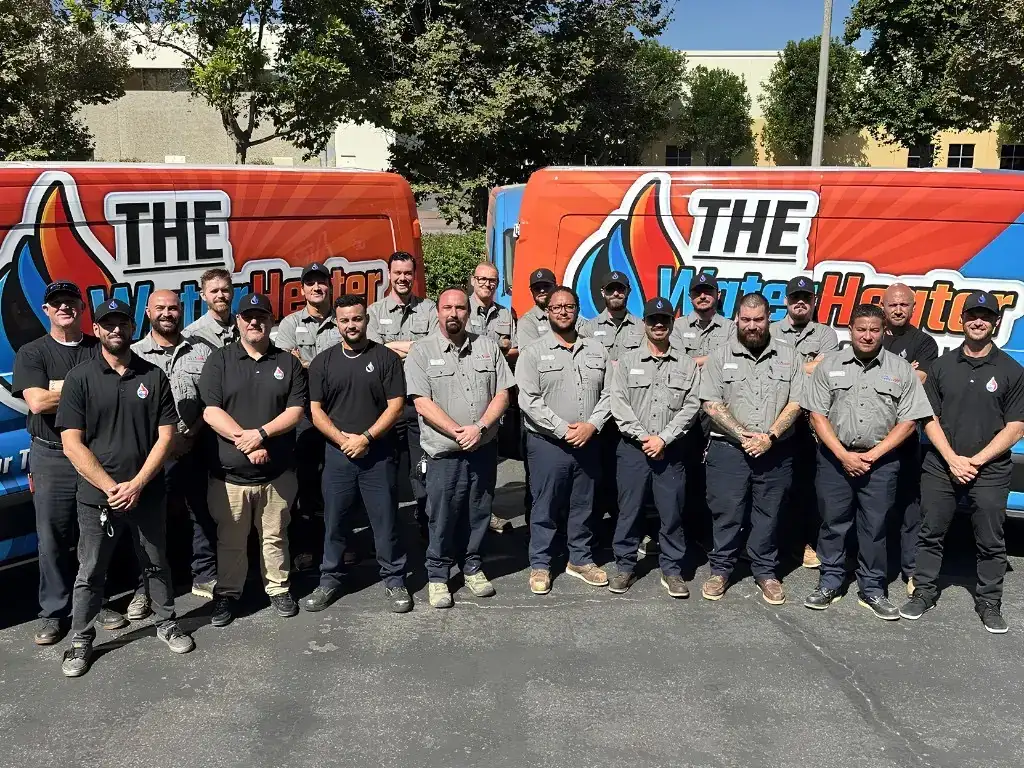
Ready for hot water?
Water Heaters Are All We Do
Same-day water heater service across Los Angeles, Orange & Ventura counties — with water-quality context that respects the evidence.