Your Local Water Profile: Stevenson Ranch
This profile explains what the applicable water provider reported for Stevenson Ranch, what those results may mean throughout a home, and where property-specific testing or inspection may still be needed.

Water provider: Santa Clarita Valley Water Agency
Public water system CA1910240 · 2025 report · Current 2025 monitoring cycle
View the 2025 Santa Clarita Valley Water Agency Consumer Confidence ReportWhat the official water report says
Your water at a glance
Santa Clarita Valley Water Agency
The report lists hardness as 160 mg/L; this is hard on the USGS scale.
USGS hardness scale: 0–60 soft; 61–120 moderately hard; 121–180 hard; >180 very hard, in mg/L as CaCO3.
Santa Clarita Valley Water Agency — compliance, as reported
The report states: “SCV Water is in compliance with all drinking water regulations unless a specific violation is noted. [p. 204-208]”
The Three C's — 1 of 3
Chemistry
What does this water tend to do in a home?
Total Dissolved Solids
The utility reported: 310 mg/L
SECONDARY STANDARDS · report p. 458 · official report
Total Dissolved Solids
The utility reported: 645 mg/L
SECONDARY STANDARDS · report p. 458 · official report
Total Dissolved Solids
The utility reported: 715 mg/L
SECONDARY STANDARDS · report p. 458 · official report
Lead - Consumer Taps
The utility reported: Not detected at the report's stated reporting limit ug/L
LEAD AND COPPER · report p. 440 · official report
Lead - Consumer Taps
The utility reported: Not detected at the report's stated reporting limit ug/L
LEAD AND COPPER · report p. 440 · official report
Copper - Consumer Taps
The utility reported: 460 ug/L
LEAD AND COPPER · report p. 439 · official report
Copper - Consumer Taps
The utility reported: 330 ug/L
LEAD AND COPPER · report p. 439 · official report
The Three C's — 2 of 3
Contaminants
What was reported, and what do the applicable standards mean?
Legal limit — maximum contaminant level (MCL)
The highest level legally allowed in public drinking water under the applicable rule. Do not use MCL as a generic label for goals, action levels, notification levels, or independent guidelines. It is different from a non-enforceable health goal.
California health goal — public health goal (PHG)
A non-enforceable health-protective target developed for standard-setting context. It is not the California legal limit.
Federal health goal — maximum contaminant level goal (MCLG)
A non-enforceable EPA public-health target used in setting standards. It is not the legal limit.
Legal disinfectant-residual limit — maximum residual disinfectant level (MRDL)
The highest level of a drinking-water disinfectant allowed under the applicable rule. It is not an MCL for a contaminant.
Santa Clarita Valley Water Agency — regulated contaminants reported as detected (23)
Fluoride
The utility reported: 0.3 mg/L
Reported range: 0.3-0.3
Legal limit (MCL): 2 · Health goal (PHG): 1 — not an enforceable limit
Violation per report: No
Typical source, per the report: Naturally occurring
INORGANICS · report p. 395 · official report
Fluoride
The utility reported: 0.4 mg/L
Reported range: 0.2-0.7
Legal limit (MCL): 2 · Health goal (PHG): 1 — not an enforceable limit
Violation per report: No
Typical source, per the report: Naturally occurring
INORGANICS · report p. 395 · official report
Fluoride
The utility reported: 0.6 mg/L
Reported range: 0.5-0.7
Legal limit (MCL): 2 · Health goal (PHG): 1 — not an enforceable limit
Violation per report: No
Typical source, per the report: Naturally occurring
INORGANICS · report p. 395 · official report
Nitrate (as Nitrogen)
The utility reported: 0.7 mg/L
Reported range: 0.6-0.8
Legal limit (MCL): 10 · Health goal (PHG): 10 — not an enforceable limit
Violation per report: No
Typical source, per the report: Runoff and leaching from fertilizer use; leaching from septic tanks and sewage; erosion of natural deposits
INORGANICS · report p. 399 · official report
Nitrate (as Nitrogen)
The utility reported: 4.2 mg/L
Reported range: 1.8-7.3
Legal limit (MCL): 10 · Health goal (PHG): 10 — not an enforceable limit
Violation per report: No
Typical source, per the report: Runoff and leaching from fertilizer use; leaching from septic tanks and sewage; erosion of natural deposits
INORGANICS · report p. 399 · official report
Nitrate (as Nitrogen)
The utility reported: 1.3 mg/L
Reported range: 0.7-1.6
Legal limit (MCL): 10 · Health goal (PHG): 10 — not an enforceable limit
Violation per report: No
Typical source, per the report: Runoff and leaching from fertilizer use; leaching from septic tanks and sewage; erosion of natural deposits
INORGANICS · report p. 399 · official report
Haloacetic Acids (HAA5)
The utility reported: 6.2 ug/L
Reported range: ND-13
Legal limit (MCL): 60 · Health goal (PHG): 0 — not an enforceable limit
Violation per report: No
Typical source, per the report: Byproduct of drinking water disinfection
DISINFECTION BY-PRODUCTS · report p. 412 · official report
Haloacetic Acids (HAA5)
The utility reported: 5.5 ug/L
Reported range: 2-9.4
Legal limit (MCL): 60 · Health goal (PHG): 0 — not an enforceable limit
Violation per report: No
Typical source, per the report: Byproduct of drinking water disinfection
DISINFECTION BY-PRODUCTS · report p. 412 · official report
Trihalomethanes, Total (TTHMs)
The utility reported: 21 ug/L
Reported range: 4.8-52
Legal limit (MCL): 80 · Health goal (PHG): 0 — not an enforceable limit
Violation per report: No
Typical source, per the report: Byproduct of drinking water disinfection
DISINFECTION BY-PRODUCTS · report p. 414 · official report
Trihalomethanes, Total (TTHMs)
The utility reported: 30 ug/L
Reported range: 20-47
Legal limit (MCL): 80 · Health goal (PHG): 0 — not an enforceable limit
Violation per report: No
Typical source, per the report: Byproduct of drinking water disinfection
DISINFECTION BY-PRODUCTS · report p. 414 · official report
Coliform % Positive Samples/# of Positives
The utility reported: 0 %
Reported range: 0-0
Legal limit (MCL): 5 · Health goal (PHG): 0 — not an enforceable limit
Violation per report: No
Typical source, per the report: Naturally present in the environment
MICROBIOLOGICAL · report p. 418 · official report
Coliform % Positive Samples/# of Positives
The utility reported: 0 %
Reported range: 0-0.67
Legal limit (MCL): 5 · Health goal (PHG): 0 — not an enforceable limit
Violation per report: No
Typical source, per the report: Naturally present in the environment
MICROBIOLOGICAL · report p. 418 · official report
Coliform % Positive Samples/# of Positives
The utility reported: 0 %
Reported range: 0-1
Legal limit (MCL): 5 · Health goal (PHG): 0 — not an enforceable limit
Violation per report: No
Typical source, per the report: Naturally present in the environment
MICROBIOLOGICAL · report p. 418 · official report
Surface Water Only EGJG
The utility reported: 0.3 NTU
Reported range: 0.3
TT: 1 NTU · Health goal (PHG): NONE — not an enforceable limit
Violation per report: No
Typical source, per the report: Soil runoff
CLARITY / TURBIDITY · report p. 420 · official report
Surface Water Only ESFP
The utility reported: 0.4 NTU
Reported range: 0.4
TT: 1 NTU · Health goal (PHG): NONE — not an enforceable limit
Violation per report: No
Typical source, per the report: Soil runoff
CLARITY / TURBIDITY · report p. 422 · official report
Alpha Activity, Gross
The utility reported: 3.8 PCI/L
Reported range: ND-4.9
Legal limit (MCL): 15 · Health goal (PHG): 0 — not an enforceable limit
Violation per report: No
Typical source, per the report: Erosion of natural deposits
RADIOLOGICAL · report p. 427 · official report
Beta Activity, Gross
The utility reported: 3.5 PCI/L
Reported range: ND-5.1
Legal limit (MCL): 50* · Health goal (PHG): 0 — not an enforceable limit
Violation per report: No
Typical source, per the report: Decay of natural and man-made deposits
RADIOLOGICAL · report p. 429 · official report
Uranium
The utility reported: 4.0 PCI/L
Reported range: 1.6-8.5
Legal limit (MCL): 20 · Health goal (PHG): 0.43 — not an enforceable limit
Violation per report: No
Typical source, per the report: Erosion of natural deposits
RADIOLOGICAL · report p. 433 · official report
Uranium
The utility reported: 2.7 PCI/L
Reported range: 2.3-3.3
Legal limit (MCL): 20 · Health goal (PHG): 0.43 — not an enforceable limit
Violation per report: No
Typical source, per the report: Erosion of natural deposits
RADIOLOGICAL · report p. 433 · official report
Copper - Consumer Taps
The utility reported: 460 ug/L
Reported range: 3
AL: 1300 · Health goal (PHG): 300 — not an enforceable limit
Violation per report: No
Typical source, per the report: Internal corrosion of household plumbing systems; erosion of natural deposits; leaching from wood preservatives
LEAD AND COPPER · report p. 439 · official report
Copper - Consumer Taps
The utility reported: 330 ug/L
Reported range: 0
AL: 1300 · Health goal (PHG): 300 — not an enforceable limit
Violation per report: No
Typical source, per the report: Internal corrosion of household plumbing systems; erosion of natural deposits; leaching from wood preservatives
LEAD AND COPPER · report p. 439 · official report
Lead - Consumer Taps
The utility reported: Not detected at the report's stated reporting limit ug/L
Reported range: 2
AL: 15 · Health goal (PHG): 0.2 — not an enforceable limit
Violation per report: No
Typical source, per the report: Internal corrosion of household water plumbing systems; discharges from industrial manufacturers; erosion of natural deposits
LEAD AND COPPER · report p. 440 · official report
Lead - Consumer Taps
The utility reported: Not detected at the report's stated reporting limit ug/L
Reported range: 0
AL: 15 · Health goal (PHG): 0.2 — not an enforceable limit
Violation per report: No
Typical source, per the report: Internal corrosion of household water plumbing systems; discharges from industrial manufacturers; erosion of natural deposits
LEAD AND COPPER · report p. 440 · official report
Santa Clarita Valley Water Agency — unregulated monitoring and secondary (aesthetic) records (23)
Unregulated means monitored without an applicable enforceable legal limit (MCL) — it does not mean unimportant or illegal. Secondary records address aesthetic, cosmetic, or technical effects such as taste, odor, staining, or scale, and are not automatically primary health standards.
Odor-Threshold
The utility reported: 1 TON
Reported range: 1-1
Typical source, per the report: Naturally-occurring organic materials
SECONDARY STANDARDS · report p. 452 · official report
Odor-Threshold
The utility reported: 1 TON
Reported range: 1-1
Typical source, per the report: Naturally-occurring organic materials
SECONDARY STANDARDS · report p. 452 · official report
Odor-Threshold
The utility reported: 1 TON
Reported range: 1-1
Typical source, per the report: Naturally-occurring organic materials
SECONDARY STANDARDS · report p. 452 · official report
Turbidity
The utility reported: 0.2 NTU
Reported range: 0.1-0.2
Typical source, per the report: Soil runoff
SECONDARY STANDARDS · report p. 457 · official report
Turbidity
The utility reported: 0.2 NTU
Reported range: ND-1.0
Typical source, per the report: Soil runoff
SECONDARY STANDARDS · report p. 457 · official report
Turbidity
The utility reported: 0.2 NTU
Reported range: 0.1-0.9
Typical source, per the report: Soil runoff
SECONDARY STANDARDS · report p. 457 · official report
Conductivity
The utility reported: 500 us/cm
Reported range: 480-540
Typical source, per the report: Substances that form ions when in water; seawater influence
SECONDARY STANDARDS · report p. 459 · official report
Conductivity
The utility reported: 1009 us/cm
Reported range: 640-1300
Typical source, per the report: Substances that form ions when in water; seawater influence
SECONDARY STANDARDS · report p. 459 · official report
Conductivity
The utility reported: 1150 us/cm
Reported range: 1100-1200
Typical source, per the report: Substances that form ions when in water; seawater influence
SECONDARY STANDARDS · report p. 459 · official report
Chromium, hexavalent (CrVI)
The utility reported: 1.7 ug/L
Reported range: ND-2.2
Typical source, per the report: Discharge from electroplating factories, leather tanneries, wood preservation, chemical synthesis, refractory production, and textile manufacturing facilities; erosion of natural deposits
ADDITIONAL TESTS · report p. 465 · official report
Boron
The utility reported: 0.2 mg/L
Reported range: 0.2-0.2
Typical source, per the report: NA
ADDITIONAL TESTS · report p. 467 · official report
Boron
The utility reported: 0.2 mg/L
Reported range: 0.2-1.6
Typical source, per the report: NA
ADDITIONAL TESTS · report p. 467 · official report
Perfluorooctanesulfonic acid (PFOS)
The utility reported: Not detected at the report's stated reporting limit ng/L
Reported range: ND-5.2
Typical source, per the report: NA
ADDITIONAL TESTS · report p. 470 · official report
Perfluorooctanesulfonic acid (PFOS)
The utility reported: 4.1 ng/L
Reported range: ND-5.5
Typical source, per the report: NA
ADDITIONAL TESTS · report p. 470 · official report
Perfluorooctanoic acid (PFOA)
The utility reported: Not detected at the report's stated reporting limit ng/L
Reported range: ND-5.9
Typical source, per the report: NA
ADDITIONAL TESTS · report p. 471 · official report
Perfluorooctanoic acid (PFOA)
The utility reported: Not detected at the report's stated reporting limit ng/L
Reported range: ND-4.8
Typical source, per the report: NA
ADDITIONAL TESTS · report p. 471 · official report
Perfluorobutanesulfonic acid (PFBS)
The utility reported: Not detected at the report's stated reporting limit ng/L
Reported range: ND-6.4
Typical source, per the report: NA
ADDITIONAL TESTS · report p. 472 · official report
Perfluorobutanesulfonic acid (PFBS)
The utility reported: Not detected at the report's stated reporting limit ng/L
Reported range: ND-3.9
Typical source, per the report: NA
ADDITIONAL TESTS · report p. 472 · official report
Perfluorohexanesulphonic acid (PFHxS)
The utility reported: Not detected at the report's stated reporting limit ng/L
Reported range: ND-9.2
Typical source, per the report: NA
ADDITIONAL TESTS · report p. 473 · official report
Perfluorohexanesulphonic acid (PFHxS)
The utility reported: 4.0 ng/L
Reported range: ND-6.4
Typical source, per the report: NA
ADDITIONAL TESTS · report p. 473 · official report
Potassium
The utility reported: 2.6 mg/L
Reported range: 2.6-2.7
Typical source, per the report: NA
ADDITIONAL TESTS · report p. 474 · official report
Potassium
The utility reported: 3.2 mg/L
Reported range: 1.9-5.1
Typical source, per the report: NA
ADDITIONAL TESTS · report p. 474 · official report
Potassium
The utility reported: 3.1 mg/L
Reported range: 2.9-3.4
Typical source, per the report: NA
ADDITIONAL TESTS · report p. 474 · official report
The Three C's — 3 of 3
Corrosion
What conditions could influence pipes, fixtures, and a water heater?
Lead - Consumer Taps
The utility reported: Not detected at the report's stated reporting limit ug/L
LEAD AND COPPER · report p. 440 · official report
Copper - Consumer Taps
The utility reported: 460 ug/L
LEAD AND COPPER · report p. 439 · official report
Copper - Consumer Taps
The utility reported: 330 ug/L
LEAD AND COPPER · report p. 439 · official report
Alpha Activity, Gross
The utility reported: 3.8 PCI/L
Reported range: ND-4.9
Typical source, per the report: Erosion of natural deposits
RADIOLOGICAL · report p. 427 · official report
Perfluorohexanesulphonic acid (PFHxS)
The utility reported: Not detected at the report's stated reporting limit ng/L
Reported range: ND-9.2
Typical source, per the report: NA
ADDITIONAL TESTS · report p. 473 · official report
Perfluorohexanesulphonic acid (PFHxS)
The utility reported: 4.0 ng/L
Reported range: ND-6.4
Typical source, per the report: NA
ADDITIONAL TESTS · report p. 473 · official report
Whole-Home Relevance
What this may mean throughout your home
Local conditions can be relevant to equipment and fixtures — actual effects depend on your property.
Water heater (tank and tankless)
- What the local report can tell us
- The report's hardness and mineral values above are the system-level inputs most relevant to scale and sediment where water is heated.
- What a homeowner may notice
- Hardness minerals can contribute to scale on heating surfaces, sediment in tanks, and more frequent flushing or descaling needs.
- What the report cannot tell us
- Property-specific outcomes — actual effects depend on temperature, use, equipment design, installation, maintenance, and property plumbing.
- Responsible next step
- Inspect the actual water heater and plumbing when symptoms involve hot-water odor, scale, sediment, corrosion, flow, noise, or repeated service demand.
Dishwasher and washing machine
- What the local report can tell us
- Reported hardness and secondary (aesthetic) records are the relevant system-level context for spotting and residue.
- What a homeowner may notice
- Hard water can change soap behavior and may contribute to spotting on dishes and residue in laundry.
- What the report cannot tell us
- Property-specific outcomes — actual effects depend on temperature, use, equipment design, installation, maintenance, and property plumbing.
- Responsible next step
- Inspect the actual water heater and plumbing when symptoms involve hot-water odor, scale, sediment, corrosion, flow, noise, or repeated service demand.
Pipes, fixtures, faucets, and supply lines
- What the local report can tell us
- The corrosion-related inputs above (such as pH) describe the water entering the property — not the condition of any specific plumbing.
- What a homeowner may notice
- Mineral deposits can appear on aerators and fixtures; corrosion outcomes depend on materials, age, and water conditions together.
- What the report cannot tell us
- Property-specific outcomes — actual effects depend on temperature, use, equipment design, installation, maintenance, and property plumbing.
- Responsible next step
- Inspect the actual water heater and plumbing when symptoms involve hot-water odor, scale, sediment, corrosion, flow, noise, or repeated service demand.
Drinking and cooking water
- What the local report can tell us
- The contaminant records above show what the utility reported for the system and period, with each benchmark type labeled.
- What a homeowner may notice
- Taste, odor, or aesthetic preferences can be noticeable even when health-based standards are met.
- What the report cannot tell us
- Property-specific outcomes — actual effects depend on temperature, use, equipment design, installation, maintenance, and property plumbing.
- Responsible next step
- Inspect the actual water heater and plumbing when symptoms involve hot-water odor, scale, sediment, corrosion, flow, noise, or repeated service demand.
Decision Pathways
Treatment pathways to evaluate
Treatment is a decision pathway, not a product conclusion — no equipment can be responsibly chosen from city-level data alone.
The evaluation sequence we follow, in order:
- 1Define the concern
- 2Verify utility-level and home-specific evidence
- 3Choose point of treatment
- 4Verify the exact certified reduction claim for the exact model
- 5Review tradeoffs and maintenance
Water filtration
- Objective it can address
- Specific substances or aesthetic conditions (taste, odor, chlorine character).
- Point of treatment
- Point of entry or point of use, depending on the objective.
- Limitations to verify
- A filter works only for the conditions and reduction claims its exact design and certification support — filtration does not soften water.
Certification note: a standard number alone doesn't prove a product reduces every contaminant — the exact model's certified claim must match your objective.
Water softening
- Objective it can address
- Hardness minerals (calcium and magnesium) and the scale they can contribute to.
- Point of treatment
- Typically point of entry, confirmed by evaluation.
- Limitations to verify
- Softening primarily exchanges hardness minerals — it is not a universal contaminant-removal device.
Certification note: a standard number alone doesn't prove a product reduces every contaminant — the exact model's certified claim must match your objective.
Reverse osmosis
- Objective it can address
- Specified dissolved substances at a dedicated outlet, commonly drinking and cooking water.
- Point of treatment
- Typically point of use.
- Limitations to verify
- Produces a reject-water stream and needs pressure and maintenance; verify the exact NSF/ANSI 58 reduction claims for the exact model. It is not automatically the best system for every home.
Certification note: a standard number alone doesn't prove a product reduces every contaminant — the exact model's certified claim must match your objective.
When testing is the right next step
Use a certified laboratory when the concern is tap-specific, property-specific, or not resolved by the utility report.
When inspection is the right next step
Inspect the actual water heater and plumbing when symptoms involve hot-water odor, scale, sediment, corrosion, flow, noise, or repeated service demand.
Evidence You Can Check
Official reports, sources, and methodology
Official report — Santa Clarita Valley Water Agency
2026 Annual Consumer Confidence Report · data year 2025 · Current 2025 monitoring cycle
View the 2025 Santa Clarita Valley Water Agency Consumer Confidence ReportSource water, per the report: SCV Water’s water supply comes from four main sources: groundwater, imported water, recycled water and stored (banked) water. Groundwater makes up 33% (20,350 acre-feet) of the water supply. Imported water from the Sierra Nevada mountains in Northern California accounts for 66% (40,500 acre-feet). Recycled water for outdoor irrigation provides 1% (350 acre-feet) of the supply. Stored (banked) water in Kern County is used during a drought or emergency.
Nearby community water profiles
How this affects your water heater
Hard water and elevated mineral content shorten anode life and accelerate tank sediment — the same factors that drive flush and replacement timing in Stevenson Ranch. This profile describes your utility's reported water; a property-specific evaluation confirms what reaches your tap.
Property-Specific Next Step
Request a Water Quality Evaluation
Request a water-heater and water-quality evaluation tailored to the property, equipment, and homeowner objective.
A property-specific evaluation confirms your goals, provider, tap conditions, plumbing, equipment, installation, and maintenance before any treatment recommendation — this profile alone is never used to prescribe equipment.
Ready for hot water?
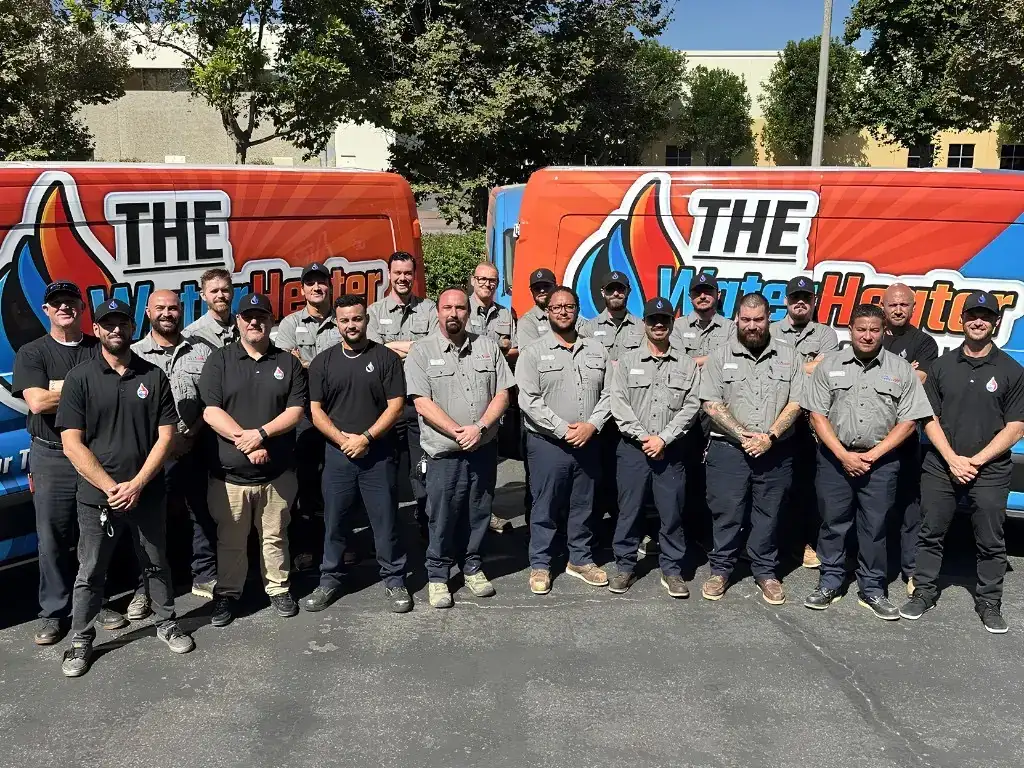
Water Heaters Are All We Do
Same-day water heater service across Los Angeles, Orange & Ventura counties — with water-quality context that respects the evidence.