What Happens If You Don’t Descale Your Tankless Water Heater?
What happens if you dont descale your tankless water heater is a question every Southern California homeowner should know the answer to — especially if you’re on hard water. Here’s the short version:
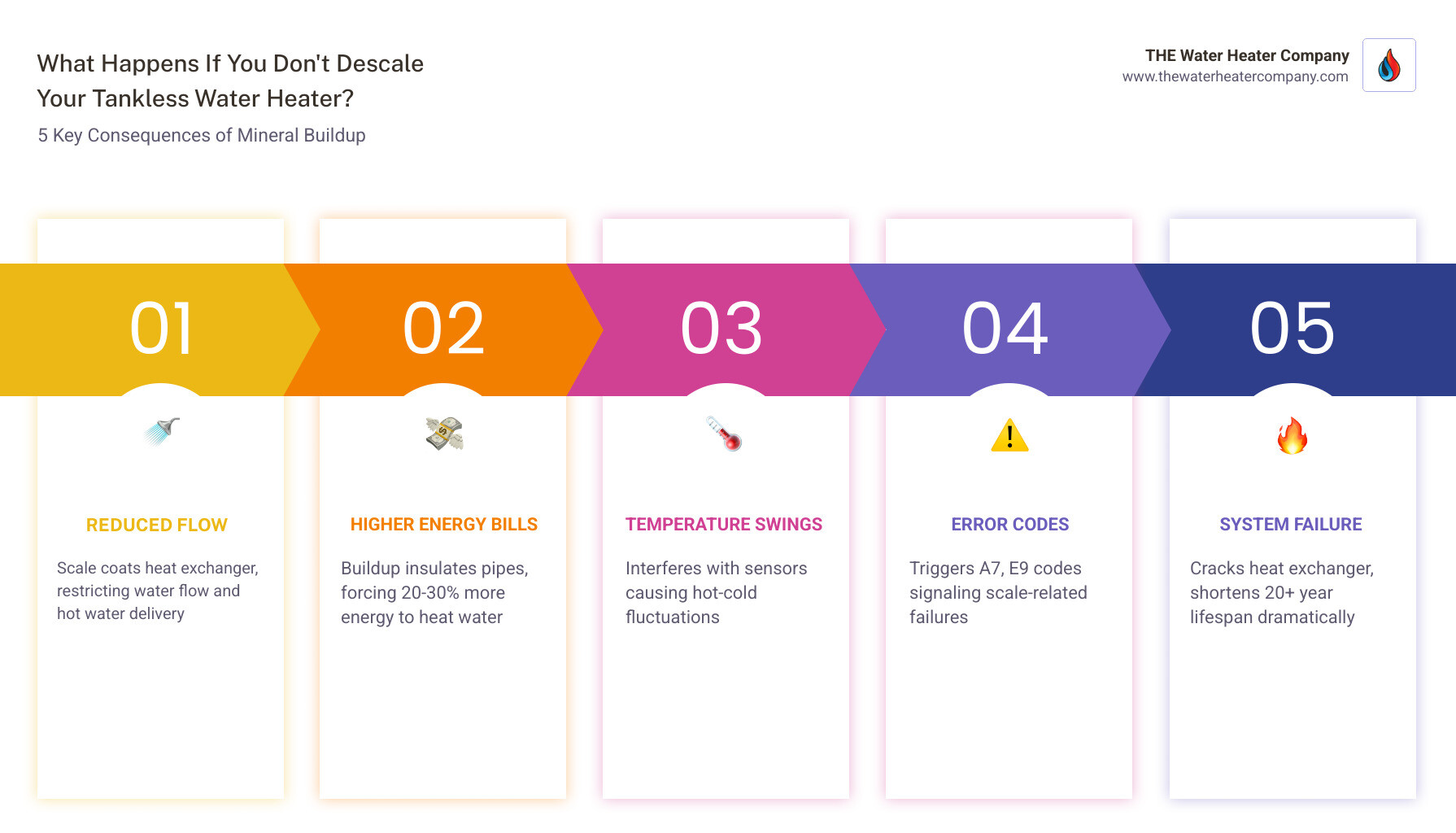
- Reduced hot water flow — Scale coats the inside of your heat exchanger, restricting water from moving through freely
- Higher energy bills — Mineral buildup acts as insulation, forcing your unit to burn more energy to heat the same amount of water
- Fluctuating water temperatures — Scale interferes with sensors and flow rates, causing unpredictable hot and cold swings
- Error codes and warning lights — Common scale-related codes like A7 and E9 signal your system is struggling
- Unusual noises — Knocking, banging, popping, or boiling sounds are a red flag that scale is disrupting normal operation
- Component damage — Over time, the heat exchanger can crack, sensors can fail, and ignition problems can develop
- Shortened system lifespan — A tankless unit that should last 20+ years may fail years earlier without regular descaling
Mineral scaling is the number one cause of poor performance and early failure in tankless water heaters. It’s not a dramatic event — it’s a slow, quiet process that chips away at your system’s efficiency until the damage becomes hard to ignore or reverse.
I’m Anthony Hamilton, Co-Founder and CEO of THE Water Heater Company, and after years of diagnosing water heater problems across Southern California — one of the hardest-water regions in the country — I’ve seen what happens if you dont descale your tankless unit and let scale go unchecked. In the sections ahead, I’ll walk you through exactly what’s happening inside your system, what warning signs to watch for, and how to protect your investment before it becomes a costly repair.
What is Scale and Why Does It Target Your Tankless System?
To understand the threat, we first have to look at the chemistry of your water. In regions like Los Angeles and Orange County, our water is “hard,” meaning it is packed with dissolved minerals—primarily calcium and magnesium.
When this hard water enters your tankless water heater, it hits the heat exchanger. This is where the magic happens: high-powered burners or electric elements transfer heat to the water instantly. However, minerals like calcium carbonate have a unique property called “inverse solubility.” Unlike sugar, which dissolves better in hot tea, calcium actually becomes less soluble as temperatures rise.
As the water heats up, these minerals drop out of the liquid and solidify, latching onto the hot metal surfaces of the heat exchanger. Over time, these microscopic crystals build up into a hard, chalky crust known as limescale. Because tankless systems rely on narrow copper or stainless steel passages to heat water quickly, even a small amount of scale can cause a major bottleneck.
What happens if you dont descale your tankless?
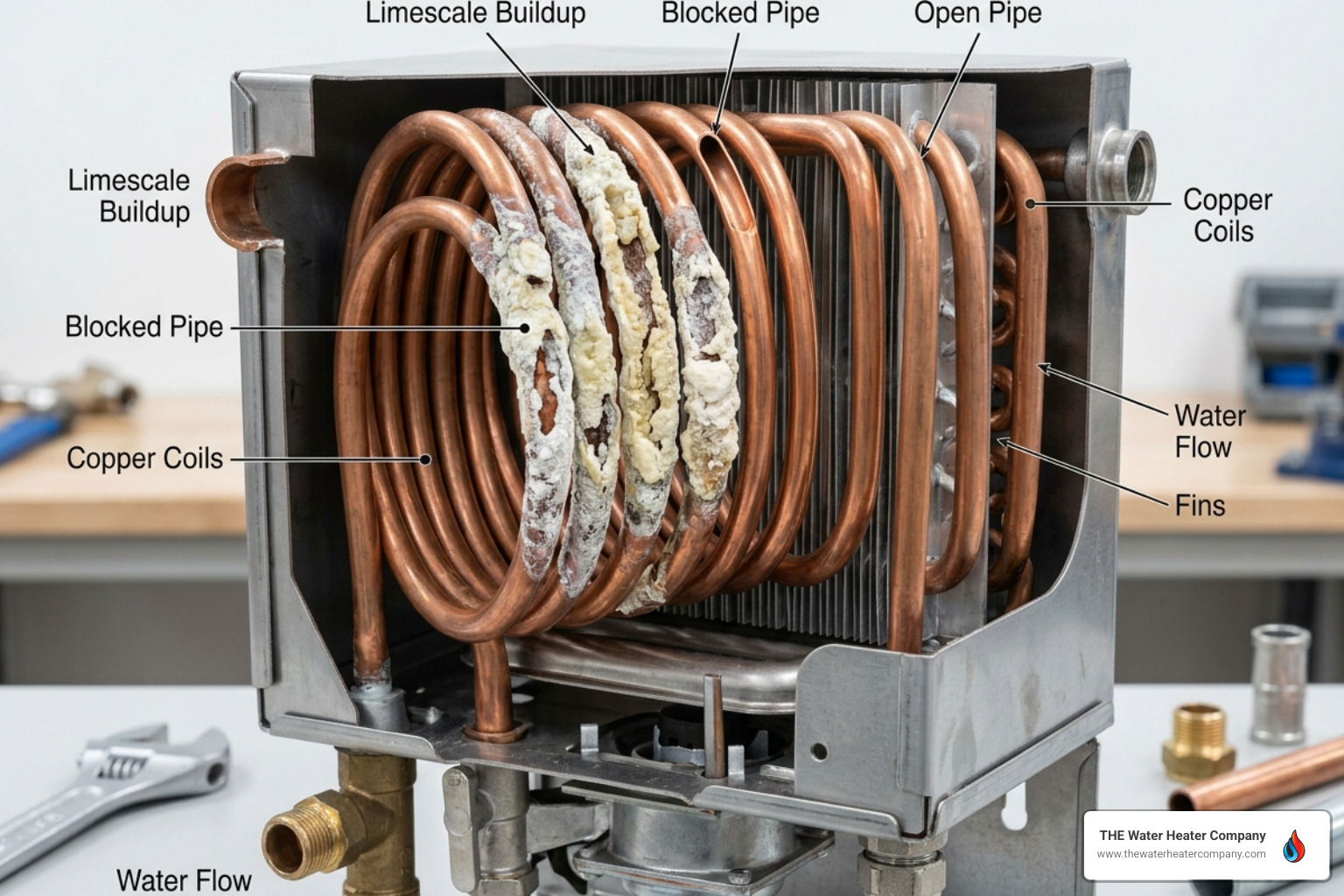
If you ignore the need for a flush, your unit begins a downward spiral. The primary victim is the heat exchanger. When scale coats these internal pipes, it creates a physical barrier between the heat source and the water. This leads to two major problems: flow restriction and overheating.
As the “pipes” inside the heater narrow due to buildup, you’ll notice a significant drop in water pressure at your showerhead or faucet. More dangerously, the heat exchanger itself begins to overheat. Because the scale is insulating the water, the metal of the heat exchanger gets much hotter than it was designed to be, leading to “hot spots” that can eventually fatigue the metal.
Efficiency loss and what happens if you dont descale your tankless
One of the most immediate impacts of neglecting maintenance is a spike in your utility bills. We often see homeowners wondering why their energy consumption is climbing in 2026, only to find a thick layer of scale inside their heater.
Think of scale as a thermal insulator—similar to the insulation in your attic. It is excellent at stopping heat from moving. When your heat exchanger is wrapped in this mineral “blanket,” the burners have to stay on longer and burn hotter just to get the water to your desired temperature. This wasted energy goes straight to the atmosphere through the vent rather than into your bathwater. For homes using hot water recirculating systems, this efficiency loss is amplified because the unit may be cycling more frequently to maintain temperature in the loops.
Component damage and what happens if you dont descale your tankless
Beyond the monthly bills, the physical integrity of the unit is at stake. When you skip descaling, the mechanical strain can lead to:
- Heat Exchanger Cracks: The constant overheating and cooling (thermal cycling) of a scaled exchanger can cause the metal to warp and eventually crack, leading to internal leaks that often require a full water heater replacement.
- Sensor Failure: Scale can coat the thermistors (temperature sensors) and flow sensors. If the computer can’t “see” how hot the water is or how fast it’s moving, it may shut down for safety or fail to ignite altogether.
- Ignition Issues: In gas models, scale can interfere with the burner’s ability to transfer heat, leading to ignition failure or “flame out” errors as the system struggles to stay within safe operating parameters.
If you are already experiencing these issues, you may need water heater repair to clear the sensors or assess the damage to the exchanger.
Warning Signs: How to Tell Your Heater is Struggling
Your tankless unit is smart—it will usually try to tell you when it’s choking on minerals. Keep an ear and an eye out for these symptoms:
- Error Codes A7 or E9: These are common industry codes (varying slightly by brand) that typically point to flow blockage or overheating issues—both hallmarks of scale.
- The “Knock and Bang”: If you hear sounds like popcorn popping or a tea kettle whistling inside the unit, that’s often the sound of water boiling trapped beneath a layer of scale.
- The Cold Water Sandwich: This is when your shower starts hot, goes cold for a minute, and then gets hot again. While some of this is inherent to tankless design, heavy scaling makes the “sandwich” much worse by slowing down the ignition response time.
- Reduced Pressure: If your hot water pressure is noticeably lower than your cold water pressure, the “arteries” of your heater are likely clogged.
Prevention Strategies for Southern California Homeowners
Living in Southern California means we have to be more proactive than homeowners in the Pacific Northwest. In our service areas, a “set it and forget it” mentality will lead to a dead heater in five to seven years.
| Strategy | Benefit | Best For |
|---|---|---|
| Annual Flushing | Removes existing scale using food-grade citric acid. | Every tankless owner in SoCal. |
| Water Softeners | Removes calcium/magnesium before it enters the home. | Homes with high mineral content (10+ GPG). |
| Inline Filters | Traps sediment and uses scale-inhibiting media. | Targeted protection for the heater itself. |
| Professional Maintenance | Includes internal cleaning, filter checks, and sensor tuning. | Maximizing the 20-year lifespan. |
To truly protect your system, we recommend a combination of regular descaling and water filtration and conditioning.
Local water quality in Santa Clarita and Pasadena
We pay special attention to our neighbors in the valleys. If you are looking for service areas in Santa Clarita or Pasadena, you likely know that the water here is exceptionally hard. It’s not uncommon to see water hardness levels exceeding 15 to 20 grains per gallon (GPG). In these conditions, a tankless unit can develop significant scaling in as little as six months. For these “high-risk” zones, we often recommend a bi-annual flush or the installation of a whole-home softener to prevent the minerals from ever reaching the heat exchanger.
Frequently Asked Questions about Tankless Maintenance
How often should I descale my unit in Southern California?
For most homes in Los Angeles and the surrounding counties, once a year is the gold standard. However, if you have a large family using a lot of hot water, or if you live in a particularly hard-water area like Santa Clarita, we recommend checking the unit every 6 to 9 months.
Can I use vinegar for descaling my tankless system?
While white vinegar is a popular DIY choice because it’s a mild acid, it isn’t always the best for modern units. It can sometimes take hours to dissolve heavy buildup and can leave a lingering odor. We prefer using concentrated, food-grade citric acid solutions. They are more effective at breaking down stubborn calcium deposits and are safer for the copper components inside your heater.
Does a whole-home water softener eliminate the need for flushing?
It dramatically reduces the frequency, but it doesn’t eliminate the need entirely. Even “soft” water can have trace minerals that precipitate at high temperatures. If you have a softener, you might be able to move to a 3-to-5-year flushing schedule, but you should still have a technician inspect the unit annually to ensure no “silent” scaling is occurring.
Conclusion
A tankless water heater is a high-performance machine, much like a fine European sports car. It offers incredible efficiency and endless comfort, but it requires specific care to stay at its peak. What happens if you dont descale your tankless isn’t just a matter of a little less hot water—it’s the difference between a system that lasts 25 years and one that ends up in a scrap heap after seven.
At THE Water Heater Company, our expert technicians specialize in the unique water conditions of Southern California. Whether you’re in Santa Barbara, Ventura, or the heart of Los Angeles, we’re here to help you maintain your warranty and keep your water hot.
Don’t wait for an error code to tell you there’s a problem. Schedule your professional tankless maintenance today and give your water heater the long, efficient life it deserves.

The Essential’s
Call THE Water Heater Company today to get immediate help with your water needs.
“
-

“Fair Pricing & Expert Service”
Their technician Gonzo, was clearly very competent and more importantly, he took the time and effort to do a really fantastic job.
-
“Fantastic Service!”
THE Water Heater Company understood the situation I was going through. They were able to help me out and get the job done quickly.
-
“Reasonable Pricing”
Kevin did a great job on replacing my old leaky yet still working water heater. He answered all my questions and explained all the details. -
“Quick Response Time”
He was very informative and responsive to my questions and when I am making a huge investment in my home I want to be sure I am going with a company I could count on and would not cut corners. -
“Real Professionals”
Communication was great with the owner and they were very responsive, ensuring a first-class installation and experience.
-
“Great Service”
Not only did he do the service we needed, but checked the whole unit in addition to other waterline components. -
“Professional and Responsive”
They have repaired my water heater, installed a hot water recirculating pump, and now installed a new water heater. -
“Real Professionals”
It took a little over three hours but no management was necessary as the guys were very competent and clearly have been doing this for a long time.