Gas vs. Electric for Your Home: What Southern California Homeowners Need to Know
Choosing between gas and electric for your home is one of the most practical decisions you’ll make as a homeowner — and it affects everything from your monthly utility bill to how quickly you get hot water in the morning.
Here’s a quick breakdown to help you decide:
| Factor | Gas | Electric |
|---|---|---|
| Heating speed | Faster | Slower |
| Upfront installation cost | Higher | Lower |
| Monthly operating cost | Generally lower | Generally higher |
| Safety risks | Carbon monoxide, gas leaks | Electrical faults (lower risk overall) |
| Works during power outages | Yes (most units) | No |
| Environmental impact | Produces emissions | Cleaner with renewable energy |
| Lifespan | 15-20 years | 20-30 years |
| Best for Southern California | Strong option where gas is available | Competitive in mild climates |
The honest answer is: there is no single right choice. What works best depends on your home’s existing infrastructure, your local utility rates, how much hot water your household uses, and your long-term priorities.
That said, in Southern California — where winters are mild and utility costs can run high — the decision carries some unique wrinkles that are worth understanding before you commit to a system.
Natural gas has been a staple of home energy for decades, and for good reason — it heats water fast, tends to cost less to run month-to-month, and keeps working even when the power goes out. Electric systems, on the other hand, have fewer safety risks, are often cheaper to install, and are becoming more viable as the grid gets cleaner.
Both options have real advantages. And both have trade-offs that could genuinely affect your comfort and your budget.
I’m Anthony Hamilton, Co-Founder and CEO of THE Water Heater Company, and I’ve spent years in the field helping Southern California homeowners navigate exactly these kinds of decisions — including choosing between gas and electric for your home’s water heating system. In the sections ahead, I’ll walk you through everything you need to know so you can make a confident, informed choice for your household.
Key Performance Factors When Choosing Between Gas and Electric for Your Home
When we talk about performance, we are usually talking about one thing: how quickly can you get a hot shower when the kids have already used up half the tank? In water heating, this is known as the “recovery rate.”
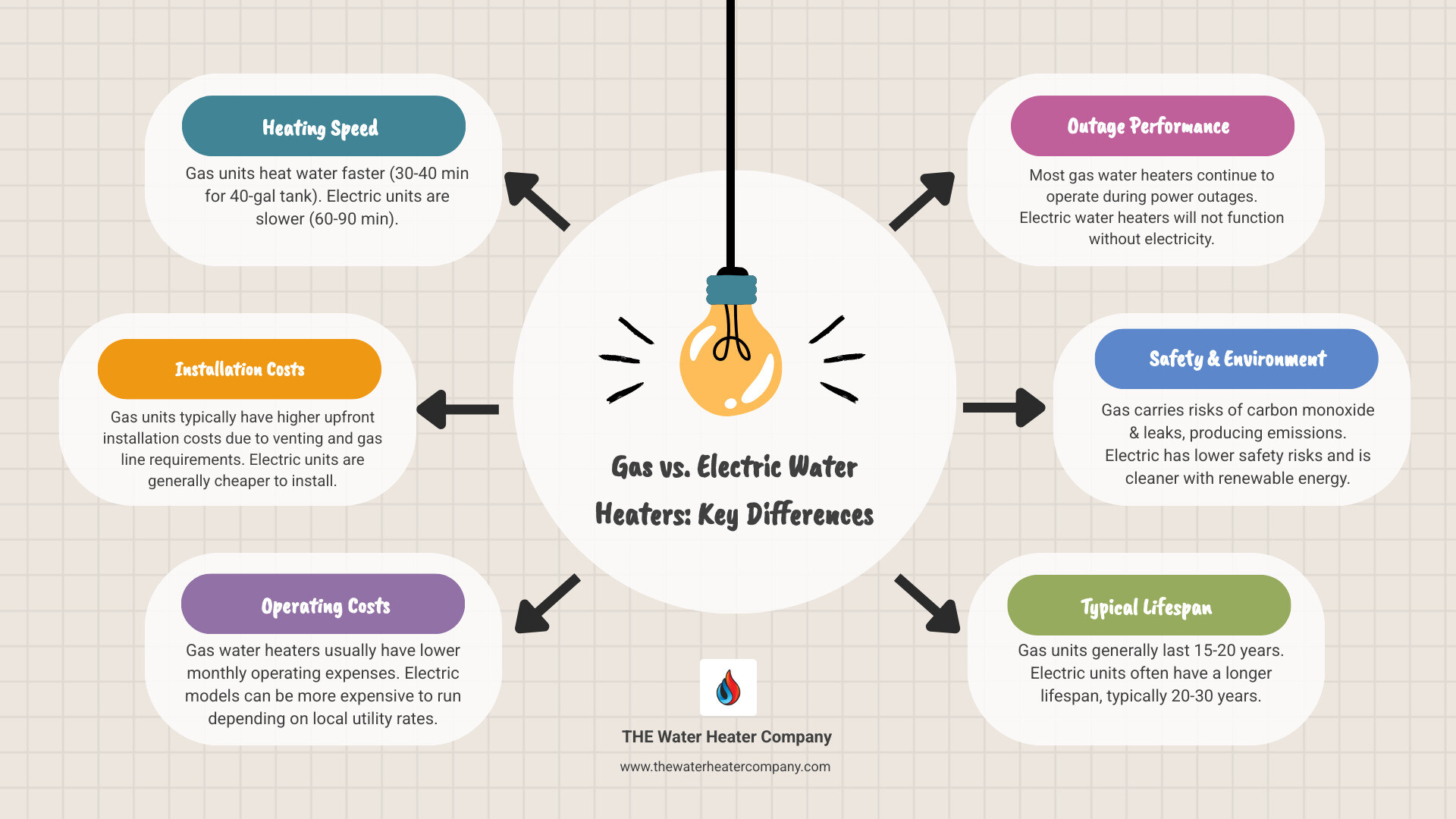
Gas water heaters are the heavy lifters in this category. Because a gas burner creates an intense, immediate flame, it can heat a large volume of water much faster than an electric element. For a standard 40-gallon tank, a gas model can often recover in about 30 to 40 minutes, while an electric model might take 60 to 90 minutes to reach the same temperature. If you have a high-demand household in Los Angeles or Pasadena, that time difference matters.
However, electricity has made massive strides in thermal efficiency. While gas units lose some heat through the venting process (exhausting combustion gases outside), electric units convert almost 100% of their energy directly into heat within the water. This is reflected in the Energy Factor (EF) rating. You’ll often see electric units with higher EF ratings than standard gas tanks.
For those looking for the ultimate performance, tankless water heaters are a game-changer. Whether gas or electric, these units provide “endless” hot water by heating it on demand. In Southern California, gas tankless units are incredibly popular because they can handle high flow rates — allowing you to run the dishwasher and the shower simultaneously without a drop in temperature.
Performance Benefits at a Glance:
- Gas: Faster recovery times, better for large families, higher heat output (BTUs).
- Electric: Higher point-of-use efficiency, quieter operation, more precise temperature control in some modern models.
Infrastructure and Installation Requirements for Southern California
One of the biggest hurdles in choosing between gas and electric for your home isn’t just what you want; it’s what your house can actually handle.
If you are looking into water heater replacement services, we first have to look at your existing “hookups.” A gas water heater requires a dedicated gas line and a proper venting system to safely move carbon monoxide and other combustion byproducts out of your home. If your home wasn’t built for gas, running a new line can be a significant project involving permits and potential wall or floor modifications.
Electric units, conversely, don’t need vents or gas lines, but they are “power hungry.” A standard electric tank usually requires a 240-volt dedicated circuit. If your electrical panel is already full — which we see often in older homes in Van Nuys or Santa Barbara — you might need a panel upgrade to support the new load.
| Requirement | Gas System | Electric System |
|---|---|---|
| Venting | Required (PVC or Metal) | Not Required |
| Power Source | Gas Line + 120v Outlet (for some) | 240v Dedicated Circuit |
| Space | Needs clearance for air/venting | More flexible placement |
| Safety Code | Earthquake strapping + Gas shutoff | Earthquake strapping + Electrical disconnect |
In cities like Santa Monica or Irvine, local building codes are very specific about how these units are installed, particularly regarding earthquake strapping and safety pans. We always ensure every installation meets these rigorous Southern California standards.
Safety, Maintenance, and Long-Term Reliability
Safety is a top priority for every family we serve. With gas appliances, the primary concerns are gas leaks and carbon monoxide (CO) exposure. This is why regular water heater maintenance services are so critical. We check the pilot light assembly, the burner, and the venting to ensure everything is airtight.
Electric water heaters are generally considered “safer” because there is no combustion happening inside the home. There is no risk of a gas leak or CO poisoning. However, they aren’t maintenance-free. Over time, the heating elements can burn out or become “calcified” due to the hard water we often have in Southern California.
Whether you choose gas or electric, sediment is the enemy of longevity. In areas like Santa Clarita or Camarillo, minerals in the water settle at the bottom of the tank. If you don’t perform regular sediment flushing, a gas burner will have to work harder to heat through that “mud,” eventually cracking the tank. In an electric unit, sediment can bury the lower heating element, causing it to burn out prematurely.
If you ever find yourself with a leak or a lack of heat, our water heater repair services can diagnose the issue quickly. For gas units, we often look at the thermocouple or gas valve; for electric, we check the thermostats and elements. We also highly recommend checking your anode rod every few years — this “sacrificial” rod prevents the tank from rusting from the inside out.
Environmental Impact and Performance During Outages
The “green” factor is becoming a major part of the conversation in 2026. Electric water heaters have the potential to be 100% carbon-free if your home uses solar panels or if your utility provider (like those serving Santa Ana or Irvine) pulls from renewable sources like wind or hydro.
Gas, while a fossil fuel, is often considered a “cleaner” burning option compared to other traditional fuels. In fact, natural gas households can sometimes have a lower carbon footprint than those using standard electric resistance heating if the local power grid still relies heavily on coal or older gas plants.
Another factor to consider is water quality. Many homeowners pair their new heater with water filtration services. By removing harsh minerals and chemicals before they reach the heater, you can extend the life of either a gas or electric unit significantly.
Power Outage Performance: This is where gas often wins. Most standard gas water heaters use a standing pilot light or a battery-powered ignition that doesn’t require electricity to heat water. If the power goes out during a Southern California storm, you can still take a hot shower. Electric units, however, will go cold as soon as the grid goes down unless you have a robust home battery backup system.
Conclusion
At THE Water Heater Company, we believe that the best system is the one that fits your lifestyle and your home’s specific needs. Whether you are leaning toward the fast recovery of gas or the simple, vent-free installation of electric, we are here to provide expert diagnostics and reliable service.
We are proud to be a local, family-owned business serving communities from Santa Barbara to Santa Ana and everywhere in between, including Los Angeles, Pasadena, and Van Nuys. We know the local codes, the local water conditions, and the local utility trends.
If you’re worried about the upfront investment, we also offer financing options to help make your home upgrade more manageable. Don’t spend another day with lukewarm water or worrying about an aging unit. Give us a call, and let’s make choosing between gas and electric for your home the easiest decision you make all year.
Which system heats water faster when choosing between gas and electric for your home?
Gas systems are the clear winners when it comes to speed. A gas burner can produce significantly more BTUs (British Thermal Units) than an electric heating element. This means that if you drain a 50-gallon tank, a gas unit will have it back up to temperature in roughly half the time it takes an electric unit. This makes gas the preferred choice for high-demand households or families who tend to take back-to-back showers.
How does the Southern California climate affect choosing between gas and electric for your home?
Our mild climate is actually a big advantage for tank water heaters. Because our “groundwater” (the water coming into your home) doesn’t get as cold as it does in the Midwest, your heater doesn’t have to work as hard to reach your desired temperature. This makes electric heat pumps particularly effective in Southern California, as they can pull heat from the warm ambient air to help heat your water, often reaching efficiencies that rival or beat gas in terms of monthly cost.
What are the typical lifespans for these systems?
Generally, electric water heaters last longer than gas models. Electric units typically last 20 to 30 years because they have fewer moving parts and no internal combustion chamber that experiences the “stress” of a constant flame. Gas units typically last 15 to 20 years. However, these lifespans are entirely dependent on routine maintenance. A gas unit that is flushed annually and has its anode rod replaced will easily outlast an electric unit that is neglected and allowed to fill with sediment.

The Essential’s
Call THE Water Heater Company today to get immediate help with your water needs.
“
-

“Fair Pricing & Expert Service”
Their technician Gonzo, was clearly very competent and more importantly, he took the time and effort to do a really fantastic job.
-
“Fantastic Service!”
THE Water Heater Company understood the situation I was going through. They were able to help me out and get the job done quickly.
-
“Reasonable Pricing”
Kevin did a great job on replacing my old leaky yet still working water heater. He answered all my questions and explained all the details. -
“Quick Response Time”
He was very informative and responsive to my questions and when I am making a huge investment in my home I want to be sure I am going with a company I could count on and would not cut corners. -
“Real Professionals”
Communication was great with the owner and they were very responsive, ensuring a first-class installation and experience.
-
“Great Service”
Not only did he do the service we needed, but checked the whole unit in addition to other waterline components. -
“Professional and Responsive”
They have repaired my water heater, installed a hot water recirculating pump, and now installed a new water heater. -
“Real Professionals”
It took a little over three hours but no management was necessary as the guys were very competent and clearly have been doing this for a long time.