How Old Is Too Old for a Water Heater — And What Southern California Homeowners Need to Know
How old is too old for a water heater? Here’s the short answer:
| Water Heater Type | Typical Lifespan | When to Start Planning Replacement |
|---|---|---|
| Traditional tank (gas or electric) | 8–12 years | At year 8, especially with warning signs |
| Tankless | 15–20 years | At year 15, or when repairs become frequent |
| Heat pump (hybrid) | 13–15 years | At year 10–12 with declining performance |
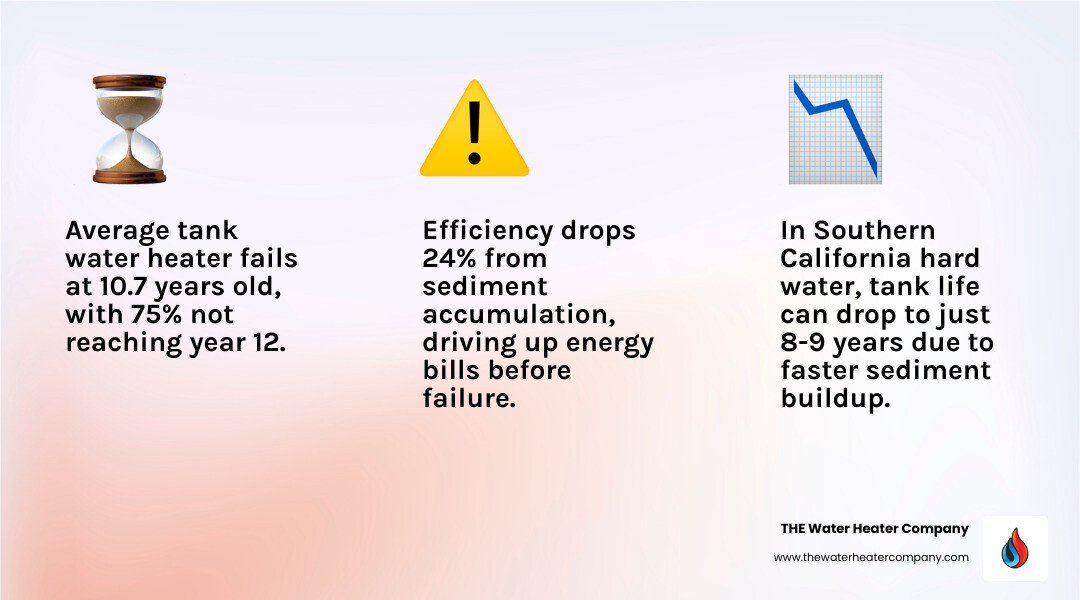
The rule of thumb: If your tank water heater is 10 years old or older, it’s time to start thinking about replacement — even if it still seems to be working fine. Research shows the average water heater fails at 10.7 years old, and 75% of tanks don’t make it to year 12.
Most homeowners don’t think about their water heater until something goes wrong — a cold shower on a winter morning, a puddle on the garage floor, or a utility bill that’s quietly crept higher than it should be. By then, the damage is often already done. The reality is that water heaters don’t announce when they’re about to give out. They age slowly, lose efficiency quietly, and in the worst cases, fail suddenly — releasing 40 to 50 gallons of water into your home with little warning.
In Southern California, the problem is compounded by hard water. Cities like Los Angeles, Irvine, and Camarillo have water supplies with significant mineral content that accelerates sediment buildup inside tanks, depletes protective anode rods faster, and shortens the effective life of your unit compared to national averages. What might last 12 years in another region could be struggling at 8 or 9 years here.
This guide will walk you through everything you need to know — from decoding your water heater’s age using its serial number, to recognizing the warning signs of failure, to deciding whether repair or replacement makes more sense for where your unit stands today.
I’m Anthony Hamilton, Co-Founder and CEO of THE Water Heater Company, and after years working in the field across Southern California, I’ve seen exactly how old is too old for a water heater — and the costly consequences homeowners face when they wait too long. Let’s make sure that doesn’t happen to you.
Understanding the Lifespan of Your Home’s Water Heater

When we talk about whether your unit is past its prime, we have to look at the technology inside. Not all water heaters are created equal, and their life expectancies vary significantly based on their design.
For a traditional storage tank water heater, the Department of Energy recognizes a typical service life of 8 to 12 years. These units are constantly under pressure and subject to the corrosive effects of water sitting in a metal tank. By contrast, tankless models generally last 15 to 20 years because they don’t have a large vessel that is prone to corrosion.
To help you visualize the differences, we’ve broken down the key metrics for the most common systems found in Southern California homes:
| Feature | Traditional Tank | Tankless Unit | Heat Pump (Hybrid) |
|---|---|---|---|
| Average Lifespan | 8–12 Years | 15–20 Years | 13–15 Years |
| Primary Failure Mode | Tank Corrosion/Leaks | Scale Build-up/Electronics | Compressor Failure |
| Efficiency Trend | Decreases with age | Remains stable with flushing | High efficiency throughout |
| Replacement Trigger | 10+ years or leaks | 18+ years or major repair | 12+ years or efficiency loss |
As we look toward May 2026, many homeowners are weighing these lifespans against modern efficiency standards. While a tankless system has a higher initial footprint, its longevity and energy savings often make it the smarter long-term play. You can learn more about these timelines in our guide on The Lifespan of a Water Heater: Knowing When to Replace.
The unfortunate reality is that 75% of water heater tanks fail before they turn 12 years old. This is why we emphasize that once you cross that decade mark, you are essentially living on borrowed time. For more details on these industry benchmarks, check out Don’t Get Left in the Cold: How Long Your Water Heater Really Lasts.
Determining how old is too old for a water heater using serial numbers
If you didn’t personally install your water heater, you might have no idea how old it is. Thankfully, the answer is usually hiding in plain sight on the manufacturer’s label. Every unit has a data plate containing a serial number that encodes the manufacture date.
Here is how to decode the most common brands we see in Santa Barbara, Santa Clarita, and Pasadena:
- Bradford White: They use a letter-based code for the year and month. For example, if the serial number starts with “YH,” the “Y” represents the year 2024, and the “H” represents August.
- Rheem/Ruud: These are usually straightforward. The first four digits of the serial number often represent the month and year. A serial number starting with “0526” would indicate May 2026.
- A.O. Smith: Their format often uses the first two digits for the year and the next two for the week. “2210” would mean the 10th week of 2022.
If the label is faded or confusing, we recommend snapping a photo and sending it to a professional. Knowing the exact age is the first step in answering the question: how old is too old for a water heater?
Warning Signs That Your Water Heater Is Too Old and Failing
Age is just a number, but performance is a reality. Even a unit that is only seven or eight years old can show signs of premature failure, especially in the high-mineral environments of Irvine or Santa Ana.
One of the most common “red flags” is rusty or discolored water. If you notice a metallic tint only when the hot water is running, it’s a strong indicator that the internal glass lining of your tank has cracked and the steel body is beginning to corrode. Once corrosion starts, there is no “repair” that can stop it.
Rumbling and popping sounds are another major warning. These noises are caused by sediment—mostly calcium and magnesium—that has settled at the bottom of the tank. As the water underneath this layer of “crust” boils, it bubbles up through the sediment, creating a loud knocking sound. This doesn’t just sound bad; it’s actively damaging your tank and making it work harder to heat the water. For a deeper dive into these symptoms, read Don’t Get Left in the Cold: How to Spot a Dying Water Heater.
Other critical signs include:
- Moisture or pooling around the base: Even a small “weep” of water can turn into a 50-gallon flood overnight.
- Inconsistent temperatures: If your showers alternate between scalding and freezing, your heating elements or thermostat are likely failing.
- Rising energy bills: As sediment builds up, your heater has to run longer to achieve the same temperature.
For more on these issues, see our article on the Most Common Problems with Tank Water Heaters.
Recognizing how old is too old for a water heater through performance
It’s not just about whether the unit works; it’s about how efficiently it works. Research shows that even a half-inch layer of calcium sediment can force a water heater to use up to 24% more energy. In a large household, that’s a significant amount of money being wasted every month.
We often refer to this as the “Silent Flood” risk. An aging tank might look pristine on the outside while the internal components are being eaten away by hard water. If your hot water capacity has dropped—meaning you run out of hot water halfway through a shower—your tank is likely filled with sediment, leaving less room for actual water.
The Risks of Waiting: Why Proactive Replacement Matters
Many homeowners ask us, “If it’s still making hot water, why should I replace it?” The answer lies in the statistics of failure. The average insurance claim for a water heater failure is $4,444, but that number can skyrocket past $55,000 if the unit is located in an attic or a finished space where a burst can destroy drywall, flooring, and personal belongings.
By choosing a planned replacement, you gain several advantages:
- Selection Control: You can research energy-efficient models, such as ENERGY STAR certified heat pump water heaters, which can save a household of four over $330 per year.
- Avoid Emergency Premiums: Emergency service calls on weekends or holidays often come with higher labor rates.
- Prevention of Damage: You eliminate the risk of the “slow leak” that causes mold or the “sudden burst” that causes floods.
Replacing a 10-year-old unit with a modern high-efficiency model can cut your water heating costs by 20% to 30% annually. You can explore the full range of benefits in our post on the Top Benefits of Replacing Your Old Water Heater Before It Fails. When you’re ready to make the switch, our team specializes in Water Heater Replacement across Southern California.
Repair vs. Replace: Deciding When Your System Is Past Its Prime
How do you decide between a quick fix and a total overhaul? We recommend using two simple frameworks: the 8-Year Rule and the 50% Math Test.
- The 8-Year Rule: If your unit is under 8 years old, a repair usually makes sense. If it is over 8 years old and requires a major repair (over $500), replacement is almost always the better financial move.
- The 50% Math Test: If the cost of the repair is more than 50% of the cost of a new unit, and the tank is out of warranty, don’t throw good money after bad.
Repairs like replacing a thermocouple or a heating element are worth doing on a younger tank. However, if the tank body itself is leaking, or if you have significant internal corrosion, no repair can save it. We discuss these nuances in detail in our articles Should I Repair or Replace My Water Heater? and How to Know When to Repair or Replace Your Water Heater.
One critical factor is the anode rod. This “sacrificial” rod is designed to corrode so your tank doesn’t. Once it’s fully depleted—usually by year five or six in Southern California—the water begins attacking the tank’s glass lining and steel. If you haven’t replaced your anode rod by year 10, the tank is likely already compromised.
Is my unit’s age making it how old is too old for a water heater repair?
Older units often present hidden challenges. For instance, metal threads can become brittle and rust together, making it impossible to replace a single valve without breaking the entire connection. Safety components like the Temperature and Pressure (T&P) valve can become “cemented” shut by mineral deposits, creating a dangerous situation where the tank cannot vent excess pressure.
Furthermore, parts for units older than 12 years may become obsolete. Upgrading to a modern system ensures you have access to current technology and warranty protections. To compare your current setup with modern alternatives, see The Difference Between Tank vs Tankless Water Heaters.
Maximizing Longevity in Southern California’s Hard Water
Living in Los Angeles, Irvine, or Camarillo means dealing with some of the hardest water in the country. This mineral-heavy water is the primary enemy of your water heater. To extend the life of your unit, we recommend a proactive maintenance schedule:
- Annual Tank Flushing: This removes the sediment that causes rumbling and efficiency loss. Both tank and tankless units require this service.
- Anode Rod Inspection: Check this every 3 years and replace it by year 5 to keep the tank protected.
- Pressure Reducing Valves (PRV): High water pressure can stress your tank and cause premature leaks. Ensure your home’s pressure is regulated to a safe level (usually around 50–60 psi).
- Expansion Tanks: In many local jurisdictions, code requires an expansion tank to handle the thermal expansion of water as it heats up, preventing stress on the main tank.
- Seismic Strapping: Given our location, ensuring your water heater is properly strapped according to California code is essential for both safety and longevity.
Whether you choose a Tank vs Tankless Water Heater, regular maintenance is the only way to ensure you get the full 12 or 20 years of service you paid for.
Frequently Asked Questions about Aging Water Heaters
Is it safe to flush a water heater that is over 12 years old?
We generally advise caution here. If a tank has been neglected for 12 years, the sediment at the bottom may actually be “plugging” microscopic corrosion holes. Flushing a severely neglected old tank can sometimes trigger a leak that wasn’t there before. If your unit is that old and has never been serviced, a professional inspection is the safest first step.
Why are modern replacement tanks wider than my old one?
You aren’t imagining things! In 2015, the Department of Energy updated efficiency standards, requiring water heaters to have thicker insulation. As a result, a modern 50-gallon tank is often about two inches wider than a model from 2010. This can make installations in tight closets a bit more complex, sometimes requiring a slight shift in plumbing or a switch to a more compact tankless unit.
Does a knocking sound mean my water heater is going to explode?
Not exactly, but it’s not good news. The knocking is the sound of steam bubbles trapped under a layer of sediment. While it’s unlikely to cause an explosion (thanks to safety valves), it indicates that your tank is overheating and the metal is under extreme stress. It is a major sign that your unit is approaching the end of its life.
Conclusion
At THE Water Heater Company, we understand that your home’s hot water is a necessity, not a luxury. Whether you are in Santa Barbara, Van Nuys, or Los Angeles, our family-owned team is dedicated to providing honest assessments and expert service. We don’t just want to sell you a new unit; we want to ensure your home is safe, efficient, and comfortable.
If you’re still wondering how old is too old for a water heater for your specific home, don’t wait for a puddle to appear. Contact us today for a professional diagnostic and let us help you plan for a reliable future.
For expert assistance with your system, visit our Water Heater Repair page to schedule a visit from one of our Southern California specialists.

The Essential’s
Call THE Water Heater Company today to get immediate help with your water needs.
“
-

“Fair Pricing & Expert Service”
Their technician Gonzo, was clearly very competent and more importantly, he took the time and effort to do a really fantastic job.
-
“Fantastic Service!”
THE Water Heater Company understood the situation I was going through. They were able to help me out and get the job done quickly.
-
“Reasonable Pricing”
Kevin did a great job on replacing my old leaky yet still working water heater. He answered all my questions and explained all the details. -
“Quick Response Time”
He was very informative and responsive to my questions and when I am making a huge investment in my home I want to be sure I am going with a company I could count on and would not cut corners. -
“Real Professionals”
Communication was great with the owner and they were very responsive, ensuring a first-class installation and experience.
-
“Great Service”
Not only did he do the service we needed, but checked the whole unit in addition to other waterline components. -
“Professional and Responsive”
They have repaired my water heater, installed a hot water recirculating pump, and now installed a new water heater. -
“Real Professionals”
It took a little over three hours but no management was necessary as the guys were very competent and clearly have been doing this for a long time.