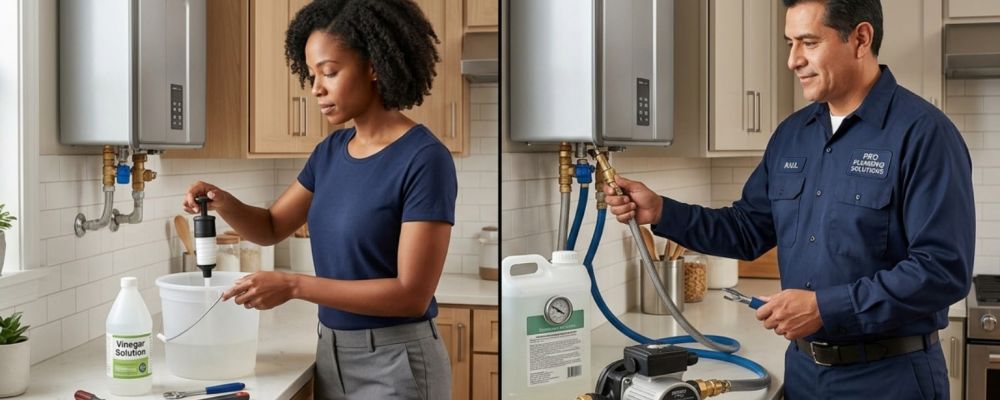
Is DIY Descaling Worth It — Or Should You Call a Pro?
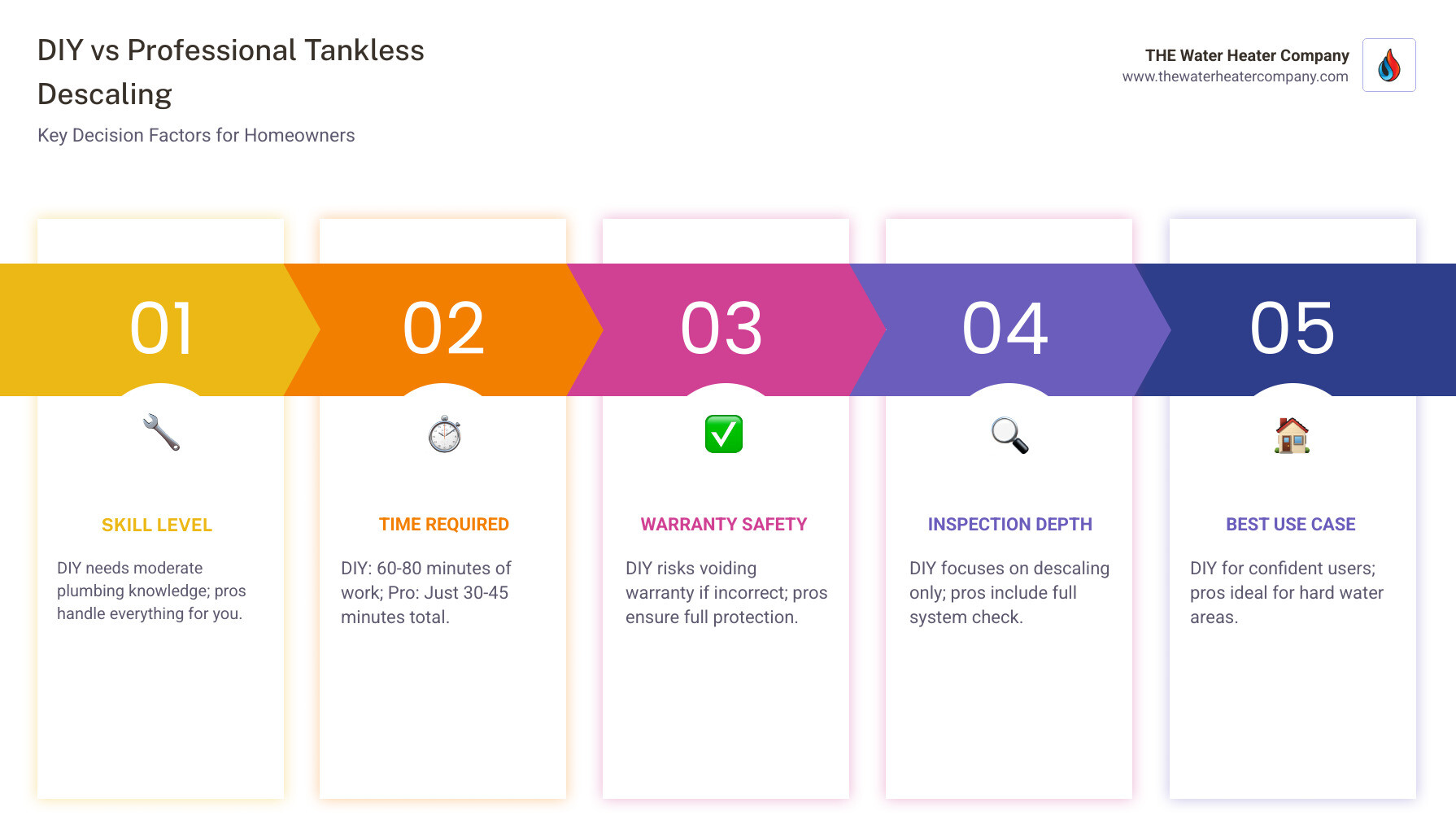
Professional vs diy tankless descaling is one of the most common maintenance questions Southern California homeowners face — and the answer isn’t one-size-fits-all. Here’s a quick breakdown to help you decide:
| Factor | DIY Descaling | Professional Service |
|---|---|---|
| Skill required | Moderate | None (handled for you) |
| Time investment | 60–80 minutes | 30–45 minutes |
| Warranty protection | Risk if done incorrectly | Fully protected |
| Thoroughness | Descaling only | Descaling + full inspection |
| Best for | Confident, hands-on homeowners | Most homeowners, especially in hard water areas |
Bottom line: DIY descaling is a real option for capable homeowners — but in Southern California’s hard water regions, the risk of voiding your warranty or missing a deeper issue often makes professional service the smarter call.
If you’ve noticed your tankless water heater taking longer to deliver hot water, showing error codes, or running less efficiently than it used to, scale buildup is likely the culprit. Mineral-rich water — common across Southern California — causes calcium and magnesium deposits to coat the inside of your heat exchanger over time. That thin layer of scale acts like insulation in the worst possible way: it forces your unit to work harder, drives up energy costs, and shortens the lifespan of a system built to last 15–20 years.
The good news is that descaling is a well-understood maintenance task. The question is simply whether you should tackle it yourself or hand it off to a licensed professional — and that’s exactly what this guide will help you figure out.
I’m Anthony Hamilton, Co-Founder and CEO of THE Water Heater Company, and after years of hands-on work with tankless systems across Southern California, I’ve seen how the professional vs diy tankless descaling decision plays out for real homeowners. That experience shapes everything in this guide, so let’s get into it.
Why is my tankless water heater acting up in Santa Clarita?
If you live in Santa Clarita or the surrounding valleys, you likely know that our water is “hard.” But what does that actually mean for your plumbing? Hard water contains high concentrations of dissolved minerals, specifically calcium and magnesium. When this water is flash-heated inside the compact heat exchanger of tankless water heaters, these minerals precipitate out of the liquid and solidify.
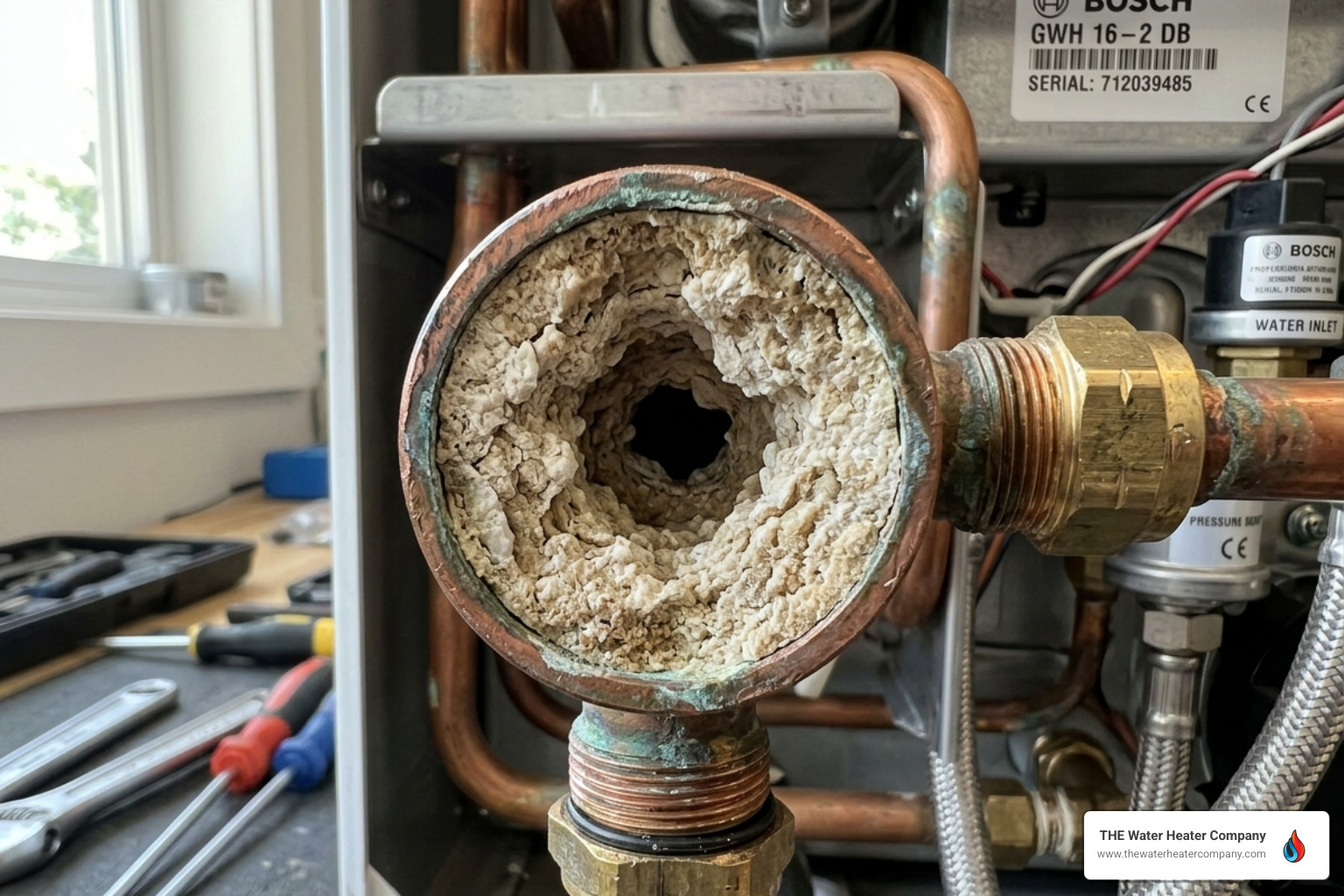
This solid material is known as “scale” or limescale. In April 2026, as we look at modern high-efficiency units, the tolerances for water flow are tighter than ever. Even a thin layer of scale — just 1.5 mm thick — can reduce your unit’s heat transfer efficiency by up to 12%. This forces the burner to stay on longer and run hotter to reach your desired temperature, which leads to:
- Fluctuating Temperatures: You might experience the “cold water sandwich,” where the water goes from hot to cold and back again because the unit is struggling to maintain a steady flame.
- Reduced Water Pressure: Scale doesn’t just coat the walls; it narrows the path for water. If your morning shower feels more like a light drizzle, buildup is likely the cause.
- Error Codes: Many modern units from brands like Rinnai, Navien, or Rheem will display codes (such as “LC” or “11”) when they detect overheating or restricted flow.
- Noises: You might hear rumbling or “kettling” sounds as water gets trapped behind scale deposits and turns to steam.
When these symptoms appear, it’s a sign that you need water heater repair or a deep descale to prevent the heat exchanger from cracking. Neglecting this maintenance can reduce the lifespan of your unit from a healthy 20 years to significantly less, potentially leading to an early water heater replacement.
The risks of professional vs diy tankless descaling
Deciding between professional vs diy tankless descaling often comes down to how much risk you are willing to take with a piece of equipment that costs thousands of dollars. While the process of flushing a unit is straightforward in theory, the execution carries several pitfalls.
Warranty Compliance
This is the single biggest “gotcha” for homeowners. Most major manufacturers, including Navien and Rinnai, specifically state in their warranty terms that the unit must be maintained according to their guidelines. In many cases, they require proof that a licensed professional performed the service. If you DIY the flush and a component fails six months later, the manufacturer may deny your claim if you cannot produce a professional service invoice.
Component Damage
A tankless unit is a precision instrument. During a DIY flush, it is easy to accidentally send debris into the flow sensor or get the check valve stuck. Furthermore, using the wrong concentration of descaling solution can lead to chemical corrosion of the copper or stainless steel heat exchanger. If the acid is too strong or left in too long, it can “pinhole” the metal, leading to internal leaks that cannot be repaired.
Isolation Valve Issues
To descale a unit, you must have isolation valves (service valves) installed. If your installer skipped these, a DIY job becomes nearly impossible for a novice, as it requires cutting into the lines. A professional plumber will check these valves for leaks and ensure they are functioning correctly before starting the process.
Comparing your maintenance options in Van Nuys and Irvine
Whether you are in the San Fernando Valley or down in Orange County, the technical requirements for descaling remain the same. However, the time and tools required differ significantly between a homeowner and a pro.
| Feature | DIY Approach | The Water Heater Company Pro Service |
|---|---|---|
| Tools Needed | Submersible pump, 2 hoses, 5-gallon bucket | Commercial-grade high-flow pumping station |
| Solution | White vinegar or consumer-grade kit | Professional-grade virgin descaling solution |
| Time | 60–80 minutes of active labor | 30–45 minutes of efficient service |
| Inspection | Visual check only | Full diagnostic, leak check, and filter cleaning |
| Reliability | Variable based on pump strength | Guaranteed results with professional equipment |
The step-by-step reality of professional vs diy tankless descaling
If you choose the DIY route, you’ll need to purchase a kit, which usually includes a 1/6 or 1/4 horsepower submersible pump. The process involves:
- Shutting off the gas, power, and water.
- Connecting hoses to the cold and hot service ports.
- Circulating a solution (either food-grade white vinegar or a commercial descaler) through the unit for 45 to 90 minutes.
- Flushing the unit with fresh water to remove any acidic residue.
- Cleaning the air intake filter and the water inlet screen.
While this sounds simple, a professional plumber does more than just “circulate liquid.” We monitor the flow rate to ensure the pump is actually overcoming the scale resistance. We also check the “bits” that homeowners often miss, such as the flame rod and the igniter, which can also be affected by the high heat caused by scale buildup. Unlike tank water heaters, which mostly deal with heavy sediment at the bottom, tankless units deal with “calcification” that bonds to the metal.
When to choose professional vs diy tankless descaling in Santa Ana
In areas like Santa Ana, where water hardness can be particularly aggressive, we often recommend professional maintenance services for a few key reasons. First, a professional has the technical troubleshooting skills to identify if a “no hot water” issue is actually scale or a failing gas valve or pressure regulator.
Second, there is the “mess factor.” If a hose pops off during a DIY flush, you are pumping acidic vinegar or chemicals all over your garage or utility closet. Our technicians use heavy-duty, reinforced hoses and sealed buckets to ensure your home stays clean. Finally, we provide a service record. If you ever sell your home in Irvine or Pasadena, having a documented history of professional maintenance adds value and provides peace of mind to the buyer.
Preventing future scale buildup in Southern California homes
While descaling is necessary, you can significantly reduce how often you need it by addressing the water quality entering your home. At THE Water Heater Company, we specialize in water filtration and conditioning systems that stop scale before it starts.
- Water Softeners: By replacing calcium and magnesium ions with sodium or potassium, a softener prevents scale from ever forming. This protects not just your water heater, but also your dishwasher, laundry machine, and fixtures.
- Scale Inhibitors: These are smaller, inline cartridges that don’t “soften” the water but change the chemical structure of the minerals so they can’t stick to the heat exchanger.
- Recirculation Systems: If you have hot water recirculating systems, be aware that scale can build up even faster because hot water is constantly moving through the unit. These systems require even more diligent maintenance.
Living in a high-risk seismic zone like Los Angeles also means your water heater setup likely includes earthquake valves. During a professional descaling visit, our team can inspect these safety devices to ensure they haven’t been tripped or damaged, providing an extra layer of home safety.
Frequently Asked Questions about Tankless Maintenance
How often should I descale my unit in a hard water area?
In Southern California locations with very hard water (180+ mg/L), you should descale every 6 to 12 months. If you have a water softener, you can often push this back to every 3 to 5 years, though an annual inspection is still recommended to check the internal filters and sensors.
Will performing my own maintenance void the manufacturer warranty?
It depends on the brand. Manufacturers like Navien and Rinnai are very strict. If a DIY descaling is done incorrectly — for example, if the solution isn’t flushed out completely and causes corrosion — the warranty will almost certainly be voided. Hiring a licensed professional is the safest way to keep your warranty intact.
Is white vinegar as effective as commercial descaling chemicals?
White vinegar is a great, eco-friendly option for light, annual maintenance. However, for units that haven’t been serviced in years, vinegar may be too weak to dissolve heavy, hardened “pebble” scale. In those cases, a professional-grade commercial descaling solution is required to fully restore flow.
Conclusion
Choosing between professional vs diy tankless descaling ultimately comes down to your comfort level with home maintenance and your desire for long-term protection. While a DIY kit can save you a few dollars in the short term, the comprehensive inspection, warranty protection, and efficiency gains provided by a professional service often pay for themselves by extending the life of your water heater.
At THE Water Heater Company, we are a local, family-owned business dedicated to being the trusted authority for homeowners from Santa Barbara to Irvine. Our expert technicians understand the unique water challenges of Southern California and are ready to ensure your tankless unit runs at peak performance for years to come.
Ready to protect your investment and enjoy endless hot water without the stress? Schedule your professional maintenance today and let our family take care of yours.

The Essential’s
Call THE Water Heater Company today to get immediate help with your water needs.
“
-

“Fair Pricing & Expert Service”
Their technician Gonzo, was clearly very competent and more importantly, he took the time and effort to do a really fantastic job.
-
“Fantastic Service!”
THE Water Heater Company understood the situation I was going through. They were able to help me out and get the job done quickly.
-
“Reasonable Pricing”
Kevin did a great job on replacing my old leaky yet still working water heater. He answered all my questions and explained all the details. -
“Quick Response Time”
He was very informative and responsive to my questions and when I am making a huge investment in my home I want to be sure I am going with a company I could count on and would not cut corners. -
“Real Professionals”
Communication was great with the owner and they were very responsive, ensuring a first-class installation and experience.
-
“Great Service”
Not only did he do the service we needed, but checked the whole unit in addition to other waterline components. -
“Professional and Responsive”
They have repaired my water heater, installed a hot water recirculating pump, and now installed a new water heater. -
“Real Professionals”
It took a little over three hours but no management was necessary as the guys were very competent and clearly have been doing this for a long time.