Is Gas or Electric the Right Fuel for Your Tankless Water Heater?
When comparing gas vs electric for tankless water heaters, the short answer is: gas is better for large homes with high hot water demand, while electric works well for smaller homes or single-point applications. Here’s a quick breakdown:
| Factor | Gas Tankless | Electric Tankless |
|---|---|---|
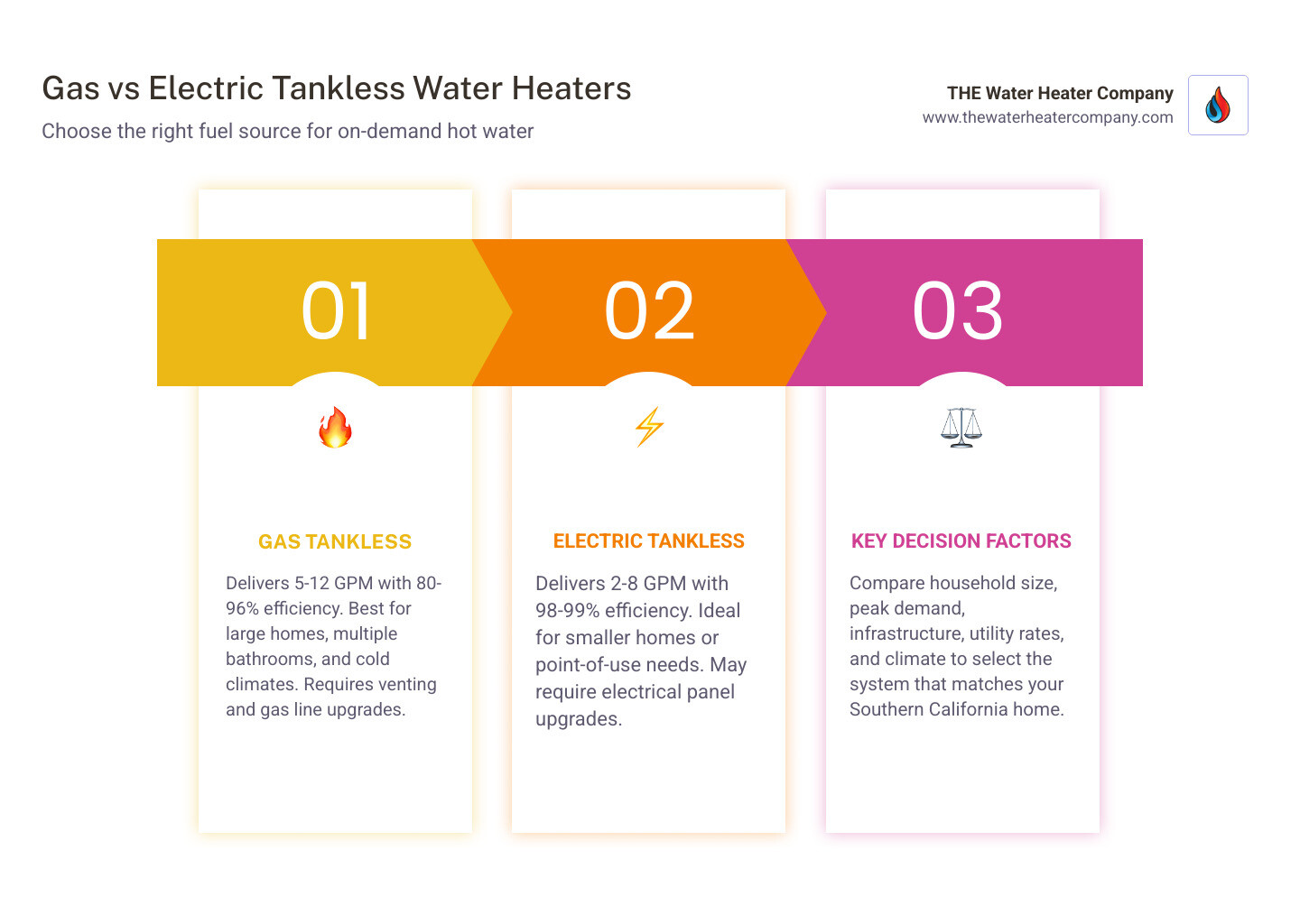
| Flow Rate | 5-12 GPM | 2-8 GPM |
| Energy Efficiency | 80-96% UEF | 98-99% UEF |
| Best For | Large households, multiple bathrooms | Smaller homes, point-of-use |
| Installation Complexity | Higher (venting + gas line) | Moderate (may need panel upgrade) |
| Cold Climate Performance | Excellent | Good |
| Maintenance | More (venting, burner checks) | Less (no combustion) |
Replacing or upgrading a water heater is one of those decisions that feels simple on the surface — until you start weighing flow rates, utility bills, installation requirements, and long-term efficiency. For Southern California homeowners especially, the choice between gas and electric tankless systems has real consequences for your monthly energy costs, your home’s infrastructure, and whether your family actually gets hot water when everyone needs it at once.
Tankless water heaters have become increasingly popular because they heat water on demand rather than storing it, eliminating the standby energy losses that come with traditional tank models. According to the U.S. Department of Energy, homes using 41 gallons or less of hot water daily can be 24-34% more energy efficient with a tankless system compared to a conventional storage tank heater. But once you decide to go tankless, you still face a major fork in the road: gas or electric?
The answer depends on your home’s existing infrastructure, your household’s peak hot water demand, and your local utility rates — not just the sticker price on the unit itself.
I’m Anthony Hamilton, Co-Founder and CEO of THE Water Heater Company, and I’ve spent years in the field helping Southern California homeowners navigate the gas vs electric for tankless water heaters decision — from Camarillo to Irvine and everywhere in between. In the sections ahead, I’ll break down everything you need to know so you can make a confident, informed choice.
Gas vs electric for tankless water heaters terms to learn:
Understanding the Basics of Gas vs Electric for Tankless Water Heaters
To make an informed decision, it helps to understand how these systems differ at a fundamental level. Both types provide on-demand heating, meaning they only consume energy when you turn on a hot water tap. This is a massive departure from traditional tank water heaters, which constantly keep dozens of gallons of water hot all day and night.
However, the mechanism used to transfer that heat to your water is entirely different depending on whether you choose gas or electric.
In a gas system, a powerful burner ignites natural gas or propane to heat a heavy-duty heat exchanger. As cold water passes through this exchanger, it absorbs the heat rapidly before flowing to your tap. In an electric system, the unit utilizes electric resistance heating elements. The water flows directly over these elements, which heat up instantly when water flow is detected.
Choosing the right option requires looking closely at your home’s physical layout and utility access. If you are trying to make choosing between gas and electric for your home made easy, the first step is checking what utilities are currently connected to your utility closet. For a deeper dive into these utility types, you can also consult our A-Z guide to gas or electric water heater to see how these power sources behave across different styles of equipment.
How Gas vs Electric for Tankless Water Heaters Generate Hot Water
The physical process of heating water on demand is a marvel of modern home engineering. When you open a hot water faucet anywhere in your home, a flow sensor inside the tankless unit detects the movement of water and immediately activates the heating sequence.
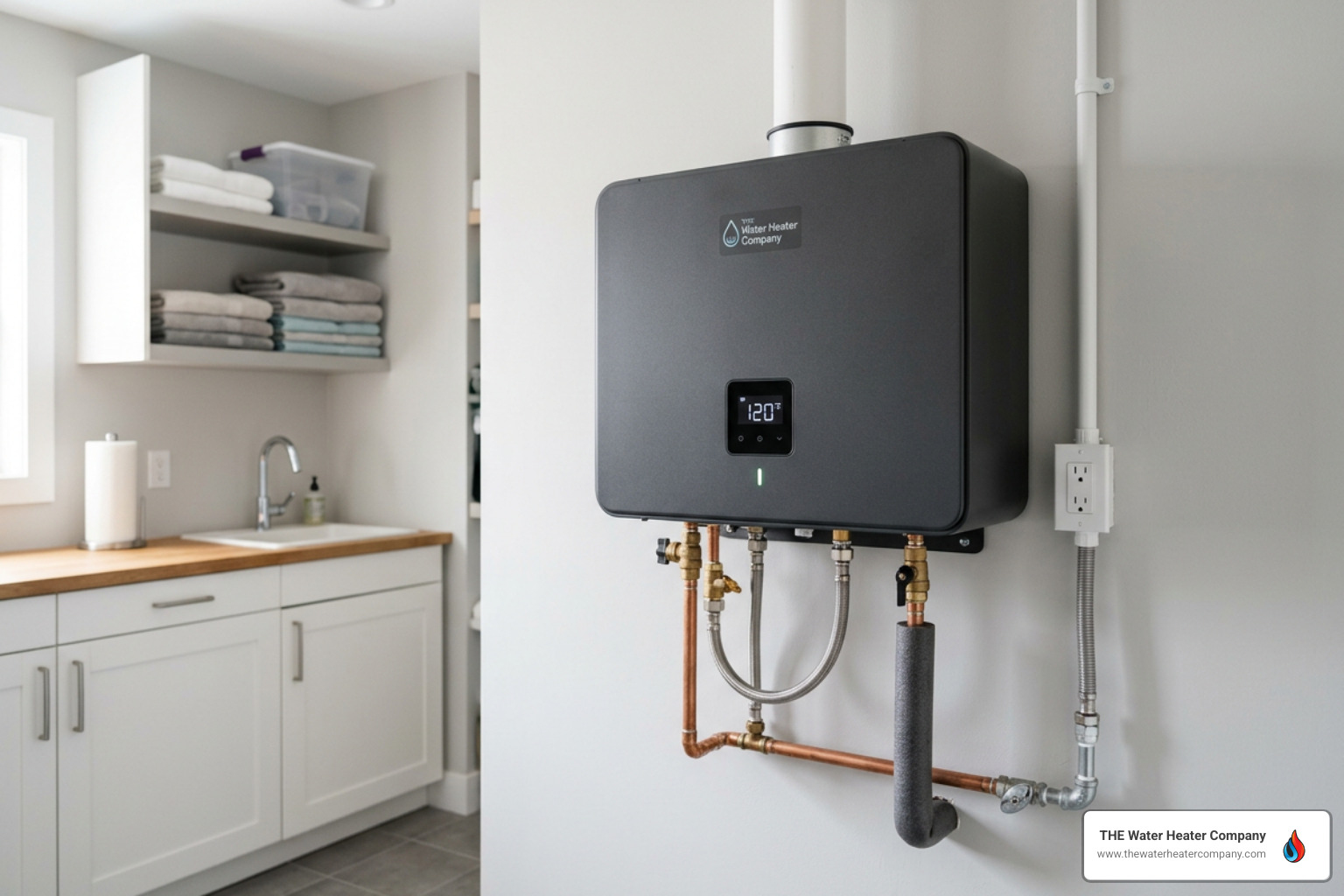
In a gas-powered tankless water heater, the electronic ignition lights a gas burner. This burner creates a high-BTU flame inside a combustion chamber. The heat from this flame is transferred to a copper or stainless steel heat exchanger. As the cold water winds through the tightly coiled pipes of the heat exchanger, the thermal energy is transferred into the water. The combustion process produces exhaust gases, which must then be safely vented outside your home.
An electric tankless water heater bypasses the combustion process entirely. Instead of a burner and heat exchanger, it uses heavy-duty electric resistance heating elements submerged directly in the water path. When the flow sensor is triggered, these elements instantly draw high-voltage electricity to heat up. The heat transfer is incredibly direct, requiring no venting, no air supply, and no flame.
Performance and Flow Rate Comparison
When we talk about performance in the tankless world, we are talking about flow rate — specifically, how many gallons per minute (GPM) of hot water a unit can produce at a consistent temperature. This is where the debate between gas vs electric for tankless water heaters gets highly practical.
If you have a busy household where multiple people are showering, running the dishwasher, or doing laundry at the same time, peak demand becomes your primary concern. If your system cannot keep up with simultaneous usage, you will experience sudden drops in temperature or water pressure.
In the match-up of choosing your power: gas vs electric tankless water heater performance, gas units generally come out on top for raw power. They can deliver flow rates ranging from 5 to 12 GPM, whereas electric models typically top out between 2 and 8 GPM under ideal conditions. To understand how this compares to traditional storage systems, you can read our breakdown of tank vs tankless water heaters.
| Performance Metric | Gas Tankless Water Heaters | Electric Tankless Water Heaters |
|---|---|---|
| Average Flow Rate | 5 to 10+ GPM | 2 to 5 GPM (up to 8 in warm climates) |
| Simultaneous Showers | 3 to 5 low-flow showers | 1 to 2 showers |
| Heating Speed | Extremely fast ramp-up | Fast, but limited by electrical draw |
| Suitability | Large family homes, high-demand | Small homes, apartments, point-of-use |
Flow Rates and Household Size Suitability
For large households with multiple bathrooms, a gas tankless water heater is almost always the superior choice. Because gas burners can output a massive amount of heat energy instantly, they can easily support several simultaneous hot water demands.
Electric models, on the other hand, are highly limited by the maximum electrical current they can safely draw from your home’s electrical panel. As a result, they are generally better suited for smaller households, apartments, or point-of-use applications (such as a dedicated unit for a detached guest house or an outdoor kitchen).
To help you visualize your household’s peak demand, here is a list of typical fixture flow rates:
- Low-flow showerhead: 1.5 to 2.0 GPM
- Standard showerhead: 2.0 to 2.5 GPM
- Kitchen faucet: 1.0 to 2.2 GPM
- Washing machine: 2.0 to 3.0 GPM
- Dishwasher: 1.0 to 2.0 GPM
If you live in Santa Monica or Pasadena and have a home with three bathrooms, and two people are showering while the washing machine is running, your peak demand could easily reach 7 GPM. A gas unit can handle this with ease, whereas a standard electric unit would struggle, likely resulting in lukewarm showers.
Climate Impact on Performance
One of the most overlooked factors in choosing a tankless water heater is the temperature of the groundwater entering your home. A tankless water heater must raise the temperature of the incoming cold water to your desired thermostat setting (typically 120°F). The colder the incoming water, the more energy the system needs to achieve that temperature rise.
In cold climates, incoming groundwater temperatures can drop to near-freezing in the winter. This drastically reduces the GPM output of any tankless water heater, especially electric models, which simply do not have the raw heating capacity to handle a massive temperature rise at high flow rates.
Fortunately, here in Southern California — including our service areas like Santa Barbara, Camarillo, Santa Clarita, and Los Angeles — our groundwater remains relatively warm year-round. This gives both gas and electric tankless units a distinct performance advantage. However, even in milder climates, a gas unit provides more reliable, consistent water pressure during the cooler winter months when groundwater temperatures do dip slightly.
Energy Efficiency and Environmental Impact
Efficiency is a major selling point for tankless technology. By eliminating the constant energy usage required to keep a giant tank of water hot, you naturally lower your home’s energy footprint. When evaluating different models, you will want to look at the Uniform Energy Factor (UEF), which is the standard measure of water heater efficiency.
If you are wondering, is a tankless water heater right for your home and budget?, understanding the efficiency differences between gas and electric models is key to calculating your long-term utility impact.
Thermal Efficiency and Standby Losses
Electric tankless water heaters are incredibly efficient at converting energy into heat. In fact, they achieve nearly 98% to 99% thermal efficiency because the heating elements are fully submerged in the water, resulting in almost zero energy loss.
Gas tankless units typically achieve between 80% and 96% efficiency. Non-condensing gas models lose some heat through their metal venting systems, while high-efficiency condensing gas models capture that escaping heat to preheat incoming water, pushing their efficiency to the upper end of the spectrum. Additionally, older gas water heaters with standing pilot lights can waste energy, but modern gas tankless heaters utilize electronic ignitions to eliminate standby energy waste entirely.
While electric units win the pure thermal efficiency battle, your monthly operating costs will depend heavily on local utility rates. In many parts of Southern California, natural gas historically costs less per unit of energy than electricity, meaning a gas unit can still be highly cost-effective to run despite having a slightly lower efficiency rating on paper.
Choosing Gas vs Electric for Tankless Water Heaters Based on Carbon Footprint
For environmentally conscious homeowners in areas like Santa Ana and Irvine, the carbon footprint of their appliances is a major consideration.
Electric tankless units have no on-site emissions. If your home is powered by solar panels or if your local grid relies heavily on renewable energy sources like wind and solar, an electric tankless water heater can operate with a incredibly low carbon footprint.
Gas units burn fossil fuels, which naturally releases carbon dioxide and other greenhouse gases through the vent. However, because they are so much more efficient than old-fashioned gas tank heaters, upgrading to a gas tankless system still represents a major environmental step forward for homes that rely on gas infrastructure.
Infrastructure and Installation Requirements
Choosing between gas and electric is rarely just about the unit itself; it is about what your home is physically capable of supporting. The existing infrastructure in your utility closet or garage will dictate the complexity of your installation.
Before making a decision, it is essential to understand the unique requirements of each system. We recommend reading our guide on water heater installation in Southern California: what homeowners should know to get a sense of local building codes and permitting. Additionally, our article on how much does a new water heater cost in California? details the various installation factors that can impact your project without focusing on volatile equipment pricing.
Venting and Gas Line Upgrades
If you select a gas tankless water heater, you must have a way to safely vent the combustion byproducts out of your home. This typically requires specialized concentric venting made of stainless steel or, in the case of condensing models, durable PVC. This venting must run through an exterior wall or up through the roof.
Furthermore, gas tankless heaters require a massive amount of fuel instantly when they fire up. This means your existing gas line may need to be upgraded from a standard 1/2-inch pipe to a larger 3/4-inch or 1-inch line to ensure the unit gets enough fuel without starving your furnace or gas stove. In some cases, homeowners opt for an outdoor installation to simplify venting requirements, provided local safety codes allow it.
Electrical Panel Capacity
Electric tankless water heaters do not require any venting or gas lines, which makes their physical placement much more flexible. However, they place a massive demand on your home’s electrical system.
A whole-house electric tankless water heater typically requires a dedicated 240-volt circuit and can draw up to 120 to 150 amps of power. If your home in Santa Clarita or Van Nuys has an older 100-amp or even 150-amp electrical panel, you will almost certainly need to upgrade your entire electrical panel to 200 or 300 amps to support the unit. This infrastructure upgrade can add significant complexity to your installation project.
Maintenance and Lifespan Considerations
Investing in a tankless water heater is a long-term commitment. Fortunately, both gas and electric tankless units are built to last. While traditional tank heaters typically need replacement every 6 to 10 years, a high-quality tankless water heater can easily last 15 to 20 years or more with proper care.
To maximize this lifespan, regular maintenance is non-negotiable. You can learn more about the long-term care of these systems on our dedicated tankless water heaters service page.
Descaling and Annual Flushing
The single greatest threat to any tankless water heater is hard water. Southern California is notorious for high mineral content in our water supply. As water is heated, calcium and magnesium minerals precipitate out and cling to the heat exchanger or heating elements, creating a hard crust known as scale.
This scale acts as an insulator, reducing heat transfer efficiency and forcing your unit to work harder to heat the water. Over time, severe scale buildup can cause the system to overheat, throw error codes, or shut down entirely.
To prevent this, both gas and electric units require an annual flush and descaling using a food-grade vinegar solution. If you live in an area with exceptionally hard water, pairing your tankless unit with a whole-house water softener or water filtration system is an excellent way to protect your investment and extend its life.
Burner Inspections and Vent Checks
While electric units only need periodic descaling and filter cleaning, gas tankless water heaters have additional maintenance needs due to the combustion process.
An annual professional inspection for a gas unit should include:
- Cleaning the burner assembly to ensure a clean, efficient flame.
- Checking the combustion chamber for debris or soot.
- Inspecting the venting system to ensure it is clear of obstructions (like bird nests) and properly sealed.
- Testing safety sensors, fan operation, and the pressure relief valve.
Frequently Asked Questions about Tankless Water Heaters
Navigating water heating can be tricky. Here are some of the most common questions we hear from homeowners across Southern California.
Do tankless water heaters work during a power outage?
No. This is a common misconception, especially regarding gas units. While gas units use natural gas or propane as their primary fuel source, they still rely on electricity to power the electronic ignition, the digital control board, safety sensors, and the combustion fan. Unless you have your tankless unit connected to a backup generator or a dedicated battery backup system, neither a gas nor an electric tankless water heater will provide hot water during a power outage.
How long do gas and electric tankless water heaters last?
With regular professional maintenance, both gas and electric tankless water heaters can last 20 years or more. This is a massive upgrade over traditional storage tank models, which typically last only 10 to 15 years. If you are trying to decide between these two paths, we recommend reading our comparison guide: should I go tankless or stick with a traditional water heater?.
Can an electric tankless water heater support a large home?
In Southern California, a high-capacity electric tankless water heater can sometimes support a mid-sized home with two bathrooms because our groundwater is relatively warm. However, for truly large homes with high simultaneous hot water demands, electric units are generally limited by the maximum electrical amperage a home can safely allocate to a single appliance. For large households, a gas tankless water heater remains the most reliable option for uninterrupted, whole-house hot water.
Conclusion
The choice between gas vs electric for tankless water heaters comes down to your home’s unique layout, your household’s peak water usage, and your long-term efficiency goals.
If you have a large family with multiple bathrooms and already have a gas line in place, a gas tankless water heater is the clear winner for performance and reliability. If you live in a smaller home, condo, or are looking to install a point-of-use system — and your electrical panel has the capacity to support it — an electric tankless unit offers incredible efficiency, a simpler physical footprint, and zero on-site emissions.
At THE Water Heater Company, we specialize in helping Southern California homeowners find the perfect water heating solutions for their homes. Whether you are in Santa Barbara, Camarillo, Santa Clarita, Pasadena, Van Nuys, Los Angeles, Santa Ana, or Irvine, our family-owned team is here to provide expert diagnostics, seamless installations, and reliable maintenance.
Ready to make the switch to endless hot water? Contact us today to explore our professional water heater services and find the perfect fit for your home!

The Essential’s
Call THE Water Heater Company today to get immediate help with your water needs.
“
-

“Fair Pricing & Expert Service”
Their technician Gonzo, was clearly very competent and more importantly, he took the time and effort to do a really fantastic job.
-
“Fantastic Service!”
THE Water Heater Company understood the situation I was going through. They were able to help me out and get the job done quickly.
-
“Reasonable Pricing”
Kevin did a great job on replacing my old leaky yet still working water heater. He answered all my questions and explained all the details. -
“Quick Response Time”
He was very informative and responsive to my questions and when I am making a huge investment in my home I want to be sure I am going with a company I could count on and would not cut corners. -
“Real Professionals”
Communication was great with the owner and they were very responsive, ensuring a first-class installation and experience.
-
“Great Service”
Not only did he do the service we needed, but checked the whole unit in addition to other waterline components. -
“Professional and Responsive”
They have repaired my water heater, installed a hot water recirculating pump, and now installed a new water heater. -
“Real Professionals”
It took a little over three hours but no management was necessary as the guys were very competent and clearly have been doing this for a long time.