Why Knowing How to Secure Your Water Heater for Earthquakes Could Save Your Home
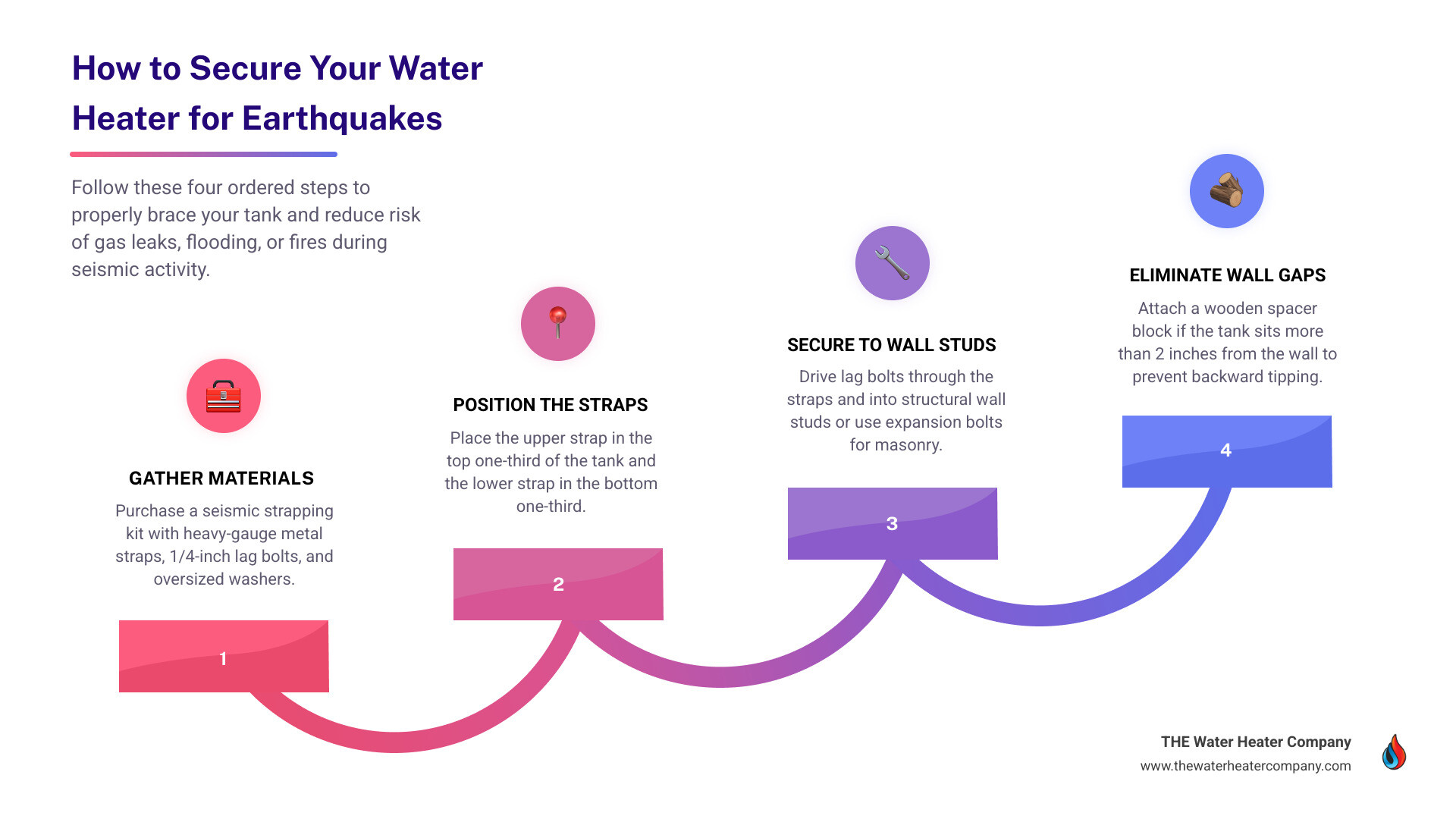
How to secure your water heater for earthquakes comes down to four key steps:
- Gather materials – Purchase a seismic strapping kit with heavy-gauge metal straps, 1/4-inch lag bolts, and oversized washers
- Position the straps – Place the upper strap in the top one-third of the tank and the lower strap in the bottom one-third
- Secure to wall studs – Drive lag bolts through the straps and into structural wall studs (or use expansion bolts for masonry)
- Eliminate wall gaps – If the tank sits more than 2 inches from the wall, attach a wooden spacer block to prevent backward tipping
An unsecured water heater is one of the most overlooked hazards in a Southern California home. A full 50-gallon tank weighs roughly 450 pounds — and during a tremor, that mass doesn’t just fall quietly. It can rupture gas lines, flood your home, and trigger fires that spread fast. After both the 1989 Loma Prieta and 1994 Northridge earthquakes, investigators found that single-strap and plumber’s tape bracing methods failed repeatedly, driving major changes to how experts recommend securing these units today.
The good news? Proper bracing is a straightforward project most homeowners can complete in an afternoon — and it’s also a legal requirement in California for any new or replacement water heater installed since July 1, 1991.
I’m Anthony Hamilton, Co-Founder and CEO of THE Water Heater Company, and I’ve spent years helping Southern California homeowners understand how to secure your water heater for earthquakes as part of safe, code-compliant installations across the region. In the guide below, I’ll walk you through everything you need to know to protect your home, your family, and your water supply.
Why Learning How to Secure Your Water Heater for Earthquakes is Essential
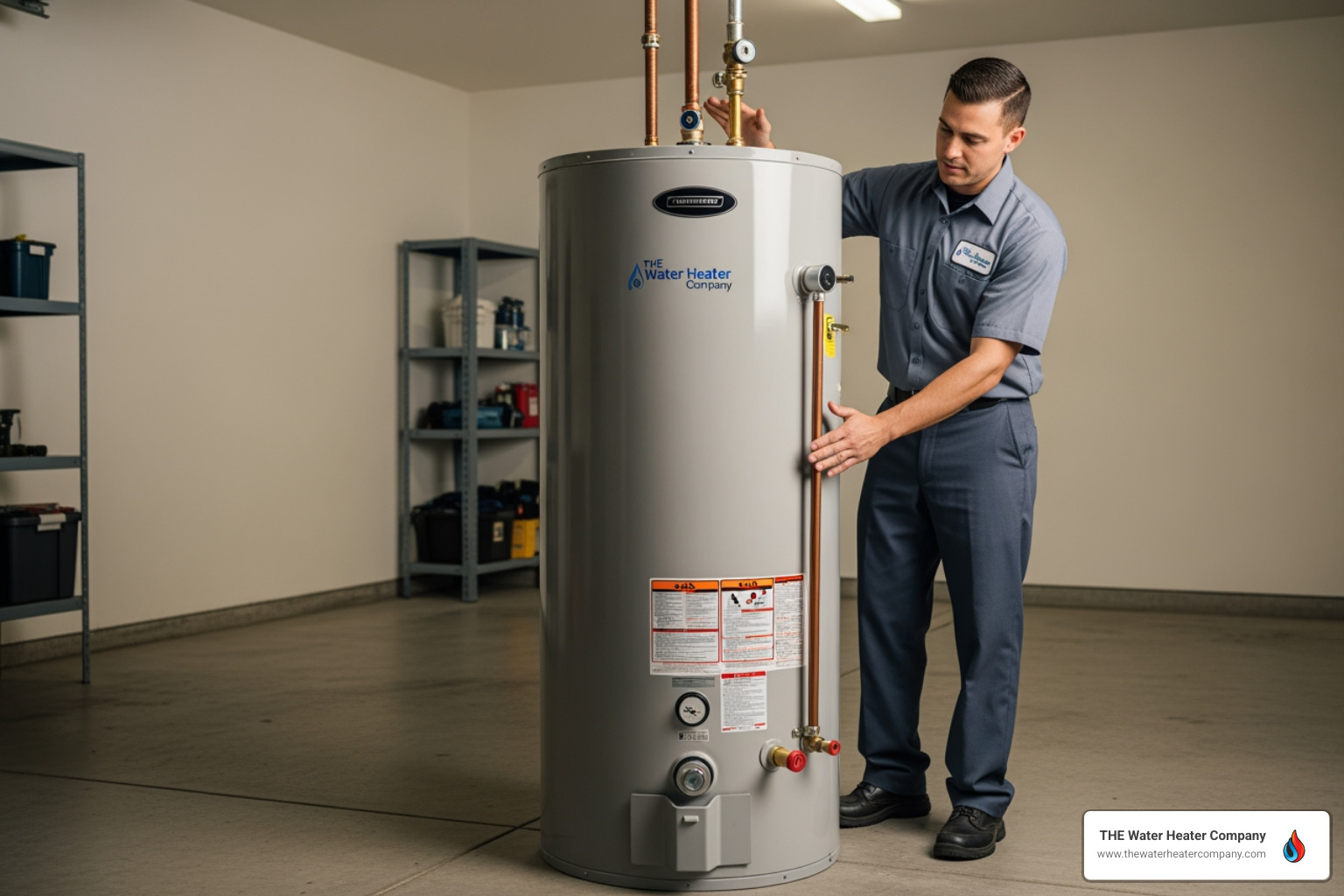
When you think of earthquake preparedness, you likely think of “drop, cover, and hold on.” But preparedness starts long before the ground moves. In places like Santa Clarita, Pasadena, and Los Angeles, your water heater is a silent giant. When full, a standard 50-gallon unit weighs about 450 pounds. During a significant seismic event, gravity alone cannot hold that weight in place. Without mechanical bracing, this mass becomes a dangerous projectile.
If a water heater topples, the consequences are often a triple-threat of disaster:
- Fire Hazards: As the tank falls, it can snap rigid gas lines, leading to immediate leaks and potential explosions.
- Flooding Risks: Ruptured water lines can dump 30 to 50 gallons of water instantly, followed by a continuous flow from the main line until it is manually shut off.
- Structural Damage: 450 pounds of shifting metal can easily crush nearby items or even damage the structural framing of your garage or utility closet.
By mastering Water Heater Installation in Southern California, you aren’t just following the law; you are creating a buffer of safety for your entire household.
Protecting Your Emergency Water Supply
One of the most practical reasons to secure your tank is that it serves as a “backup reservoir.” After a major disaster, municipal water supplies may be contaminated or shut off. A secured, upright water heater contains up to 50 gallons of potable water. If the tank remains standing, you can connect a garden hose to the drain spout at the bottom, open a nearby faucet to vent the system, and access fresh water for drinking and hygiene. If the tank falls and ruptures, that vital resource is lost to the floor.
Preventing Catastrophic Gas Leaks
In California, gas-related fires are a leading cause of property loss after earthquakes. Rigid piping has no “give.” When the tank moves, the pipe snaps. This is why understanding The Law of the Land California Gas Valve Rules is so important. Securing the tank ensures that the connection to the gas supply remains intact, preventing the invisible threat of a gas leak from turning a tremor into a tragedy.
California Legal Requirements and Safety Standards
California has some of the strictest seismic safety laws in the country, and for good reason. Under California Health and Safety Code 19211, all water heaters must be braced, anchored, or strapped to resist falling or horizontal displacement due to earthquake forces. This mandate applies to any new or replacement water heater sold or installed on or after July 1, 1991.
Current 2020 February Water Heater Installation Codes in California require a minimum of two sets of straps. Depending on the size of the unit (specifically those over 52 gallons), a third strap may even be required at the mid-point to prevent the tank from buckling.
Mandatory Bracing for Property Transfers
If you are planning to sell your home in Santa Ana, Irvine, or anywhere in Southern California, your water heater will be a focal point of the safety inspection. Real estate compliance laws require sellers to certify that the water heater is properly braced. If it isn’t, it can delay the closing of your home. It’s a simple fix that prevents major headaches during a property transfer.
The Shift from Single to Double Strapping
The history of how to secure your water heater for earthquakes is written in the lessons of past disasters. Before the 1989 Loma Prieta and 1994 Northridge earthquakes, many homes used a single strap across the middle of the tank. Data from those events showed that tanks simply “pivoted” out of the single strap or burst through thin plumber’s tape. As a result, the Division of the State Architect (DSA) updated guidelines to the double-strap method we use today, ensuring both the top and the base are stabilized.
Step-by-Step Guide: How to Secure Your Water Heater for Earthquakes
Ready to get to work? Securing your tank is a manageable DIY project, but it requires the right materials. Avoid using standard “plumber’s tape” (the thin, perforated metal ribbon), as it can stretch or tear under the extreme kinetic energy of a quake. Instead, look for a California-approved seismic strapping kit.
| Feature | Plumber’s Tape | Heavy-Gauge Metal Strapping |
|---|---|---|
| Material | Thin, flexible 24-gauge steel | Heavy-duty steel |
| Durability | May stretch or snap | Designed for seismic loads |
| Code Compliance | Generally not approved for >40 gal | Fully compliant with CA Code |
| Safety | High failure rate in Northridge | Industry standard for safety |
For a deep dive into what to expect during this process, check out Water Heater Installation in Southern California What Homeowners Should Know.
Step 1: Gather Materials and Locate Wall Studs
You will need:
- A seismic strapping kit (includes straps, lag bolts, and tensioners)
- A stud finder
- A power drill with a 3/16-inch drill bit
- A socket wrench
Start by using your stud finder to locate the vertical wood studs behind the water heater. You must anchor into the structural members of the home—not just the drywall. If your heater is against a masonry or concrete wall, you will need 1/4-inch expansion bolts instead of lag screws.
Step 2: Position the Upper and Lower Straps
Placement is everything.
- Upper Strap: Should be positioned in the upper one-third of the tank, at least 9 inches below the top cap.
- Lower Strap: Should be in the lower one-third of the tank, at least 4 inches above the gas control valve or thermostat.
Step 3: Secure the Straps to the Structure
Drill pilot holes into the center of the studs to prevent the wood from splitting. Wrap the heavy-gauge strap around the tank—some experts recommend 1.5 wraps for maximum grip—and secure it to the wall using 1/4-inch x 3-inch lag bolts and oversized washers. The bolts should penetrate the wood by at least 1.5 inches. Once attached, use the cinch mechanism or tension bolts to tighten the straps until they are snug. They should be tight enough to prevent movement but not so tight that they dent the tank’s outer shell.
Step 4: Eliminate Gaps with Spacers
If there is a gap larger than 1 to 2 inches between the tank and the wall, the water heater can still “rock” backward, potentially shearing the bolts. To fix this, attach a wooden spacer block (a scrap piece of 2×4 works perfectly) to the wall stud behind the tank. This ensures the tank has a solid surface to lean against, providing 360-degree stability.
Upgrading to Flexible Connectors and Safety Valves
Even with the best straps, the ground movement in Southern California can be violent. This is where “flexibility” becomes your best friend. Rigid copper or galvanized piping is prone to snapping when the house and the tank move at different frequencies.
Why Flexible Water and Gas Lines are Critical
We highly recommend replacing any rigid piping with corrugated stainless steel or braided metal flexible connectors. These act like shock absorbers, allowing the tank to shift slightly without breaking the seal. This simple upgrade is one of the most effective ways to prevent post-earthquake flooding and fires.
Automatic Seismic Shut-off Valves
For ultimate peace of mind, consider an automatic Earthquake Valve. These valves are installed on your main gas line and are designed to automatically trip and shut off the gas flow when they sense a magnitude 5.4 earthquake or higher. This takes the “human element” out of the equation—if you aren’t home or can’t reach the gas meter, the valve does the work for you. Combined with Pressure Regulators, these components form a comprehensive safety shield for your home. You can find these as part of our specialized Services.
Long-Term Maintenance for Your Earthquake Straps
As of May 2026, many homes in the Van Nuys and Camarillo areas have straps that were installed a decade or more ago. Like any safety equipment, these require regular inspection.
We recommend a quick check every 6 months:
- Check Tension: Give the tank a gentle “nudge.” If it wiggles, tighten the cinch bolts.
- Inspect for Corrosion: In humid areas or garages, metal straps can rust. If you see significant corrosion, replace the kit.
- Verify Bolt Integrity: Ensure the lag bolts haven’t pulled away from the wall or loosened over time.
- Post-Seismic Check: Always inspect your straps immediately after any earthquake felt in your area.
At THE Water Heater Company, we prioritize these details because we know the stakes. Why Choose Us? Because we don’t just install tanks; we build safety systems tailored to the unique seismic needs of Southern California.
Frequently Asked Questions about how to secure your water heater for earthquakes
Is plumber’s tape sufficient for how to secure your water heater for earthquakes?
No. Standard 24-gauge perforated plumber’s tape is generally considered insufficient for modern safety standards, especially for tanks 40 gallons or larger. It is too thin and can stretch or snap under the weight of a shifting 450-pound tank. Always use heavy-gauge metal strapping kits specifically labeled for seismic use.
Do tankless units require the same strapping method?
Tankless water heaters do not use traditional straps because they don’t have a large, cylindrical tank. Instead, they require a different approach to how to secure your water heater for earthquakes. They must be mounted to a structural backing plate (like 3/4-inch plywood) or directly into wall studs using heavy-duty bolts and vibration-isolation mounts. This ensures the unit doesn’t “bounce” off the wall during a tremor.
How often should I inspect my seismic bracing?
As of May 2026, industry standards suggest an annual inspection at the very least. However, given the active fault lines in Southern California, checking your straps every six months and after any noticeable tremor is the safest practice. Look for signs of metal fatigue, loose bolts, or shifting of the tank.
Conclusion
Securing your water heater is one of the most cost-effective and impactful ways to protect your home from earthquake damage. From preventing catastrophic fires and floods to preserving a vital emergency water supply, the benefits are undeniable. Whether you are in Santa Barbara, Pasadena, or Irvine, the team at THE Water Heater Company is here to ensure your home meets the highest safety standards.
Don’t wait for the next tremor to find out if your bracing is up to the task. If you’re unsure about your current setup or need a professional touch, we’re here to help with expert safety audits and installations.
Secure your home with expert earthquake valve installation and give your family the peace of mind they deserve. Reach out to us today—we’re your local Southern California experts in keeping the hot water flowing and the home standing tall.

The Essential’s
Call THE Water Heater Company today to get immediate help with your water needs.
“
-

“Fair Pricing & Expert Service”
Their technician Gonzo, was clearly very competent and more importantly, he took the time and effort to do a really fantastic job.
-
“Fantastic Service!”
THE Water Heater Company understood the situation I was going through. They were able to help me out and get the job done quickly.
-
“Reasonable Pricing”
Kevin did a great job on replacing my old leaky yet still working water heater. He answered all my questions and explained all the details. -
“Quick Response Time”
He was very informative and responsive to my questions and when I am making a huge investment in my home I want to be sure I am going with a company I could count on and would not cut corners. -
“Real Professionals”
Communication was great with the owner and they were very responsive, ensuring a first-class installation and experience.
-
“Great Service”
Not only did he do the service we needed, but checked the whole unit in addition to other waterline components. -
“Professional and Responsive”
They have repaired my water heater, installed a hot water recirculating pump, and now installed a new water heater. -
“Real Professionals”
It took a little over three hours but no management was necessary as the guys were very competent and clearly have been doing this for a long time.