What to Do When You Have Rusty Water from Your Hot Water Tap
If you’re dealing with rusty water from your hot water tap, here’s what to do right away:
- Don’t drink it. Avoid using the discolored water for drinking or cooking until the issue is resolved.
- Run the cold tap separately. If the cold water runs clear but the hot is brown or orange, your water heater is the most likely source.
- Check multiple faucets. If only one fixture is affected, the problem may be local to that fixture. If all hot taps are discolored, it points to the heater or the hot water pipes.
- Check with neighbors. If both hot and cold taps are rusty across your home, contact your local water utility — a water main disturbance may be the cause.
- Note the age of your water heater. Most tanks begin showing signs of internal corrosion between 5 and 7 years, and typically need replacement by 8 to 12 years.
- Call a licensed plumber if the discoloration persists after running the taps, or if the water has a metallic odor or taste.
Turning on your hot tap and watching brown or rust-colored water pour out is one of those moments that stops you in your tracks. Is it safe? Where is it coming from? Do you need a whole new water heater? These are fair questions — and the good news is that most cases of rusty hot water point to one of just a few fixable sources: your water heater, your home’s pipes, or a temporary disturbance in the municipal supply.
The pattern matters more than the color alone. Rust that shows up only in the hot water is almost always coming from inside your home’s plumbing system — often the water heater itself. Understanding that distinction is the first step toward fixing it without guessing.
I’m Anthony Hamilton, Co-Founder and CEO of THE Water Heater Company, and after years in the field diagnosing and resolving exactly this kind of problem for Southern California homeowners, I know how unsettling rusty water from your hot water tap can be — and how quickly the right diagnosis can point you toward a real solution. Let’s walk through what’s actually going on and what you should do next.
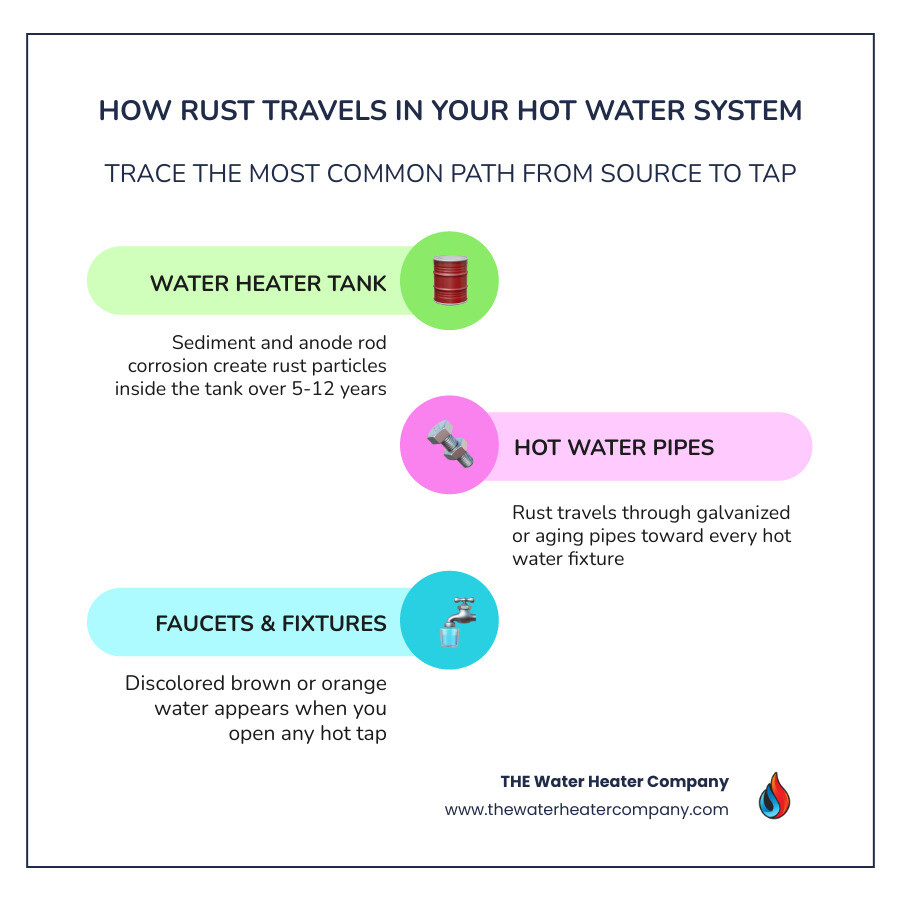
Rusty water from your hot water tap what to do vocab explained:
Rusty Water from Your Hot Water Tap: What to Do to Isolate the Source
When you first notice that worrisome brown stream, you do not have to immediately panic and assume you are facing a massive plumbing catastrophe. Instead, you can play “water detective” right in your own home. Pinpointing the source of the rust is surprisingly straightforward if you follow a systematic temperature and location test.

To isolate the source, perform these diagnostic steps:
- The Temperature Test: Go to a faucet (a bathtub faucet is ideal because it has a high flow rate and makes color changes easy to see) and run the cold water for at least one to two minutes. Note the color. Now, turn off the cold, turn on the hot water, and let it run. If the cold water is crystal clear but the hot water looks like weak tea or orange juice, you have narrowed the problem down to your hot water system.
- The Location Test: Check other faucets throughout your house. If the rusty hot water only appears at your master bathroom sink, but runs clear in your kitchen and guest shower, the problem is likely localized corrosion in the plumbing or fixture of that specific bathroom. However, if every single hot water tap in your home is pouring out discolored water, the issue is systemic—meaning it is originating directly from your water heater or your main hot water distribution lines.
- The Morning Test: Observe when the rust is most prominent. If the water comes out rusty first thing in the morning (after sitting stagnant overnight) but clears up after running for a minute, this is a classic sign of corroding galvanized steel pipes. The water absorbs iron particles as it sits in contact with the decaying metal overnight.
To help you visualize what these symptoms mean, we have put together a quick-reference guide comparing the three most common culprits:
| Symptom | Likely Source | What is Happening? | What to Do |
|---|---|---|---|
| Hot water is rusty; cold water is completely clear | Water Heater Tank | Sediment buildup or internal tank corrosion (failing anode rod). | Flush the tank; inspect the anode rod. |
| Both hot and cold water are rusty at all times | Municipal Water Supply | Water main break, fire hydrant flushing, or utility maintenance. | Run cold taps for 15 minutes; check with neighbors. |
| Water is rusty only after sitting unused overnight | Galvanized Pipes | Zinc coating has worn off, exposing raw iron to oxygen and water. | Plan for eventual pipe replacement or filtration. |
If your diagnostic steps point squarely to your water heater, you will want to read up on the Signs You Need a Water Heater Repair to see if a quick fix is possible. If the issue is accompanied by pooling water, you should immediately review our guide on What to Do If Your Water Heater Is Leaking or You Have No Hot Water to prevent property damage.
Is Rusty Hot Water Safe to Drink, Bathe In, or Use for Laundry?
One of the most immediate concerns homeowners have when they see discolored water is safety. Can you still wash your hands? Is it safe to jump in the shower? Can you use it to wash a load of laundry?
From a health standpoint, the iron and manganese that cause rusty water are classified by environmental agencies as “secondary contaminants.” This means they are primarily aesthetic, cosmetic, and technical nuisances rather than direct toxic health hazards. The human body actually requires iron to transport oxygen in the blood, and the small amounts of rust particles ingested from a brief slip-up are generally harmless to healthy individuals.
However, “generally harmless” does not mean you should continue drinking or cooking with it. Rusty water can harbor bacteria, have a terrible metallic taste, and indicate that lead or other heavy metals are leaching from older, corroded pipe joints. If anyone in your household is immunocompromised or has conditions like hemochromatosis (an iron overload disorder), they should strictly avoid contact with discolored water.
When it comes to bathing and household use, the risks are more practical than medical:
- Skin and Hair: Bathing in rusty water can leave your skin feeling dry and itchy. The oxidized iron can react with soap, making it incredibly difficult to get a good lather. For those with light-colored or blonde hair, repeated exposure to rusty water can lead to brassy tones and unwanted orange tinting.
- Laundry Disasters: Do not run your washing machine if you have rusty hot water! Iron is a natural dye. If you wash a load of whites or light-colored fabrics in rusty water, you will likely end up with permanent yellow, orange, or brown stains. If you accidentally wash clothes in rusty water, do not put them in the dryer (which sets the stain). Rewash them using a specialized rust-remover detergent once your water runs clear.
- Fixture Staining: Over time, consistent rust in your water supply will leave unsightly, stubborn orange rings around your toilet bowls, bathtub drains, and sink basins.
To understand more about what might be lurking in your household tap water, take a look at our comprehensive resource, To Filter or Not to Filter: The Ultimate Guide to Home Water Quality.
Root Causes of Discolored Hot Water
To truly understand rusty water from your hot water tap what to do, we have to look at the underlying science of why water turns brown. Rust is nothing more than oxidized iron—the result of iron, oxygen, and water mixing together. In a home plumbing system, this chemical reaction is accelerated by several factors.
First, heat acts as a catalyst. Warm water speeds up chemical reactions, which is why corrosion often occurs much faster inside your hot water system than in your cold water lines. Additionally, hot water is more effective at dissolving minerals and carrying suspended particles, making the discoloration highly visible.
Second, water chemistry plays a major role. In many areas of Southern California, including Los Angeles, Santa Clarita, and Pasadena, hard water is highly prevalent. Hard water contains high concentrations of calcium and magnesium. While these minerals don’t cause rust directly, they create heavy scale buildup inside your water heater. This scale acts as an insulating barrier, causing the tank to overheat, which in turn degrades the protective glass lining of the tank and accelerates metal corrosion.
Furthermore, dissolved oxygen in the water supply constantly feeds the oxidation process. If your home has older plumbing, you may also be dealing with galvanic corrosion. This occurs when two dissimilar metals—such as copper pipes and galvanized steel connections—come into direct contact. Without a dielectric union to separate them, an electrical current naturally flows between the metals, causing the weaker metal (the steel) to corrode at an alarming rate.
For a deeper dive into how minerals interact with your plumbing appliances, you can read our article on How Hard Water Affects Your Water Heater and How to Protect It.
Why You Have Rusty Water from Your Hot Water Tap: What to Do About Tank Corrosion
If your diagnostic tests confirmed that the rust is only coming from the hot water, the primary suspect is your water heater tank.
To understand why this happens, it helps to know how a traditional tank is built. Standard water heaters are made of steel, which naturally wants to rust when exposed to water. To prevent this, manufacturers coat the inside of the tank with a thin, protective glass lining. However, over years of constant heating and cooling cycles, this glass lining inevitably develops tiny microscopic cracks.
Once water reaches the raw steel behind the glass, the tank begins to corrode. To prevent this, water heaters are equipped with a “sacrificial” anode rod. This rod, usually made of magnesium or aluminum, is designed to corrode instead of the steel tank. It acts as a metallic bodyguard, attracting the corrosive elements in the water.
However, the anode rod has a limited lifespan. On average, an anode rod will completely deplete after 3 to 5 years, depending on your water quality. If you have a water softener installed, the added sodium in the water can actually accelerate anode rod degradation, sometimes chewing through it in under 3 years. Once the anode rod is fully dissolved, the corrosive elements turn their full attention to the steel tank walls.
Most water heaters show visible rust or corrosion after five to seven years of operation. Once the internal steel tank itself begins to rust and flake off into your hot water supply, the structural integrity of the tank is compromised. A rusted steel tank cannot be patched or repaired; once the tank itself is corroding, an emergency replacement is the only long-term solution to prevent a catastrophic burst.
To learn more about the chemical reactions taking place inside your tank, check out our guide on How Hard Water and Chemicals Hurt Your Water Heater.
Preventing Rusty Water from Your Hot Water Tap: What to Do for Long-Term Maintenance
The best way to handle rusty hot water is to prevent it from ever forming in the first place. With a consistent, proactive maintenance routine, you can easily double the lifespan of your water heater and keep your water crystal clear.
Here are the key preventative steps we recommend for every homeowner:
- Annual Tank Flushing: As water is heated, heavy sediment and mineral scale settle to the bottom of the tank. Over time, this buildup creates a thick layer of sludge that traps heat, corrodes the bottom of the tank, and discolors your water. Flushing your water heater at least once a year sweeps away this sediment before it can cause permanent damage.
- Anode Rod Inspections: Do not wait for your water to turn brown to check your anode rod! We recommend having your anode rod inspected every 3 years (or every 2 years if you use a water softener). If the rod is depleted or looks like a rusted wire, replacing it immediately will reset your tank’s defense system and prevent the steel walls from corroding.
- Temperature Adjustment: Keep your water heater set to around 120°F (49°C). Extremely high temperatures accelerate both scale buildup and the rate of metal corrosion inside the tank.
For a step-by-step walkthrough on how to perform this essential maintenance, take a look at The Importance of Flushing Your Water Heater and How Often You Should Do It as well as our expert tips on How to Prevent Sediment Buildup in Your Water Heater for Better Performance.
Long-Term Solutions for Corroded Pipes and Water Heaters
If your home plumbing system has chronic corrosion, temporary flushes and quick fixes will only delay the inevitable. For a permanent solution that ensures clean, healthy water for decades to come, you have to address the root infrastructure.
If the issue is old, decaying galvanized steel pipes—which were standard in many Southern California homes built before 1970—the ultimate solution is a whole-house repipe. Galvanized pipes develop internal rust as their protective zinc coating deteriorates over a 40-to-50-year lifespan. Replacing these old lines with modern copper pipes or durable PEX (cross-linked polyethylene) tubing will permanently eliminate pipe-based rust, dramatically improve your home’s water pressure, and protect your appliances from clogging with metallic flakes.
If your water heater is past its prime (typically 8 to 12 years old) and pouring out rust, upgrading to a modern, highly efficient water heating system is your best path forward. During this transition, installing a dedicated water filtration or water softening system is highly recommended.
A high-quality water filtration system can capture suspended iron particles, chlorine, and heavy metals before they ever reach your water heater or taps. To explore your options, read our article, Water Filtration 101: A Breakdown of Carbon, Reverse Osmosis, UV and Ion Exchange Systems. To see how these systems specifically protect homes in our local region, check out How Hard Water Is Hitting Southern California Homes and How to Fight Back.
Frequently Asked Questions About Discolored Water
Can a tankless water heater eliminate rust issues?
Yes, tankless systems significantly reduce the risk of rusty hot water. Because they heat water on demand rather than storing it in a large steel tank, there is no massive tank body to corrode over time. Most high-quality tankless units utilize copper or stainless steel heat exchangers, which are highly resistant to rust. However, tankless systems are still susceptible to hard water scale buildup, so regular flushing and proper water filtration remain essential to keep them running efficiently.
How fast can a water heater fail after rust appears?
The timeline is highly unpredictable. Once you start seeing visible rust in your hot water, it means the internal steel tank is actively corroding. Some water heaters can limp along for several months to a year, while others might develop a major, destructive leak within weeks. Because a burst water heater can cause thousands of dollars in water damage to your home, we always recommend scheduling a professional inspection as soon as rust appears rather than waiting for a catastrophic failure.
Does home insurance cover water heater rust damage?
In most cases, standard homeowners insurance does not cover the cost of replacing a rusted water heater, as insurance companies view rust and corrosion as wear and tear resulting from a lack of routine maintenance. However, if your water heater suddenly bursts and floods your home, your policy may cover the resulting damage to your walls, floors, and personal belongings—though they still won’t pay for the new water heater itself. It is always best to check your specific policy details.
Conclusion
At the end of the day, dealing with rusty water from your hot water tap is a clear signal from your plumbing system that something needs attention. Whether it is a simple matter of flushing out accumulated sediment, replacing a worn-out sacrificial anode rod, or planning for a system replacement, taking action early will save you from stress, cold showers, and expensive water damage.
At THE Water Heater Company, we are dedicated to helping Southern California homeowners maintain clean, safe, and reliable hot water. Serving communities from Santa Barbara and Camarillo down to Santa Clarita, Pasadena, Van Nuys, Los Angeles, Santa Ana, and Irvine, our team of experienced, friendly technicians is always ready to provide expert diagnostics and honest solutions.
If you are tired of seeing brown water in your bath or are worried about the health of your water heater, do not wait for the problem to get worse. Contact us today to schedule a professional inspection and let us help you restore peace of mind to your home.
Ready to get your hot water running crystal clear again? Schedule your professional Water Heater Repair service with us today!

The Essential’s
Call THE Water Heater Company today to get immediate help with your water needs.
“
-

“Fair Pricing & Expert Service”
Their technician Gonzo, was clearly very competent and more importantly, he took the time and effort to do a really fantastic job.
-
“Fantastic Service!”
THE Water Heater Company understood the situation I was going through. They were able to help me out and get the job done quickly.
-
“Reasonable Pricing”
Kevin did a great job on replacing my old leaky yet still working water heater. He answered all my questions and explained all the details. -
“Quick Response Time”
He was very informative and responsive to my questions and when I am making a huge investment in my home I want to be sure I am going with a company I could count on and would not cut corners. -
“Real Professionals”
Communication was great with the owner and they were very responsive, ensuring a first-class installation and experience.
-
“Great Service”
Not only did he do the service we needed, but checked the whole unit in addition to other waterline components. -
“Professional and Responsive”
They have repaired my water heater, installed a hot water recirculating pump, and now installed a new water heater. -
“Real Professionals”
It took a little over three hours but no management was necessary as the guys were very competent and clearly have been doing this for a long time.