Why Knowing How a Seismic Valve Prevents Gas Leaks After a Quake Saves Southern California Homes
Most Californians live within 30 miles of an active fault line. When a major earthquake strikes, the shaking can easily rupture rigid gas pipes connected to your water heater or home appliances, leading to catastrophic post-quake fires. In fact, up to half of all post-earthquake fires are caused by natural gas leaks. To protect your property and family, getting professional Earthquake Shut-Off Valve Service in Los Angeles, CA is one of the most effective safety upgrades you can make. These specialized devices shut off your gas automatically, preventing fuel from feeding a fire when utility lines break.
Learn more about our protective earthquake shut-off valves or contact our licensed plumbing team to schedule your professional safety inspection.
Understanding how a seismic valve prevents gas leaks after a quake is crucial for protecting your family and home from post-earthquake fires.
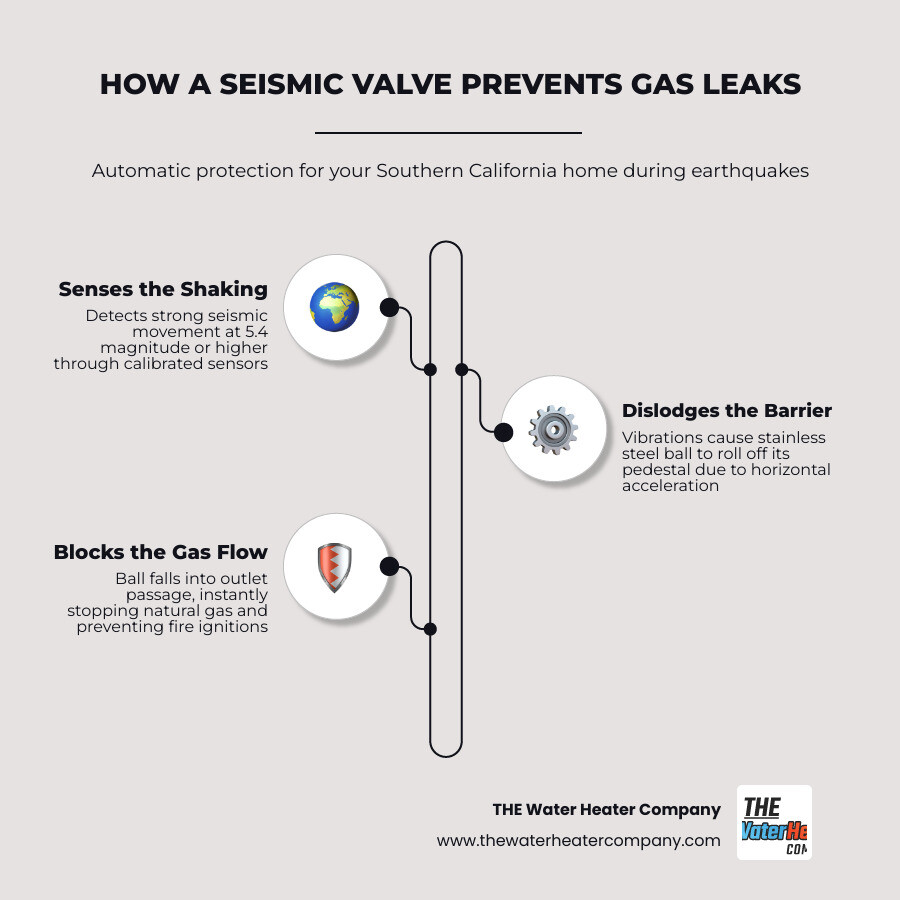
Here is the quick answer to how these safety devices automatically protect your home:
- Senses the Shaking: The valve detects strong seismic ground movement, typically triggering at a magnitude of 5.4 or higher.
- Dislodges the Barrier: The physical vibrations cause a precisely calibrated internal stainless steel ball to roll off its pedestal.
- Blocks the Gas Flow: The ball falls directly into the valve’s outlet passage, instantly blocking natural gas from entering your home.
- Prevents Fire Ignitions: By stopping the gas flow immediately at the meter, gas cannot escape into your home even if your indoor pipes or water heater connections break.
These automatic safety valves act as a vital, mechanical firewall that operates without human intervention or electrical power.
I’m Anthony Hamilton, Co-Founder and CEO of THE Water Heater Company, and I’ve spent my career helping Southern California families secure their homes against natural disasters. My hands-on plumbing experience has given me a deep, practical understanding of how a seismic valve prevents gas leaks after a quake to protect properties when shaking begins.
How a seismic valve prevents gas leaks after a quake definitions:
- earthquake preparedness tips for california homeowners
- how to secure your water heater for earthquakes
Understanding the Threat: Why Gas Safety Matters in Southern California
Living in Southern California—whether your home is in Pasadena, Santa Monica, Irvine, or Santa Barbara—means sharing the landscape with major fault lines, including the infamous San Andreas Fault. While we often prepare for earthquakes by anchoring bookshelves and storing extra water, the invisible threat lurking inside our walls is far more dangerous: our natural gas lines.
During a seismic event, the earth does not just shake; it rolls, shifts, and shears. This violent movement places immense physical stress on rigid utility pipes. According to historical data from the Earthquake Country Alliance, about one in four fires following a major earthquake is directly related to natural gas leaks. In more severe scenarios, gas leaks account for up to 50% of post-earthquake fires.
To understand the real-world impact, we only have to look back at the devastating 6.7 magnitude Northridge earthquake in 1994. In the aftermath of that single event, 185 mobile homes burned to the ground due to gas-fueled fires. When structural foundations shift, rigid pipe connections break, releasing highly flammable natural gas into confined spaces. A single spark from damaged electrical wiring or a water heater pilot light can then trigger an explosion.
By reviewing our Earthquake Preparedness Tips for California Homeowners Survival Guide, you can learn how to secure your property. However, manual shut-off valves are only useful if you are home, unharmed, and have a wrench nearby. An automatic seismic valve acts as your home’s 24/7 silent guardian. For a deeper dive into these protective benefits, read The Definitive Guide to Earthquake Valve Benefits.
How a Seismic Valve Prevents Gas Leaks After a Quake
An earthquake-actuated automatic gas shut-off valve is a highly specialized mechanical safety device. Installed directly onto your home’s exterior gas line, its sole purpose is to stop the flow of natural gas into your living space the moment a major tremor occurs.
Because it operates entirely on mechanical principles, it requires no electricity, batteries, or smart-home connections to function. If the power grid goes down—as it almost always does during a major quake—your seismic valve remains fully operational. By cutting off the gas supply at the source, it prevents fuel from escaping into your home, reducing the risk of fire and structural explosions.
The Science Behind How a Seismic Valve Prevents Gas Leaks After a Quake
The engineering behind how a seismic valve prevents gas leaks after a quake is incredibly elegant. Inside the valve housing, a precisely engineered trigger mechanism monitors ground acceleration.
In a standard mechanical seismic valve (such as the industry-standard KOSO or Northridge designs), a stainless steel ball rests securely on a small central pedestal or is suspended by a calibrated magnet.
[ Normal State ] [ Seismic Trigger (5.4+ Mag) ]
   +---------+ +---------+
   |  (Ball) | <-- Resting on | |
   |   [P]   | Pedestal |   [P]   |  (Ball) <-- Rolls off
   +----|----+ +----|----+ |
 | | v
========v======== =============v=============
  Gas Flow: OPEN Gas Flow: BLOCKED (Sealed)
================= ===========================
Here is exactly what happens when an earthquake strikes:
- Sinusoidal Oscillations: The valve is designed to respond specifically to horizontal, sinusoidal oscillations (the side-to-side shaking typical of destructive S-waves).
- Horizontal Acceleration: When the horizontal acceleration of the ground reaches approximately 0.11g (equivalent to an earthquake of roughly 5.4 magnitude on the Richter scale), the physical forces displace the ball.
- The Drop: The stainless steel ball rolls off its pedestal or breaks away from its magnetic latch.
- Positive Seal: Gravity pulls the ball down directly into the gas outlet passage. The pressure of the incoming natural gas pushes against the ball, forcing it into a soft-seat disc to create an airtight seal.
This 5.4 magnitude threshold is not arbitrary. According to engineering standard ASME 25-97, underground and structural piping systems are highly susceptible to breaking at seismic ratings of 5.4 and above. By triggering at this exact threshold, the valve shuts down the gas supply before the shaking can tear apart your home’s internal plumbing.
Seismic Valves vs. Excess Flow Valves (EFVs)
Many homeowners ask us about the difference between a seismic gas shut-off valve and an excess flow valve (EFV). While both are designed to prevent gas leaks, they operate on completely different principles.
- Seismic Shut-Off Valves respond purely to ground motion. Even if your pipes are completely intact after a 5.5 quake, the valve will shut off the gas as a preventative measure.
- Excess Flow Valves respond to gas velocity. They only trigger if there is a massive, sudden increase in gas flow—such as a complete line rupture caused by a backhoe digging up a yard or a water heater ripping off the wall. They do not protect against slow, creeping leaks or minor pipe punctures.
Here is a side-by-side comparison to help you understand how they differ:
| Feature | Seismic Shut-Off Valve (SGSV) | Excess Flow Valve (EFV) |
|---|---|---|
| Primary Trigger | Ground shaking (typically 5.4+ magnitude / 0.11g acceleration) | Extreme gas flow velocity (ruptured line) |
| Protects Against | Structural movement, appliance displacement, slow & fast leaks | Major pipe ruptures, severed service lines |
| Installation Location | On the customer's house line (downstream of the meter) | On the utility's service line (underground, near the street) |
| Power Source | Fully mechanical (gravity/latch system) | Fully mechanical (pressure differential) |
| Reset Procedure | Manual reset by homeowner or professional | Often resets automatically once pressure equalizes |
| Responsibility | Purchased and maintained by the homeowner | Installed and maintained by the utility company |
Step-by-Step: How to Prepare Your Home and Install a Seismic Valve
Because natural gas is highly volatile, installing a seismic valve requires strict adherence to safety protocols and local building codes. This is not a weekend DIY project. In Southern California, gas safety installations must comply with local municipal guidelines across Los Angeles, Pasadena, Santa Ana, Irvine, and surrounding areas.
Proper Placement and Installation Requirements
To ensure your seismic valve functions correctly when you need it most, proper placement is key:
- Downstream of the Meter: The valve must be installed on your property's "house line"—the pipe that carries gas from the meter into your home.
- No Utility Interference: California Public Utilities Commission (CPUC) regulations strictly prohibit installing any private safety valves on the utility company’s equipment. This means the valve cannot be attached directly to the meter itself or any pipes on the upstream side.
- Rigid Mounting: The valve body must be securely braced to your home’s exterior wall or foundation using a heavy-duty stabilizer bracket. If the valve is allowed to wobble or shake independently of the house, passing trucks or minor bumps could cause a false activation.
- Perfect Leveling: Many high-quality seismic valves require precise vertical and horizontal alignment during installation. If the valve is tilted even slightly, the internal ball may sit off-center, making it too sensitive or preventing it from dropping during an actual earthquake.
For a comprehensive breakdown of the tools, sizing, and technical steps required for this process, check out our guide on How to Master Earthquake Valve Installation.
Securing Your Water Heater and Gas Appliances
A seismic valve is your primary line of defense, but it works best alongside other safety measures. Your gas water heater is one of the most vulnerable appliances in your home. Containing dozens of gallons of heavy water, an unanchored water heater can easily tip over during a quake, snapping its rigid gas and water lines.
To prevent this, we recommend taking these three essential steps:
- Install Double Earthquake Straps: Secure your water heater tank to the wall studs using approved metal strapping kits. You need one strap on the upper third of the tank and one on the lower third.
- Use Flexible Gas Connectors: Replace any rigid yellow or black iron pipes leading directly into your appliances with certified, flexible stainless steel gas connectors. These allow your appliances to shift slightly during a quake without breaking the seal.
- Anchor Other Major Gas Appliances: Ensure your furnace, stove, and clothes dryer are properly anchored to prevent them from sliding and pulling their gas lines out of the wall.
To make sure your water heater is fully protected, follow our step-by-step guide: Secure Your Water Heater for Earthquakes in 4 Easy Steps.
What to Do After the Shaking Stops: Safely Resetting Your Gas Valve
When a major earthquake strikes, your seismic valve will do its job and cut off the gas supply. Once the shaking stops and you have verified that your family is safe, you will eventually need to restore your gas service. However, rushing to reset your valve without performing proper safety checks can be incredibly dangerous.
Step-by-Step Reset Procedure
If you are confident there are no gas leaks on your property, you can manually reset your valve. Most residential seismic valves (like the Little Firefighter AGV series or the Northridge valve) feature a simple mechanical reset mechanism.
Here is the safe way to reset your valve:
- Smell and Listen: Walk through your home and around your gas meter. Do you smell rotten eggs (the mercaptan additive in natural gas)? Do you hear a hissing sound? If you suspect a leak, do not attempt to reset the valve. Evacuate immediately and call 911.
- Turn Off Appliances: Go inside and turn off all gas appliances, including your stove, oven, dryer, and water heater.
- Locate the Reset Mechanism: On the side of your seismic valve, you will find a reset screw or a rotating faceplate.
- Reset the Valve:
- For screw-type valves: Use a flathead screwdriver to slowly turn the reset screw clockwise (usually a quarter or half turn) until the indicator window changes from red (closed) to green (open).
- For magnet-type valves: Rotate the faceplate counterclockwise one full turn to allow the internal magnet to lift the stainless steel ball back onto its pedestal.
- Perform a Soap-Water Test: Mix a few drops of dish soap with water and spray it onto the valve connections. If you see growing bubbles, you have a leak.
- Relight Pilot Lights: Once gas flow is restored, you will need to safely relight the pilot lights on older water heaters or furnaces following the manufacturer’s instructions.
When to Call a Professional to Restore Your Gas Service
While resetting the valve is mechanically simple, verifying that your gas system is safe is highly complex. If your seismic valve closed during an earthquake, there is a strong possibility that a pipe inside your walls or underground was damaged.
If you reset the valve with a broken pipe inside your walls, you will fill your home with highly explosive gas. We strongly recommend contacting our team of licensed plumbers to perform a professional safety inspection before restoring your gas. We will run a gas line pressure test to verify that your system is completely airtight, relight your appliance pilots, and ensure your water heater is operating safely.
Frequently Asked Questions About How a Seismic Valve Prevents Gas Leaks After a Quake
What magnitude of earthquake triggers a seismic valve?
Seismic valves are calibrated to trigger during earthquakes registering approximately 5.1 to 5.4 on the Richter scale, or when horizontal ground acceleration reaches 0.11g to 0.15g. This specific acceleration threshold is the point at which structural damage and pipe ruptures typically begin to occur. To prevent false alarms from heavy street traffic, construction equipment, or minor bumps, quality valves are installed with rigid stabilizing brackets that isolate the device from non-seismic vibrations.
Are seismic gas shut-off valves required by California law?
Yes, depending on your city and whether you are building or remodeling. In the City of Los Angeles, municipal ordinances require approved seismic gas shut-off valves on all new construction, as well as commercial and residential buildings undergoing significant remodels (often defined as projects over a certain valuation). Many surrounding Southern California cities have adopted similar requirements. Additionally, some insurance companies require these valves before issuing or renewing homeowner policies in high-risk zones.
To learn more about the specific regulations in your neighborhood, read our detailed breakdown: The Law of the Land California Gas Valve Rules.
What maintenance does a seismic valve require to ensure it works?
Because they are purely mechanical and built with corrosion-resistant materials (like cast aluminum and stainless steel), seismic valves require very little maintenance. However, we recommend a quick annual visual inspection:
- Ensure the valve body is clean and free of heavy dirt, rust, or debris.
- Verify that the structural stabilizing bracket is tightly anchored to your home's exterior wall and has not vibrated loose.
- Check the indicator window to ensure it remains clear and readable.
- During your regular annual water heater maintenance check, have our professional technicians inspect the valve to ensure it remains perfectly level and operational.
Conclusion
When the ground starts shaking in Southern California, every second counts. Knowing how a seismic valve prevents gas leaks after a quake gives you peace of mind, knowing that your home is protected from gas-fueled fires even if you aren't there to turn off the valve yourself. This simple mechanical upgrade is one of the most reliable investments you can make to secure your property, your family, and your peace of mind.
At THE Water Heater Company, we are proud to serve families across Santa Barbara, Camarillo, Santa Clarita, Pasadena, Van Nuys, Los Angeles, Santa Ana, and Irvine. Our expert, family-owned team specializes in professional seismic shut-off valve installation, water heater strapping, and comprehensive gas line safety inspections.
Don't wait for the next big tremor to catch you unprepared. Schedule your professional seismic valve installation with the experts at THE Water Heater Company today and take control of your home's earthquake safety.

The Essential's
Call THE Water Heater Company today to get immediate help with your water needs.
"
-

"Fair Pricing & Expert Service"
Their technician Gonzo, was clearly very competent and more importantly, he took the time and effort to do a really fantastic job.
-
"Fantastic Service!"
THE Water Heater Company understood the situation I was going through. They were able to help me out and get the job done quickly.
-
"Reasonable Pricing"
Kevin did a great job on replacing my old leaky yet still working water heater. He answered all my questions and explained all the details. -
"Quick Response Time"
He was very informative and responsive to my questions and when I am making a huge investment in my home I want to be sure I am going with a company I could count on and would not cut corners. -
"Real Professionals"
Communication was great with the owner and they were very responsive, ensuring a first-class installation and experience.
-
"Great Service"
Not only did he do the service we needed, but checked the whole unit in addition to other waterline components. -
"Professional and Responsive"
They have repaired my water heater, installed a hot water recirculating pump, and now installed a new water heater. -
"Real Professionals"
It took a little over three hours but no management was necessary as the guys were very competent and clearly have been doing this for a long time.