What a Water Heater Leaking From the Bottom Actually Means
Water heater leaking from the bottom what it means is almost never good news — but the cause can range from a simple valve fix to full tank failure. Here’s a quick breakdown:
| Possible Cause | Severity | Typically Repairable? |
|---|---|---|
| Loose or faulty drain valve | Low to moderate | Yes |
| T&P relief valve discharge | Moderate | Yes (valve replacement) |
| Internal tank corrosion | High | No — replacement required |
| Condensation | None | Not a leak |
| Nearby pipe or fitting drip | Low to moderate | Yes |
The bottom line: if water is coming from the tank itself, you’re likely looking at a full replacement. If it’s coming from a valve or nearby component, a repair may be all you need.
Finding a puddle under your water heater is one of those moments that stops you in your tracks. According to industry data, roughly 14,000 U.S. homeowners face a water leak disaster every single day — and water heater failures are a major contributor. In Southern California homes, where hard water and aging infrastructure are common, bottom leaks are a frequent and urgent problem that deserves immediate attention.
I’m Anthony Hamilton, Co-Founder and CEO of THE Water Heater Company, and after years in the field diagnosing exactly this kind of issue — a water heater leaking from the bottom what it means for your tank, your home, and your family’s safety — I’ll walk you through everything you need to know. Let’s start with the most common causes and what they tell you about the health of your system.
Water heater leaking from the bottom what it means terms to know:
Water Heater Leaking from the Bottom: What It Means
When you spot water pooling at the base of your unit, it is crucial to understand the mechanics of what is happening inside the metal jacket. Your water heater is not just a simple metal bucket; it is a highly engineered, pressurized system designed to hold between 40 and 80 gallons of water under constant pressure (usually between 50 and 80 PSI).
A bottom leak is a clear signal that either an external component has failed or the internal structural integrity of the tank has been compromised. External component failures — such as a faulty valve or loose connection — are highly manageable and typically only require target repairs. However, when the leak originates from the inner tank itself, it usually points to irreversible internal corrosion. Understanding these differences can help you determine whether you are dealing with a minor maintenance task or an urgent system failure. Recognizing these early Signs You Need a Water Heater Repair can save you from catastrophic property damage.
Is a Water Heater Leaking from the Bottom What It Means for Your Tank’s Lifespan?
The average storage tank water heater has a typical service life of 8 to 12 years. If your unit is approaching or has exceeded this window, a bottom leak is often the final chapter of its operational lifespan.
Inside every tank water heater sits a crucial component known as the sacrificial anode rod. This rod is made of highly active metals like magnesium, aluminum, or zinc. Its sole job is to attract corrosive elements in the water, sacrificing itself to protect the steel tank lining from rust. Over a period of 3 to 5 years, this rod completely degrades. Once the anode rod is fully depleted, the corrosive minerals in the water turn their attention to the steel walls of your tank. This leads to electrochemical degradation, thin spots, and eventual pinhole leaks near the bottom seam.
If your water heater is older and starts weeping water from its base, it is a strong indicator that the tank has reached its natural end of life. To protect your home from sudden flooding, it is helpful to learn Don’t Get Left in the Cold: How to Spot a Dying Water Heater before a complete rupture occurs.
Understanding a Water Heater Leaking from the Bottom: What It Means for Safety
A leaking water heater is far more than a simple inconvenience; it is a serious safety hazard that should never be ignored. Leaving a bottom leak unaddressed can quickly lead to severe consequences:
- Water Damage & Structural Issues: A slow, undetected drip can warp floorboards, rot support beams, and ruin drywall in adjacent rooms.
- Mold and Mildew Growth: Damp, warm spaces around a leaking water heater are prime breeding grounds for toxic black mold, which can impact your indoor air quality and family’s health within 24 to 48 hours.
- Electrical and Gas Hazards: For electric water heaters, pooling water near the lower heating element or electrical access panels can cause short circuits or severe shock hazards. For gas units, water dripping onto the burner assembly can disrupt the pilot light or lead to gas line corrosion.
- Catastrophic Tank Burst: A compromised steel shell operating under high municipal water pressure can fail completely without warning, instantly releasing dozens of gallons of hot water into your home.
If you find yourself facing an active leak, knowing What to Do If Your Water Heater Is Leaking or You Have No Hot Water is your first line of defense to keep your home and family safe.
Common Causes of Bottom Leaks and How to Spot Them
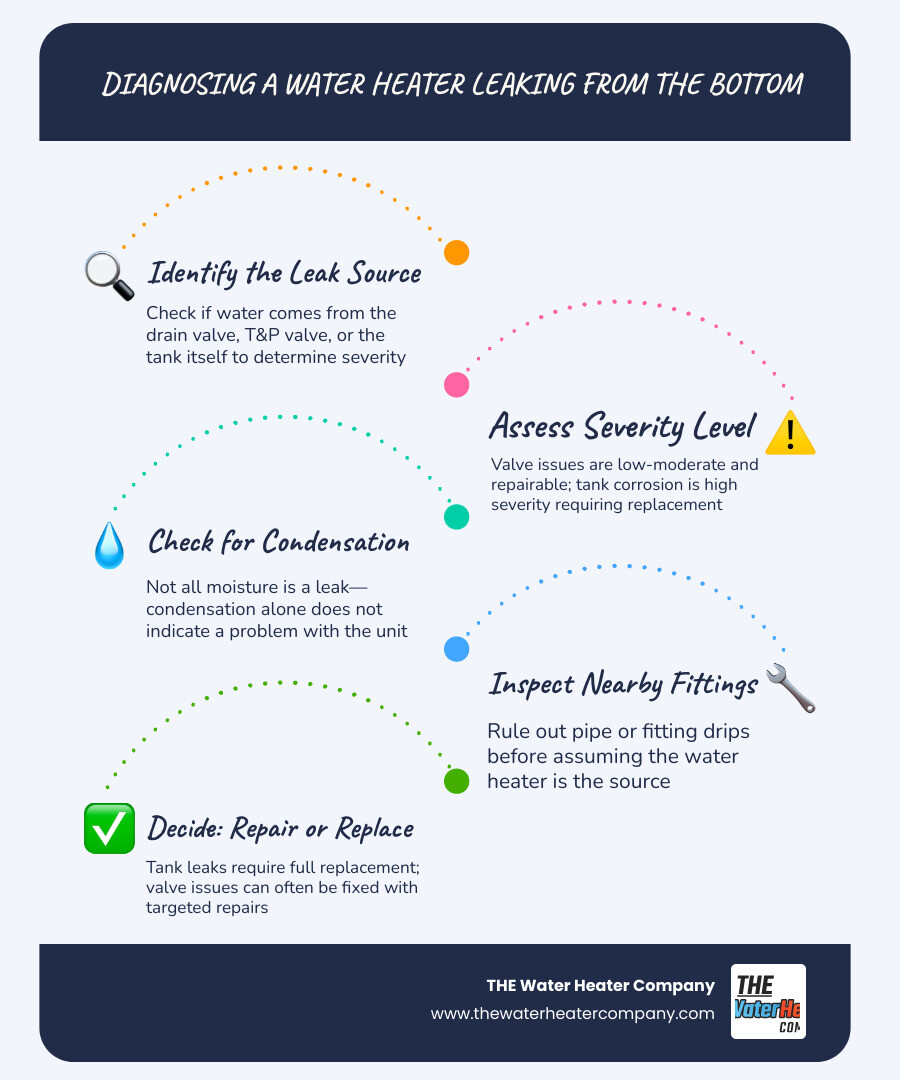
To accurately diagnose a bottom leak, we must systematically narrow down the source. Water naturally travels downward, meaning a leak that appears at the bottom of the unit could actually be dripping from a loose connection at the top of the tank and running down the side jacket.
Before assuming your tank has failed, dry the entire unit with a towel and observe the key points of connection.
Here is a quick reference table to help you distinguish between a simple drain valve issue and a terminal tank crack:
| Feature | Leaking Drain Valve | Cracked or Corroded Tank |
|---|---|---|
| Water Location | Dripping directly from the valve nozzle or threaded connection | Pooling under the jacket, seeping from bottom seams |
| Water Quality | Often clear, but may contain white mineral flakes | Frequently rusty, muddy, or discolored |
| Leak Pattern | Consistent dripping or slow, steady stream | Can start as an intermittent drip and rapidly worsen |
| Repair Option | Replace the valve with a durable brass model | Complete water heater replacement |
Faulty Temperature & Pressure (T&P) Relief Valve
The Temperature & Pressure (T&P) relief valve is a critical safety device installed on every storage water heater. It is designed to open and discharge water through a dedicated discharge tube if the internal temperature exceeds 210°F or if the pressure exceeds 150 PSI. This prevents the tank from over-pressurizing and potentially exploding.
The discharge tube of the T&P valve typically runs down the side of the water heater and terminates within 6 inches of the floor or drain pan. If you see water pooling around the bottom of this tube, it means the T&P valve is doing its job and releasing water. This can happen for two reasons:
- Thermal Expansion: In closed plumbing systems (common in many Southern California cities like Pasadena and Irvine), water expands as it heats up. With nowhere to go, this expansion causes dramatic pressure spikes that force the T&P valve to open.
- Faulty Valve: Over time, the internal spring of the T&P valve can weaken, or mineral scale can build up on the seal, preventing it from closing fully.
If the T&P valve is leaking even when water pressure and temperatures are within safe parameters, the valve itself must be professionally replaced.
Leaking Drain Valve
The drain valve is located near the very bottom of your water heater tank and is used to flush sediment during routine maintenance. Many standard residential water heaters come equipped with cheap, plastic drain valves from the factory.
Over time, these plastic valves can degrade, warp, or crack due to constant heat exposure. Additionally, when sediment settles at the bottom of the tank, mineral debris can get trapped inside the valve seat when it is opened and closed, preventing it from sealing completely.
If you notice water dripping directly from the threaded opening of the drain valve or around its base where it threads into the tank, try gently tightening the handle. If it continues to drip, the plastic valve should be replaced with a high-quality, full-port brass drain valve.
Internal Tank Corrosion and Seam Leaks
The most serious cause of a bottom leak is a breach in the inner steel tank. Modern storage water heaters are constructed with a heavy steel outer shell and a vitrified glass or ceramic lining on the inside to protect the steel from water contact.
However, over years of constant thermal expansion and contraction (heating and cooling cycles), this glass lining can develop microscopic cracks. Once water makes direct contact with the underlying steel, rust begins to form. This electrochemical degradation eventually eats through the steel shell, resulting in pinhole leaks.
When this happens, water will seep out from behind the outer metal jacket or drip from the bottom seam of the heater. Because the pressurized steel tank cannot be safely welded or patched, a tank seam leak is a terminal failure that requires a professional Water Heater Replacement.
Hard Water and Sediment Accumulation
Southern California is notorious for having highly mineralized municipal water. Cities like Santa Ana, Los Angeles, and Santa Clarita often have hard water packed with calcium and magnesium.
As water is heated inside your tank, these dissolved minerals precipitate out of the water and settle to the bottom as solid sediment. This layer of sediment acts as an insulating barrier between the gas burner (or electric element) and the water.
This causes several major problems:
- Thermal Stress: The bottom of the tank must get much hotter than designed just to heat the water through the thick layer of sediment, causing severe thermal stress and cracking the glass lining.
- Sediment Sizzling: You may hear popping, rumbling, or sizzling sounds as water trapped beneath the sediment layer boils and turns to steam.
- Accelerated Corrosion: The localized overheating accelerates the breakdown of the steel tank base, leading to early failure.
If your water heater is struggling under these conditions, prompt Water Heater Repair and a thorough tank flush can help mitigate the damage before a total leak occurs.
Should You Repair or Replace Your Leaking Water Heater?
When faced with a water heater leaking from the bottom, the big question is always: Can I fix this, or do I need a new one?
The answer depends entirely on the source of the leak and the age of your unit.
If the leak is traced to a faulty drain valve, a worn-out T&P valve, or a loose pipe connection at the top of the tank, these are highly repairable issues. A skilled plumber can quickly swap out these components, extending the life of your current system.
However, if the leak is coming from the internal tank shell itself, repair is simply not an option. A compromised pressurized vessel cannot be safely patched. Attempting to weld or seal a leaking tank is a safety hazard that can lead to a catastrophic rupture.
To help you make an informed decision, consider these guidelines:
- Under 6 Years Old: If the tank is still under warranty and experiencing a valve leak, repair is almost always the right path. If the tank itself has failed, it may be covered under the manufacturer’s replacement warranty.
- 6 to 10 Years Old: The decision depends heavily on the source of the leak and the overall condition of the unit. If there is heavy rust around the base, replacement is usually the most cost-effective long-term choice.
- Over 10 Years Old: At this stage, even if the leak is coming from a repairable component like a drain valve, investing in repairs is often a temporary fix. The tank is likely nearing the end of its reliable lifespan, and a proactive replacement is highly recommended.
For a deeper dive into making this decision, check out our guides on Should I Repair or Replace My Water Heater? and How to Know When to Repair or Replace Your Water Heater.
Frequently Asked Questions About Bottom Leaks
Is a water heater leaking from the bottom dangerous?
Yes, it can be. Beyond the immediate risk of severe water damage and structural rot, a bottom leak can create serious electrical hazards if water contacts the electrical components of an electric unit. For gas units, water can damage the control valve or burner. Additionally, a heavily corroded tank operating under high pressure carries a risk of a sudden, catastrophic burst, which can flood your home with hot water in seconds.
Can a bottom leak be repaired without replacing the whole unit?
It depends entirely on the source. If the leak is coming from the drain valve or the T&P relief valve discharge tube, yes — these components can be easily replaced. However, if the water is leaking from the internal tank shell or seeping out from the bottom metal seams, it cannot be repaired and the entire unit must be replaced.
How can I prevent my water heater from leaking from the bottom?
The best way to prevent bottom leaks is through regular maintenance:
- Annual Flushing: Flush your water heater tank at least once a year to remove mineral sediment buildup, especially in hard-water areas of Southern California.
- Anode Rod Replacement: Have a professional check and replace your sacrificial anode rod every 3 to 5 years to keep the inner steel tank protected from corrosion.
- Pressure Monitoring: Ensure your home’s water pressure does not exceed 80 PSI, and install a thermal expansion tank if you have a closed plumbing system.
Conclusion
A water heater leaking from the bottom what it means for your home is simple: it is an issue that requires prompt, expert attention. Whether it is a quick valve replacement or a complete system upgrade, ignoring a leak can turn a manageable issue into a major home disaster.
At THE Water Heater Company, we are dedicated to providing the highest level of service, transparency, and reliability. As a local, family-owned business, we serve communities across Southern California, including Santa Barbara, Camarillo, Santa Clarita, Pasadena, Van Nuys, Los Angeles, Santa Ana, and Irvine. We specialize in expert diagnostics, targeted repairs, and high-quality installations to keep your home comfortable and safe.
Don’t wait for a small drip to turn into a major flood. Schedule expert water heater repair services with our friendly, experienced team today!

The Essential’s
Call THE Water Heater Company today to get immediate help with your water needs.
“
-

“Fair Pricing & Expert Service”
Their technician Gonzo, was clearly very competent and more importantly, he took the time and effort to do a really fantastic job.
-
“Fantastic Service!”
THE Water Heater Company understood the situation I was going through. They were able to help me out and get the job done quickly.
-
“Reasonable Pricing”
Kevin did a great job on replacing my old leaky yet still working water heater. He answered all my questions and explained all the details. -
“Quick Response Time”
He was very informative and responsive to my questions and when I am making a huge investment in my home I want to be sure I am going with a company I could count on and would not cut corners. -
“Real Professionals”
Communication was great with the owner and they were very responsive, ensuring a first-class installation and experience.
-
“Great Service”
Not only did he do the service we needed, but checked the whole unit in addition to other waterline components. -
“Professional and Responsive”
They have repaired my water heater, installed a hot water recirculating pump, and now installed a new water heater. -
“Real Professionals”
It took a little over three hours but no management was necessary as the guys were very competent and clearly have been doing this for a long time.