Why Seismic Gas Shutoff Valve Importance Explained Matters for Every Southern California Homeowner
Understanding seismic gas shutoff valve importance explained could be one of the most valuable things you do as a Southern California homeowner. When an earthquake strikes, the shaking itself is only part of the danger. What happens in the minutes after — gas quietly leaking from ruptured lines into walls, crawlspaces, and attics — is where catastrophe can quietly build. According to the Earthquake Country Alliance, one in four fires following an earthquake is linked to natural gas leaks.
Here is a quick overview of why these valves matter:
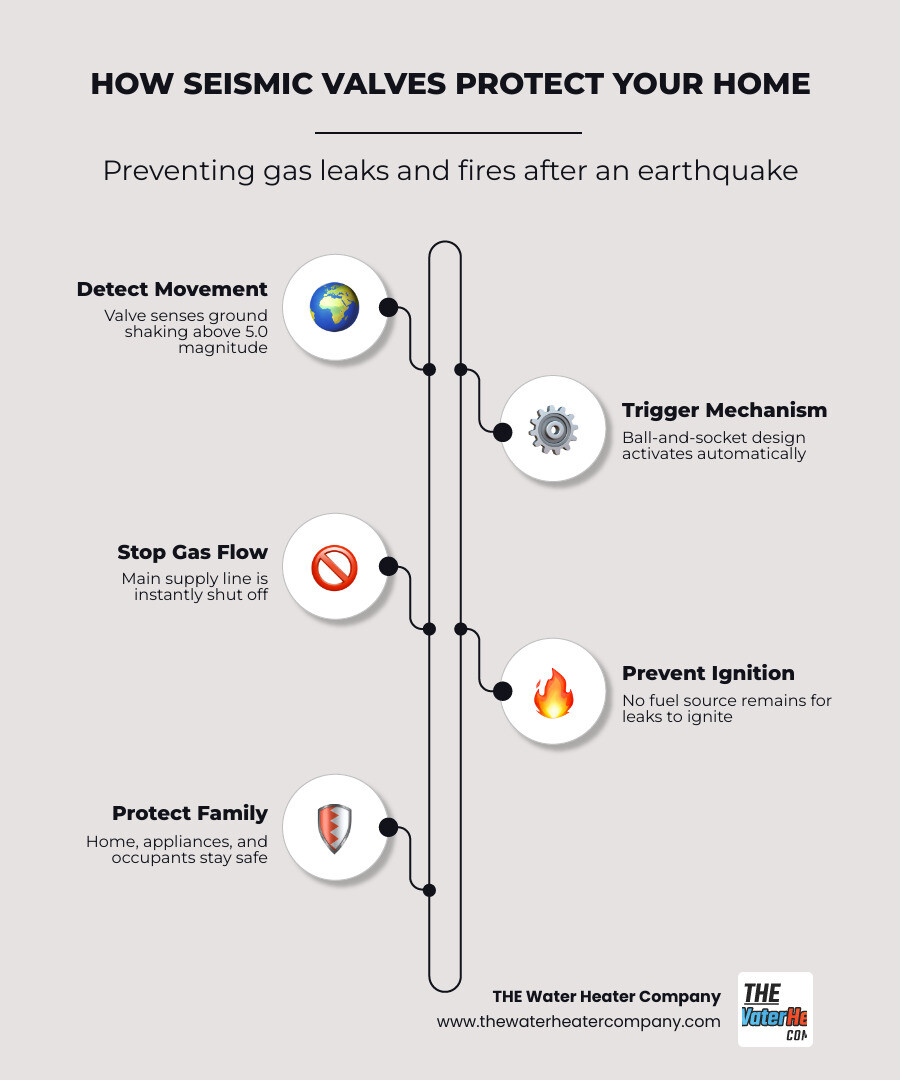
- Automatic protection: A seismic gas shutoff valve closes on its own the moment it detects significant ground movement, with no action required from you
- Fire and explosion prevention: By stopping gas flow immediately, the valve cuts off the fuel source before it can ignite
- Protects the whole home: Gas appliances, water heaters, furnaces, and stoves are all safeguarded when the main gas supply is interrupted
- Required in many areas: Cities like Los Angeles mandate these valves for new construction, major renovations, and property sales
- Peace of mind: Automated safety systems work even when you are asleep, away, or unable to respond
Most homeowners never think about their gas line until something goes wrong. But in earthquake country — from Pasadena to Irvine — the right safety equipment installed before a quake is what separates a close call from a tragedy.
I’m Anthony Hamilton, Co-Founder and CEO of THE Water Heater Company, and through years of working on gas-connected systems like water heaters across Southern California, I’ve seen why having seismic gas shutoff valve importance explained clearly to homeowners can make a life-saving difference. In this guide, we’ll walk you through everything you need to know — from how these valves work to what the law requires and what to do after the ground stops shaking.
Seismic gas shutoff valve importance explained terms explained:
- earthquake preparedness tips for california homeowners
- how to secure your water heater for earthquakes
Understanding Seismic Gas Shutoff Valves and Their Crucial Role in Home Safety

When we talk about home safety in Southern California, we often focus on structural retrofitting or emergency food supplies. While those are incredibly important, securing your utility lines is just as vital. A seismic gas shutoff valve is a specialized mechanical device installed on your main gas line that acts as a silent sentry, waiting to protect your home.
During an earthquake, underground shifts and violent building vibrations can easily twist, crack, or completely sever natural gas pipes. If a pipe ruptures inside your home, highly flammable natural gas will begin to fill the space. All it takes is a single tiny spark — from a cycling refrigerator, a light switch, or a damaged electrical wire — to ignite the gas, leading to devastating fires or explosions.
By having a seismic valve in place, you ensure that the gas supply is cut off at the source before it ever has a chance to pool inside your living spaces. To truly appreciate this technology, it helps to understand How a Seismic Valve Prevents Gas Leaks After a Quake by reacting instantly to tectonic forces.
The Mechanics Behind the Seismic Gas Shutoff Valve Importance Explained
So, how does this clever device actually know when to shut off? It doesn’t rely on electricity, batteries, or a Wi-Fi connection, which is fantastic news because power is often the first thing to go during a major earthquake. Instead, it relies entirely on the laws of physics.
Most residential seismic valves use a precision-engineered ball-and-socket design. Inside the valve, a metallic ball sits securely on a small socket or cradle. When a seismic wave of sufficient intensity hits the home, the ground movement dislodges the ball from its cradle. Gravity takes over, and the ball falls directly into the gas passage, instantly sealing the valve and stopping the flow of gas.
To prevent the valve from shutting off every time a heavy truck rumbles down your street or your kids slam the front door, these devices are designed to meet strict engineering standards, specifically the ASCE 25-16 standard. This industry standard ensures that the valve will only trigger during real, significant seismic activity—typically ground motion equivalent to a magnitude 5.4 or greater on the Richter scale. It is a highly reliable, mechanical slam-shut safety system that works when you need it most.
Understanding the Seismic Gas Shutoff Valve Importance Explained in High-Risk Zones
For families living in high-risk zones like Pasadena, Los Angeles, Santa Clarita, and Irvine, the threat of “The Big One” is a constant reality. In these densely populated regions, post-earthquake fires are historically responsible for a massive portion of property damage. When multiple fires break out simultaneously across a city due to ruptured gas lines, local fire departments can quickly become overwhelmed. Water mains may also fracture, leaving firefighters with limited resources to battle the blazes.
This is why having the seismic gas shutoff valve importance explained is so critical for local homeowners. Installing a valve turns your home into a self-protecting structure. Even if you are away from home, at work, or unable to access your main gas shutoff during a disaster, the valve acts on your behalf. To explore the full spectrum of these protective advantages, you can read The Definitive Guide to Earthquake Valve Benefits, which outlines how these devices safeguard both lives and property.
For a broader look at keeping your household secure, check out our Earthquake Preparedness Tips for California Homeowners Survival Guide to build a comprehensive safety plan.
Securing Your Water Heater and Gas Appliances
Your main gas line is only as safe as the appliances connected to it. During a major tremor, heavy appliances can shift, tip over, or slide, tearing away from their gas connections. Your water heater is one of the most vulnerable appliances in your home because it is tall, top-heavy when filled with gallons of water, and connected directly to both water and gas lines.
If a water heater topples, it will almost certainly rupture its gas line, creating an immediate fire hazard. This is why California law requires all water heaters to be properly strapped and anchored to the wall studs. Combining a seismic shutoff valve at your meter with properly secured appliances creates a double layer of defense.
To make sure your system is up to code and physically secure, follow our step-by-step instructions on how to Secure Your Water Heater for Earthquakes in 4 Easy Steps. Taking these physical mitigation steps alongside valve installation gives your home the best possible chance of surviving a major quake undamaged.
Seismic Gas Shutoff Valves vs. Excess Flow Valves (EFVs)
Many homeowners confuse seismic gas shutoff valves with another common safety device: the Excess Flow Valve (EFV). While both are designed to shut off gas in an emergency, they detect different problems, operate on completely different principles, and are installed in different locations.
To help clear up the confusion, we have put together this comparison table:
| Feature | Seismic Gas Shutoff Valve (SGV) | Excess Flow Valve (EFV) |
|---|---|---|
| Primary Trigger | Ground movement (typically $\ge$ 5.4 magnitude) | Sudden, massive increase in gas flow rate or pressure loss |
| Detection Method | Mechanical motion sensor (ball-and-socket) | Internal spring mechanism sensing flow velocity |
| Installation Location | Homeowner’s side of the meter (downstream) | Utility’s side of the meter (upstream on the service line) |
| Protects Against | All downstream leaks, regardless of size, caused by shaking | Major line ruptures (e.g., from construction digging or vehicle impacts) |
| Does it detect slow leaks? | No (only responds to ground movement) | No (only responds to sudden, high-volume flow) |
| Responsibility | Customer-owned and maintained | Utility-owned (though homeowners can request installation) |
| Reset Method | Manual reset by a qualified professional | Typically resets automatically once pressure is equalized |
While an EFV is excellent for preventing disaster if a contractor accidentally cuts through an underground line in your yard, it may not trigger during an earthquake if the gas leak inside your home is relatively small or distributed across multiple small pipe cracks. A seismic valve, on the other hand, will shut off the gas supply completely during a major quake even if your pipes haven’t broken yet, providing proactive protection.
Installation, Legal Requirements, and Post-Earthquake Procedures
Installing a seismic gas shutoff valve is not just a smart safety move; in many parts of Southern California, it is a legal obligation. Local municipalities have established strict rules to ensure that homes are retrofitted with these life-saving devices.
In Los Angeles, for example, municipal ordinances mandate the installation of approved seismic shutoff valves under specific conditions, such as:
- New construction projects.
- Commercial or residential additions, alterations, or repairs valued above a certain threshold.
- At the time of a property sale or transfer of ownership.
If you are buying or selling a home in Los Angeles, Pasadena, or Santa Ana, staying compliant with these rules is essential to avoiding delays in escrow. To understand the exact regulations that apply to your property, take a look at our breakdown of The Law of the Land California Gas Valve Rules.
Professional Installation Requirements and Proper Placement
Can you install a seismic valve yourself? The short answer is no. Working with natural gas lines is incredibly dangerous and requires specialized knowledge, tools, and licensing.
Furthermore, California regulations require that seismic shutoff valves be installed on the customer-owned “house line” (downstream of the utility meter), rather than on the utility company’s equipment. Installing a valve in the wrong location or failing to support it with proper bracing can lead to “nuisance trips” (where the valve shuts off during minor, non-hazardous vibrations) or, worse, prevent the valve from operating during a real earthquake.
To ensure your valve is installed safely, legally, and in compliance with local plumbing codes, the job must be handled by a licensed plumbing professional. We recommend reviewing our guide on How to Master Earthquake Valve Installation to see how our expert technicians ensure perfect placement, secure mounting, and code compliance.
Post-Earthquake Procedures: Resetting Your Valve and Handling Gas Leaks
Once the shaking stops, your seismic valve will have done its job and cut off the gas supply. When you realize your gas appliances aren’t working, your first instinct might be to immediately reset the valve. However, safety must always come first.
Before attempting to restore gas to your home, follow these vital steps:
- Perform a visual and sensory check: Walk around your property. Do you smell gas (a distinct sulfur or “rotten egg” odor)? Do you hear a hissing sound? If you suspect a leak, do not try to reset the valve. Evacuate the area immediately and contact your gas utility provider or emergency services.
- Check the valve indicator: Most approved seismic valves feature an indicator window. If the indicator is red, the valve has been triggered and the gas is shut off. If it is green or silver, the valve is still open.
- Get a professional inspection: We strongly recommend having a licensed plumber perform a professional leak and pressure test on your gas lines before restoring service. An earthquake could have damaged pipes behind your walls that you cannot see.
- Resetting the valve: If your home is cleared of leaks, the valve can be manually reset. This is typically done by using a specialized tool or screwdriver to turn the reset screw on the side of the valve body until the indicator changes back to open.
- Relight pilot lights: Once the gas flow is restored, all appliance pilot lights (such as those on older water heaters or furnaces) must be safely relit. If you are uncomfortable doing this, our team is always here to help.
Frequently Asked Questions About the Seismic Gas Shutoff Valve Importance Explained
Can I install a seismic gas shutoff valve myself?
No, you should never attempt a DIY installation of a seismic gas shutoff valve. Working on gas lines requires a permit from your local Department of Building and Safety, and the work must be performed by a licensed plumbing contractor (such as a C-36 licensed plumber). Improper installation can cause dangerous gas leaks, violate building codes, and prevent the safety device from working when you need it most.
What should I do if I suspect a gas leak after an earthquake?
If you smell gas, hear a hissing sound near a gas line, or suspect a leak after an earthquake:
- Immediately evacuate everyone from the home.
- Do not flip any light switches, light matches, or use any electrical devices (including your cell phone) inside the house, as these can create a spark.
- Once you are a safe distance away, call 911 and your gas utility company.
- If it is safe to do so, you can use a 12-to-15-inch adjustable wrench to manually turn off the main gas valve at your meter by turning the valve tang perpendicular to the pipe.
Do insurance companies offer discounts for installing these valves?
Yes! Many insurance providers offer discounts on the earthquake portion of your homeowner’s insurance policy if you have a certified, professionally installed seismic gas shutoff valve. Because these valves significantly reduce the risk of fire following an earthquake, insurers view your home as a much lower risk. Be sure to ask your insurance agent about available safety discounts after your installation is complete.
Conclusion
When it comes to living in Southern California, earthquake safety isn’t something to leave to chance. Securing your home with a professionally installed seismic gas shutoff valve is one of the most effective, proactive steps you can take to protect your family and your property from the devastating secondary effects of a major quake.
At THE Water Heater Company, we are proud to be your local, family-owned plumbing and water heating experts. Serving Santa Barbara, Camarillo, Santa Clarita, Pasadena, Van Nuys, Los Angeles, Santa Ana, and Irvine, our experienced technicians are dedicated to keeping your home safe, compliant, and comfortable. Whether you need a seismic valve installed, your water heater secured, or a post-earthquake safety inspection, we are here to provide fast, reliable, and professional service.
Don’t wait for the next tremor to think about your gas line safety. Contact us today to learn more about our professional Earthquake Valves installation services and give your household the ultimate peace of mind.

The Essential’s
Call THE Water Heater Company today to get immediate help with your water needs.
“
-

“Fair Pricing & Expert Service”
Their technician Gonzo, was clearly very competent and more importantly, he took the time and effort to do a really fantastic job.
-
“Fantastic Service!”
THE Water Heater Company understood the situation I was going through. They were able to help me out and get the job done quickly.
-
“Reasonable Pricing”
Kevin did a great job on replacing my old leaky yet still working water heater. He answered all my questions and explained all the details. -
“Quick Response Time”
He was very informative and responsive to my questions and when I am making a huge investment in my home I want to be sure I am going with a company I could count on and would not cut corners. -
“Real Professionals”
Communication was great with the owner and they were very responsive, ensuring a first-class installation and experience.
-
“Great Service”
Not only did he do the service we needed, but checked the whole unit in addition to other waterline components. -
“Professional and Responsive”
They have repaired my water heater, installed a hot water recirculating pump, and now installed a new water heater. -
“Real Professionals”
It took a little over three hours but no management was necessary as the guys were very competent and clearly have been doing this for a long time.