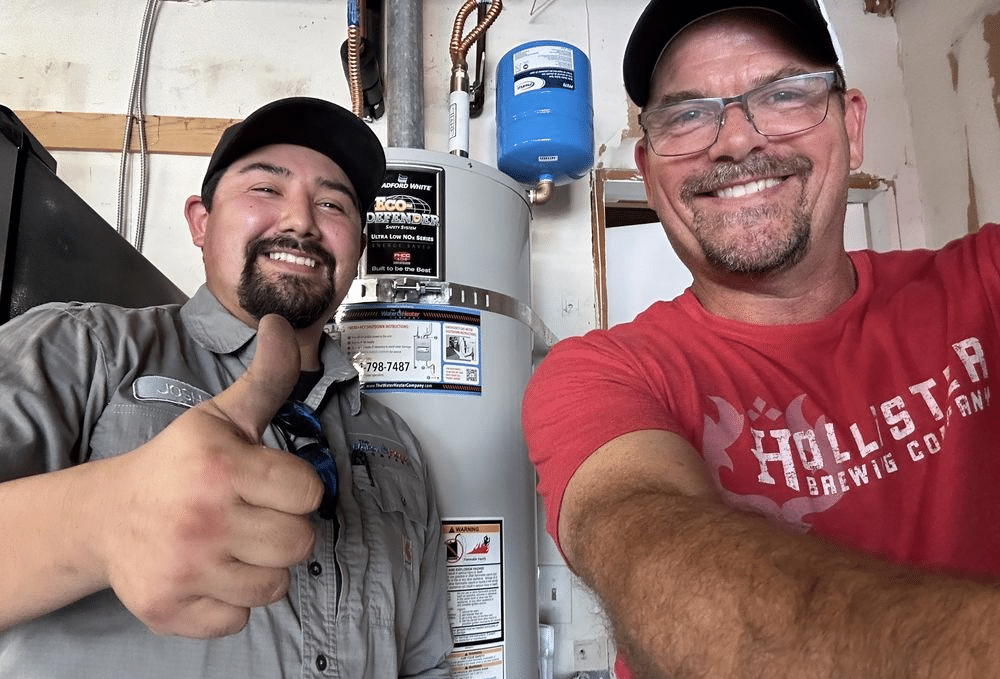
DIY vs Professional Water Heater Flushing: Which Is Right for You?
When it comes to diy vs professional water heater flushing, the right choice depends on your comfort level with basic plumbing tasks, your water heater type, and the water hardness in your area — particularly in Southern California, where hard water is a real challenge.
Here’s a quick comparison to help you decide:
| Factor | DIY Flushing | Professional Flushing |
|---|---|---|
| Cost | Lower upfront | Higher upfront, more thorough |
| Time | 1–3 hours | 30–75 minutes |
| Tools needed | Garden hose, bucket, gloves | Commercial-grade equipment |
| Sediment removal | Good for loose sediment | Removes heavy scale buildup |
| Warranty protection | May be at risk | Typically maintained |
| Inspection included | No | Yes — valves, anode rod, pressure |
| Best for | Healthy units with mild buildup | Hard water areas, older units, tankless systems |
Bottom line: DIY flushing works well for most homeowners with straightforward tank water heaters and mild sediment buildup. But if you’re in a hard water area, have a tankless system, or haven’t flushed in years, a professional service is the safer, more thorough choice.
Most water heaters should be flushed at least once a year. Skipping this routine maintenance allows sediment — calcium, magnesium, sand, and mineral deposits from incoming water — to settle at the bottom of your tank. Over time, that buildup acts like insulation between your heating element and the water, forcing the system to work harder, use more energy, and wear out faster. In Southern California, where water hardness levels can reach 250–400 ppm in some areas, this process happens faster than most homeowners realize.
The good news? Whether you decide to handle it yourself or call in a professional, flushing your water heater is one of the single most effective things you can do to protect your system and your household’s hot water supply.
I’m Anthony Hamilton, Co-Founder and CEO of THE Water Heater Company, and I’ve spent years in the field helping Southern California homeowners navigate exactly this kind of diy vs professional water heater flushing decision. In this guide, I’ll walk you through everything you need to know — honestly and without the pressure — so you can make the choice that’s right for your home.
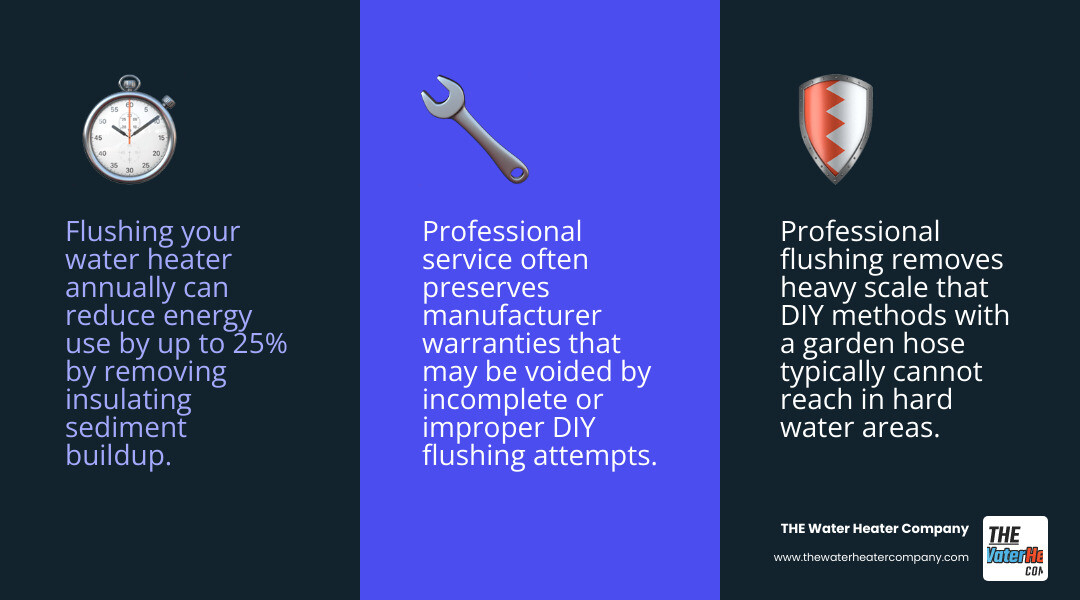
Why Regular Water Heater Flushing is Essential
To understand why flushing is so critical, we have to look at what is happening inside your water heater right now. Every time water enters your tank, it carries microscopic minerals, primarily calcium and magnesium. When this water is heated, these minerals crystallize and settle out of the liquid, sinking to the bottom of the tank.
This accumulation of mineral “gunk” creates a thick, stony barrier right over the burner (in gas models) or around the lower heating elements (in electric models). This sediment layer acts as an extremely effective thermal insulator. Instead of directly heating the water, your system’s burner must first cook through inches of solid mineral crust.
According to energy efficiency data, even a tiny 1.5 mm layer of scale inside a water heater can reduce its heat transfer efficiency by up to 12%. This means your system runs longer, consumes substantially more energy, and drives up your monthly utility bills.
Furthermore, this insulating layer causes the bottom of the tank to overheat, which degrades the protective glass lining of the tank and leads to premature metal fatigue. Over time, this results in tank cracks and catastrophic leaks. To dive deeper into the mechanics of how this buildup affects your system, check out The Importance of Flushing Your Water Heater and How Often You Should Do It.
How Often to Flush Your Water Heater
Under normal operating conditions, manufacturers and plumbing experts agree that a standard tank water heater should be flushed at least once every 12 months. However, this is not a one-size-fits-all rule. If you live in a region with highly mineralized water, you may need to flush your system every six months to prevent the sediment from hardening into a solid crust.
Conversely, if you have a high-quality, whole-house water softening system installed, you can often extend this maintenance window. For a detailed breakdown of how to structure your maintenance schedule based on your specific household setup, refer to The Homeowner’s Guide to Water Heater Flushing Frequency.
The Impact of Hard Water on Your System
Water hardness is the ultimate wild card in the lifespan of your water heating system. In Southern California — including communities like Santa Barbara, Camarillo, Santa Clarita, Pasadena, Van Nuys, Los Angeles, Santa Ana, and Irvine — municipal water is notoriously hard.
When calcium and magnesium are constantly baked onto the internal components of your water heater, they do not just sit quietly at the bottom of the tank. In tankless water heaters, these minerals form a tight, constrictive scale inside the narrow passages of the copper heat exchanger. This restricts water flow, reduces water pressure, and can cause the system to overheat and shut down entirely, throwing error codes.
For traditional tank systems, hard water minerals accelerate the consumption of your anode rod and can lead to a distinct “rumbling” or “popping” noise. This sound is actually steam bubbles pocketing and collapsing beneath the heavy sediment layer at the bottom of the tank. To learn how to combat these mineral-heavy conditions, you can read about How to Prevent Sediment Buildup in Your Water Heater for Better Performance.
DIY vs Professional Water Heater Flushing: Key Differences
Deciding between diy vs professional water heater flushing comes down to understanding what each path actually entails.
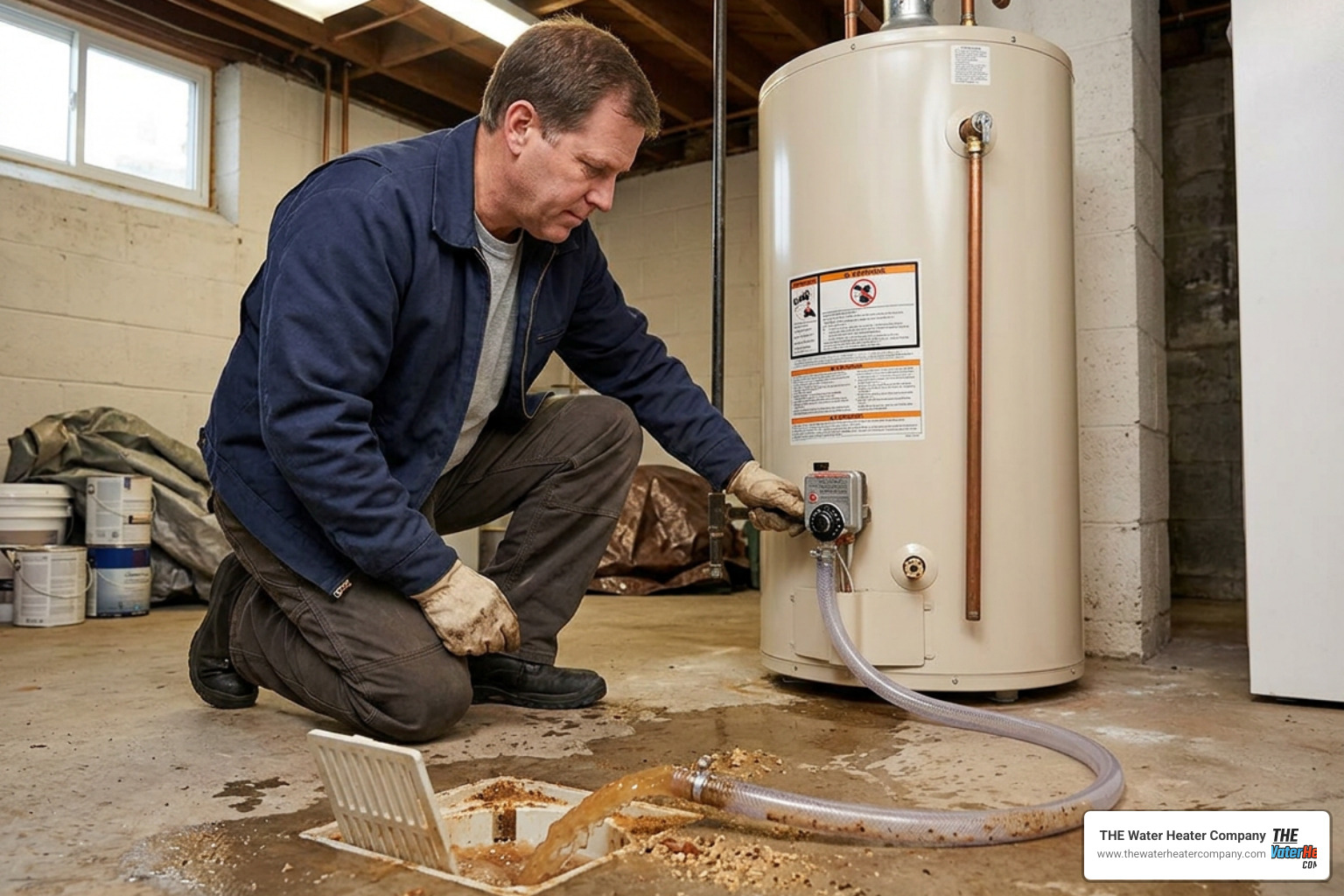
For a DIY flush, a homeowner typically connects a standard garden hose to the drain valve, runs it to a nearby floor drain or driveway, and allows gravity to empty the tank. While this is effective at removing loose, sandy sediment, it often leaves behind the heavier, hardened mineral chunks that have bonded to the bottom of the tank or the electric elements.
A professional water heater flush is a far more comprehensive process. When our technicians service a water heater, we do not just drain the water. We use specialized, high-flow flushing techniques and commercial-grade descaling solutions to break down and dissolve the stubborn, baked-on scale.
Furthermore, a professional service includes a multi-point safety and performance inspection. We test the Temperature and Pressure (T&P) relief valve, check the health of the sacrificial anode rod, inspect the gas connections or electrical wiring, verify proper venting, and ensure the system meets local Southern California seismic strapping codes.
The Risks of DIY vs Professional Water Heater Flushing
While draining a tank seems simple on paper, DIY flushing carries several distinct risks:
- Incomplete Descaling: Simply draining the water does not dissolve hardened scale. For tankless systems, attempting a DIY flush without a proper circulation pump and high-grade descaler will leave the heat exchanger clogged.
- Component Damage: Traditional water heaters often come equipped with cheap, plastic drain valves. These plastic valves become extremely brittle over time. When a homeowner attempts to open a stuck plastic valve, it can easily snap off, causing hot water to flood the room.
- Electric Element Burnout: If you turn the power back on to an electric water heater before the tank is completely full of water, the upper heating element will burn out in a matter of seconds—a mistake known as “dry firing.”
- Warranty Complications: Many major water heater manufacturers require documented proof of professional annual maintenance to honor warranty claims. If a system fails due to scale buildup and you cannot produce professional service receipts, your warranty may be voided.
To understand how these risks play out specifically for tankless units, read our comparison on DIY Descaling vs Hiring a Plumber for Your Tankless Unit.
Making the Choice: DIY vs Professional Water Heater Flushing
If you are a handy homeowner with a standard gas tank water heater, a high-quality brass drain valve, and a safe place to drain hot water, handling the annual flush yourself is a viable option. It allows you to stay on top of basic maintenance on your own schedule.
However, if you have a tankless system, do not own a utility pump and descaling hoses, or simply want the peace of mind that comes with a professional safety inspection, hiring an expert is the smarter choice. Our professional technicians complete the entire process quickly, clean up any mess, inspect all safety devices, and provide you with official documentation to keep your manufacturer’s warranty fully intact. For a broader look at what comprehensive care looks like, take a look at Water Heater Maintenance 101.
Step-by-Step Guide to DIY Water Heater Flushing
If you have weighed the pros and cons of diy vs professional water heater flushing and decided to tackle a standard tank flush yourself, we want to make sure you do it safely and effectively. Here is our step-by-step checklist for a standard gas or electric tank water heater.
Essential Tools and Safety Steps
Before you begin, gather the following tools:
- A standard garden hose (heavy-duty, hot-water-rated is highly recommended)
- A flathead screwdriver
- Protective work gloves and safety goggles
- A large bucket (to check water clarity)
- Old towels (to clean up any minor spills)
Step 1: Shut Down the Power and Heat Source
Safety is paramount. For an electric water heater, turn off the dedicated circuit breaker at your main electrical panel. For a gas water heater, turn the gas control valve on the front of the unit to the “Pilot” or “Off” position. Never attempt to drain a water heater while it is actively heating water.
Step 2: Shut Off the Cold Water Supply
Locate the cold water inlet valve at the top of your water heater and turn it completely clockwise to shut off the incoming water.
Step 3: Connect the Hose and Route It Safely
Attach your garden hose to the drain valve located at the bottom of the water heater tank. Run the other end of the hose to a safe drainage location, such as a driveway, a yard drain, or a large utility sink. Ensure the drainage spot can safely handle very hot water without damaging landscaping or cracking cold concrete.
Step 4: Open a Hot Water Faucet
Go inside your home and turn on a hot water faucet in a nearby bathtub or sink. This breaks the vacuum seal inside the plumbing system, allowing air into the lines so the water heater tank can drain smoothly.
Step 5: Open the Drain Valve
Slowly open the drain valve on the water heater using your flathead screwdriver (or by hand if it has a handle). Let the water drain completely. This process typically takes 20 to 40 minutes, though heavy sediment accumulation can restrict the flow and make it take much longer.
Step 6: Perform a Mini-Flush to Remove Loose Sediment
Once the tank is empty, turn the cold water supply valve back on for 30-second bursts. This sends rushes of cold water into the bottom of the tank, stirring up any loose, remaining sediment and forcing it out through the drain hose. Repeat this until the water running out of the hose is completely clear.
Step 7: Close Up and Refill the Tank
Close the drain valve tightly and disconnect your garden hose. Turn the cold water supply valve back on to begin refilling the tank. Keep the hot water faucet inside your home open; it will sputter and hiss as air is purged from the lines. Once a steady, uninterrupted stream of water flows from the faucet, the tank is full, and you can turn the faucet off.
Step 8: Restore Power or Gas
Only after the tank is completely full of water should you turn the circuit breaker back on or relight your gas pilot light.
Note: If you are descaling a tankless system, the process is entirely different and requires a closed-loop pump system to circulate descaling solutions through the heat exchanger. To learn why this specialized process is so critical, read Why Descaling is the Secret to a Long Tankless Life.
Additional Maintenance Tasks to Perform
While your water heater is draining, you should take the opportunity to address a few other critical maintenance tasks. First, test your Temperature and Pressure (T&P) relief valve by gently lifting its lever. Water should discharge into the drain line; when you release the lever, it should snap shut and stop the flow completely. If it continues to drip, the valve is faulty and must be replaced immediately.
Second, check your thermostat settings. We recommend keeping your thermostat set to 120°F. This is hot enough to prevent the growth of harmful bacteria like Legionella, but cool enough to prevent accidental scalding and slow down the rate of mineral scale formation. If you notice any issues during these checks, it could be a sign of a larger problem. Read more about identifying these issues in Signs You Need a Water Heater Repair.
When to Skip DIY and Call a Professional Plumber
While basic flushing is a great project for hands-on homeowners, there are several scenarios where attempting a DIY flush can lead to expensive property damage or safety hazards.
If your water heater has not been flushed in several years, heavy sediment can solidify into a thick, concrete-like block at the bottom of the tank. If you attempt to open the drain valve in this state, the sediment can completely clog the valve, leaving it permanently stuck in a semi-open, leaking position.
Additionally, replacing a depleted sacrificial anode rod — which protects your tank from rusting out — often requires a high-torque impact wrench because these rods fuse to the tank threads over time. Attempting to force a stuck anode rod with hand tools can easily twist and damage the tank’s internal glass lining, ruining the unit.
If you are dealing with gas lines, electrical connections, or heavy scale, it is always safest to call in a professional. To help you decide whether your system just needs a tune-up or a full upgrade, read How to Know When to Repair or Replace Your Water Heater.
Recognizing System Damage and Leaks
If you notice rusty water coming from your hot water taps, see pooling water around the base of the tank, or hear persistent, heavy thumping noises even after a flush, your system may already have internal structural damage. A professional plumber can perform a thorough diagnostic assessment to determine if a repair is possible or if it is time for a replacement. For guidance on this decision, refer to Should I Repair or Replace My Water Heater?.
Frequently Asked Questions about Water Heater Maintenance
Can I flush my water heater myself?
Yes, if you have a traditional tank water heater, a brass drain valve, a garden hose, and feel comfortable working around hot water and electricity or gas. However, if you have a tankless unit, lack the necessary closed-loop pumping equipment, or live in a hard water area with severe scale buildup, professional service is highly recommended to protect your system and maintain your warranty.
What happens if I don’t flush my water heater?
If you skip flushing, sediment will build up at the bottom of the tank or inside the tankless heat exchanger. This acts as an insulating barrier, forcing your water heater to work harder and consume more energy. Over time, this extra stress causes heating elements to burn out, restricts water pressure, leads to fluctuating water temperatures, and significantly shortens the lifespan of your appliance, often leading to a premature tank failure and water damage.
How do I know if my water heater needs repair instead of a flush?
If you are experiencing persistent issues like water pooling around the base of the tank, a complete lack of hot water, rusty or foul-smelling water, or error codes on a tankless system, a simple flush will not solve the problem. These symptoms indicate component failures, structural leaks, or electrical issues that require professional diagnostics. If you are experiencing any of these warning signs, visit our Water Heater Repair service page to schedule an inspection.
Conclusion
Whether you choose the DIY route or decide to call in the experts, regular water heater flushing is a non-negotiable part of responsible homeownership. It keeps your utility bills low, protects your household’s hot water comfort, and ensures your water heater lives a long, productive life.
At THE Water Heater Company, we are proud to serve Southern California communities across Santa Barbara, Camarillo, Santa Clarita, Pasadena, Van Nuys, Los Angeles, Santa Ana, and Irvine. As a local, family-owned business, we specialize in providing fast, reliable, and expert water heater maintenance, repairs, and water filtration solutions.
If you would rather leave the hose, the hot water, and the safety testing to the pros, we are here to help. Schedule professional water heater repair and maintenance services with our friendly, experienced team today, and let us take care of your home’s hot water system!

The Essential’s
Call THE Water Heater Company today to get immediate help with your water needs.
“
-

“Fair Pricing & Expert Service”
Their technician Gonzo, was clearly very competent and more importantly, he took the time and effort to do a really fantastic job.
-
“Fantastic Service!”
THE Water Heater Company understood the situation I was going through. They were able to help me out and get the job done quickly.
-
“Reasonable Pricing”
Kevin did a great job on replacing my old leaky yet still working water heater. He answered all my questions and explained all the details. -
“Quick Response Time”
He was very informative and responsive to my questions and when I am making a huge investment in my home I want to be sure I am going with a company I could count on and would not cut corners. -
“Real Professionals”
Communication was great with the owner and they were very responsive, ensuring a first-class installation and experience.
-
“Great Service”
Not only did he do the service we needed, but checked the whole unit in addition to other waterline components. -
“Professional and Responsive”
They have repaired my water heater, installed a hot water recirculating pump, and now installed a new water heater. -
“Real Professionals”
It took a little over three hours but no management was necessary as the guys were very competent and clearly have been doing this for a long time.