How Fast Does Your Water Heater Actually Heat Water?
If you’ve ever wondered which water heater type heats faster, here’s your quick answer:
| Water Heater Type | Approximate Heat-Up Time (Full Tank) | Recovery Rate |
|---|---|---|
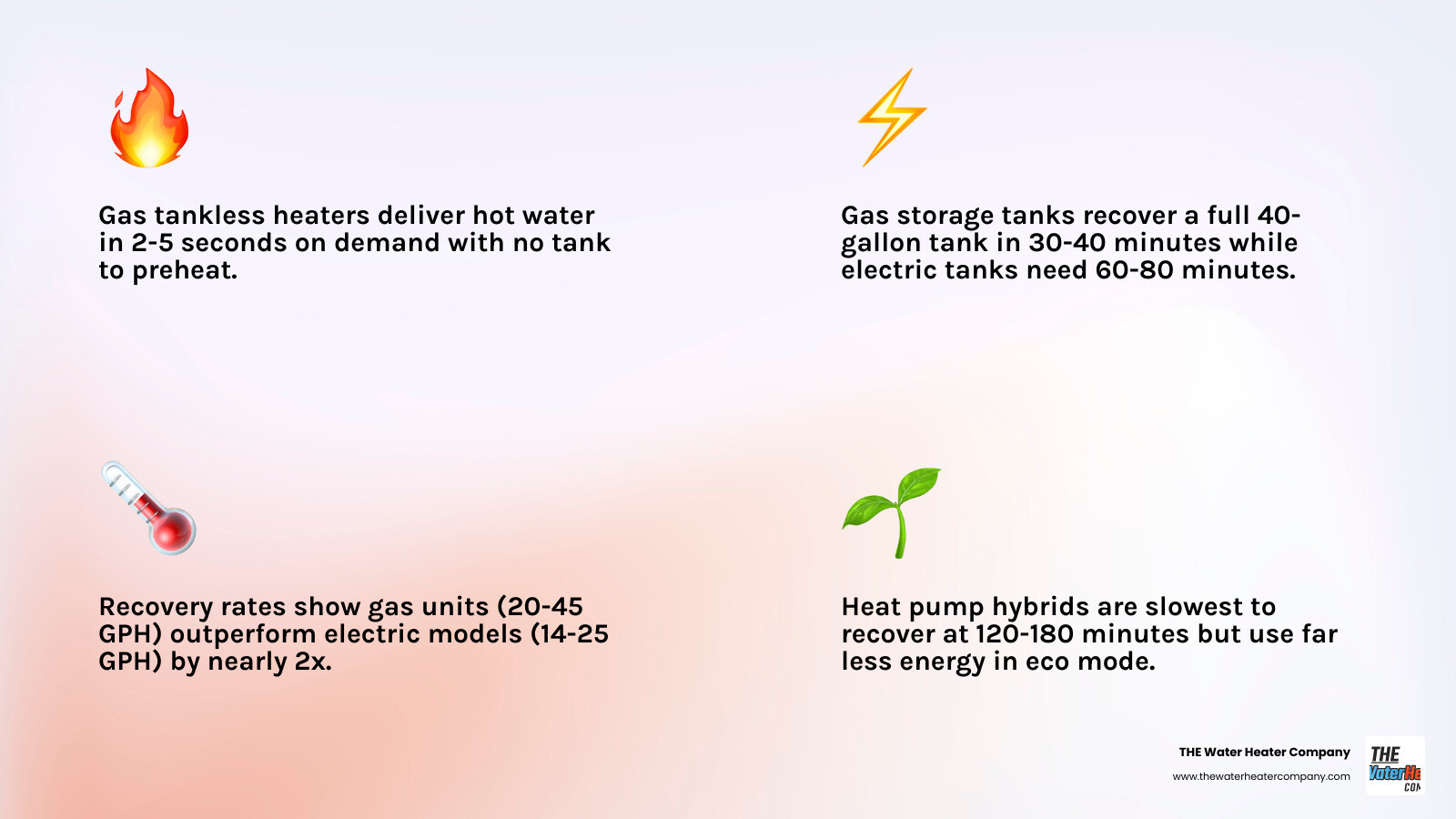
| Gas Storage Tank | 30-40 minutes (40 gal) | 20-45 GPH |
| Electric Storage Tank | 60-80 minutes (40 gal) | 14-25 GPH |
| Tankless (Gas) | 2-5 seconds (on demand) | 2-5 GPM flow rate |
| Heat Pump (Hybrid) | 120-180 minutes (heat pump mode) | 8-12 GPH (eco mode) |
Gas tankless water heaters heat water the fastest, delivering hot water within seconds on demand. Among storage tank models, gas heats roughly twice as fast as electric. Heat pump water heaters are the slowest to recover but the most energy-efficient.
You turn on the tap. Cold water. More cold water. Then — finally — a slow trickle of warmth. For many Southern California homeowners, that wait is a daily frustration, and it often comes down to one thing: the type of water heater in your home and how fast it can actually do its job. Water heating is the second-highest energy cost in most homes, so the choice you make doesn’t just affect your comfort — it affects your monthly bills too. Understanding heating speed, recovery rate, and hot water demand can help you make a smarter decision for your household.
I’m Anthony Hamilton, Co-Founder and CEO of THE Water Heater Company, and after years of hands-on work installing and replacing every major water heater type across Southern California, I’ve seen how much which water heater type heats faster matters to real families juggling morning routines and back-to-back showers. Let’s break it all down so you can make a confident, informed choice.
Quick look at which water heater type heats faster:
- choosing between gas and electric for your home
- gas vs electric for tankless water heaters
- is a gas or electric water heater better
Understanding Water Heater Types and How They Operate
To understand which water heater type heats the fastest, we first have to look under the hood of each system. Water heaters come in several distinct designs, and each handles the physics of heat transfer differently.
The two primary categories you will encounter are storage tank models and tankless (on-demand) units. How these systems generate and transfer heat depends heavily on their fuel source — primarily natural gas or electricity.
If you are currently evaluating your options, reviewing our dedicated guides on Tank Water Heaters and Tankless Water Heaters can provide a solid foundation for how these systems are integrated into Southern California homes.
Storage Tank Water Heaters
The traditional storage tank water heater is the most common fixture in American homes. These systems maintain a constant reservoir of hot water — typically between 30 and 50 gallons — so it is ready when you turn on a tap.
- Electric Storage Tanks: These units use internal electric resistance heating elements that plunge directly into the water. When the thermostat detects a temperature drop, the elements switch on, converting electricity directly into heat. While electric resistance is nearly 100% efficient at converting energy, the heating process is relatively slow.
- Gas Storage Tanks: Gas models utilize a burner assembly located at the bottom of the tank. The burning natural gas heats the bottom of the tank and sends hot combustion gases up through a central flue, transferring heat to the surrounding water. Because gas burners generate intense, concentrated heat, they raise water temperatures much faster than electric elements.
The primary disadvantage of any storage tank system is standby heat loss. Because the tank must keep those 40 or 50 gallons warm 24/7, heat constantly escapes through the tank walls, forcing the system to cycle on and reheat the water even when nobody is home.
Tankless On-Demand Systems
Tankless water heaters do away with the storage tank entirely. Instead of keeping a large volume of water hot all day, they wait until a hot water tap is turned on.
When water flows through the unit, a sensor activates a powerful heat exchanger. This heat exchanger instantly transfers heat to the incoming cold water as it flows through the coils.
- Gas Tankless Units: These systems use highly powerful gas burners to produce a rapid temperature rise. They are capable of delivering high flow rates, typically ranging from 2 to 5 gallons per minute (GPM), making them ideal for handling multiple simultaneous hot water demands.
- Electric Tankless Units: These systems use high-wattage electric elements to heat the water. Because they require massive electrical draws, they often require significant electrical panel upgrades and generally produce lower flow rates than gas-fired models.
By eliminating standby heat loss, tankless systems can be 24% to 34% more energy-efficient than conventional tanks for homes that use 41 gallons or less of hot water daily. Even in high-use homes (around 86 gallons per day), they remain 8% to 14% more efficient. If you are trying to decide whether to make the jump, check out our analysis on Should I Go Tankless or Stick with a Traditional Water Heater?.
Which Water Heater Type Heats Faster?

When we talk about “heating speed,” we are looking at two key metrics: initial heat-up time (how long it takes to heat a completely cold tank of water) and recovery rate (how quickly the water heater can replenish hot water as it is being used).
Gas vs. Electric Storage Tank Recovery Times
If you have a storage tank system, recovery time is the metric that determines whether you get a warm shower or an icy surprise if you are second in line. This is where the debate over which water heater type heats faster gets highly lopsided.
Gas water heaters are the undisputed speed champions of the storage tank world. A standard 40-gallon gas water heater can heat a full tank of cold water in roughly 30 to 40 minutes. A comparable electric storage tank unit, on the other hand, will take 60 to 80 minutes — or even longer — to do the exact same job.
This performance gap comes down to raw heating power, measured in British Thermal Units (BTUs) for gas and kilowatts (kW) for electricity:
- Gas Burners: Standard residential gas water heaters operate with burners rated between 30,000 and 50,000 BTUs per hour. This allows them to recover roughly 20 to 25 gallons of hot water per hour (and up to 40 to 55 gallons per hour for high-input models).
- Electric Elements: A typical electric water heater operates with dual 4,500-watt elements. When converted to heating capacity, 4,500 watts equals roughly 15,350 BTUs per hour. Consequently, electric units recover at a much slower rate of 14 to 20 gallons per hour.
For a deeper dive into how these fuel sources stack up against one another in real-world scenarios, you can read our Choosing Your Power: Gas vs. Electric Tankless Water Heater Performance guide.
Tankless Systems and Instant Hot Water Availability
If your definition of “fast” is how quickly hot water appears when you turn on the faucet, tankless systems are in a league of their own.
A tankless water heater heats water on demand. The moment you open a tap, the unit’s heat exchanger fires up and heats the water within 2 to 5 seconds. However, it is important to distinguish between instant heating at the unit and instant hot water at your tap.
The delay you experience at your sink or shower is usually not caused by the water heater itself, but rather by pipe delay. The hot water must physically push the cold water out of the pipes leading from the heater to your fixture. If your bathroom is on the opposite side of your house from the water heater, you will still have to wait for that cold water to clear out.
Even with pipe delay, tankless systems eliminate the risk of running out of hot water because they provide a continuous, endless supply. You can learn more about how this technology works by reading Instant Hot Water: How Tankless Water Heaters Eliminate Waiting Time.
Heat Pump Hybrid Heaters: Efficiency vs. Speed
Heat pump (or hybrid) water heaters represent the cutting edge of energy efficiency. In fact, they are two to three times more energy-efficient than conventional electric storage water heaters, allowing a family of four to save approximately $550 per year on their utility bills.
However, heat pump technology is engineered for efficiency, not raw heating speed:
- How They Work: Instead of generating heat directly, a heat pump works like a refrigerator in reverse. It extracts heat from the surrounding ambient air and transfers it into the water tank using a compressor and refrigerant cycle.
- The Speed Penalty: Because extracting heat from the air takes time, a hybrid water heater running strictly in “Eco” or “Heat Pump Only” mode has a very slow recovery rate — typically just 8 to 12 gallons per hour. It can take 2 to 3 hours to heat a full tank of water from scratch.
- The Hybrid Solution: To offset this slow speed, hybrid units feature backup electric resistance elements. When hot water demand spikes, the system automatically switches to “Hybrid” or “High Demand” mode, engaging the electric elements to match the recovery speed of a standard electric tank (20 to 25 GPH) at the cost of temporary efficiency loss.
Key Factors That Influence Water Heater Heating Speed
While fuel type and system design are the primary drivers of heating performance, several real-world variables can speed up or slow down your water heater’s operation.
How Tank Size and First-Hour Rating (FHR) Affect Performance
When choosing a storage tank water heater, many homeowners focus solely on tank capacity (e.g., buying a “50-gallon tank”). However, tank size alone is a misleading metric. The more important number to look for is the First-Hour Rating (FHR).
The FHR is a measure of how many gallons of hot water the unit can deliver in a single hour of peak usage, starting with a fully heated tank. It combines the tank’s storage capacity with its recovery rate.
- A 40-gallon gas water heater with a fast recovery rate might have an FHR of 70 gallons.
- A 50-gallon electric water heater with a slower recovery rate might only have an FHR of 60 gallons.
In this scenario, the smaller gas tank will actually provide more usable hot water during a high-demand morning routine than the larger electric tank. For a complete comparison of how these metrics affect daily life, refer to our guide on Tank vs. Tankless Water Heaters.
The Impact of Seasonal Incoming Water Temperatures
Your water heater does not start heating water from room temperature; it heats the water that enters your home from municipal water lines buried underground. The temperature of this incoming groundwater varies significantly by season, even in relatively mild climates like Southern California.
In cities like Santa Clarita or Pasadena, winter groundwater temperatures can drop to 50°F or lower. If your thermostat is set to 120°F, your water heater must achieve a temperature rise of 70 degrees. In the summer, when incoming water might be 70°F, the system only needs a 50-degree rise.
This seasonal temperature drop directly impacts heating speed:
- Storage Tanks: A cold winter inlet can increase tank recovery times by 25% to 35% compared to summer.
- Tankless Units: Because tankless units heat water on the fly, a lower inlet temperature means the system must work harder to achieve the desired temperature, which can slightly reduce the maximum flow rate (GPM) the unit can deliver.
Why Sediment Buildup Slows Down Your Heating Time
Over time, dissolved minerals in your water — such as calcium and magnesium — naturally precipitate out of the water and settle to the bottom of your water heater tank. This is particularly common in areas of Southern California with hard water.
As this sediment accumulates, it forms a thick, chalky layer of scale directly over the gas burner or surrounding the lower electric heating element. This sediment acts as an unwanted thermal insulator.
- Instead of heat transferring directly into the water, the burner or element must first heat up the thick layer of sediment.
- A mere 1/2 inch of sediment buildup can increase your water heater’s heating time by 20% to 40%, forcing the system to run longer, waste energy, and undergo unnecessary wear and tear.
To prevent this, we highly recommend scheduling an annual tank flushing. Regularly clearing out sediment keeps your system running at peak efficiency and maintains its original heating speed.
Frequently Asked Questions About Heating Speed
Which water heater type heats faster for large families?
For larger families with high peak hot water demands (such as back-to-back morning showers, running the dishwasher, and doing laundry), a high-input gas storage tank or a gas tankless water heater is almost always the best option.
Gas storage tanks recover twice as fast as electric models, meaning the wait time between showers is significantly reduced. Alternatively, a gas tankless water heater completely eliminates the wait by heating water continuously as long as the tap is open. You can explore how tankless units manage continuous demand in our article on How Tankless Water Heaters Provide Endless Hot Water for Your Home.
Which water heater type heats faster in cold climates?
In cold climates where incoming groundwater temperatures drop significantly, gas-fired water heaters (both tank and tankless) consistently outpace electric and hybrid models.
The intense heat generated by natural gas combustion allows these systems to handle steep temperature rises quickly. Electric resistance elements struggle to keep up with very cold inlet temperatures, and heat pump hybrid units run much slower in cold ambient air because there is less heat to extract from the surrounding environment.
Does a tankless water heater heat water faster than a tank?
Yes and no — it depends on how you define “fast.”
- At the Unit: A tankless water heater heats water almost instantly (in 2 to 5 seconds) as it passes through the heat exchanger, whereas a storage tank can take 30 to 80 minutes to heat a cold tank of water.
- At the Faucet: Because of pipe delay, both systems will take roughly the same amount of time to deliver hot water to a distant faucet. However, once the hot water arrives, the tankless system will never run out, whereas a storage tank will eventually empty and require time to recover.
Conclusion
Choosing the right water heater is all about balancing heating speed, energy efficiency, and your household’s daily hot water demands. If raw heating speed and fast recovery times are your top priorities, gas-powered systems — whether traditional storage tanks or modern tankless units — are the clear winners. If long-term energy savings are your primary goal, a hybrid heat pump water heater is an incredibly efficient choice, provided you size the tank slightly larger to accommodate its slower recovery times.
At THE Water Heater Company, we are proud to be the trusted, family-owned water heating experts serving communities across Southern California, including Santa Barbara, Camarillo, Santa Clarita, Pasadena, Van Nuys, Los Angeles, Santa Ana, and Irvine. Our experienced technicians specialize in professional water heater installation, repair, and preventative maintenance, helping you keep your hot water flowing reliably and efficiently.
If you are ready to upgrade your home’s hot water performance or need professional maintenance to restore your system’s heating speed, we are here to help. More info about our services is just a click away — contact us today to schedule your appointment!

The Essential’s
Call THE Water Heater Company today to get immediate help with your water needs.
“
-

“Fair Pricing & Expert Service”
Their technician Gonzo, was clearly very competent and more importantly, he took the time and effort to do a really fantastic job.
-
“Fantastic Service!”
THE Water Heater Company understood the situation I was going through. They were able to help me out and get the job done quickly.
-
“Reasonable Pricing”
Kevin did a great job on replacing my old leaky yet still working water heater. He answered all my questions and explained all the details. -
“Quick Response Time”
He was very informative and responsive to my questions and when I am making a huge investment in my home I want to be sure I am going with a company I could count on and would not cut corners. -
“Real Professionals”
Communication was great with the owner and they were very responsive, ensuring a first-class installation and experience.
-
“Great Service”
Not only did he do the service we needed, but checked the whole unit in addition to other waterline components. -
“Professional and Responsive”
They have repaired my water heater, installed a hot water recirculating pump, and now installed a new water heater. -
“Real Professionals”
It took a little over three hours but no management was necessary as the guys were very competent and clearly have been doing this for a long time.