Call 877-798-7487 to speak with a live local agent today

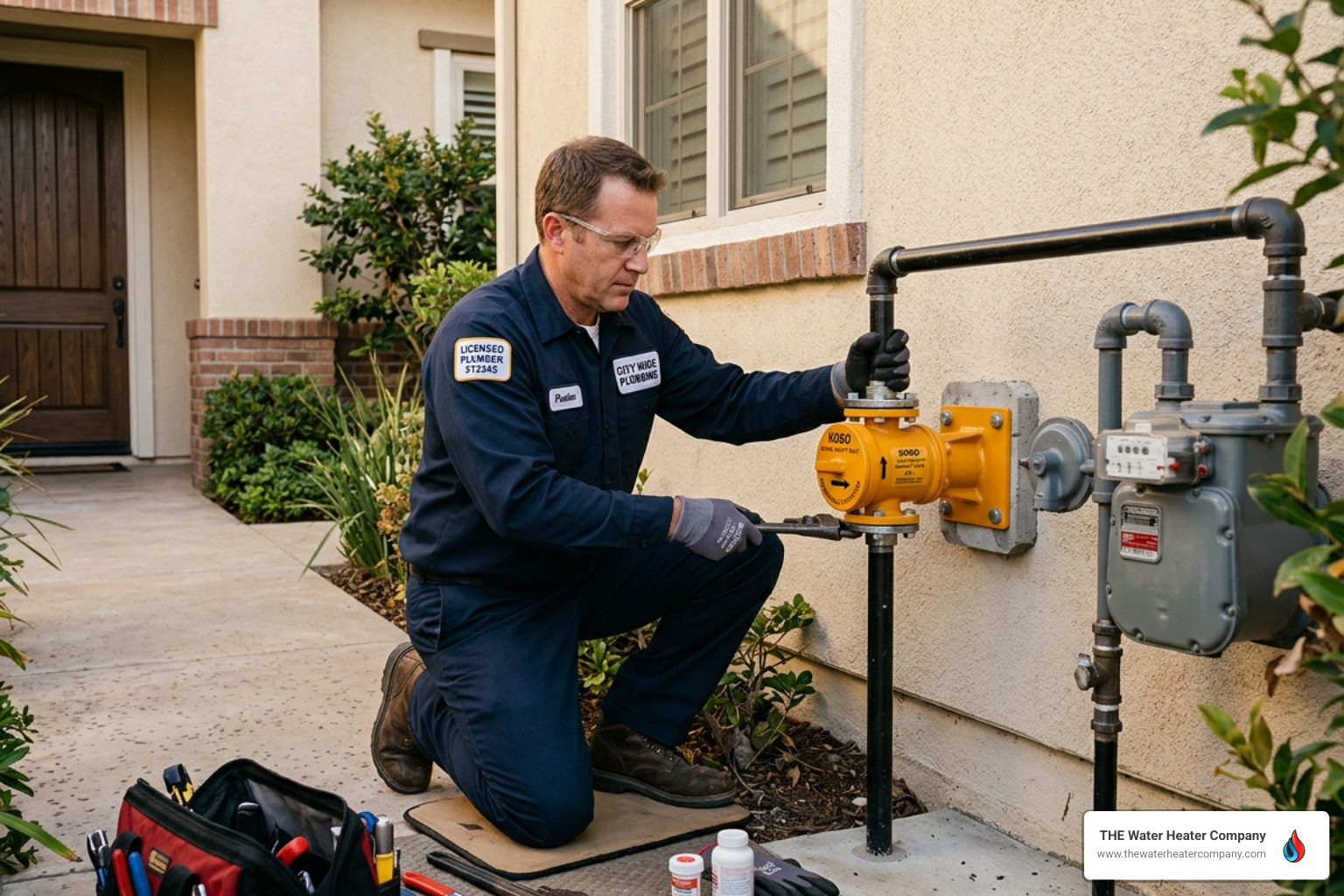
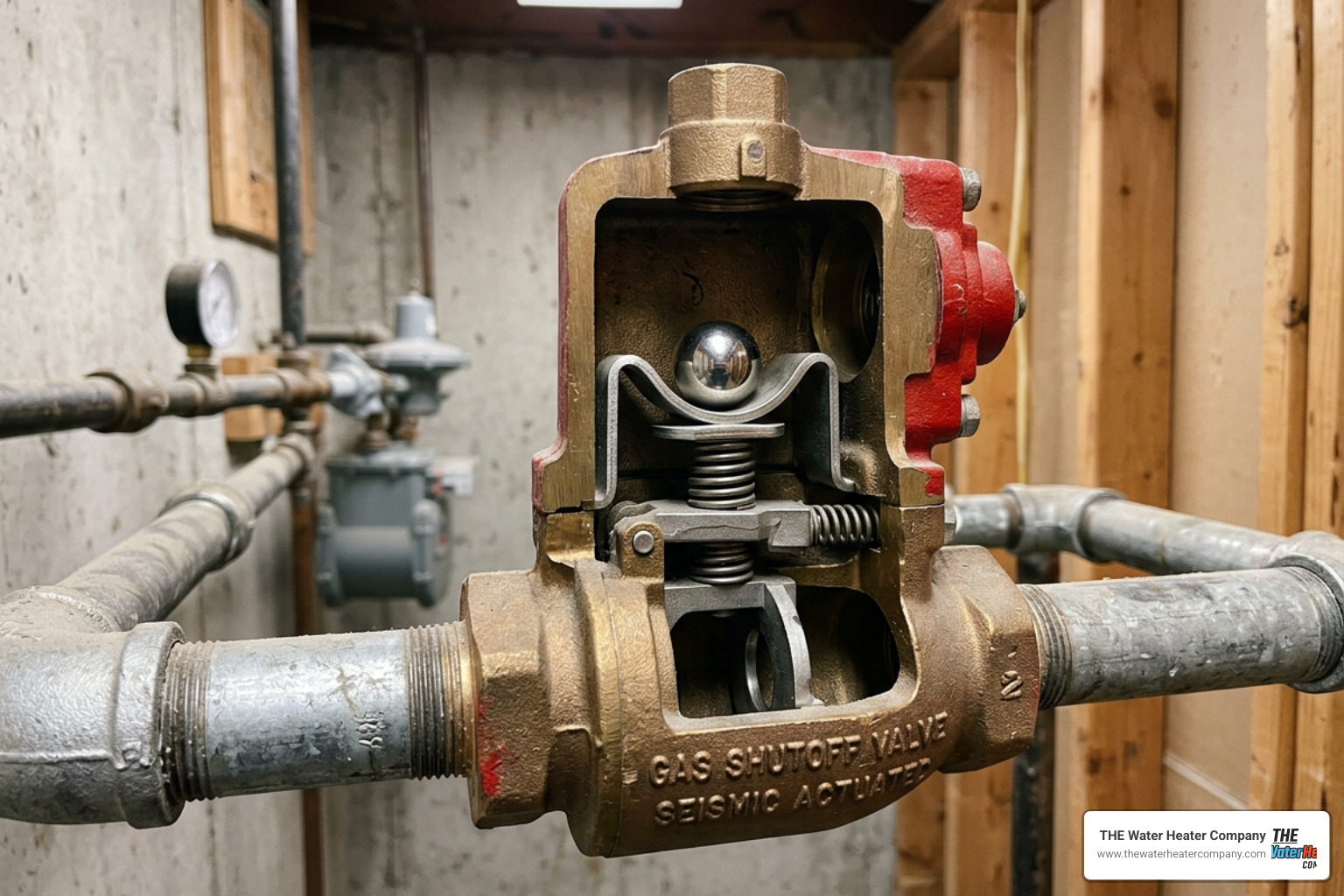
seismic gas shutoff valve installed on home exterior gas line

How a Seismic Gas Shutoff Valve Works

What is a Seismic Gas Shutoff Valve and Why Do You Need One?

How a seismic gas shutoff valve works is something every Southern California homeowner should understand — because in an earthquake, it could be the difference between a close call and a catastrophe.

Here’s the short answer:

A seismic gas shutoff valve automatically stops the flow of natural gas to your home when it detects ground shaking at roughly magnitude 5.4 or greater on the Richter scale. Inside the valve, a small metal ball sits balanced on a pedestal. When the earth shakes hard enough, that ball rolls off and drops into a position that physically blocks gas from flowing through the line — no electricity, no manual action required.

How it works, step by step:

  1. Earthquake occurs — ground shaking reaches a sufficient magnitude
  2. Internal ball dislodges — the metal ball rolls off its pedestal due to the vibration
  3. Gas flow is blocked — the ball falls into the outlet passage and seals it shut
  4. Valve locks closed — it stays closed until manually reset by a qualified professional
  5. Gas is restored safely — only after a licensed inspection confirms no leaks

This matters because ruptured gas lines are one of the most dangerous consequences of an earthquake. During the Great San Francisco Earthquake of 1906, fires ignited by broken gas lines caused roughly 90% of the city’s total destruction — burning 490 city blocks. That history is exactly why these valves exist.

I’m Anthony Hamilton, Co-Founder and CEO of THE Water Heater Company, and with years of hands-on plumbing experience serving Southern California homeowners, I’ve seen how critical it is to understand how a seismic gas shutoff valve works — especially for homes connected to natural gas in one of the most seismically active regions in the country. In the sections below, I’ll walk you through the mechanics, installation requirements, and what you need to know to keep your home protected.
Infographic showing how a seismic gas shutoff valve stops gas flow during an earthquake, step by step

How does a seismic gas shutoff valve work word guide:

A seismic gas shutoff valve (often called an earthquake valve or seismic safety valve) is a specialized safety device installed directly on your home’s gas line. Its primary purpose is simple yet life-saving: to instantly cut off the supply of natural gas or liquid propane entering your home when significant seismic activity occurs.

Living in Southern California, we are no strangers to the earth moving beneath our feet. In fact, Southern California experiences approximately 10,000 earthquakes every single year. While the vast majority of these are too small to be felt, we experience 15 to 20 earthquakes annually that register above a magnitude 4.0. When an earthquake climbs above a 5.5 magnitude, it is capable of causing severe structural damage.

During major quakes, the violent shaking causes the ground to shift, structures to sway, and underground piping to bend or break. If your home’s internal gas lines or appliance connections rupture, highly flammable natural gas will flood your living spaces. All it takes is a single spark—from a cycling refrigerator, a light switch, or a pilot light—to trigger a devastating explosion. Historical disasters, such as the 1994 Northridge earthquake, proved that post-earthquake fires can cause as much, if not more, destruction than the actual shaking itself. In Northridge, gas-fueled fires destroyed hundreds of homes and mobile homes, highlighting why automatic intervention is so critical.

By installing a seismic gas shutoff valve, you create an automatic physical barrier against these fire hazards. To learn more about how these devices protect your family and property, read through The Definitive Guide to Earthquake Valve Benefits.

Beyond the obvious safety advantages, installing these valves is often a matter of legal and financial necessity. California building codes have evolved significantly to address seismic risks. In many of our service areas—including Los Angeles, Pasadena, Santa Clarita, and Irvine—local ordinances strictly mandate these safety devices. If you are planning a major home renovation, building a new home, or putting your property up for sale, you must comply with these state and local regulations. For a comprehensive breakdown of these mandates, check out our guide on The Law of the Land California Gas Valve Rules.

How does a seismic gas shutoff valve work compared to an excess flow valve?

It is incredibly common for homeowners to confuse seismic gas shutoff valves with excess flow valves (EFVs). While both are designed to shut off gas in an emergency, they rely on entirely different triggers and serve distinct safety functions.

A seismic gas shutoff valve is motion-sensitive. It is triggered exclusively by the physical vibrations and ground movement of an earthquake. It does not care how much gas is flowing through your pipes; if the ground shakes with enough force (typically a magnitude of 5.1 to 5.4), the valve automatically trips and shuts off the gas. This means it will protect your home even if a pipe hasn’t broken yet, preventing gas from entering a structurally compromised building.

An excess flow valve (EFV), on the other hand, is flow-sensitive. It does not detect earthquakes or shaking. Instead, it monitors the velocity of the gas moving through the pipe. If an underground service line is completely severed—perhaps by a contractor digging in the yard or a tree root failure—the sudden, massive drop in pressure causes the gas to rush through the pipe at an extremely high rate. The EFV senses this abnormal flow and immediately clamps down to restrict the gas.

Feature Seismic Gas Shutoff Valve Excess Flow Valve (EFV)
Primary Trigger Physical ground shaking (seismic motion) Excessive gas flow rate (pressure drop)
Activation Threshold ~5.1 to 5.4 magnitude (or ~0.11g acceleration) Sudden surge in flow due to a major line break
Typical Installation Location Homeowner’s side of the meter (downstream) Utility’s side of the meter (underground/upstream)
Reset Method Manual reset required after safety inspection Often resets automatically once pressure is equalized and repaired
Primary Protection Prevents structural fires from internal pipe ruptures Prevents massive gas clouds from severed outdoor lines
Regulatory Mandate Local municipal codes, California home sales Federal law for new single-family lines since 2006

By installing both devices, homeowners achieve the ultimate level of dual-protection: the seismic valve guards against internal home hazards caused by shaking, while the EFV guards against external line breaks.

How Does a Seismic Gas Shutoff Valve Work Mechanically?

To appreciate the reliability of a seismic gas shutoff valve, you have to look at its engineering. These devices are designed to operate under the worst possible conditions, which means they must function perfectly even if your home completely loses electrical power, internet connection, or cellular service. For this reason, high-quality seismic valves are entirely mechanical, gravity-assisted devices.

Most standard seismic valves utilize a clever, elegant “ball-and-pedestal” design. Inside the sealed, cast-aluminum valve housing, a heavy, precision-engineered stainless steel ball sits balanced on a tiny, vertical pedestal. Under normal day-to-day conditions, the ball remains perfectly balanced, allowing natural gas to flow freely around the pedestal and through the open valve chamber.

However, the valve is calibrated to respond to specific seismic forces. According to national safety standards (such as ASCE 25-97), the valve must only trigger when it detects ground movement equivalent to a magnitude 5.2 to 5.4 earthquake. Mechanically, this threshold translates to approximately 0.11g of horizontal acceleration sustained over a specific frequency (usually sinusoidal oscillations of 5.5 on the Richter scale sustained for several seconds).

This calibration is incredibly precise. It ensures that the valve will not trip from minor day-to-day vibrations, such as heavy trucks driving down your street, low-flying airplanes, or children slamming the front door. The physical shaking must match the distinct, rolling frequency of a damaging earthquake to dislodge the ball from its perch.

How does a seismic gas shutoff valve work to block gas flow during a quake?

When the ground begins to roll and shake at that 0.11g threshold, the horizontal forces push the stainless steel ball off its balanced pedestal.

Once the ball is dislodged, gravity takes over. The ball rolls down an internal ramp or angled guide and drops directly into the main gas flow channel, landing on a soft-seat orifice. The natural pressure of the incoming gas line pushes against the fallen ball, creating a tight, hermetic seal that completely blocks any further gas from passing through the valve and entering your home.

Some advanced commercial and residential models, like the KOSO seismic valve, utilize a gravity-assisted check valve combined with an acceleration-sensitive rolling latch mechanism. In these designs, when the rolling ball shifts at 0.11g, its weight transfers to a reacting cylinder. This cylinder releases a spring-loaded latch, allowing a heavy check valve to swing downward and snap shut.

To help homeowners quickly assess the status of their gas supply after a disaster, these valves feature a clear, built-in status indicator window on the exterior casing:

  • Green Bar / Window: Indicates the valve is open, the ball is on the pedestal, and gas is flowing normally.
  • Red Bar / Window: Indicates the valve has been triggered, the mechanism has closed, and the gas supply is blocked.

Once the valve triggers and locks closed, it cannot reopen on its own. It features a manual reset shaft or faceplate on the outside of the unit, which must be physically turned to lift the ball back onto its pedestal or reset the internal latch. This manual-only reset is a critical safety feature; it ensures that gas cannot flow back into a potentially damaged home until a thorough inspection has been conducted.

Installation, Resetting, and Maintenance Requirements for Homeowners

Understanding where and how a seismic gas shutoff valve is installed is essential for maintaining your home’s safety and staying compliant with local Southern California codes.

First and foremost, the valve must be installed on the homeowner’s side of the gas meter (downstream of the meter). Utility providers, such as SoCalGas, own and maintain the meter itself and the piping leading up to it. California Public Utilities Commission regulations strictly prohibit homeowners or private plumbers from installing any devices on utility-owned equipment. Therefore, our expert technicians install the seismic valve on the “house line”—the pipe that exits the meter and runs directly into your home.

Because the valve relies on physical movement to trigger, proper stabilization is absolutely vital. If the valve is allowed to wobble, sag, or vibrate loosely on the pipe, it can easily suffer from “false trips” during minor events, or fail to trip during an actual earthquake. During a professional installation, we secure the valve using heavy-duty, corrosion-resistant stabilizer brackets anchored to the exterior wall of your home, typically within 6 inches of the valve itself. This ensures the valve only moves when your home’s foundation moves.

If you are looking to secure your entire gas and utility system, it is also the perfect time to evaluate your water heating equipment. Heavy water heaters can easily tip over during a quake, breaking their gas connections and starting fires. Learn how to protect this system by reading Secure Your Water Heater for Earthquakes in 4 Easy Steps, and prepare your household for professional installation by reviewing How to Master Earthquake Valve Installation.

Post-Earthquake Safety and the Resetting Process

If a major earthquake strikes and your seismic valve successfully activates, your gas will be cut off. Once the shaking stops, do not immediately attempt to reset the valve.

Before restoring gas to your home, you must verify that your gas lines are completely undamaged. If you reset the valve while there is an undetected leak inside your walls or at an appliance connection, you could fill your home with gas and create an immediate explosion hazard.

Follow these safety steps after a major earthquake:

  1. Sniff for leaks: Walk around your home and check for the distinct “rotten egg” smell of natural gas. Listen closely for any hissing sounds near your water heater, stove, furnace, or outdoor lines.
  2. Inspect appliances: Check that your gas-burning appliances have not shifted, tilted, or pulled away from their wall connections.
  3. Call a professional: If you smell gas, hear hissing, or suspect a leak, immediately turn off your manual main gas valve using an adjustable wrench, leave the property, and call the utility company or a licensed plumber.
  4. The Resetting Procedure: If—and only if—a comprehensive safety inspection confirms that your home’s gas lines are completely sound, the valve can be manually reset.
    • For standard pedestal valves, this involves removing a protective cap and slowly turning the reset shaft or faceplate (sometimes using a specialized tool or a strong magnet built into the faceplate) to lift the internal ball back onto its perch.
    • Because resetting the valve requires relighting pilot lights and performing pressure tests on your system, it is highly recommended to have this completed by a licensed plumbing contractor.

For a complete guide on preparing your home’s gas, water, and electrical systems for seismic events, read our Earthquake Preparedness Tips for California Homeowners Survival Guide.

Frequently Asked Questions About Seismic Gas Valves

Are earthquake shutoff valves required by law in California?

Yes, but the exact requirements depend on your location and the age of your property. Under California state law, all newly constructed residential and commercial buildings built since 2000 must have earthquake-actuated gas shutoff valves installed.

Furthermore, many local municipalities throughout Southern California have passed strict local ordinances. For example, in the City of Los Angeles, a seismic gas shutoff valve must be installed on any residential or commercial building containing gas piping whenever:

  • The building is sold or undergoes a change of ownership (the valve must be installed before the close of escrow).
  • Significant structural alterations or additions are made to the property (typically commercial alterations exceeding a specific valuation threshold).

Because local building codes vary between cities like Pasadena, Santa Ana, Irvine, and Santa Barbara, it is always best to consult with a local plumbing expert who understands the specific municipal codes in your neighborhood.

Who is authorized to install and reset these safety valves?

To comply with local building codes, safety regulations, and insurance requirements, seismic gas shutoff valves must be installed by a qualified professional. In California, this means a licensed plumbing contractor (holding a C-36 plumbing license) or an authorized utility representative.

Improper DIY installation can lead to severe issues, such as mounting the valve backward (which blocks gas flow permanently), failing to level the device (causing constant false trips), or violating utility clearance zones. Furthermore, a permit is typically required from your local Department of Building and Safety to ensure the installation is inspected and fully compliant with the California Plumbing Code.

When it comes to resetting the valve, while some manufacturers design their valves to allow homeowner resets, local utilities and safety boards strongly recommend having a certified technician perform the reset. This ensures a professional can pressure-test your gas lines and safely relight any appliance pilot lights.

What maintenance do seismic gas shutoff valves require?

One of the greatest benefits of a high-quality, mechanically actuated seismic gas valve is that it has virtually no moving parts under normal operating conditions. Because it does not rely on electrical circuits, batteries, or complex sensors, it requires almost no active maintenance.

However, we recommend a simple annual visual inspection. During your annual water heater maintenance or plumbing check-up, our technicians will:

  • Verify that the valve remains perfectly level (if a house settles or a pipe sags, a tilted valve may trip too easily).
  • Check that the stabilizer brackets are tight and securely anchored to the wall.
  • Ensure the status indicator window is clean, clear, and showing “green.”
  • Confirm that the valve has not been painted over, as paint can clog the manual reset mechanism or seal the indicator window.

Conclusion

A seismic gas shutoff valve is a quiet, reliable sentinel protecting your Southern California home. By understanding how a seismic gas shutoff valve works, you can appreciate the brilliant simplicity of its engineering—using nothing but gravity and the laws of physics to protect your family from post-earthquake fires when you need it most.

At THE Water Heater Company, we are dedicated to keeping Southern California homes safe, efficient, and fully prepared for whatever nature throws our way. Whether you live in Santa Barbara, Camarillo, Santa Clarita, Pasadena, Van Nuys, Los Angeles, Santa Ana, or Irvine, our family-owned business is here to deliver fast, expert, and reliable service.

From professional water heater installations and repairs to retrofitting your home with certified, code-compliant safety devices, we have you covered. Don’t wait for the next big shake to secure your home. Contact us today to learn more about our professional Earthquake Valves installation services and give your family the ultimate peace of mind.
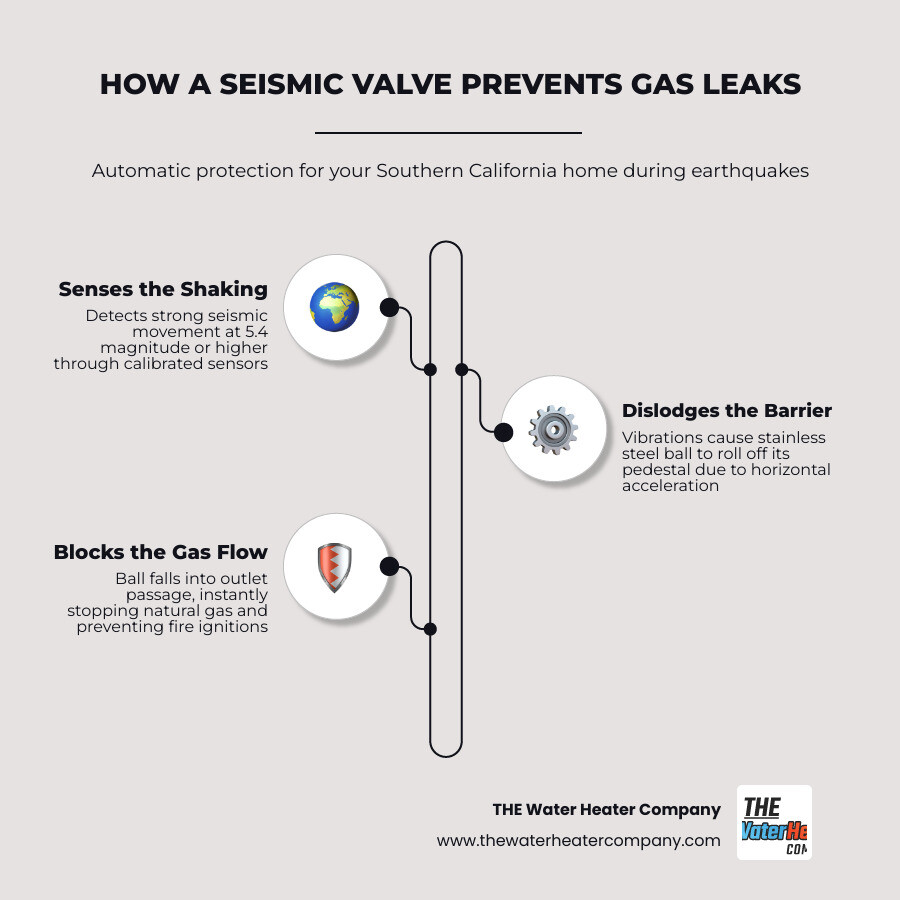
how a seismic valve prevents gas leaks after a quake

How a Seismic Valve Prevents Gas Leaks After a Quake

Why Knowing How a Seismic Valve Prevents Gas Leaks After a Quake Saves Southern California Homes

Most Californians live within 30 miles of an active fault line. When a major earthquake strikes, the shaking can easily rupture rigid gas pipes connected to your water heater or home appliances, leading to catastrophic post-quake fires. In fact, up to half of all post-earthquake fires are caused by natural gas leaks. To protect your property and family, getting professional Earthquake Shut-Off Valve Service in Los Angeles, CA is one of the most effective safety upgrades you can make. These specialized devices shut off your gas automatically, preventing fuel from feeding a fire when utility lines break.

Learn more about our protective earthquake shut-off valves or contact our licensed plumbing team to schedule your professional safety inspection.

Understanding how a seismic valve prevents gas leaks after a quake is crucial for protecting your family and home from post-earthquake fires.

Here is the quick answer to how these safety devices automatically protect your home:

  • Senses the Shaking: The valve detects strong seismic ground movement, typically triggering at a magnitude of 5.4 or higher.
  • Dislodges the Barrier: The physical vibrations cause a precisely calibrated internal stainless steel ball to roll off its pedestal.
  • Blocks the Gas Flow: The ball falls directly into the valve’s outlet passage, instantly blocking natural gas from entering your home.
  • Prevents Fire Ignitions: By stopping the gas flow immediately at the meter, gas cannot escape into your home even if your indoor pipes or water heater connections break.

These automatic safety valves act as a vital, mechanical firewall that operates without human intervention or electrical power.

I’m Anthony Hamilton, Co-Founder and CEO of THE Water Heater Company, and I’ve spent my career helping Southern California families secure their homes against natural disasters. My hands-on plumbing experience has given me a deep, practical understanding of how a seismic valve prevents gas leaks after a quake to protect properties when shaking begins.

How a seismic valve shuts off gas during an earthquake infographic

How a seismic valve prevents gas leaks after a quake definitions:

Understanding the Threat: Why Gas Safety Matters in Southern California

Living in Southern California—whether your home is in Pasadena, Santa Monica, Irvine, or Santa Barbara—means sharing the landscape with major fault lines, including the infamous San Andreas Fault. While we often prepare for earthquakes by anchoring bookshelves and storing extra water, the invisible threat lurking inside our walls is far more dangerous: our natural gas lines.

During a seismic event, the earth does not just shake; it rolls, shifts, and shears. This violent movement places immense physical stress on rigid utility pipes. According to historical data from the Earthquake Country Alliance, about one in four fires following a major earthquake is directly related to natural gas leaks. In more severe scenarios, gas leaks account for up to 50% of post-earthquake fires.

To understand the real-world impact, we only have to look back at the devastating 6.7 magnitude Northridge earthquake in 1994. In the aftermath of that single event, 185 mobile homes burned to the ground due to gas-fueled fires. When structural foundations shift, rigid pipe connections break, releasing highly flammable natural gas into confined spaces. A single spark from damaged electrical wiring or a water heater pilot light can then trigger an explosion.

By reviewing our Earthquake Preparedness Tips for California Homeowners Survival Guide, you can learn how to secure your property. However, manual shut-off valves are only useful if you are home, unharmed, and have a wrench nearby. An automatic seismic valve acts as your home’s 24/7 silent guardian. For a deeper dive into these protective benefits, read The Definitive Guide to Earthquake Valve Benefits.

How a Seismic Valve Prevents Gas Leaks After a Quake

An earthquake-actuated automatic gas shut-off valve is a highly specialized mechanical safety device. Installed directly onto your home’s exterior gas line, its sole purpose is to stop the flow of natural gas into your living space the moment a major tremor occurs.

Because it operates entirely on mechanical principles, it requires no electricity, batteries, or smart-home connections to function. If the power grid goes down—as it almost always does during a major quake—your seismic valve remains fully operational. By cutting off the gas supply at the source, it prevents fuel from escaping into your home, reducing the risk of fire and structural explosions.

The Science Behind How a Seismic Valve Prevents Gas Leaks After a Quake

The engineering behind how a seismic valve prevents gas leaks after a quake is incredibly elegant. Inside the valve housing, a precisely engineered trigger mechanism monitors ground acceleration.

In a standard mechanical seismic valve (such as the industry-standard KOSO or Northridge designs), a stainless steel ball rests securely on a small central pedestal or is suspended by a calibrated magnet.

[ Normal State ] [ Seismic Trigger (5.4+ Mag) ]
   +---------+ +---------+
   |  (Ball) | <-- Resting on | |
   |   [P]   | Pedestal |   [P]   |  (Ball) <-- Rolls off
   +----|----+ +----|----+ |
 | | v
========v======== =============v=============
  Gas Flow: OPEN Gas Flow: BLOCKED (Sealed)
================= ===========================

Here is exactly what happens when an earthquake strikes:

  1. Sinusoidal Oscillations: The valve is designed to respond specifically to horizontal, sinusoidal oscillations (the side-to-side shaking typical of destructive S-waves).
  2. Horizontal Acceleration: When the horizontal acceleration of the ground reaches approximately 0.11g (equivalent to an earthquake of roughly 5.4 magnitude on the Richter scale), the physical forces displace the ball.
  3. The Drop: The stainless steel ball rolls off its pedestal or breaks away from its magnetic latch.
  4. Positive Seal: Gravity pulls the ball down directly into the gas outlet passage. The pressure of the incoming natural gas pushes against the ball, forcing it into a soft-seat disc to create an airtight seal.

This 5.4 magnitude threshold is not arbitrary. According to engineering standard ASME 25-97, underground and structural piping systems are highly susceptible to breaking at seismic ratings of 5.4 and above. By triggering at this exact threshold, the valve shuts down the gas supply before the shaking can tear apart your home’s internal plumbing.

Seismic Valves vs. Excess Flow Valves (EFVs)

Many homeowners ask us about the difference between a seismic gas shut-off valve and an excess flow valve (EFV). While both are designed to prevent gas leaks, they operate on completely different principles.

  • Seismic Shut-Off Valves respond purely to ground motion. Even if your pipes are completely intact after a 5.5 quake, the valve will shut off the gas as a preventative measure.
  • Excess Flow Valves respond to gas velocity. They only trigger if there is a massive, sudden increase in gas flow—such as a complete line rupture caused by a backhoe digging up a yard or a water heater ripping off the wall. They do not protect against slow, creeping leaks or minor pipe punctures.

Here is a side-by-side comparison to help you understand how they differ:

Feature Seismic Shut-Off Valve (SGSV) Excess Flow Valve (EFV)
Primary Trigger Ground shaking (typically 5.4+ magnitude / 0.11g acceleration) Extreme gas flow velocity (ruptured line)
Protects Against Structural movement, appliance displacement, slow & fast leaks Major pipe ruptures, severed service lines
Installation Location On the customer's house line (downstream of the meter) On the utility's service line (underground, near the street)
Power Source Fully mechanical (gravity/latch system) Fully mechanical (pressure differential)
Reset Procedure Manual reset by homeowner or professional Often resets automatically once pressure equalizes
Responsibility Purchased and maintained by the homeowner Installed and maintained by the utility company

Step-by-Step: How to Prepare Your Home and Install a Seismic Valve

Because natural gas is highly volatile, installing a seismic valve requires strict adherence to safety protocols and local building codes. This is not a weekend DIY project. In Southern California, gas safety installations must comply with local municipal guidelines across Los Angeles, Pasadena, Santa Ana, Irvine, and surrounding areas.

Proper Placement and Installation Requirements

To ensure your seismic valve functions correctly when you need it most, proper placement is key:

  1. Downstream of the Meter: The valve must be installed on your property's "house line"—the pipe that carries gas from the meter into your home.
  2. No Utility Interference: California Public Utilities Commission (CPUC) regulations strictly prohibit installing any private safety valves on the utility company’s equipment. This means the valve cannot be attached directly to the meter itself or any pipes on the upstream side.
  3. Rigid Mounting: The valve body must be securely braced to your home’s exterior wall or foundation using a heavy-duty stabilizer bracket. If the valve is allowed to wobble or shake independently of the house, passing trucks or minor bumps could cause a false activation.
  4. Perfect Leveling: Many high-quality seismic valves require precise vertical and horizontal alignment during installation. If the valve is tilted even slightly, the internal ball may sit off-center, making it too sensitive or preventing it from dropping during an actual earthquake.

For a comprehensive breakdown of the tools, sizing, and technical steps required for this process, check out our guide on How to Master Earthquake Valve Installation.

Securing Your Water Heater and Gas Appliances

A seismic valve is your primary line of defense, but it works best alongside other safety measures. Your gas water heater is one of the most vulnerable appliances in your home. Containing dozens of gallons of heavy water, an unanchored water heater can easily tip over during a quake, snapping its rigid gas and water lines.

To prevent this, we recommend taking these three essential steps:

  • Install Double Earthquake Straps: Secure your water heater tank to the wall studs using approved metal strapping kits. You need one strap on the upper third of the tank and one on the lower third.
  • Use Flexible Gas Connectors: Replace any rigid yellow or black iron pipes leading directly into your appliances with certified, flexible stainless steel gas connectors. These allow your appliances to shift slightly during a quake without breaking the seal.
  • Anchor Other Major Gas Appliances: Ensure your furnace, stove, and clothes dryer are properly anchored to prevent them from sliding and pulling their gas lines out of the wall.

a secured water heater with earthquake straps

To make sure your water heater is fully protected, follow our step-by-step guide: Secure Your Water Heater for Earthquakes in 4 Easy Steps.

What to Do After the Shaking Stops: Safely Resetting Your Gas Valve

When a major earthquake strikes, your seismic valve will do its job and cut off the gas supply. Once the shaking stops and you have verified that your family is safe, you will eventually need to restore your gas service. However, rushing to reset your valve without performing proper safety checks can be incredibly dangerous.

Step-by-Step Reset Procedure

If you are confident there are no gas leaks on your property, you can manually reset your valve. Most residential seismic valves (like the Little Firefighter AGV series or the Northridge valve) feature a simple mechanical reset mechanism.

Here is the safe way to reset your valve:

  1. Smell and Listen: Walk through your home and around your gas meter. Do you smell rotten eggs (the mercaptan additive in natural gas)? Do you hear a hissing sound? If you suspect a leak, do not attempt to reset the valve. Evacuate immediately and call 911.
  2. Turn Off Appliances: Go inside and turn off all gas appliances, including your stove, oven, dryer, and water heater.
  3. Locate the Reset Mechanism: On the side of your seismic valve, you will find a reset screw or a rotating faceplate.
  4. Reset the Valve:
    • For screw-type valves: Use a flathead screwdriver to slowly turn the reset screw clockwise (usually a quarter or half turn) until the indicator window changes from red (closed) to green (open).
    • For magnet-type valves: Rotate the faceplate counterclockwise one full turn to allow the internal magnet to lift the stainless steel ball back onto its pedestal.
  5. Perform a Soap-Water Test: Mix a few drops of dish soap with water and spray it onto the valve connections. If you see growing bubbles, you have a leak.
  6. Relight Pilot Lights: Once gas flow is restored, you will need to safely relight the pilot lights on older water heaters or furnaces following the manufacturer’s instructions.

When to Call a Professional to Restore Your Gas Service

While resetting the valve is mechanically simple, verifying that your gas system is safe is highly complex. If your seismic valve closed during an earthquake, there is a strong possibility that a pipe inside your walls or underground was damaged.

If you reset the valve with a broken pipe inside your walls, you will fill your home with highly explosive gas. We strongly recommend contacting our team of licensed plumbers to perform a professional safety inspection before restoring your gas. We will run a gas line pressure test to verify that your system is completely airtight, relight your appliance pilots, and ensure your water heater is operating safely.

Frequently Asked Questions About How a Seismic Valve Prevents Gas Leaks After a Quake

What magnitude of earthquake triggers a seismic valve?

Seismic valves are calibrated to trigger during earthquakes registering approximately 5.1 to 5.4 on the Richter scale, or when horizontal ground acceleration reaches 0.11g to 0.15g. This specific acceleration threshold is the point at which structural damage and pipe ruptures typically begin to occur. To prevent false alarms from heavy street traffic, construction equipment, or minor bumps, quality valves are installed with rigid stabilizing brackets that isolate the device from non-seismic vibrations.

Are seismic gas shut-off valves required by California law?

Yes, depending on your city and whether you are building or remodeling. In the City of Los Angeles, municipal ordinances require approved seismic gas shut-off valves on all new construction, as well as commercial and residential buildings undergoing significant remodels (often defined as projects over a certain valuation). Many surrounding Southern California cities have adopted similar requirements. Additionally, some insurance companies require these valves before issuing or renewing homeowner policies in high-risk zones.

To learn more about the specific regulations in your neighborhood, read our detailed breakdown: The Law of the Land California Gas Valve Rules.

What maintenance does a seismic valve require to ensure it works?

Because they are purely mechanical and built with corrosion-resistant materials (like cast aluminum and stainless steel), seismic valves require very little maintenance. However, we recommend a quick annual visual inspection:

  • Ensure the valve body is clean and free of heavy dirt, rust, or debris.
  • Verify that the structural stabilizing bracket is tightly anchored to your home's exterior wall and has not vibrated loose.
  • Check the indicator window to ensure it remains clear and readable.
  • During your regular annual water heater maintenance check, have our professional technicians inspect the valve to ensure it remains perfectly level and operational.

Conclusion

When the ground starts shaking in Southern California, every second counts. Knowing how a seismic valve prevents gas leaks after a quake gives you peace of mind, knowing that your home is protected from gas-fueled fires even if you aren't there to turn off the valve yourself. This simple mechanical upgrade is one of the most reliable investments you can make to secure your property, your family, and your peace of mind.

At THE Water Heater Company, we are proud to serve families across Santa Barbara, Camarillo, Santa Clarita, Pasadena, Van Nuys, Los Angeles, Santa Ana, and Irvine. Our expert, family-owned team specializes in professional seismic shut-off valve installation, water heater strapping, and comprehensive gas line safety inspections.

Don't wait for the next big tremor to catch you unprepared. Schedule your professional seismic valve installation with the experts at THE Water Heater Company today and take control of your home's earthquake safety.

earthquake valve installation gas shutoff valve Southern California home

How to Master Earthquake Valve Installation

What to Expect From Earthquake Valve Installation (And Why It Matters in Southern California)

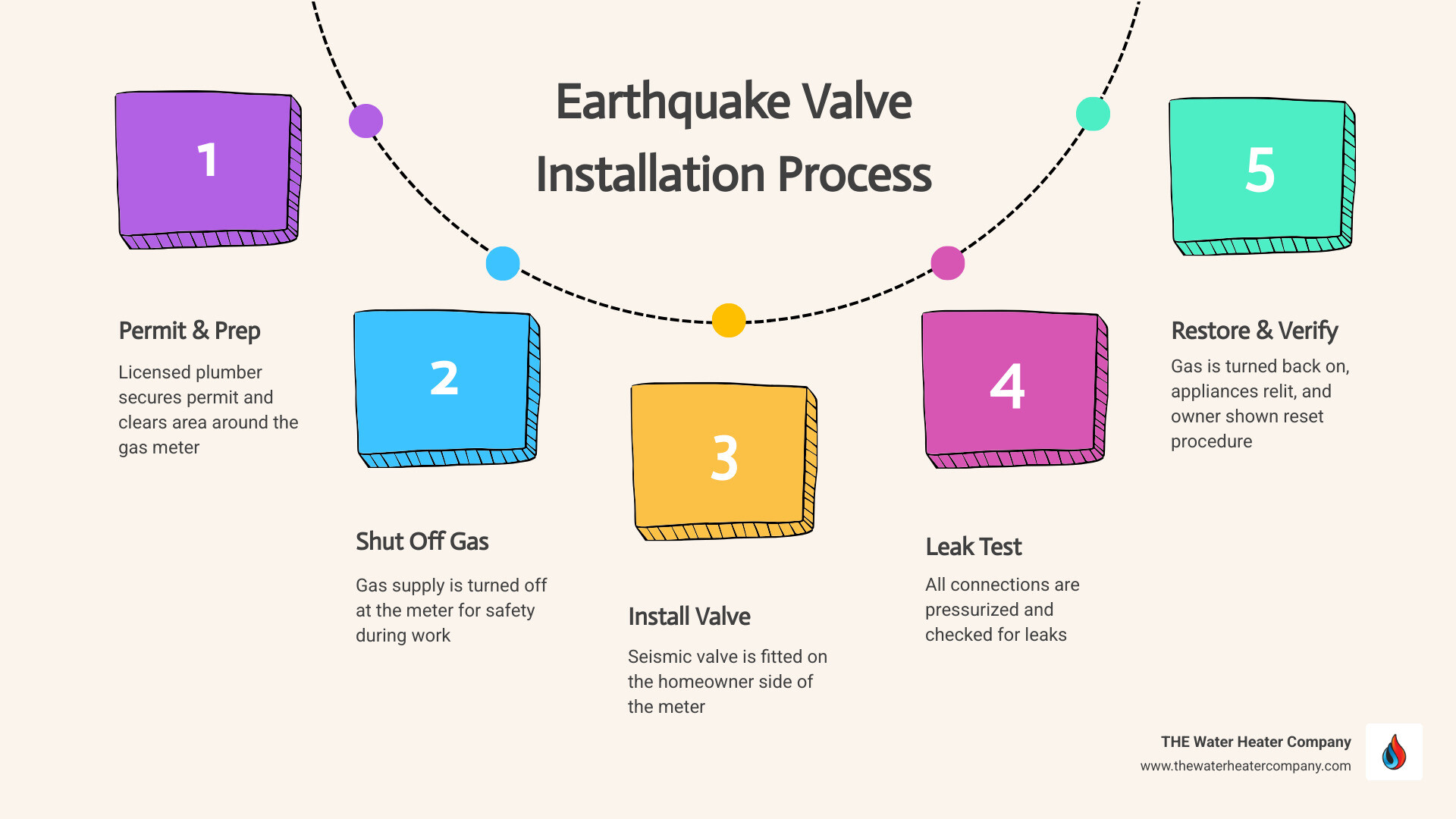
If you’re researching earthquake valve installation what to expect, here’s a quick overview before we dive deeper:

What happens during earthquake valve installation:

  1. A licensed plumber pulls the necessary permit
  2. Gas is shut off at the meter
  3. The valve is fitted on the homeowner’s side of the gas meter
  4. Connections are tested for leaks
  5. Gas is restored and appliances are checked
  6. You receive a walkthrough on how to identify a triggered valve and reset it safely

The whole process typically takes two to four hours for a standard residential installation.

When an earthquake strikes Southern California, the shaking itself is only part of the danger. A ruptured gas line in the aftermath can quietly turn a survivable event into a catastrophe. In fact, roughly 25% of post-earthquake fires are caused by natural gas leaks — and the 1994 Northridge earthquake alone revealed gas leaks in nearly one out of every five buildings where automatic shutoff valves had triggered. That single statistic makes a strong case for having one installed before the next big tremor hits.

The good news is that the installation process is straightforward when you know what to expect — and understanding it ahead of time helps everything go smoothly on the day.

I’m Anthony Hamilton, Co-Founder and CEO of THE Water Heater Company, and over the years I’ve guided countless Southern California homeowners through gas line safety decisions, including everything involved in earthquake valve installation and what to expect at every stage. My goal here is to give you clear, honest information so you can move forward with confidence.

Infographic showing 5 steps of earthquake valve installation process with seismic valve trigger mechanism explained

Simple earthquake valve installation what to expect word guide:

Understanding Seismic Gas Shutoff Valves vs. Excess Flow Valves

To understand what happens during your installation, it helps to know exactly what kind of device is being added to your gas line. Homeowners often hear the terms “seismic valve” and “excess flow valve” used interchangeably, but they are actually two distinct devices that operate on completely different principles.

Seismic Gas Shutoff Valves (Earthquake-Actuated Valves)

A seismic gas shutoff valve is a highly specialized mechanical device installed directly on your gas line. It does not require any electricity or batteries to run. Instead, it relies on a beautifully simple, gravity-based mechanical design.

Inside the valve, a small metal ball or pendulum rests balanced on a tiny ring. When an earthquake occurs, the ground shaking generates specific P-waves and S-waves. These valves are carefully calibrated to trigger only when the shaking reaches a magnitude of 5.4 or greater on the Richter scale. When that threshold is crossed, the motion knocks the metal ball off its perch, causing it to fall directly into the path of the gas flow, instantly blocking it.

Because this is a purely mechanical system, it remains 100% operational even if the power grid goes down during a major disaster. It provides 24/7 passive safety, protecting your home whether you are fast asleep or away on vacation. To learn more about how these devices protect your household, check out The Definitive Guide to Earthquake Valve Benefits.

Excess Flow Valves (EFVs)

While a seismic valve responds strictly to ground movement, an excess flow valve (EFV) responds to gas flow dynamics. An EFV measures the velocity and pressure of the gas moving through your pipes.

If a gas line ruptures downstream—perhaps because a water heater tipped over or a main line cracked—the gas will start rushing through the pipe at an extremely high, uncontrolled rate. The EFV senses this sudden surge in flow and automatically snaps shut to prevent a massive leak.

Which One Do You Need?

Ideally, having both styles of protection gives you the ultimate safety net. The seismic valve stops the gas the moment the ground starts shaking violently, even if your pipes haven’t broken yet. The excess flow valve acts as an extra layer of defense against physical line breaks from any cause, seismic or otherwise.

California Gas Valve Rules and Local Compliance

In Southern California, earthquake safety is not just a personal preference—it is often a matter of local law. While there is no single, blanket statewide mandate requiring every single existing home in California to have an earthquake valve, local municipal codes tell a very different story.

The Los Angeles Mandate and Beyond

The City of Los Angeles has led the charge on seismic safety for decades. Under Los Angeles municipal codes, automatic gas shutoff valves are strictly required for:

  • All new residential and commercial buildings constructed since September 1, 1995.
  • Existing buildings undergoing significant alterations, remodeling, or additions.
  • Any residential property when ownership is transferred (during a home sale).

This means if you are buying a home, selling a home, or pulling permits for a major renovation in Los Angeles, Pasadena, or surrounding areas, installing an approved seismic valve is a non-negotiable step to clear escrow or pass building inspections.

Other Southern California cities have adopted similar ordinances to protect their communities. Because local codes vary, it is essential to work with a team that understands the exact regulations in your specific neighborhood. You can read up on the nuances of these laws in our guide, The Law of the Land: California Gas Valve Rules.

Earthquake Valve Installation: What to Expect During the Process

When the day of your installation arrives, knowing the step-by-step process can help put your mind at ease. The installation is a highly technical task that requires working directly with your main utility gas connection, which is why it must always be performed by a licensed professional.

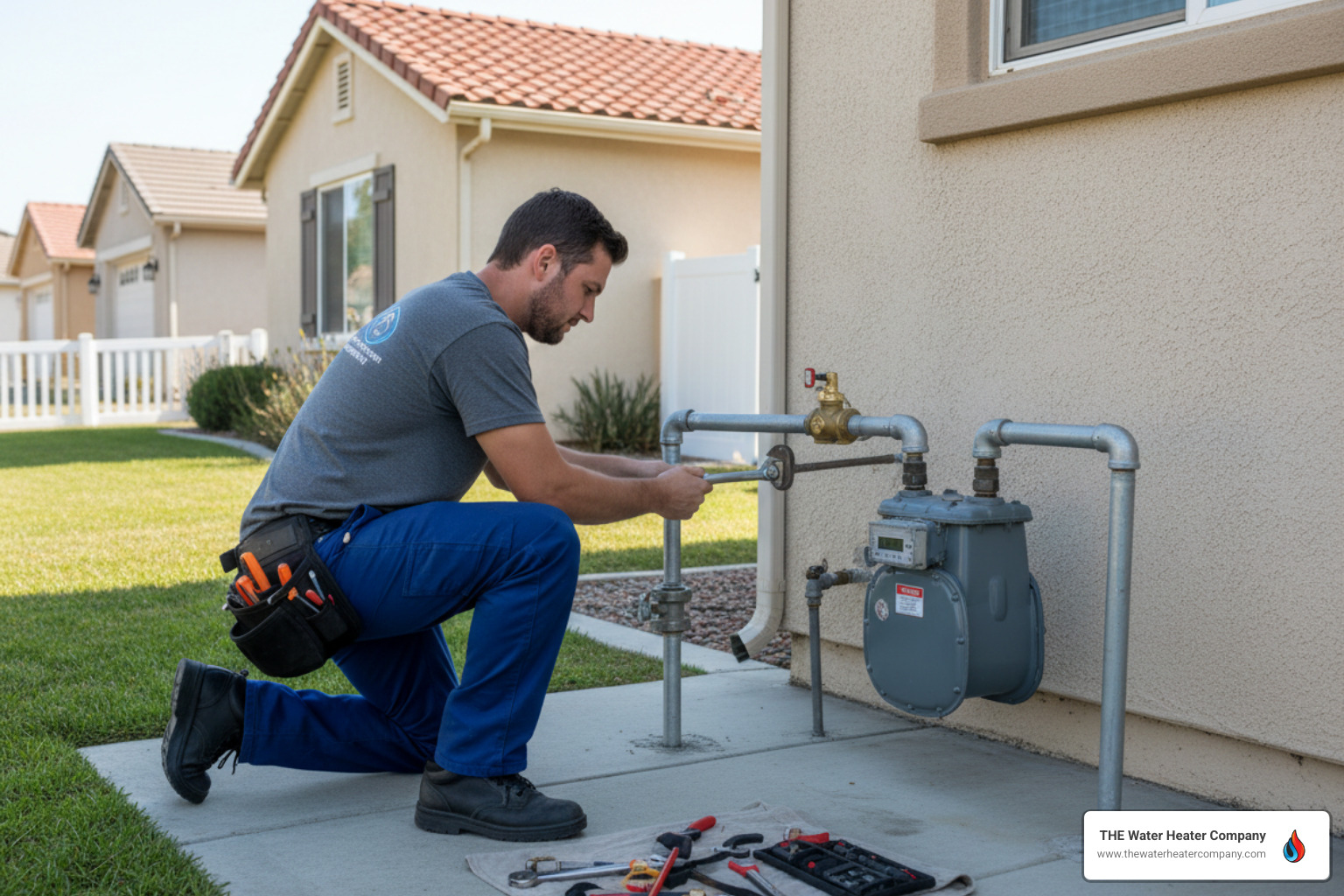
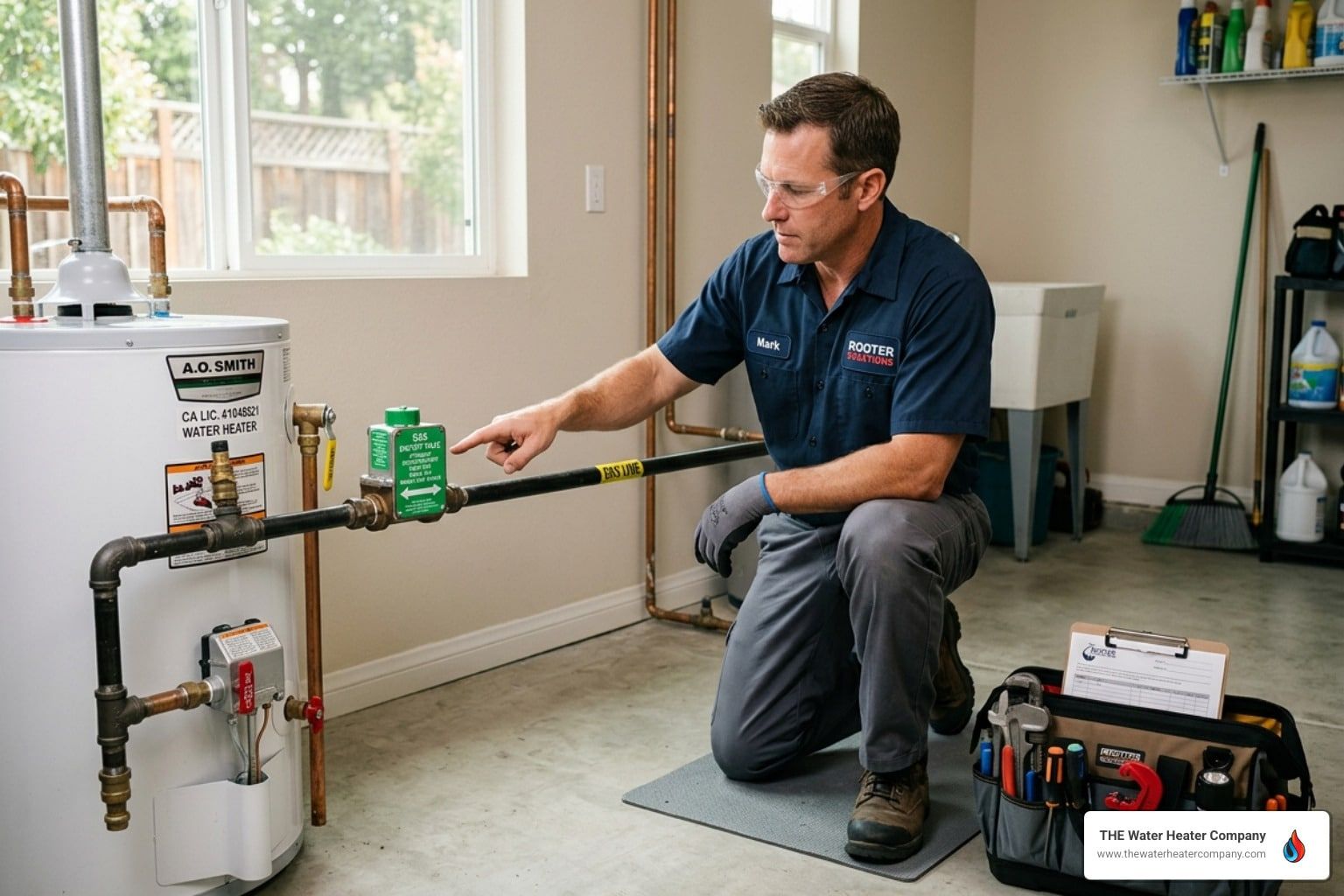
Professional plumber installing an earthquake gas shutoff valve on a home gas line

The Boundary of Responsibility: Homeowner vs. Utility Side

A common point of confusion is where the valve actually goes. Your gas meter assembly is split into two halves: the utility side and the homeowner side.

  • The Utility Side: This includes the underground service line, the regulator, and the meter itself. This equipment belongs strictly to the gas utility company (such as SoCalGas). Under CPUC Decision 01-11-068, unauthorized installations on utility-owned facilities are strictly prohibited.
  • The Homeowner Side: This is the pipe (often called the house line) that exits the meter and runs directly into your home to supply your water heater, furnace, and stove.

Your earthquake valve must be installed on your house line, right after the meter.

Step-by-Step Installation Walkthrough

When our licensed technician arrives at your home, here is the exact sequence of events:

  1. Permits and Prep: We ensure all local building permits are secured.
  2. Gas Shutoff: We turn off the main gas supply at the meter inlet valve to ensure a completely safe working environment.
  3. Pipe Modification: We carefully cut and thread the existing house line pipe to accommodate the new valve.
  4. Mounting and Bracing: The valve is mounted. It must be installed perfectly level to ensure the internal steel ball mechanism is balanced correctly. We then install rigid structural bracing to secure the valve to the exterior of your home. This bracing is critical; without it, minor everyday vibrations (like a slamming door or a ball bouncing off the wall) could accidentally trigger the valve.
  5. Pressure and Leak Testing: Once the valve is secured, we perform a rigorous pressure test and apply a specialized leak-detection solution to every single connection joint to guarantee there are zero gas leaks.
  6. Restoring Service: We turn the main gas supply back on, carefully purging any air from the lines.

To ensure your entire gas system meets strict local safety standards, we also verify that your other gas appliances are up to code. For instance, you can review standard water heater requirements in our detailed article on Water Heater Installation Codes in California.

How to prepare for earthquake valve installation what to expect

To make the installation process as quick and seamless as possible, there are a few simple ways you can prepare your home before our team arrives:

  • Clear the Area: Ensure there is at least a 3-foot clear path around your outdoor gas meter. Remove any overgrown landscaping, stored boxes, or debris. The technician will need ample physical space to work, and the valve itself requires 5 to 6 inches of clear wall space for the reset shaft to operate properly.
  • Keep Pets Secured: Since our technicians will be moving between your outdoor meter and indoor gas appliances, please keep your furry family members safely secured in a separate room.
  • Plan for a Brief Outage: Your gas will be completely shut off for a portion of the installation. This means your gas-powered water heater, stove, dryer, and fireplace will be temporarily out of service.

If you are ready to schedule your upgrade, you can learn more about our complete range of professional gas line and water heater services on our Services page.

Post-earthquake valve installation what to expect

Once the physical valve is securely in place, the job isn’t quite finished. We take several critical steps to ensure your home is fully functional and safe before we pack up:

  • Relighting Pilot Lights: Turning the gas back on means all your gas appliances will need their pilot lights relit. Our technician will personally go through your home to safely relight the pilots on your water heater, furnace, stove, and fireplace.
  • Safety Walkthrough: We will walk you through the installation, showing you exactly where the valve is, how to read its status indicator, and what to do if it ever triggers during a tremor.
  • Documentation: We provide you with the necessary documentation to prove compliance with local building codes, which is incredibly valuable if you plan to sell your home or need to update your homeowner’s insurance policy.

For quick answers to common homeowner questions regarding our installation processes, browse our FAQs page.

Testing, Maintenance, and Resetting Your Valve

An earthquake valve is a passive safety device, meaning it sits quietly for years waiting to do its job. To make sure it is ready to perform when a real emergency strikes, basic ongoing care is essential.

Checking the Status Indicator

Your valve features a clear status indicator window on the front.

  • Green or Silver Bar: The valve is open, and gas is flowing normally.
  • Red Bar: The valve has tripped and is completely closed, shutting off the gas supply.

Annual Testing

We recommend inspecting your valve at least once a year. During this visual check, verify that the valve assembly remains perfectly level and free of rust, dirt, or physical damage. You can also test its function by manually tripping the valve (according to the manufacturer’s instructions), verifying that your gas appliances lose supply, and then resetting it.

Securing your gas line is just one part of a complete home safety plan. If you want to make sure your water heater doesn’t tip over and rupture its connections during a quake, follow the steps in our guide, Secure Your Water Heater for Earthquakes in 4 Easy Steps.

How to Reset Your Valve After an Earthquake

If a major earthquake triggers your valve, do not immediately reset it. The valve did its job by shutting off the gas to prevent a fire. Before restoring the gas flow, you must ensure that there are no active leaks in your home.

  1. Check for Leaks: Smell for gas (the classic “rotten egg” odor) and listen for any hissing sounds. If you suspect a leak, leave the premises immediately and contact emergency services.
  2. Professional Inspection: We strongly advise having a licensed professional inspect your gas lines and appliances to verify that no pipes cracked or shifted during the shaking.
  3. Resetting the Valve: Once safety is verified, you can reset the valve. This is typically done using a flathead screwdriver to slowly turn the reset shaft clockwise until the indicator window changes from red back to green/silver.

Frequently Asked Questions about Earthquake Valves

Where should the earthquake valve be installed?

The valve must be installed on your property’s private “house line,” which is the pipe downstream of the gas meter. Under CPUC regulations, you are strictly prohibited from installing any devices on the utility-owned side of the meter.

Can I reset the earthquake valve myself after a tremor?

While it is mechanically possible to reset the valve yourself using a flathead screwdriver on the reset shaft, you should only do so after a qualified professional has thoroughly inspected your home’s gas lines. Resetting a valve when there is an undetected leak inside your walls can lead to catastrophic fires or explosions.

Do earthquake valves require electricity to operate?

No. These valves are entirely mechanical, relying on a balanced steel ball or pendulum mechanism. They require zero electrical power or batteries, ensuring they work flawlessly even during widespread power outages.

Conclusion

Protecting your Southern California home from seismic hazards requires a proactive approach. By pairing a professionally installed earthquake valve with a properly braced water heater, you drastically minimize the risk of post-earthquake fires and gas leaks.

At THE Water Heater Company, we are proud to serve communities across Southern California, including Santa Barbara, Camarillo, Santa Clarita, Pasadena, Van Nuys, Los Angeles, Santa Ana, and Irvine. Our family-owned business is dedicated to keeping your home safe, comfortable, and fully compliant with all local safety codes.

If you are ready to secure your home’s gas lines and water heating systems, contact us today to learn more about our professional Earthquake Valves installation services!

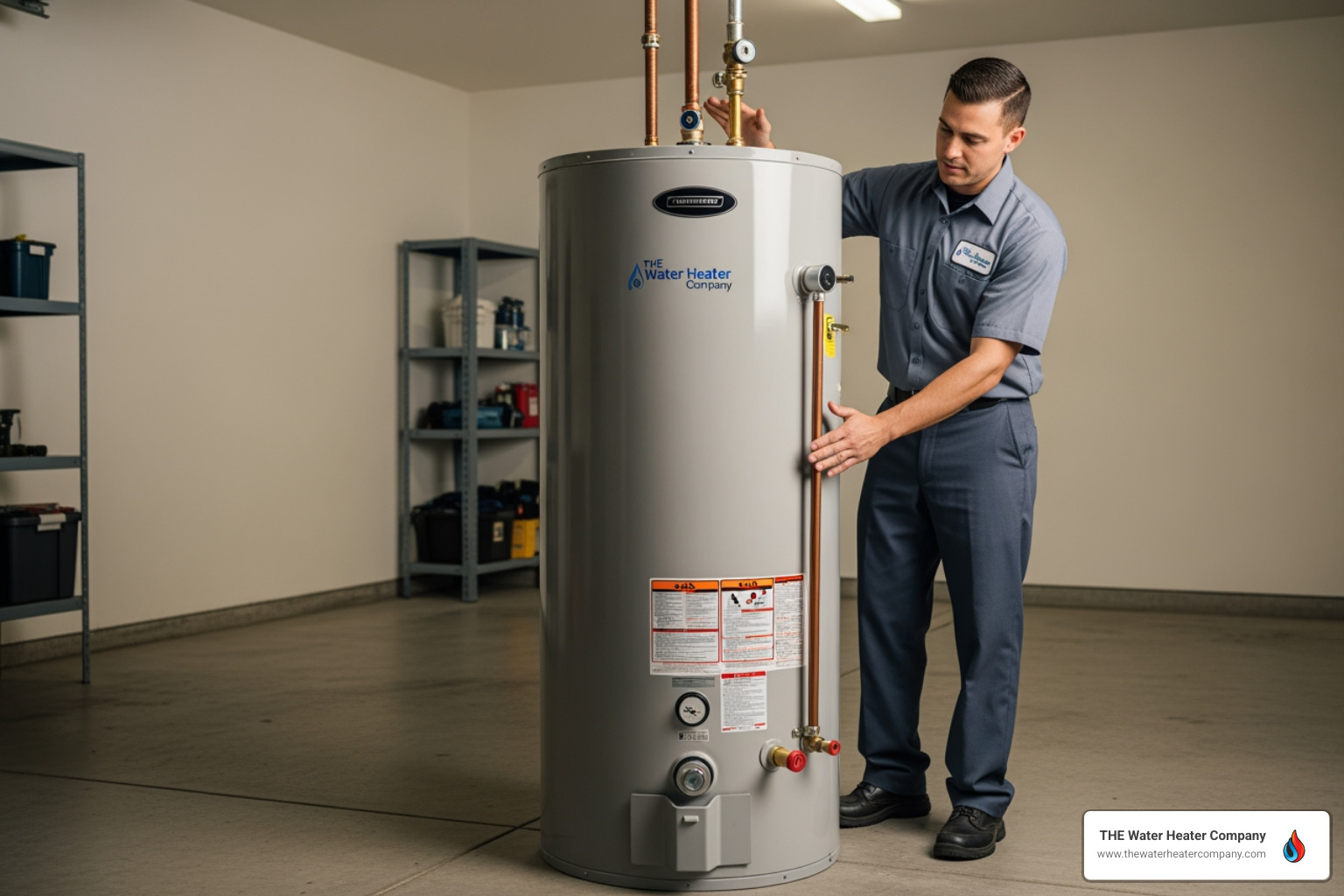
water heater strapped to wall in Southern California garage seismic safety

Secure Your Water Heater for Earthquakes in 4 Easy Steps

Why Knowing How to Secure Your Water Heater for Earthquakes Could Save Your Home

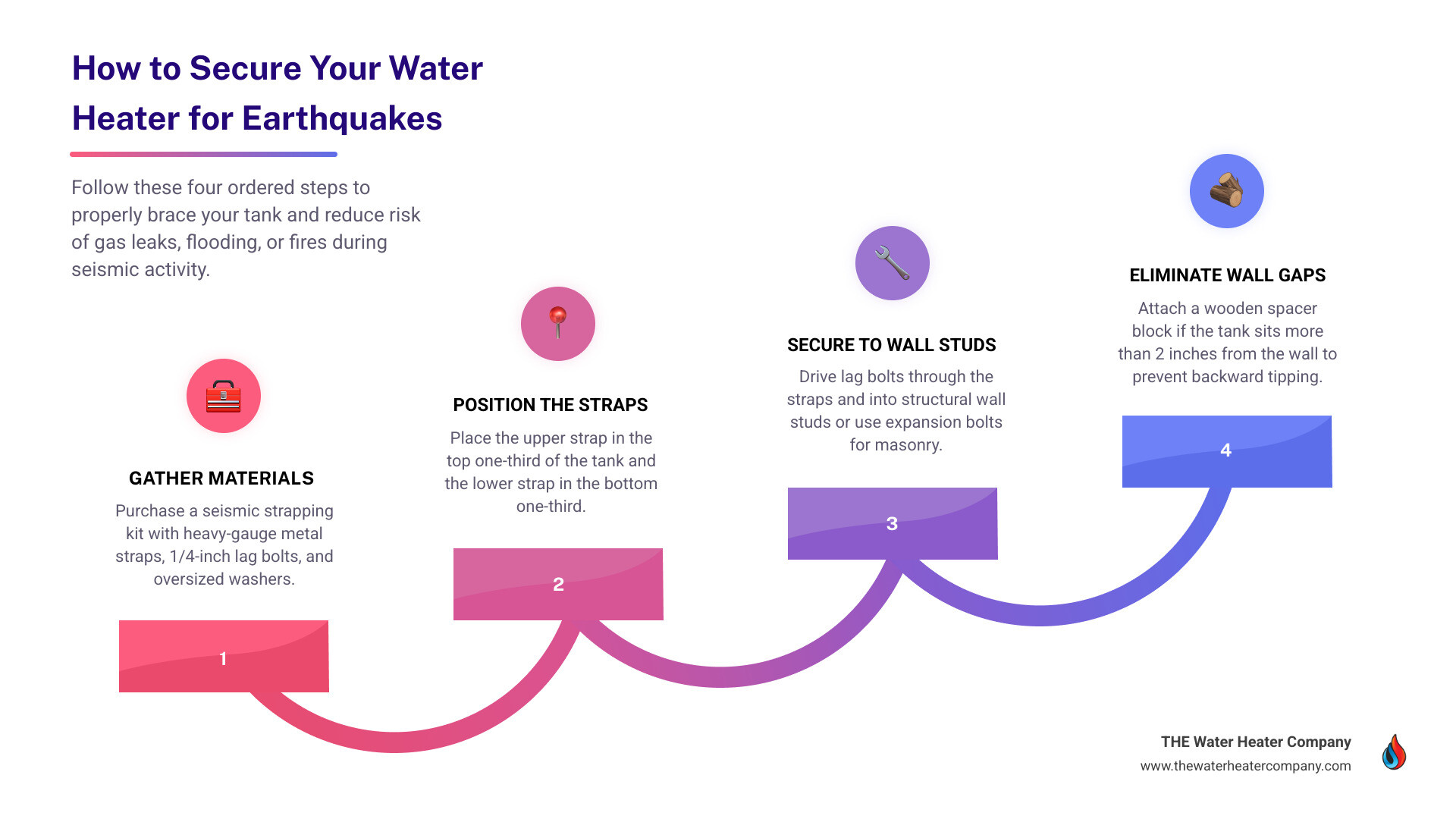
How to secure your water heater for earthquakes comes down to four key steps:

  1. Gather materials – Purchase a seismic strapping kit with heavy-gauge metal straps, 1/4-inch lag bolts, and oversized washers
  2. Position the straps – Place the upper strap in the top one-third of the tank and the lower strap in the bottom one-third
  3. Secure to wall studs – Drive lag bolts through the straps and into structural wall studs (or use expansion bolts for masonry)
  4. Eliminate wall gaps – If the tank sits more than 2 inches from the wall, attach a wooden spacer block to prevent backward tipping

An unsecured water heater is one of the most overlooked hazards in a Southern California home. A full 50-gallon tank weighs roughly 450 pounds — and during a tremor, that mass doesn’t just fall quietly. It can rupture gas lines, flood your home, and trigger fires that spread fast. After both the 1989 Loma Prieta and 1994 Northridge earthquakes, investigators found that single-strap and plumber’s tape bracing methods failed repeatedly, driving major changes to how experts recommend securing these units today.

The good news? Proper bracing is a straightforward project most homeowners can complete in an afternoon — and it’s also a legal requirement in California for any new or replacement water heater installed since July 1, 1991.

I’m Anthony Hamilton, Co-Founder and CEO of THE Water Heater Company, and I’ve spent years helping Southern California homeowners understand how to secure your water heater for earthquakes as part of safe, code-compliant installations across the region. In the guide below, I’ll walk you through everything you need to know to protect your home, your family, and your water supply.

Infographic showing 4 steps to secure a water heater for earthquakes with strap placement and risks of unsecured tanks

Why Learning How to Secure Your Water Heater for Earthquakes is Essential

When you think of earthquake preparedness, you likely think of “drop, cover, and hold on.” But preparedness starts long before the ground moves. In places like Santa Clarita, Pasadena, and Los Angeles, your water heater is a silent giant. When full, a standard 50-gallon unit weighs about 450 pounds. During a significant seismic event, gravity alone cannot hold that weight in place. Without mechanical bracing, this mass becomes a dangerous projectile.

If a water heater topples, the consequences are often a triple-threat of disaster:

  • Fire Hazards: As the tank falls, it can snap rigid gas lines, leading to immediate leaks and potential explosions.
  • Flooding Risks: Ruptured water lines can dump 30 to 50 gallons of water instantly, followed by a continuous flow from the main line until it is manually shut off.
  • Structural Damage: 450 pounds of shifting metal can easily crush nearby items or even damage the structural framing of your garage or utility closet.

By mastering Water Heater Installation in Southern California, you aren’t just following the law; you are creating a buffer of safety for your entire household.

Technician showing the heavy weight and potential movement of a full water heater tank during a tremor

Protecting Your Emergency Water Supply

One of the most practical reasons to secure your tank is that it serves as a “backup reservoir.” After a major disaster, municipal water supplies may be contaminated or shut off. A secured, upright water heater contains up to 50 gallons of potable water. If the tank remains standing, you can connect a garden hose to the drain spout at the bottom, open a nearby faucet to vent the system, and access fresh water for drinking and hygiene. If the tank falls and ruptures, that vital resource is lost to the floor.

Preventing Catastrophic Gas Leaks

In California, gas-related fires are a leading cause of property loss after earthquakes. Rigid piping has no “give.” When the tank moves, the pipe snaps. This is why understanding The Law of the Land California Gas Valve Rules is so important. Securing the tank ensures that the connection to the gas supply remains intact, preventing the invisible threat of a gas leak from turning a tremor into a tragedy.

California has some of the strictest seismic safety laws in the country, and for good reason. Under California Health and Safety Code 19211, all water heaters must be braced, anchored, or strapped to resist falling or horizontal displacement due to earthquake forces. This mandate applies to any new or replacement water heater sold or installed on or after July 1, 1991.

Current 2020 February Water Heater Installation Codes in California require a minimum of two sets of straps. Depending on the size of the unit (specifically those over 52 gallons), a third strap may even be required at the mid-point to prevent the tank from buckling.

Mandatory Bracing for Property Transfers

If you are planning to sell your home in Santa Ana, Irvine, or anywhere in Southern California, your water heater will be a focal point of the safety inspection. Real estate compliance laws require sellers to certify that the water heater is properly braced. If it isn’t, it can delay the closing of your home. It’s a simple fix that prevents major headaches during a property transfer.

The Shift from Single to Double Strapping

The history of how to secure your water heater for earthquakes is written in the lessons of past disasters. Before the 1989 Loma Prieta and 1994 Northridge earthquakes, many homes used a single strap across the middle of the tank. Data from those events showed that tanks simply “pivoted” out of the single strap or burst through thin plumber’s tape. As a result, the Division of the State Architect (DSA) updated guidelines to the double-strap method we use today, ensuring both the top and the base are stabilized.

Step-by-Step Guide: How to Secure Your Water Heater for Earthquakes

Ready to get to work? Securing your tank is a manageable DIY project, but it requires the right materials. Avoid using standard “plumber’s tape” (the thin, perforated metal ribbon), as it can stretch or tear under the extreme kinetic energy of a quake. Instead, look for a California-approved seismic strapping kit.

Feature Plumber’s Tape Heavy-Gauge Metal Strapping
Material Thin, flexible 24-gauge steel Heavy-duty steel
Durability May stretch or snap Designed for seismic loads
Code Compliance Generally not approved for >40 gal Fully compliant with CA Code
Safety High failure rate in Northridge Industry standard for safety

For a deep dive into what to expect during this process, check out Water Heater Installation in Southern California What Homeowners Should Know.

Step 1: Gather Materials and Locate Wall Studs

You will need:

  • A seismic strapping kit (includes straps, lag bolts, and tensioners)
  • A stud finder
  • A power drill with a 3/16-inch drill bit
  • A socket wrench

Start by using your stud finder to locate the vertical wood studs behind the water heater. You must anchor into the structural members of the home—not just the drywall. If your heater is against a masonry or concrete wall, you will need 1/4-inch expansion bolts instead of lag screws.

Step 2: Position the Upper and Lower Straps

Placement is everything.

  • Upper Strap: Should be positioned in the upper one-third of the tank, at least 9 inches below the top cap.
  • Lower Strap: Should be in the lower one-third of the tank, at least 4 inches above the gas control valve or thermostat.

Step 3: Secure the Straps to the Structure

Drill pilot holes into the center of the studs to prevent the wood from splitting. Wrap the heavy-gauge strap around the tank—some experts recommend 1.5 wraps for maximum grip—and secure it to the wall using 1/4-inch x 3-inch lag bolts and oversized washers. The bolts should penetrate the wood by at least 1.5 inches. Once attached, use the cinch mechanism or tension bolts to tighten the straps until they are snug. They should be tight enough to prevent movement but not so tight that they dent the tank’s outer shell.

Step 4: Eliminate Gaps with Spacers

If there is a gap larger than 1 to 2 inches between the tank and the wall, the water heater can still “rock” backward, potentially shearing the bolts. To fix this, attach a wooden spacer block (a scrap piece of 2×4 works perfectly) to the wall stud behind the tank. This ensures the tank has a solid surface to lean against, providing 360-degree stability.

Upgrading to Flexible Connectors and Safety Valves

Even with the best straps, the ground movement in Southern California can be violent. This is where “flexibility” becomes your best friend. Rigid copper or galvanized piping is prone to snapping when the house and the tank move at different frequencies.

Why Flexible Water and Gas Lines are Critical

We highly recommend replacing any rigid piping with corrugated stainless steel or braided metal flexible connectors. These act like shock absorbers, allowing the tank to shift slightly without breaking the seal. This simple upgrade is one of the most effective ways to prevent post-earthquake flooding and fires.

Automatic Seismic Shut-off Valves

For ultimate peace of mind, consider an automatic Earthquake Valve. These valves are installed on your main gas line and are designed to automatically trip and shut off the gas flow when they sense a magnitude 5.4 earthquake or higher. This takes the “human element” out of the equation—if you aren’t home or can’t reach the gas meter, the valve does the work for you. Combined with Pressure Regulators, these components form a comprehensive safety shield for your home. You can find these as part of our specialized Services.

Long-Term Maintenance for Your Earthquake Straps

As of May 2026, many homes in the Van Nuys and Camarillo areas have straps that were installed a decade or more ago. Like any safety equipment, these require regular inspection.

We recommend a quick check every 6 months:

  • Check Tension: Give the tank a gentle “nudge.” If it wiggles, tighten the cinch bolts.
  • Inspect for Corrosion: In humid areas or garages, metal straps can rust. If you see significant corrosion, replace the kit.
  • Verify Bolt Integrity: Ensure the lag bolts haven’t pulled away from the wall or loosened over time.
  • Post-Seismic Check: Always inspect your straps immediately after any earthquake felt in your area.

At THE Water Heater Company, we prioritize these details because we know the stakes. Why Choose Us? Because we don’t just install tanks; we build safety systems tailored to the unique seismic needs of Southern California.

Frequently Asked Questions about how to secure your water heater for earthquakes

Is plumber’s tape sufficient for how to secure your water heater for earthquakes?

No. Standard 24-gauge perforated plumber’s tape is generally considered insufficient for modern safety standards, especially for tanks 40 gallons or larger. It is too thin and can stretch or snap under the weight of a shifting 450-pound tank. Always use heavy-gauge metal strapping kits specifically labeled for seismic use.

Do tankless units require the same strapping method?

Tankless water heaters do not use traditional straps because they don’t have a large, cylindrical tank. Instead, they require a different approach to how to secure your water heater for earthquakes. They must be mounted to a structural backing plate (like 3/4-inch plywood) or directly into wall studs using heavy-duty bolts and vibration-isolation mounts. This ensures the unit doesn’t “bounce” off the wall during a tremor.

How often should I inspect my seismic bracing?

As of May 2026, industry standards suggest an annual inspection at the very least. However, given the active fault lines in Southern California, checking your straps every six months and after any noticeable tremor is the safest practice. Look for signs of metal fatigue, loose bolts, or shifting of the tank.

Conclusion

Securing your water heater is one of the most cost-effective and impactful ways to protect your home from earthquake damage. From preventing catastrophic fires and floods to preserving a vital emergency water supply, the benefits are undeniable. Whether you are in Santa Barbara, Pasadena, or Irvine, the team at THE Water Heater Company is here to ensure your home meets the highest safety standards.

Don’t wait for the next tremor to find out if your bracing is up to the task. If you’re unsure about your current setup or need a professional touch, we’re here to help with expert safety audits and installations.

Secure your home with expert earthquake valve installation and give your family the peace of mind they deserve. Reach out to us today—we’re your local Southern California experts in keeping the hot water flowing and the home standing tall.

california earthquake valve requirements explained

The Law of the Land: California Gas Valve Rules

Understanding Seismic Gas Shutoff Valves and How They Work

At its simplest, a seismic gas shutoff valve (often called an earthquake valve) is a motion-sensitive security guard for your home’s gas system. It sits on your main gas line and waits for a specific type of “shaking signature.”

These valves use a seismic sensor—usually a precision-engineered ball or pendulum—that is designed to stay perfectly still during normal vibrations, like a heavy truck driving by or a door slamming. however, when the ground moves with the force of a significant earthquake (typically a magnitude of 5.1 to 5.4 or higher), the sensor is dislodged. This movement triggers an actuator that immediately snaps the valve shut, blocking the flow of natural gas into your home.

One of the most important things to understand is that once these valves trigger, they stay closed. They do not automatically reset when the shaking stops. This is a safety feature; if an earthquake was strong enough to trip the valve, there is a high probability that your internal gas pipes or appliances (like your water heater) may have shifted or cracked. By requiring a manual reset, the system ensures that a human—ideally a professional—checks for leaks before the gas is turned back on.

If you are curious about the specific models we recommend for Southern California homes, you can find more info about earthquake valves on our dedicated service page.

California Earthquake Valve Requirements Explained

The legal backbone of these safety measures is found in the California Health and Safety Code, specifically Sections 19180 through 19183. These statutes authorize local governments to mandate the installation of these devices to protect the public.

However, a valve can’t just be any “off-the-shelf” part. To be legally installed in California, the valve must be certified by the Division of the State Architect (DSA). The certification process is rigorous. Manufacturers must submit their valves to independent laboratories to prove they meet S.B. Standard 12-16-1. This standard ensures the valve won’t shut off accidentally during minor tremors but will reliably activate the moment a dangerous quake hits.

Seismic Gas Shutoff Valves vs. Excess Flow Valves

Many homeowners ask us if an Excess Flow Valve (EFV) is the same thing. It isn’t. While both are safety devices, they protect against different threats.

Feature Seismic Gas Shutoff Valve Excess Flow Valve (EFV)
Trigger Ground motion/earthquake Massive gas leak/rupture
Primary Goal Prevent fires after a quake Stop flow if a pipe is severed
Installation On your house line (downstream) Often on the utility’s service line
California Law Mandatory in many local ordinances Often optional or utility-managed

While an EFV is great if a contractor accidentally digs through your gas line, it may not trigger during an earthquake if the leak is small but still dangerous. That is why california earthquake valve requirements explained almost always focus on the seismic-motion-activated variety.

Local Ordinances: Los Angeles and Southern California Standards

While state law provides the framework, local cities decide when the “trigger” happens for your specific property. As we operate across Santa Barbara, Ventura, Los Angeles, and Orange Counties, we see how these rules shift across city lines.

The Los Angeles Standard (Ordinance 171874)

The City of Los Angeles has some of the strictest rules in the nation. Under Los Angeles Ordinance 171874, a seismic gas shutoff valve is required for:

  • New Construction: Any building with fuel gas piping that was issued a permit on or after September 1, 1995.
  • Major Alterations: Any existing building undergoing additions, alterations, or repairs valued at more than $10,000. For residential properties, this trigger has been in effect since January 10, 1998.
  • Property Sales: This is the one that catches most people. Before you sell a home or a condo in Los Angeles, a compliant valve must be installed. The law technically requires this prior to the sale, but it is often handled within the 12-month window surrounding the close of escrow.

Beyond Los Angeles

Other areas we serve, like Pasadena, Santa Ana, and Irvine, follow the California Plumbing Code but may have their own specific “point-of-sale” requirements or permit triggers. For instance, in many jurisdictions, if you are replacing a water heater and the work requires a permit, the inspector may check to ensure a seismic valve is present and properly mounted.

If you’re planning a project in the city, you can find more info about services in Los Angeles to see how we help neighbors stay compliant.

Professional Installation, Certification, and Warranty Standards

You cannot simply zip-tie a seismic valve to a pipe and call it a day. The california earthquake valve requirements explained in the building code are very specific about how the installation must look.

  1. Rigid Mounting: The valve must be rigidly attached to the exterior of the building. Because the valve relies on sensing ground motion, if it is “flopping” on a loose pipe, it might not trigger correctly or could trigger falsely.
  2. Downstream of the Meter: The valve must be installed on the “customer-owned” side of the gas system. This means it goes after the utility meter. You are generally prohibited from installing your own equipment on the utility’s side (upstream).
  3. Licensed Installation: In California, these must be installed by a State-licensed contractor. This ensures the gas line is properly sized, the joints are leak-tested, and the valve is oriented correctly (many are gravity-dependent).
  4. Labeling and Warranty: Every certified valve must have a permanent, tamper-evident label showing the DSA certification number. Additionally, state regulations require these valves to come with a 30-year warranty from the manufacturer, guaranteeing they will function when called upon.

At THE Water Heater Company, we ensure that every installation meets these rigid standards, especially during a water heater replacement, which is the most common time for homeowners to upgrade their seismic safety.

licensed plumber installing seismic gas shutoff valve on residential gas line - california earthquake valve requirements

Frequently Asked Questions

What are the California earthquake valve requirements explained for property sales?

If you are selling a home in Los Angeles, the law requires a seismic gas shutoff valve to be installed on all fuel gas lines serving the building. If you are selling an individual condominium unit, the valve must be installed on the line serving that specific unit. Often, the buyer and seller negotiate this during escrow, but the city requires proof of compliance to finalize the transfer. In other Southern California cities, the requirement may be triggered by the plumbing permit pulled during the retrofitting process.

Who is qualified to meet the California earthquake valve requirements explained in state law?

Generally, a licensed plumbing contractor (C-36) or a general contractor is required to perform the installation. While a homeowner can technically install one on their own single-family dwelling (if they are a “qualified installer”), we strongly advise against DIY gas work. Natural gas is highly volatile, and an incorrectly installed valve might not only fail to protect you but could create a leak itself. For peace of mind, most Southern Californians rely on professional plumbing services to ensure the job is done to code.

Are there exceptions to these seismic valve mandates?

Yes, there are a few exceptions. Most notably:

  • Public Utilities: Systems owned and operated by the utility company (like SoCalGas) are exempt from these specific customer-side regulations.
  • Staffed Buildings: Some government or commercial buildings with 24-hour on-site maintenance staff and seismically designed piping may be exempt if they have an approved emergency plan.
  • Existing Installations: If you had a valve installed before the 1995/1998 mandates, it is usually “grandfathered” in as long as it is maintained and remains functional. However, if you do a major renovation or sell the home, you will likely need to upgrade to a modern, certified model.

Conclusion

Navigating california earthquake valve requirements explained doesn’t have to be a headache. Whether you are in Santa Barbara, Camarillo, Santa Clarita, or down in Irvine, the goal is the same: keeping your family and your property safe from the secondary fires that so often follow a major quake.

At THE Water Heater Company, we take pride in being the local, family-owned experts that Southern California trusts. From Van Nuys to Santa Ana, our technicians are trained to spot compliance issues before they become expensive problems during a home sale or inspection. We don’t just “fix things”—we ensure your home’s gas and water systems are resilient enough to handle whatever the San Andreas Fault throws our way.

If you’re unsure whether your current valve is up to code, or if you’ve recently received a notice during a home sale, give us a call. We’re here to help you get compliant and stay safe. Be sure to check out our current specials and rebates to see how we can make your next safety upgrade even more affordable. Stay safe, Southern California!

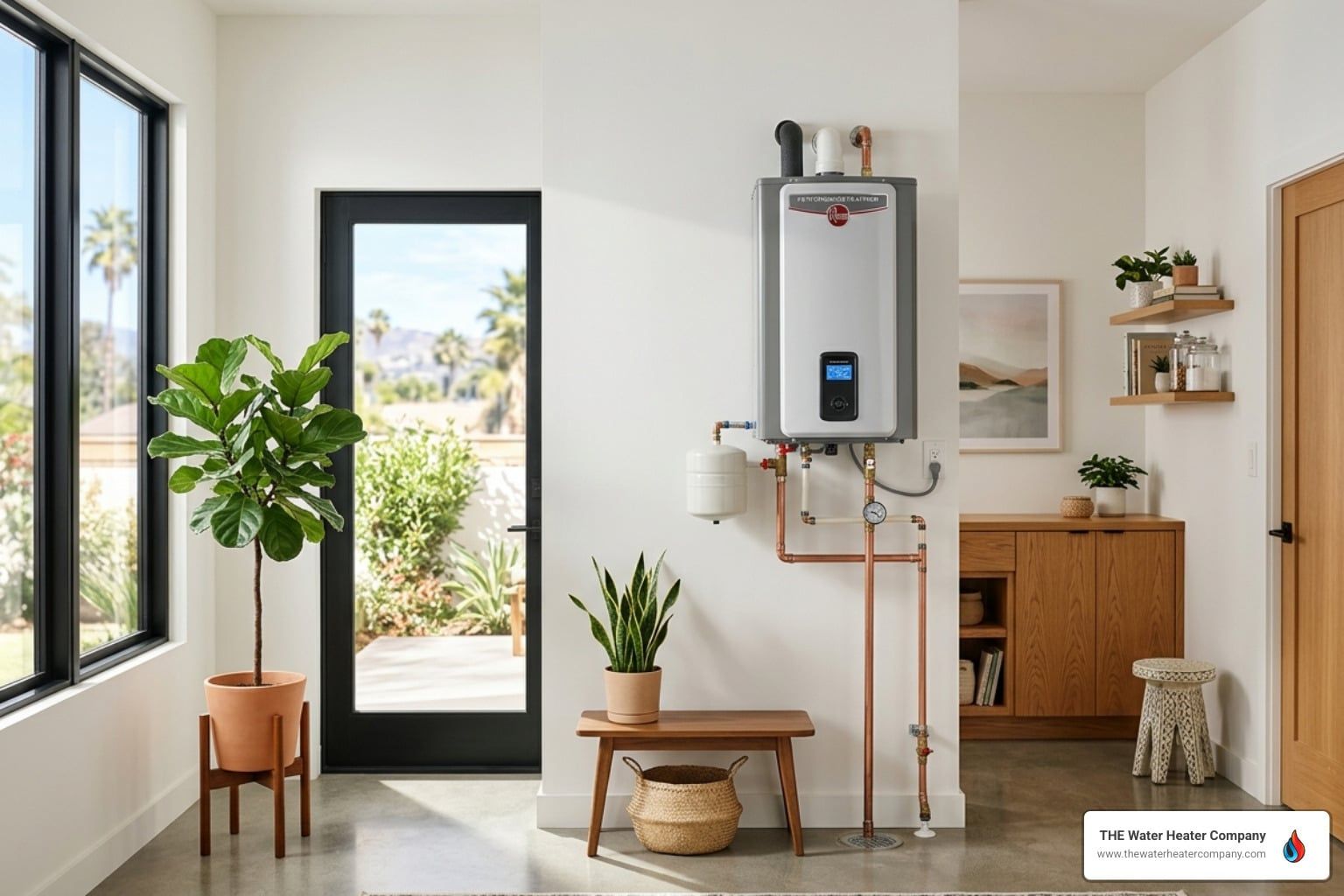
heat pump water heater in a modern Southern California home - federal tax credits for heat pump water heaters

Uncle Sam Wants to Pay for Your New Heat Pump Water Heater

Federal Tax Credits for Heat Pump Water Heaters: What Every Southern California Homeowner Should Know First

Federal tax credits for heat pump water heaters are one of the most valuable energy incentives available to U.S. homeowners right now — and if you installed a qualifying unit by December 31, 2025, you may be able to claim up to $2,000 back on your federal taxes this April.

Here’s the quick version:

Key Detail What You Need to Know
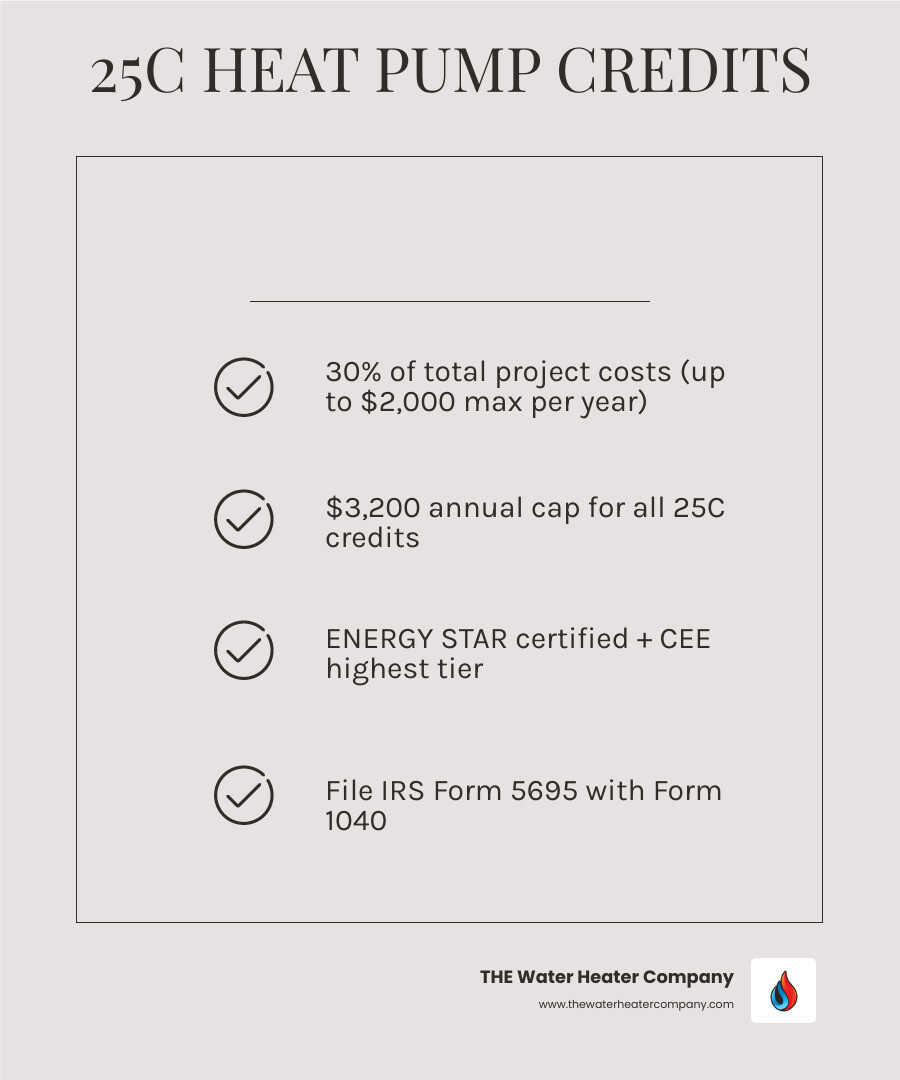
Credit amount 30% of total project costs
Maximum credit $2,000 per year
Eligibility window January 1, 2023 – December 31, 2025
Annual cap (all 25C credits) $3,200 total
Income limits None — available to any taxpayer who owes federal income tax
How to claim IRS Form 5695, filed with your federal tax return
Qualifying products ENERGY STAR certified units meeting the CEE highest efficiency tier
Who qualifies Homeowners (primary or secondary residences) and renters improving their principal residence
New for 2025 Qualified Manufacturer ID (QMID) required on your tax return

This credit comes from Section 25C of the tax code, updated by the Inflation Reduction Act, and it’s designed to reward homeowners who make the switch to high-efficiency electric water heating — technology that can be up to five times more efficient than a standard water heater.

Whether you’re filing your 2025 taxes right now or you installed your heat pump water heater earlier in the eligibility window and want to make sure you claimed everything correctly, this guide walks you through everything — eligibility, qualifying products, how to file, and how to stack credits to maximize your total savings.

I’m Anthony Hamilton, Co-Founder and CEO of THE Water Heater Company, and after years of helping Southern California homeowners navigate heat pump water heater installations — including walking customers through how to take full advantage of federal tax credits for heat pump water heaters — I’ve seen how much money gets left on the table simply due to confusion about the rules. Let’s make sure that doesn’t happen to you.

Infographic showing 30% federal tax credit breakdown for heat pump water heaters, $2,000 cap, $3,200 annual limit, and Form

Understanding the Federal Tax Credits for Heat Pump Water Heaters

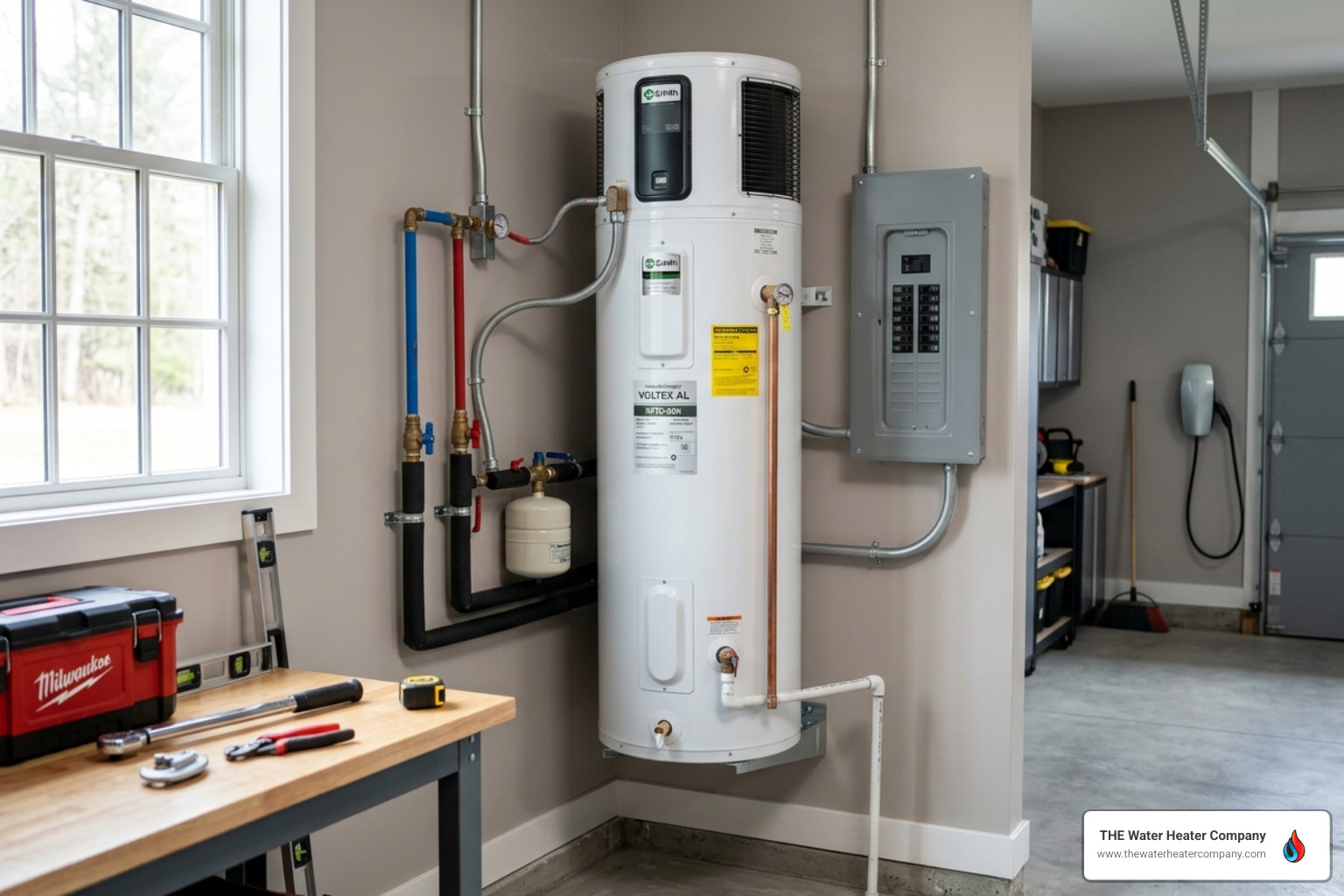
high-efficiency heat pump water heater installation in a garage - federal tax credits for heat pump water heaters

When we talk about the federal tax credits for heat pump water heaters, we are referring specifically to the Energy Efficient Home Improvement Credit, governed by Section 25C of the Internal Revenue Code. This isn’t just a small deduction from your taxable income; it is a dollar-for-dollar credit against the federal income taxes you owe.

The credit is worth 30% of the total project cost. This includes not just the unit itself, but also the labor for professional installation—which is a huge win for homeowners in areas like Santa Clarita or Pasadena where professional labor is an essential part of a safe, code-compliant install. However, there is an annual limit: you can claim up to $2,000 per year for heat pumps and heat pump water heaters combined.

It is important to understand that this is a non-refundable tax credit. In simple terms, this means the credit can reduce the tax you owe to zero, but the IRS won’t cut you a check for any “extra” credit amount that exceeds your tax liability for the year. Additionally, unlike some solar credits, you cannot “carry forward” any unused portion of this specific 25C credit to future tax years. If you don’t use it in the year of installation, you lose it.

To explore the specific units we install that meet these rigorous standards, you can check out more info about our products.

Eligibility Requirements for Homeowners and Renters

Whether you are living in a historic home in Pasadena or a modern condo in Irvine, understanding who can actually claim these federal tax credits for heat pump water heaters is step one. The good news is that the eligibility criteria are quite broad, but there are a few “gotchas” to keep in mind.

First, the property must be located in the United States and used as a residence by the taxpayer. This includes:

  • Principal Residences: Your main home where you live most of the year.
  • Second Homes: Unlike some other energy credits, you can claim the credit for a heat pump water heater installed in a second home, provided you actually use it as a residence (it can’t be a property you only rent out).
  • Renters: If you are a tenant and you pay for the installation of a qualifying heat pump water heater in your primary rental residence, you are eligible to claim the credit.

However, landlords who do not live in the property cannot claim this credit for their rental units. The credit is intended for the person actually living in and supporting the home’s energy costs. For those considering a transition from an old gas unit, you can find more info about water heater replacement on our site.

Which federal tax credits for heat pump water heaters qualify?

Not every water heater with a “heat pump” label qualifies for the full $2,000 credit. To be eligible, the unit must meet two primary technical benchmarks:

  1. ENERGY STAR Certified: The unit must meet the version 5.0 (or higher) ENERGY STAR specifications.
  2. CEE Highest Efficiency Tier: It must meet or exceed the highest efficiency tier (not including any “advanced” tiers) established by the Consortium for Energy Efficiency (CEE) that was in effect at the start of the year the unit was installed.

Most top-tier manufacturers design their hybrid heat pump models specifically to meet these standards, but we always recommend verifying the manufacturer’s certification statement before finalizing your purchase.

Occupancy and property standards for the 25C credit

The 25C credit is specifically for “existing” homes. If you are building a brand-new home from the ground up, you generally cannot claim this specific credit, as new construction falls under different builder-focused incentives.

The definition of an “existing home” is flexible—it includes single-family houses, mobile homes, cooperatives, condominiums, and even houseboats, as long as they serve as a residence. If you use a portion of your home for business (more than 20%), the credit amount may need to be allocated proportionally, so it’s always wise to consult with a tax professional if you run a large home office or business out of your Santa Barbara or Van Nuys residence.

How to Claim Your 25C Energy Efficient Home Improvement Credit

Claiming your credit doesn’t have to be a headache, but it does require some specific paperwork. Since we are currently in the April 2026 tax season, you’ll be looking at the installation you completed during the 2025 calendar year.

The primary document you need is IRS Form 5695, titled “Residential Energy Credits.” You will specifically look at Part II of this form to calculate and report your Energy Efficient Home Improvement Credit. Once calculated, this amount is transferred to your Form 1040 to reduce your total tax bill.

If the upfront cost of these high-efficiency systems is a concern, we offer various ways to make the transition easier; look at more info about financing.

Filing for federal tax credits for heat pump water heaters

When you sit down to file, ensure you have your final invoice from THE Water Heater Company handy. You will need the total cost of the project (equipment plus labor). You must claim the credit for the tax year in which the installation was completed, not necessarily when the unit was purchased. If you bought it in December 2024 but we finished the install in January 2025, it belongs on your 2025 tax return (the one you are filing now in April 2026).

The 2025 Qualified Manufacturer ID (QMID) requirement

A major change for 2025 installations is the requirement of a Qualified Manufacturer Identification Number (QMID). The IRS now requires this four-digit code to verify that the product actually meets the efficiency standards claimed.

For example, many popular Rheem models use the QMID K3A8. You will need to enter this code directly onto your tax form. Without it, the IRS may flag or deny the credit. We provide all necessary documentation and QMID information to our customers in Camarillo, Santa Ana, and across Southern California to ensure their filing process is seamless.

Maximizing Savings with Combined Upgrades and Rebates

The $2,000 cap for heat pump water heaters is part of a larger $3,200 annual limit for the 25C credit. This means you can actually claim more than just the water heater in a single year if you plan correctly.

Category Annual Credit Limit
Heat Pumps & Heat Pump Water Heaters $2,000
Weatherization (Insulation, Windows, Doors) $1,200
Total Combined Annual Limit $3,200

If your new heat pump water heater requires an electrical panel upgrade to handle the new circuit, you can claim an additional 30% of that cost, up to $600. This panel credit falls under the $1,200 “envelope” portion of the limit, meaning it doesn’t eat into your $2,000 water heater credit! To see how you can save even more, check out more info about specials and rebates.

Stacking federal credits with local Southern California incentives

One of the most common questions we get in Los Angeles and Irvine is: “Can I use the tax credit and a utility rebate?” The answer is yes, but the math changes slightly.

According to IRS rules, if you receive a “purchase price adjustment” (like a point-of-sale rebate from your utility company), you must subtract that rebate from the total project cost before calculating your 30% tax credit.

Example: If a project costs $4,000 and you get a $500 instant rebate from your local utility, your “qualified expense” for the tax credit is $3,500. Your tax credit would then be 30% of $3,500 ($1,050).

Strategic multi-year upgrade planning

Because the $3,200 limit resets every year through December 31, 2025, savvy homeowners can “stair-step” their improvements. You might install a whole-home heat pump for HVAC in 2024 to claim $2,000, then have us install your heat pump water heater in 2025 to claim another $2,000.

By spreading out your projects, you can effectively bypass the annual cap and get the maximum federal subsidy for every single upgrade. We also recommend getting a home energy audit (which qualifies for a $150 credit) to identify which upgrades will give you the best ROI in our unique Southern California climate.

Frequently Asked Questions about Heat Pump Water Heater Credits

Are there income limits for the 25C tax credit?

No. Unlike the “HEEHRA” rebate programs (which are based on Area Median Income), the 25C federal tax credits for heat pump water heaters have no income restrictions. Whether you make $50,000 or $500,000, you are eligible as long as you have federal tax liability to offset.

Can I claim the credit for a second home in Santa Barbara or Irvine?

Yes, for the heat pump water heater itself. However, you cannot claim the credit for a home energy audit or certain “building envelope” improvements (like insulation) on a second home. The water heater is one of the few items that qualifies for secondary residences.

Does the credit cover installation and labor?

Absolutely. The 30% calculation is based on the “qualified energy property expenditures,” which explicitly includes the labor costs for onsite preparation, assembly, and original installation of the unit. This is why choosing an expert team like ours is so beneficial—you get the peace of mind of a professional install, and the government helps cover the cost.

Conclusion

Navigating federal tax credits for heat pump water heaters might seem like a chore, but it’s a golden opportunity to upgrade your home’s value and efficiency for a fraction of the usual cost. At THE Water Heater Company, we aren’t just installers; we are your local partners in making home ownership in Southern California more affordable and sustainable.

From Santa Clarita to Santa Ana, our family-owned business is dedicated to providing the expert service and documentation you need to claim every penny you’re owed. If you’re ready to stop overpaying for hot water and start taking advantage of these federal incentives, we’re here to help. For more information on making this upgrade fit your budget, see more info about financing.

Homeowner in Los Angeles reviewing a utility bill for SoCalGas and SCE rebates - socal gas and edison rebates for water

Score Big Savings on Water Heaters Through SoCal Gas and Edison

Understanding SoCal Gas and Edison Rebates for Water Heaters

Navigating utility incentives can feel like a full-time job, but understanding how socal gas and edison rebates for water heaters work is the first step toward a more comfortable, energy-efficient home. These programs are largely overseen by the California Public Utilities Commission (CPUC) and are funded by utility customers to encourage energy conservation. By reducing the demand on our local power grid and natural gas infrastructure, these rebates help the entire state meet its environmental goals while lowering your monthly overhead.

Whether you are looking for more info about water heater services or are ready to pull the trigger on a new unit, it is important to know that these incentives are split between gas-powered solutions and electric-powered innovations.

Instant Savings via SoCal Gas and Edison Rebates for Water Heaters

One of the most convenient ways to save is through the “Marketplace” portals provided by both utilities. Instead of waiting weeks for a check in the mail, the SoCalGas Marketplace and SCE Marketplace often offer instant coupons or point-of-sale discounts.

When you shop through these verified portals, the rebate is often deducted directly from the purchase price at checkout. This “instant rebate” model is available for various energy-saving products. For those who prefer shopping at big-box stores, certain participating retailers also offer Golden State Rebate coupons that can be scanned at the register for immediate savings on qualifying models.

Qualifying for SoCal Gas and Edison Rebates for Water Heaters

To “score big” on these savings, your new equipment must meet strict efficiency standards. It isn’t enough to just buy a “new” water heater; it must be a “high-efficiency” one.

  • ENERGY STAR Certification: Most rebates require the unit to be ENERGY STAR certified.
  • AFUE and CEF Standards: For gas furnaces or dryers often installed alongside water heaters, look for high Annual Fuel Utilization Efficiency (AFUE) ratings. For electric units, the Combined Energy Factor (CEF) is the metric to watch.
  • Existing Homes Only: These rebates are specifically for the replacement of existing units in single-family homes. Unfortunately, new construction projects are excluded from these specific utility rebate pools.

If you are unsure if a specific model qualifies, you can find more info about rebate-eligible products on our site to ensure your investment meets the 2026 criteria.

High-Efficiency Gas Water Heater Incentives

Professional installation of a tankless gas water heater in a Pasadena home - socal gas and edison rebates for water heaters

For many of our customers in Pasadena and Santa Clarita, natural gas remains the primary fuel source for water heating. SoCalGas provides substantial incentives to move away from old, “energy-wasting” tanks and toward modern, high-efficiency technology.

If you are considering an upgrade, you might want to check out more info about tankless water heaters or compare them against more info about tank water heaters to see which fits your family’s hot water demands best.

Tankless and Storage Unit Rebate Amounts

The rebate amounts for gas units are tiered based on the efficiency and type of the unit:

  • Tankless Water Heaters: These units can net you anywhere from $80 to $1,500 in rebates. To qualify for the higher end of that spectrum, the unit usually must replace a conventional tank-type heater in a single-family detached home.
  • Storage Water Heaters: If you prefer a traditional tank, high-efficiency models (55 gallons or less) qualify for rebates between $300 and $575.
Water Heater Type Rebate Range Efficiency Requirement
High-Efficiency Tankless $80 – $1,500 ENERGY STAR Certified
High-Efficiency Storage $300 – $575 55 Gallons or Less
Solar Thermal Systems $2,500 – $5,000 Individual Household

Solar Thermal and Specialized Gas Upgrades

For those looking to go truly “green,” solar thermal water heating systems offer the largest rebates, ranging from $2,500 to $5,000. These systems use the California sun to pre-heat your water, drastically reducing gas consumption.

Additionally, there are special provisions for our neighbors who were impacted by the January 2025 Southern California wildfires. If you are rebuilding or repairing a home in an affected area, the application deadline for these rebates has been extended through December 31, 2026, giving you more time to get your home back in order. You can find more info about specialized installations for these unique circumstances on our dedicated specials page.

Electric Heat Pump Water Heater Rewards from SCE

As Southern California moves toward electrification, Southern California Edison (SCE) is putting a heavy emphasis on Heat Pump Water Heaters (HPWH). These units are incredibly efficient because they move heat rather than creating it. If your home is set up for electric appliances, this is often the most cost-effective long-term choice. Check out more info about water heater replacement to see if a heat pump is right for your home’s layout.

SCE Marketplace and Demand Response

SCE offers more than just a one-time rebate; they offer ongoing ways to save. By enrolling an eligible smart thermostat or water heater controller in a demand response program, you can receive a $75 bill credit. These programs include:

  • Capacity Bidding Program Elect (CBP-E)
  • Critical Peak Pricing (CPP)
  • Smart Energy Program (SEP)

By participating, you allow the utility to make minor adjustments to your energy usage during “peak” times, helping to prevent blackouts in the community while earning you extra credit on your bill.

Statewide Incentives and The Switch Is On

Beyond the local utilities, statewide programs like Golden State Rebates and The Switch Is On (supported by the Building Decarbonization Coalition) provide additional layers of savings. These programs work with CLEAResult and HVAC distributors through initiatives like Comfortably CA to ensure that high-efficiency equipment is affordable and accessible.

When you browse more info about high-efficiency brands, you’ll see that many of the manufacturers we carry are specifically designed to meet these statewide standards.

Income-Qualified Savings: The Energy Savings Assistance (ESA) Program

We believe everyone deserves reliable hot water, regardless of their financial situation. The Energy Savings Assistance (ESA) program is a life-changer for income-qualified homeowners and renters. This program provides professional energy-saving home improvements at no cost. This can include the repair or replacement of an inoperable water heater or the installation of water heater blankets and low-flow showerheads. If your current unit is struggling, you might first look into more info about water heater repair to see if the ESA program can cover the costs.

Eligibility and Public Assistance Programs

To qualify for the ESA program, your household income must fall at or below 250% of the Federal Poverty Guidelines. You may also be “auto-eligible” if someone in your household participates in public assistance programs such as:

  • Medi-Cal / Medicaid
  • CalFresh (SNAP)
  • LIHEAP
  • Supplemental Security Income (SSI)
  • WIC

2025-2026 Household Income Limits (Effective through May 31, 2026):

Household Size Maximum Annual Income
1-2 Persons $52,875
3 Persons $66,625
4 Persons $80,375
5 Persons $94,125
Each Additional +$13,750

Renter Protections and Multi-Unit Housing

A common myth is that you must own your home to get a free water heater. In reality, renters are eligible for the ESA program as long as they have the property owner’s permission. The program covers single-family homes, mobile homes, and multi-unit buildings like duplexes, triplexes, and fourplexes.

The ESA Whole Home program, often administered by partners like Maroma Energy Services, brings SoCalGas and SCE together to provide a comprehensive efficiency overhaul for your residence. We serve a wide range of communities, and you can find more info about service areas like Van Nuys and Santa Ana on our locations page.

How to Claim Your Rebates and Maximize Savings

Once you’ve selected your high-efficiency unit and had it professionally installed, it’s time to claim your money. Most post-purchase rebates are issued as a Prepaid Mastercard through a third-party processor like Choice Digital Corporation. For more info about current specials, always check our site before you buy to see if we have any additional manufacturer promotions that can be stacked with utility rebates.

Required Documentation and Photo Proof

The application process is mostly digital, but you’ll need to be organized. To avoid delays, have the following ready:

  • Proof of Purchase: A clear photo or scan of your paid-in-full receipt.
  • Installation Confirmation: Proof that the unit was installed within the 2026 calendar year.
  • Model/Serial Number: A clear photo of the manufacturer’s tag on the side of the actual unit.
  • Utility Account Info: Your 10-digit SoCalGas or SCE account number.

Applications can be submitted online or via mail, but the online portal is significantly faster.

Tracking Your Application Status

After you submit your application, you will receive an enrollment number. It generally takes 6 to 8 weeks to process your rebate, though it can take longer if your application is selected for a random “verification” inspection. You can use the utility’s online status check tool to see exactly where your money is in the pipeline. If you’re having trouble with your unit or need more info about professional diagnostics before you apply, our team is always here to help.

Frequently Asked Questions about SoCal Utility Rebates

Can renters apply for water heater rebates?

Yes! Renters can apply for standard rebates if they purchased the appliance themselves. For the no-cost ESA program, renters are eligible as long as the household meets income requirements and the landlord provides written permission for the installation.

How long does it take to receive a rebate payment?

Typically, you can expect to receive your Prepaid Mastercard in the mail or via email within 6 to 8 weeks of a successful application. If additional documentation is required or if the utility chooses your home for a site visit, the process may take up to 12 weeks.

Do new construction homes qualify for these programs?

No. SoCal Gas and Edison rebates for water heaters are specifically designed as “change-out” programs to encourage homeowners to replace older, less efficient equipment. New construction homes are subject to different building codes and do not qualify for these residential appliance rebates.

Conclusion

Upgrading your water heater is a significant investment, but with socal gas and edison rebates for water heaters, that investment becomes much more manageable. Whether you are in Santa Barbara, Camarillo, Santa Clarita, Pasadena, Van Nuys, Los Angeles, Santa Ana, or Irvine, our team at THE Water Heater Company is ready to help you select the perfect, rebate-eligible unit for your home.

Don’t let a lack of upfront funds stop you from saving money in the long run. You can score big savings with expert financing options that make upgrading to a high-efficiency system easier than ever. Give us a call today, and let’s get your hot water running efficiently!

how to apply for water heater rebates in california

Claim Your Cash with This California Water Heater Rebate Application Guide

Why California Homeowners Are Leaving Money on the Table in 2026

How to apply for water heater rebates in California is simpler than most homeowners think — and the savings are significant. Here’s a quick overview of the process:

  1. Check your eligibility — Confirm you have an active utility account with a qualifying provider (PG&E, SCE, SDG&E, SoCalGas, or LADWP) and that your property type qualifies.
  2. Choose a qualifying water heater — Heat pump water heaters are the most rebate-eligible, but tankless and solar thermal models may also qualify depending on your program and utility.
  3. Reserve your rebate before installation — Some programs (like SVCE) require you to reserve funds before the unit is installed.
  4. Work with a licensed, program-approved contractor — Many programs, including TECH Clean California, require contractor-led applications.
  5. Gather your documentation — You’ll need a paid itemized receipt, model and serial numbers, proof of permit closure, and a recent utility bill.
  6. Submit your application — Apply online through your utility’s portal, a program marketplace, or by mail, depending on the program.
  7. Receive your rebate — Payments typically arrive within 6–8 weeks as a prepaid card or check, depending on the program.

Your water heater is likely the second largest energy consumer in your home. That makes it one of the best places to cut costs — and California has built one of the most generous rebate ecosystems in the country to help you do exactly that. Between federal programs like HEAR and HOMES, state initiatives like TECH Clean California, utility-specific rebates from providers across Southern California, and local city add-ons, eligible homeowners can potentially stack multiple incentives to cover a substantial portion — or even the full cost — of a qualifying upgrade.

But here’s the catch: these programs have deadlines, funding caps, waitlists, and income thresholds that can trip up even motivated homeowners. Knowing which programs apply to your household, in what order to apply, and what documents to have ready can make the difference between a smooth rebate experience and a rejected application.

I’m Anthony Hamilton, Co-Founder and CEO of THE Water Heater Company, and after years of helping Southern California homeowners navigate water heater installations and replacements, I’ve seen how confusing the rebate process can be — and how much money gets left unclaimed. In this guide, I’ll walk you through exactly how to apply for water heater rebates in California so you can keep more of that money in your pocket.

Infographic showing 2026 California water heater rebate programs, eligibility tiers, and application steps - how to apply

Top California Water Heater Rebate Programs in 2026

Navigating the landscape of 2026 incentives requires understanding that there isn’t just one single “California rebate.” Instead, there is a layered system of federal, state, and utility-based programs designed to encourage the transition to high-efficiency technology.

The heavy hitters in 2026 are the HEAR (Home Electrification and Appliance Rebates) and HOMES (Home Efficiency Rebates) programs. California was allocated approximately $291 million for these initiatives, which focus heavily on whole-home upgrades and electrification. For many of our customers in Los Angeles and Pasadena, these programs are the foundation of their savings strategy.

Statewide, TECH Clean California continues to be a primary driver for Heat Pump Water Heater (HPWH) adoption. They offer significant market-rate incentives, often reaching up to $4,300 in Southern California, with even higher “Equity” rates for those who qualify. Additionally, Golden State Rebates provides instant coupons for specific energy-efficient models, making the discount immediate at the point of purchase.

If you are considering a tankless water heater, you may still find utility-specific rebates, particularly through SoCalGas, which offers incentives for high-efficiency natural gas models to help reduce consumption. For those looking at tank water heaters, the focus has shifted almost entirely toward heat pump technology, which can be up to 70% more efficient than standard electric models.

How to apply for water heater rebates in California through TECH Clean CA

TECH Clean California is unique because it is a contractor-led program. This means you cannot simply buy a unit and mail in a receipt yourself to get the full incentive. To access these funds, you must work with a TECH-certified contractor.

The process usually looks like this:

  • Find a Pro: Use the “Switch Is On” portal to find a contractor (like us!) who is registered with the program.
  • Quote and Install: Your contractor will provide a quote that often includes the rebate as an instant discount on your invoice.
  • Equity Rates: If your household income is at or below 80% of the Area Median Income (AMI), you could qualify for the Equity incentive, which can reach as high as $5,700 for a heat pump water heater.

When you’re looking into water heater replacement, starting with a TECH-certified professional ensures you don’t miss out on these thousands of dollars in state funding.

How to apply for water heater rebates in California using utility marketplaces

For those who prefer a “point-and-click” experience, utility marketplaces like the SoCalGas Marketplace or the LADWP Consumer Rebate Program portal are excellent resources. These platforms often offer “instant rebates.”

When you shop through these marketplaces, the rebate is applied directly to the purchase price. You verify your account number, choose a qualifying ENERGY STAR model, and the discount is deducted before you even enter your credit card info. We always recommend checking our specials and rebates page to see how these marketplace discounts might align with our current installation offers.

Eligibility Requirements for California Residents

A professional technician in a clean uniform verifying the model number on a modern heat pump water heater - how to apply

Before you fall in love with a specific model, you need to know if you qualify. Eligibility in 2026 is generally based on three factors: geography, income, and equipment specs.

  • Utility Account: You must be an active customer of the utility offering the rebate. For our service areas, this typically means having an account with LADWP, SCE, SoCalGas, or PG&E.
  • Income Qualifications: Many of the largest rebates are reserved for “Equity” customers. In the Los Angeles area, for a family of four, the 80% AMI threshold is approximately $76,100. If you fall below this, you may be eligible for 100% project coverage under the HEAR program.
  • Property Type: Most rebates apply to existing single-family homes, ADUs, or multi-family units (usually up to 4 units). New construction homes are generally ineligible for these specific retrofit rebates.
  • Technical Specs: To qualify for the biggest payouts, your new unit usually needs an ENERGY STAR certification and a high Uniform Energy Factor (UEF). For example, LADWP often requires a UEF of 3.3 or higher for their maximum $2,500 rebate.
  • Program Enrollments: Some programs require you to join a “Demand Response” program (like OhmConnect) or switch to a Time-of-Use (TOU) rate plan. This helps the grid manage power during peak hours.

Step-by-Step: How to Apply for Water Heater Rebates in California

If you aren’t using an instant marketplace discount, you’ll likely be following the “post-purchase” application path. Here is the roadmap to success:

  1. Get Pre-Approval: For programs like SVCE or certain HEAR tiers, you must reserve your funds before the work begins. Skipping this step can lead to a denial if the program funds run out mid-project.
  2. Verify Your Contractor: Ensure your installer is licensed. In California, it is actually a code violation to install a water heater directly on the floor—it must be on a raised platform. A professional team knows these local codes and ensures your installation is eligible for our services.
  3. Permits are Mandatory: You cannot get a rebate without a closed city permit. This is the most common reason applications are rejected. Your contractor should handle the permit filing and the final inspection.
  4. Gather Your “Proof”: You will need:
    • A paid, itemized invoice showing the model and serial number.
    • Photos of the installed unit and the manufacturer’s tag.
    • A copy of your recent utility bill.
    • The final signed-off permit from the city.
  5. Submit Online: Most portals, like the LADWP CRP or SoCalGas rebate site, allow for digital uploads. If you’ve had a breakdown and need an urgent water heater repair that turns into a replacement, keep every scrap of paper from the start.

Maximizing Your Savings by Stacking Incentives

The “holy grail” of California energy upgrades is stacking. This is the practice of combining federal, state, and local incentives for a single project.

For instance, a homeowner in Pasadena might combine:

  • Federal Tax Credit (25C): Up to $2,000 for a heat pump water heater.
  • TECH Clean California: A $3,300 to $4,300 market-rate incentive.
  • Utility Rebate: An additional $500 from a local provider.

In many cases, especially for low-income households, these can be stacked to cover 100% of the project cost. However, most programs have a rule that the total incentives cannot exceed the total cost of the job.

If you are worried about the upfront cost before the rebate check arrives, we offer various financing options to bridge the gap. We also recommend looking into hot water recirculating systems while you’re upgrading; while they might not always have the same massive rebates as the heater itself, they save a significant amount of water and energy, further increasing your long-term ROI.

Frequently Asked Questions about California Water Heater Rebates

How long does it take to receive my rebate check?

Most California utilities and state programs like TECH Clean CA or SoCalGas take between 6 to 8 weeks to process a claim. If your application is selected for a “verification inspection” (where the utility sends someone to look at the install), it can take longer. Many programs now offer digital payments via a prepaid Mastercard, which can arrive faster than a paper check.

Can I apply for a rebate if I install the unit myself?

This depends heavily on the program. Golden State Rebates and some utility marketplace instant rebates allow for self-installation. However, the largest incentives—like TECH Clean California and HEAR—require a licensed contractor. Even if a program allows DIY, you still must pull a permit and have it signed off by the city to qualify. Given the complexity of heat pump plumbing and electrical needs, professional installation is usually the safest bet to ensure the rebate is approved.

What documentation is required for a successful application?

To avoid delays, have these four things ready in PDF or JPG format:

  1. The Paid Invoice: It must be itemized and show “Paid in Full.”
  2. Model/Serial Numbers: Usually found on the yellow Energy Guide tag or the manufacturer’s sticker.
  3. Utility Bill: To prove you are the account holder at that address.
  4. Permit Documentation: Proof that the city or county has inspected and approved the installation.

Conclusion

Applying for water heater rebates in California doesn’t have to be a headache. By choosing the right equipment, working with a certified pro, and keeping your paperwork organized, you can save thousands of dollars while upgrading to a system that is better for the environment and your monthly budget.

At THE Water Heater Company, we live and breathe this stuff. Whether you’re in Santa Barbara, Camarillo, Santa Clarita, Pasadena, Van Nuys, Los Angeles, Santa Ana, or Irvine, our family-owned team is here to help you navigate the technical and administrative side of your upgrade. We know the local codes, the utility requirements, and the best products for Southern California homes.

Ready to upgrade and save? Claim your special rebate offer today and let us help you get the maximum cash back for your new water heater!

water heater replacement top rated in glendale, ca

Stop the Shivers with Top Rated Glendale Water Heater Replacement

The Fastest Way to Find Water Heater Replacement Top Rated in Glendale, CA

If you need water heater replacement top rated in Glendale, CA, here are the most important things to know right now:

  • Look for licensed, insured specialists with verifiable local reviews and a track record in Glendale
  • Same-day service is available from experienced providers who stock common units on their vehicles
  • Both tank and tankless options are available for Glendale homes, with gas and electric models to fit your needs
  • Local building codes apply — replacements in Glendale require proper permitting, earthquake strapping, and in some cases a thermal expansion tank
  • Most water heaters last 8–12 years — if yours is over 10, replacement is often more cost-effective than continued repairs

There are few things more disruptive to a household than losing hot water. Whether it happens on a cold morning before work or mid-week when the family is home, a failing water heater brings everything to a halt. For Glendale homeowners, the good news is that reliable, fast, and professional replacement services are available — but knowing who to trust and what to expect makes all the difference.

With over 51 highly-rated water heater professionals serving the Glendale area and an average customer rating of 4.7 stars across verified reviews, there’s no shortage of options. The challenge is cutting through the noise to find a provider who combines technical expertise, local code knowledge, and genuine customer care — not just the lowest price or the flashiest ad.

This guide walks you through everything you need to make a confident decision: from spotting the signs your water heater is failing, to choosing the right system for your home, to understanding what a proper Glendale-compliant installation actually involves.

I’m Anthony Hamilton, Co-Founder and CEO of THE Water Heater Company, a California-based plumbing company specializing in water heater replacement top rated in Glendale, CA, and across Southern California. With a C-36 Plumbing License, authorized provider status for leading brands, and multiple Angi Super Service Awards from 2020 through 2025, my team and I have built our reputation on doing this one thing — and doing it right.

Infographic showing key steps and considerations for water heater replacement in Glendale CA - water heater replacement top

Signs You Need Water Heater Replacement Top Rated in Glendale, CA

Identifying the exact moment to retire your old water heater can save you from a messy, flooded garage or a sudden icy shower. While some issues can be fixed with a quick repair, others are clear indicators that the unit has reached the end of its functional life.

Unit Age: The 10-Year Rule

Most conventional tank water heaters are designed to last between 8 and 12 years. If your unit is approaching or has passed the 10-year mark, it is statistically more likely to experience frequent breakdowns. In Glendale, where many homes have older plumbing infrastructure, keeping an aging unit can lead to higher utility bills and decreased efficiency.

Visual Red Flags: Leaks and Rust

If you notice a puddle forming around the base of your tank, it’s time to act fast. While a leak from a valve or a flexible connector might be repairable, a leak coming from the bottom of the tank itself usually means the internal lining has corroded. Similarly, if your hot water looks “rusty” or discolored, it suggests the tank is rusting from the inside out. This sediment eventually settles at the bottom, eating away at the steel.

Strange Noises and Rumbling

Does your water heater sound like it’s boiling rocks? Those popping or rumbling sounds are caused by sediment buildup. Over time, minerals from the water settle at the bottom of the tank. As the burner heats the water, it has to heat through that layer of “scale,” which causes the sediment to move around and make noise. This not only makes the unit loud but also forces it to work much harder, leading to metal fatigue and eventual failure.

Fluctuating Temperatures

If your morning shower starts hot but turns lukewarm within minutes, your heating elements or burner assembly are likely failing. While a bad thermocouple can sometimes be the culprit for a pilot light that won’t stay lit, consistent “lukewarm” water in an older unit often points toward a failing system. For more details on diagnosing these issues, you can explore our replacement services.

Choosing the Best System for Your Glendale Home

When it comes to water heater replacement top rated in Glendale, CA, you aren’t stuck with the same model you had before. Technology has advanced significantly, offering Glendale residents choices that prioritize either immediate cost-effectiveness or long-term energy savings.

Tank vs. Tankless: Which is Right for You?

The biggest decision most homeowners face is whether to stick with a traditional tank or upgrade to a tankless system.

  • Traditional Tank Heaters: These store a specific amount of water (usually 40, 50, or 75 gallons) and keep it hot 24/7. They are generally easier to install as a direct replacement.
  • Tankless Water Heaters: These heat water on demand. They are incredibly popular in Southern California because they save space and can reduce energy costs by up to 60% compared to a standard 50-gallon tank. They provide an endless supply of hot water, which is ideal for large families or homes with multiple bathrooms.

Gas vs. Electric

Most Glendale homes are outfitted for gas water heaters, which generally heat water faster than electric models. However, high-efficiency electric heat pump water heaters are becoming more common as California moves toward greener energy solutions. We recommend choosing a system based on your existing utility hookups to avoid extensive remodeling.

Sizing Based on Demand

For tank systems, sizing is about gallon capacity. For tankless systems, sizing is based on Gallons Per Minute (GPM) flow. If you have a home with five bathrooms, you’ll need a high-GPM tankless unit to ensure everyone can shower at the same time without a drop in pressure.

Comparison Table: Tank vs. Tankless

Feature Traditional Tank Tankless (On-Demand)
Lifespan 8–12 Years Up to 20 Years
Hot Water Supply Limited to tank size Endless
Energy Efficiency Standard Very High (up to 60% savings)
Space Required Large footprint Compact, wall-mounted
Maintenance Annual flushing Minimal (periodic descaling)

If you’re interested in the specifics of on-demand heating, check out our guide on tankless systems.

Professional Installation and Glendale Building Codes

Installing a water heater in Glendale isn’t just about connecting two pipes and a gas line. Because we live in a high-seismic activity zone, California has some of the strictest building codes in the country to ensure your safety.

Earthquake Strapping and Safety

California law requires all water heaters to be braced, anchored, or strapped to resist falling or horizontal displacement during an earthquake. In Glendale, this typically involves two heavy-duty straps—one in the upper third and one in the lower third of the unit—secured into the wall studs. This prevents gas lines from snapping and causing fires during a tremor.

Thermal Expansion and Closed-Loop Systems

Glendale’s plumbing system often utilizes “closed-loop” configurations. When water is heated, it expands. In an older “open” system, that pressure could back up into the city main. In a closed system, that pressure has nowhere to go, which can stress your pipes and cause your water heater tank to fail prematurely. To solve this, local codes often require a thermal expansion tank—a small tank installed above your water heater that absorbs this excess pressure.

Professional vs. DIY: Why It Matters

While a DIY project might seem tempting, water heater replacement involves high-voltage electricity, flammable natural gas, and high-pressure water.

  • Permitting: Professional installers handle the necessary city permits and coordinate with Glendale building inspectors.
  • Warranty: Many manufacturers, especially for tankless units, will void your warranty if the system isn’t installed by an authorized professional.
  • Safety: Improper venting of a gas water heater can lead to carbon monoxide buildup in your home—a risk that is never worth taking.

For more information on staying compliant with local regulations, visit our page on local code compliance.

Frequently Asked Questions

How long do units last before needing water heater replacement top rated in Glendale, CA?

On average, you can expect a traditional tank to last about 10 years. In Glendale, the “hardness” of the water can lead to faster sediment buildup, which can shorten that lifespan if the unit isn’t maintained. Tankless units are more durable, often lasting 20 years or more. To get the most out of your unit, we recommend an annual tank flushing and a check of the anode rod—a sacrificial rod inside the tank that “attracts” corrosion so the tank itself doesn’t rust. You can find more water heater maintenance tips here.

What are the benefits of a water heater replacement top rated in Glendale, CA?

Aside from the obvious benefit of not having to take cold showers, a new unit offers:

  1. Lower Utility Bills: Modern units are significantly more energy-efficient.
  2. Reliability: You gain peace of mind knowing you won’t wake up to a flooded garage.
  3. Better Recovery Rates: New units heat water faster, meaning less waiting between showers.
  4. Warranty Protection: Most new installs come with 6-year to 10-year warranties on the tank.

Is a thermal expansion tank required in Glendale?

In many cases, yes. If your home has a backflow prevention device or a pressure-reducing valve, it is considered a closed-loop system. Glendale building codes require a thermal expansion tank in these scenarios to prevent dangerous pressure spikes. During a professional inspection, we can determine if your specific home configuration requires one.

Conclusion

Losing hot water is an inconvenience no Glendale family should have to endure for long. By choosing water heater replacement top rated in Glendale, CA, you aren’t just buying a new appliance; you’re investing in the safety, efficiency, and comfort of your home. Whether you opt for a high-capacity traditional tank or a space-saving, energy-efficient tankless system, the key is ensuring the job is done right the first time.

At THE Water Heater Company, we pride ourselves on being a family-owned Southern California authority. We understand the specific needs of Glendale residents—from local building codes to the best brands for our climate. Our expert technicians are ready to provide fast, reliable service with the industry-leading warranties you deserve.

Don’t let a failing unit turn into a household emergency. Schedule your Glendale water heater replacement with us today and get back to the comfort of a hot shower!

water heater replacement best in pasadena, ca

Who Offers the Best Water Heater Replacement in Pasadena?

Who Offers the Best Water Heater Replacement in Pasadena, CA?

If you need the water heater replacement best in Pasadena, CA, here are the key factors to look for when choosing a provider:

  • Licensed and insured technicians with C-36 Plumbing License and local Pasadena experience
  • Same-day or emergency service availability for sudden failures
  • Full-service installation including permits, earthquake strapping, and city inspections
  • Multiple system options — tank, tankless, and hybrid heat pump water heaters
  • Manufacturer warranties (6–10 years on parts) plus a labor warranty from your plumber
  • Hard water expertise specific to Southern California’s water quality challenges
  • Verified customer reviews on Google and Yelp from Pasadena homeowners

Waking up to a cold shower is never how anyone wants to start their morning. Yet for many Pasadena homeowners, that moment of icy water is the first sign that their water heater has quietly been failing for months — or even years. Whether it’s a tank that’s been slowly rusting from the inside out, sediment buildup from Southern California’s notoriously hard water, or a unit that’s simply reached the end of its lifespan, the need for a reliable replacement can go from “someday” to “right now” in a matter of hours.

With over 54 highly-rated water heater professionals serving the Pasadena area and average homeowner ratings of 4.8 out of 5 based on verified reviews, there’s no shortage of options. But knowing who to trust with one of your home’s most essential systems — and what to expect from the process — makes all the difference between a smooth upgrade and a costly headache.

This guide breaks down everything a Pasadena homeowner needs to know: the warning signs that it’s time to act, how to choose the right system for your household, what local codes require, and how to find a specialist who will get the job done right the first time.

I’m Anthony Hamilton, Co-Founder and CEO of THE Water Heater Company, and after years working in the field and building a California-based plumbing company around water heater specialization, I’ve helped countless homeowners navigate exactly this decision — including finding the water heater replacement best in Pasadena, CA for their specific home and family needs. Let’s walk through what you need to know.

Infographic showing steps to find the best water heater replacement in Pasadena CA - water heater replacement best in

Identifying the Need for Water Heater Replacement Best in Pasadena, CA

Recognizing the early warning signs of a failing water heater can save you from the chaos of an emergency flood or a week without hot water. In our experience serving the Pasadena community, most homeowners wait until the unit has completely died before calling for help. However, your water heater is usually “talking” to you long before the final breakdown.

One of the most obvious signs is the age of the unit. Standard tank water heaters in Southern California typically last between 8 and 15 years. If your unit is pushing double digits, it is officially in the “red zone.” Because of the specific environmental factors in our region, a unit that is 10 years or older should be inspected immediately to avoid a catastrophic failure.

Other telltale signs include:

  • Rusty Water: If your hot water looks tea-colored or rusty, but the cold water runs clear, the inside of your tank is likely corroding.
  • Metallic Odors: A distinct metallic smell or taste in your hot water often indicates that the internal lining of the tank is breaking down.
  • Strange Rumbling Noises: As water heaters age, sediment builds up at the bottom. When the burner heats the water, these deposits harden and move around, creating banging, popping, or rumbling sounds.
  • Frequent Repair Needs: If you’ve had to call a plumber more than once in the last year for the same unit, you are likely throwing good money after bad.
  • Inconsistent Water Temperatures: If your showers start hot but turn lukewarm within minutes, your heating elements or dip tube are likely failing.
  • Visible Corrosion: Check the fittings and the base of the tank. Any white, crusty buildup or orange rust streaks are signs of slow leaks that will eventually lead to a burst tank.

If you are noticing any of these issues, you can find more info about water heater services to help you decide on the next steps for your home.

When to Seek Water Heater Replacement Best in Pasadena, CA

Sometimes, a repair simply isn’t an option. A complete system failure—where the unit won’t turn on at all—is the most common reason for an emergency replacement. However, structural tank damage is the most dangerous. If the outer shell of a tank is compromised or leaking from the bottom, it cannot be “patched.”

Additionally, many Pasadena residents are choosing to move away from outdated technology. Older units are significantly less efficient than modern models. If you’ve noticed your utility bills creeping up month after month without a change in usage, your water heater might be working overtime just to maintain basic temperatures.

Signs of Internal Tank Decay

Internal decay is the “silent killer” of water heaters. Because you can’t see inside the steel jacket, you have to rely on secondary symptoms. Sediment buildup is particularly aggressive in Pasadena due to local water hardness. This buildup leads to “cloudy” water or a “slow recovery time”—meaning it takes forever for the tank to heat back up after one person takes a shower.

If you hear popping sounds (often compared to microwave popcorn), that is the sound of steam bubbles escaping through a thick layer of sediment at the bottom of the tank. This causes the tank to overheat and eventually cracks the internal glass lining, leading to a total loss of the unit.

Choosing the Right System for Your Pasadena Home

Once you’ve determined that a replacement is necessary, the next step is choosing the technology that fits your lifestyle. We believe there is no “one-size-fits-all” solution; the best choice depends on your home’s layout, your family’s hot water demand, and your long-term goals for energy efficiency.

Conventional Storage Tanks

These are the traditional units most of us grew up with. They keep a large volume of water (usually 40 to 100 gallons) hot and ready at all times.

  • Pros: Lower upfront cost, simpler installation, and reliable performance during power outages (for gas models).
  • Cons: They use energy to keep water hot even when you aren’t using it (standby heat loss), and they can run out of hot water if used heavily.

Tankless On-Demand Systems

Tankless water heaters are becoming the gold standard for water heater replacement best in Pasadena, CA. These units heat water instantly as it flows through the device.

  • Pros: Endless hot water, significant energy savings, and a much smaller footprint (they mount on the wall). They also last 20+ years, nearly double the lifespan of a tank.
  • Cons: Higher initial investment and may require upgrades to your gas lines or venting.

Hybrid Heat Pump Technology

Hybrid models are essentially “super-efficient” electric tanks. They pull heat from the surrounding air to warm the water.

  • Pros: They are 2-3 times more efficient than standard electric heaters and often qualify for significant rebates.
  • Cons: They require more space (to pull in air) and are generally only available in electric configurations.

Comparison Table: Tank vs. Tankless

Feature Traditional Tank Tankless (On-Demand)
Average Lifespan 8–15 Years 20+ Years
Hot Water Supply Limited to Tank Size Endless / Unlimited
Energy Efficiency Standard High (up to 30% savings)
Physical Size Large (Floor Standing) Compact (Wall Mounted)
Maintenance Annual Flush Annual Descaling

Selecting the Water Heater Replacement Best in Pasadena, CA for Your Family

To pick the right unit, consider your “Peak Hour Demand.” This is the maximum amount of hot water your family uses during the busiest hour of the day (usually in the morning).

  • Small Households (1-2 people): A 40-gallon tank or a small tankless unit is usually sufficient.
  • Large Families (4+ people): We almost always recommend a tankless system or a high-recovery 75-gallon tank to ensure no one is stuck with a cold shower after the third person finishes.
  • Fuel Sources: Most Pasadena homes use natural gas, which is generally more cost-effective for heating water than electricity. However, if you have solar panels, an electric hybrid model might be your most economical long-term choice.

Benefits of High-Efficiency Upgrades

Upgrading isn’t just about avoiding leaks; it’s about improving your quality of life. High-efficiency models offer a reduced carbon footprint, which aligns with California’s environmental goals. Furthermore, the compact design of tankless units can free up valuable square footage in your garage or utility closet. Perhaps the most underrated benefit is the advanced safety features found in modern units, such as automatic shut-off valves and improved venting systems that prevent carbon monoxide risks.

In Pasadena, replacing a water heater isn’t as simple as swapping out a battery. Because these units involve high-pressure water, gas lines, and electricity, the City of Pasadena has strict building codes to ensure resident safety.

When we perform an installation, we must adhere to several critical requirements:

  1. Building Permits: A permit is mandatory for all water heater replacements in Pasadena. This ensures that a city inspector verifies the work is safe.
  2. Earthquake Strapping: Given our location in Southern California, all water heaters must be secured with heavy-duty straps to the wall studs to prevent them from tipping over during a seismic event.
  3. Venting Standards: Gas water heaters produce combustion gases. Proper venting is essential to prevent these gases from entering your living space.
  4. Thermal Expansion Tanks: If you have a “closed” plumbing system (common in many Pasadena neighborhoods), an expansion tank is required to handle the pressure changes that occur when water is heated.

The Professional Installation Timeline

A standard tank-for-tank replacement usually takes between 2 and 6 hours. If you are upgrading from a tank to a tankless system, the process is more involved and can take 3 to 10 hours, as we often need to reroute gas lines or install new venting through the exterior wall.

Our process includes:

  • Site Preparation: Protecting your floors and clearing the work area.
  • Old Unit Removal: We drain, disconnect, and haul away your old unit for proper recycling.
  • System Calibration: Setting the temperature to a safe 120°F and testing the gas pressure.
  • Homeowner Orientation: We walk you through how to use your new unit and how to shut it off in an emergency.

Why Licensed Expertise Matters

It can be tempting to hire a “handyman” for a quick swap, but water heater installation is specialized work. A bonded and insured technician protects you from liability if something goes wrong. Furthermore, most manufacturers will void your warranty if the unit is not installed by a licensed professional. We ensure that every installation is code-compliant, meaning you won’t have issues when it comes time to sell your home and the home inspector checks your utility room.

Maximizing Longevity in Southern California’s Hard Water Environment

Pasadena is known for many things—the Rose Parade, beautiful architecture, and unfortunately, very hard water. The mineral content in our local water supply is high in calcium and magnesium. When this water is heated, these minerals crystallize and settle at the bottom of your tank.

To get the most out of your water heater replacement best in Pasadena, CA, we recommend a proactive maintenance strategy:

  • Annual Tank Flushing: For traditional tanks, flushing the unit once a year removes the “sludge” at the bottom, keeping the burner efficient.
  • Anode Rod Replacement: This “sacrificial” rod hangs inside your tank and attracts corrosive elements so they eat the rod instead of your tank. Replacing this every 3-5 years can double the life of your heater.
  • Descaling Procedures: Tankless units require a specialized “flush” with a food-grade descaling solution to keep the heat exchanger clear of mineral scale.
  • Pressure Regulator Valves (PRV): High water pressure can stress your tank and cause premature leaks. We often check your home’s incoming pressure to ensure it’s within a safe range.

If you want to protect your investment further, you can find more info about maintenance services or consider integrating a water filtration system to treat the water before it even reaches your heater.

Frequently Asked Questions about Pasadena Water Heaters

How long does a professional water heater replacement typically take?

For a standard tank-to-tank replacement, you can expect the water to be back on in about 2 to 4 hours. If you are converting to a tankless system, expect a full day of work (6 to 10 hours) due to the necessary plumbing and gas line modifications.

Are permits and inspections mandatory for new installations in Pasadena?

Yes. The City of Pasadena requires a plumbing permit for all water heater replacements. This is for your safety, ensuring that earthquake strapping, venting, and temperature-pressure relief valves are all installed correctly. A professional service will typically handle the permit application and scheduling the inspection for you.

What is the average lifespan of a modern water heater in Southern California?

In Pasadena, a traditional tank water heater usually lasts 8 to 12 years, though some can stretch to 15 with meticulous maintenance. Tankless units are much more durable, often lasting 20 years or more because they don’t hold standing water that causes rust.

Conclusion

Choosing the water heater replacement best in Pasadena, CA is about more than just picking a model number; it’s about choosing a partner who understands the local landscape. From the hard water challenges of the San Gabriel Valley to the specific earthquake safety codes of our city, your home deserves an expert touch.

At THE Water Heater Company, we are a local, family-owned Southern California business. We don’t just “do plumbing”—we specialize in water heaters. Our team is dedicated to providing fast, reliable service with the kind of craftsmanship that only comes from years of focused experience. We believe in fair pricing, industry-leading warranties, and treating every Pasadena home as if it were our own.

Don’t wait for your old unit to flood your garage or leave you shivering in the shower. Schedule your water heater replacement best in Pasadena, CA today and enjoy the peace of mind that comes with reliable, efficient hot water.

water heater replacement affordable in glendale, ca

Glendale Water Heater Replacement Deals That Won’t Drain Your Wallet

Glendale Homeowners: Here’s How to Get Affordable Water Heater Replacement in Glendale, CA Without Sacrificing Quality

Water heater replacement affordable in Glendale, CA is absolutely achievable — and most homeowners don’t need to overpay to get reliable, long-lasting hot water back in their homes.

Here’s a quick snapshot of what Glendale homeowners should know:

  • Average tank water heater lifespan: 8–12 years
  • Tankless water heater lifespan: Up to 20 years with proper maintenance
  • Glendale-specific requirements: Earthquake strapping and seismic gas shut-off valves are mandatory by local code
  • Hard water impact: Southern California’s mineral-heavy water accelerates sediment buildup, reducing efficiency and shortening unit life
  • Best way to save: Choose an Energy Star-rated model, maintain it annually, and work with a water heater specialist — not just a general plumber

Losing hot water is never convenient. Whether you’re getting hit with cold showers in the morning or noticing a puddle forming around your tank, the problem rarely fixes itself. Glendale homeowners face a unique set of challenges — from hard water that quietly destroys heating elements to a region that averages more than one earthquake per day, making proper installation more than just a comfort issue. It’s a safety one.

The good news? Getting quality water heater replacement at a fair price in Glendale doesn’t require compromise. It just requires knowing what to look for.

I’m Anthony Hamilton, Co-Founder and CEO of THE Water Heater Company, and I’ve spent my career in the plumbing trades helping Southern California homeowners navigate exactly this kind of decision — from finding water heater replacement affordable in Glendale, CA to choosing the right system for their home’s specific demands. Let’s walk through everything you need to know so you can make a confident, informed choice.

Infographic showing steps to affordable water heater replacement in Glendale CA with key local requirements - water heater

Recognizing When You Need Water Heater Replacement Affordable in Glendale, CA

It is easy to take hot water for granted until that first icy shock in the shower. However, your water heater usually tries to tell you it’s failing long before it finally gives up the ghost. In Glendale’s Mediterranean climate, we see significant seasonal fluctuations in water temperature, which puts extra stress on aging units.

The most obvious factor is the calendar. A traditional tank water heater typically lasts between 8 and 12 years. If your unit is celebrating its tenth birthday, it is officially in the “danger zone.” Beyond age, keep an eye out for these red flags:

  • Rusty or Discolored Water: If your hot water looks like tea or has a metallic scent, it’s a sign that the internal lining of your tank is corroding. Once the tank starts to rust from the inside out, a leak is inevitable.
  • Strange Noises: Do you hear banging, popping, or rumbling coming from the closet or garage? That is the sound of hardened sediment. In Glendale, our water is notoriously “hard,” meaning it’s full of minerals. These minerals settle at the bottom of the tank, harden, and then bounce around when the burner kicks on.
  • Puddles and Moisture: Any moisture around the base of the unit is a major concern. It could be a simple fitting, but it often indicates a hairline fracture in the tank itself.
  • Inconsistent Temperatures: If your water goes from scalding to lukewarm in minutes, your heating elements or burner assembly are likely failing.

If you are noticing these signs, it is time to look into More info about Glendale water heater services to prevent a flood in your home. Catching these issues early is the best way to ensure your water heater replacement affordable in Glendale, CA stays within budget by avoiding emergency restoration costs.

Choosing the Best System for Glendale’s Unique Conditions

Selecting a new water heater in Glendale isn’t just about picking the same model you had before. Our local environment—specifically our hard water and seismic activity—should dictate your choice.

Feature Traditional Tank Tankless System
Lifespan 8–12 Years Up to 20 Years
Energy Efficiency Standard High (Energy Star)
Space Required Large Footprint Compact/Wall-Mount
Hot Water Supply Limited to Tank Size Endless
Maintenance Annual Flush Annual Descaling

Hard Water and Seismic Impact

Glendale’s water contains high levels of calcium and magnesium. This “hard water” acts as an unwanted insulator; as sediment builds up on the bottom of a tank or inside a tankless heat exchanger, the unit has to work harder and run longer to heat the water. This leads to efficiency loss and premature failure. We often recommend pairing a new installation with whole-house water filtration to protect your investment.

Furthermore, Glendale averages more than one earthquake per day. While most are too small to feel, the cumulative vibration can loosen connections. This is why local codes are so strict about how units are secured.

Benefits of Going Tankless for Water Heater Replacement Affordable in Glendale, CA

For many Southern California homeowners, tankless is the gold standard for long-term value. Instead of keeping 50 gallons of water hot all day (and wasting energy in the process), a tankless unit heats water on demand using a high-powered heat exchanger.

  • Endless Hot Water: You can run the dishwasher, the laundry, and two showers simultaneously without running out.
  • Longevity: Because they don’t store water, they aren’t subject to the same corrosive forces as tanks, allowing them to last up to 20 years.
  • Space Savings: These units are about the size of a suitcase and mount on the wall, freeing up valuable square footage in your garage or utility closet.
  • Precise Sizing: We size tankless units by GPM (Gallons Per Minute) flow rate. This ensures the unit matches your household’s peak demand perfectly.

Traditional Tank Options for Water Heater Replacement Affordable in Glendale, CA

While tankless is popular, traditional tanks remain a reliable and cost-effective choice for many. We offer a range of high-capacity units from 40 to 100 gallons.

  • Gas vs. Electric: Most Glendale homes are plumbed for gas, which is generally more efficient for heating large volumes of water quickly. However, high-efficiency electric heat pump models are becoming a popular “green” alternative.
  • Quick Recovery: Modern professional-grade tanks have improved “recovery times,” meaning they can reheat a full tank of water much faster than the models from a decade ago.
  • Commercial Grade: For Glendale businesses or large multi-family properties, we provide commercial-grade units designed for heavy, continuous use.

In Glendale, “affordable” must also mean “legal and safe.” Cutting corners on installation might save a few dollars today, but it can lead to denied insurance claims or safety hazards later. Because of our proximity to fault lines, the City of Glendale has strict requirements for water heater installations.

  1. Earthquake Strapping: All water heaters must be secured with heavy-duty metal straps anchored to the wall studs. One strap must be in the upper third of the unit and one in the lower third to prevent the unit from toppling during a tremor.
  2. Seismic Gas Shut-Off Valves: For gas units, a seismic valve is often required. This device automatically snaps shut if it detects significant seismic activity, preventing gas leaks and potential fires if a pipe breaks.
  3. Thermal Expansion Tanks: Glendale uses “closed-loop” water systems. When water heats up, it expands. In a closed system, that pressure has nowhere to go, which can stress your pipes and the water heater tank. A thermal expansion tank provides a “cushion” for that extra pressure, significantly extending the life of your unit.
  4. T&P Relief Valve: The Temperature and Pressure relief valve is a critical safety device. If the tank gets too hot or the pressure gets too high, this valve opens to prevent a dangerous rupture.

Our team works closely with Glendale building inspectors to ensure every installation is 100% code-compliant, giving you peace of mind that your home and family are protected.

Frequently Asked Questions about Glendale Water Heaters

How long does a professional installation take?

Most residential water heater replacements can be completed in 2 to 4 hours. Our expert technicians arrive with fully stocked trucks, allowing us to perform an immediate assessment and often provide same-day service. We handle everything from draining the old tank to hauling it away for proper recycling.

Should I repair or replace my aging unit?

If your unit is under 8 years old and the repair is a simple fix—like replacing a thermocouple or a heating element—repair is usually the best path. However, if you are facing major component failure, frequent leaks, or a significant spike in your utility bills, the long-term value of a new, high-efficiency unit usually outweighs the cost of repeated repairs on an old system.

What are the risks of DIY water heater installation?

While YouTube makes it look easy, DIY installation in Glendale is risky. Beyond the physical weight of the units, you are dealing with pressurized water, natural gas lines, and carbon monoxide venting. An improper vent can lead to deadly gas buildup in your home. Furthermore, most manufacturers will void your warranty if the unit isn’t installed by a licensed professional. Hiring a specialist ensures the job is done right, to code, and under warranty.

How can I extend the life of my new water heater?

To get the most out of your water heater replacement affordable in Glendale, CA, follow these maintenance tips:

  • Annual Flushing: Drain the tank once a year to remove the “crunchy” sediment buildup caused by Glendale’s hard water.
  • Anode Rod Inspection: Every 2–3 years, have a pro check the anode rod. This “sacrificial” rod attracts corrosion so the tank doesn’t have to. Replacing it is a cheap way to double the life of your tank.
  • Test the T&P Valve: Once a year, quickly lift the lever on the relief valve to ensure it isn’t stuck.

Conclusion

At THE Water Heater Company, we believe that every Glendale resident deserves access to reliable hot water without breaking the bank. As a local, family-owned Southern California business, we take pride in being the trusted authority for our neighbors. We don’t just “swap tanks”—we provide engineered solutions tailored to Glendale’s specific water quality and safety needs.

Whether you need a high-capacity traditional tank for a busy household or you’re ready to upgrade to a space-saving tankless system, we are here to provide fast, expert service with the best warranties in the industry.

Don’t wait for a cold shower or a flooded garage. Schedule your affordable water heater replacement in Glendale today and experience the difference that specialized expertise makes.

water filtration & conditioning residential in cheviot hills, ca

How to Choose the Perfect Residential Water System in Cheviot Hills

Why Water Filtration & Conditioning Residential in Cheviot Hills, CA Matters for Your Home

Water filtration & conditioning residential in Cheviot Hills, CA is one of the most impactful upgrades a homeowner can make for their family’s health, comfort, and home longevity. If you’re trying to figure out where to start, here’s a quick overview:

Top reasons Cheviot Hills homeowners invest in water filtration and conditioning:

  • Hard water damage – Mineral buildup shortens the life of appliances, pipes, and water heaters
  • Contaminants – Average tap water can contain over 250 known contaminants, including chlorine, lead, and sediment
  • Skin and hair issues – Hard water strips moisture, leaving skin dry and hair brittle
  • Bad taste or odor – Chlorine and other chemicals affect drinking water quality
  • Spotty dishes and glassware – A telltale sign of mineral-heavy water
  • Soap scum buildup – Hard water makes it harder for soap to lather and rinse clean

The right system — whether a whole-house filter, water softener, or reverse osmosis unit — depends on your specific water quality and household needs. This guide walks you through exactly how to choose.

I’m Anthony Hamilton, Co-Founder and CEO of THE Water Heater Company, and with over 25 years of hands-on experience serving Southern California homeowners — including those needing water filtration & conditioning residential in Cheviot Hills, CA — I’ve seen how the right water system transforms a home. Let’s break down your options so you can make a confident, informed decision.

Infographic showing top benefits of home water filtration and conditioning for Cheviot Hills residents - water filtration &

Understanding Water Filtration & Conditioning Residential in Cheviot Hills, CA

Cheviot Hills is a beautiful, serene enclave, but the water traveling through its pipes tells a more complex story. Like much of Los Angeles and Southern California, our local water is often characterized by its “hardness.” This isn’t just a technical term; it refers to a high concentration of dissolved minerals, primarily calcium and magnesium. While these minerals aren’t necessarily harmful to drink, they are incredibly tough on your home.

Beyond hardness, the average American drinking water can contain over 250 known contaminants. In our neck of the woods, residents often deal with high levels of chlorine—added by municipalities to kill bacteria—which can leave your water smelling like a swimming pool and tasting metallic. You might also find sediment, trace heavy metals like lead (often from aging infrastructure), and volatile organic compounds (VOCs).

At THE Water Heater Company, we believe that understanding your water is the first step toward perfecting it. Whether you are drawing from municipal lines or have specific concerns about local pipe conditions, More info about water filtration services can help you identify exactly what is coming out of your tap.

Identifying the Need for Water Filtration & Conditioning Residential in Cheviot Hills, CA

How do you know if your home is crying out for a water intervention? You don’t always need a laboratory test to see the signs. If you step out of the shower feeling like your skin is tight and itchy, or if your hair feels brittle and straw-like despite using expensive conditioners, hard water is likely the culprit.

Other red flags include:

  • The “Dishwasher Disappointment”: Glassware that comes out looking cloudy or covered in white spots.
  • The Soap Struggle: Difficulty getting soap or shampoo to lather, and a persistent “filmy” feeling on your skin after rinsing.
  • The Nose Test: A distinct chemical or “bleach” smell when you turn on the kitchen faucet.
  • Visible Deposits: White, crusty scales forming around the base of your faucets or inside your tea kettle.

The Impact of Hard Water on Plumbing and Appliances

The most “expensive” symptoms of poor water quality are the ones you can’t see until it’s too late. Limescale acts like cholesterol for your home’s plumbing. It builds up inside pipes, restricting water flow and increasing pressure.

Your water heater is particularly vulnerable. As water is heated, minerals precipitate out and settle at the bottom of the tank (or inside the heat exchanger of a tankless unit). This creates a layer of “rock” that the burner has to heat through, forcing your system to work harder, consume more energy, and eventually fail prematurely.

Feature Unfiltered/Hard Water Filtered/Conditioned Water
Appliance Lifespan Reduced by up to 30-50% Maximum manufacturer lifespan
Energy Bills Higher due to scale insulation Lower due to efficient heat transfer
Plumbing Pipes Scale buildup and potential corrosion Clear, high-flow pipes
Cleaning Products Requires 50% more soap/detergent Uses significantly less soap
Water Heater Frequent flushing and repairs needed Minimal maintenance required

Types of Residential Water Systems for Your Home

Choosing a system for water filtration & conditioning residential in Cheviot Hills, CA isn’t a one-size-fits-all process. We generally categorize systems into “Point-of-Entry” (Whole-House) and “Point-of-Use” (Specific Taps).

Selecting the Right Water Filtration & Conditioning Residential in Cheviot Hills, CA

To get the best results, we often recommend a combination of technologies tailored to the specific “personality” of your water.

  • Water Softeners (Ion Exchange): These are the workhorses for tackling Southern California’s hard water. They replace calcium and magnesium ions with sodium ions, effectively “softening” the water before it enters your water heater and plumbing.
  • Carbon Filtration: This is the gold standard for removing chlorine, bad tastes, and odors. High-quality carbon filters act like a giant sponge for chemicals.
  • Reverse Osmosis (RO): Usually installed under the kitchen sink, RO systems use a semi-permeable membrane to strip away up to 99% of contaminants, including lead, arsenic, and fluoride. It provides bottled-water quality right from a dedicated faucet.
  • UV Disinfection: For those concerned about biological contaminants, UV light can neutralize bacteria and viruses without adding any chemicals to the water.

Point-of-Use vs. Whole-House Filtration

A whole-house system is the ultimate “set it and forget it” solution. It treats every drop of water that enters your home, meaning your shower water is just as clean as your drinking water. This protects your expensive plumbing and ensures that when you wash your clothes, they stay bright and soft.

Point-of-use filters, like under-sink RO units or showerhead filters, are great for targeted needs. If you primarily care about the taste of your coffee and drinking water, an RO system is a fantastic addition. However, if you want to stop the scale buildup in your dishwasher and protect your water heater, More info about conditioning services at the whole-house level is the way to go.

Maximizing Efficiency with Energy-Efficient Upgrades

In Cheviot Hills, we are all looking for ways to live more sustainably while saving on utility costs. One of the best ways to do this is by pairing your new water filtration system with an energy-efficient water heater.

Tankless water heaters are a favorite in our area because they provide endless hot water and take up very little space. However, they are sensitive to hard water. By installing a water conditioner alongside a tankless unit, you ensure the internal components stay free of scale, maintaining the unit’s high efficiency for decades.

Incentives for Southern California Homeowners

The good news is that the government and local utilities want you to upgrade! There are significant financial incentives available for residents who choose high-efficiency systems:

  • Tankless Federal Tax Credit: You may be eligible for a credit of up to $600 for energy-efficient water heaters installed through 2032.
  • SoCal Gas Rebates: For 2025, there are rebates available up to $1,500 for qualifying energy-efficient residential appliances, including certain tankless water heaters.

These programs make it much easier to invest in premium equipment that pays for itself through lower monthly bills and a longer system lifespan.

Maintenance and Professional Installation Best Practices

A water filtration system is an investment, and like any investment, it requires a little bit of care to perform its best. While some homeowners consider DIY options, water filtration & conditioning residential in Cheviot Hills, CA often involves complex plumbing integration that is best left to the pros.

Why Professional Installation Matters

At THE Water Heater Company, we don’t just “hook up” a filter. We perform a comprehensive analysis to ensure the system is sized correctly for your household’s water usage. If a system is too small, you’ll experience drops in water pressure; if it’s too large, you’re overpaying for capacity you don’t need.

Professional installation also ensures:

  • Leak Prevention: We use high-quality fittings and pressure regulators to prevent catastrophic water damage.
  • Warranty Protection: Many premium brands, such as Halo Water or PureSpring, require professional installation to keep the warranty valid.
  • Local Code Compliance: We ensure every installation meets the specific safety and plumbing codes of Los Angeles.

Once your system is in place, we recommend More info about system maintenance—including annual checkups and filter replacements—to keep your water quality at its peak.

Frequently Asked Questions about Cheviot Hills Water

How do I know if my home has hard water?

You can look for physical signs like white “crust” on faucets, spotty glasses, or dry skin. However, the most accurate way is through a professional water analysis. We can test your water on-site to give you a precise reading of the mineral content and help you decide if a softener is necessary.

What is the difference between a water filter and a water softener?

Think of it this way: a filter removes “bad stuff” (contaminants like chlorine, lead, and sediment), while a softener removes “hard stuff” (minerals like calcium and magnesium). Many Cheviot Hills homes benefit most from a hybrid system that does both—removing chemicals for health and taste while softening the water to protect the home.

Are there rebates available for water system upgrades?

Yes! Between the Federal Tax Credit (up to $600) and the SoCal Gas Rebates (up to $1,500 for qualifying tankless units in 2025), there are plenty of ways to offset the cost of your home water upgrades. We always stay up to date on the latest incentives to help our customers save as much as possible.

Conclusion

Your home in Cheviot Hills is your sanctuary, and the water running through it should be nothing short of perfect. From protecting your skin and hair to extending the life of your appliances and water heater, the benefits of a professional water system are clear.

As a local, family-owned business, THE Water Heater Company is dedicated to providing our neighbors with the honest advice and expert service they deserve. We take pride in our 4.9-star rating and our commitment to being the trusted authority in Southern California water solutions.

Ready to transform your home’s water? Schedule your water filtration & conditioning residential in cheviot hills, ca consultation today and let us help you find the perfect system for your family.

tankless water replacement affordable in los alamitos, ca

Budget Friendly Tankless Water Replacement Options in Los Alamitos

Why Finding Tankless Water Replacement Affordable in Los Alamitos, CA Is Easier Than You Think

If you’re looking for tankless water replacement affordable in los alamitos, ca, here are the key options to know about:

  • Rebates and tax credits — A federal tax credit covers 30% of installation costs (up to $600) through 2032, making upfront costs more manageable.
  • Multiple local providers — There are over 90 highly-rated plumbers serving the Los Alamitos area, giving you real options to compare.
  • Long-term savings offset upfront costs — Tankless units can reduce energy consumption by up to 34% compared to traditional tank models.
  • Financing options — Many local plumbers offer financing plans to spread out the cost of replacement.
  • Same-day service availability — Several providers in the area offer same-day or next-day installations.

Running out of hot water at the wrong moment is frustrating — and for many Los Alamitos homeowners, it’s the moment they start asking whether it’s finally time to make the switch. A tankless water heater heats water only when you need it, meaning no standby energy waste, no cold showers, and no bulky storage tank taking up space in your home. With a lifespan of 20 years or more compared to just 8–12 years for traditional tank models, going tankless is less of an expense and more of a long-term investment in your home’s comfort and efficiency.

I’m Anthony Hamilton, Co-Founder and CEO of THE Water Heater Company, a California-based plumbing company with hands-on expertise in helping Southern California homeowners find tankless water replacement affordable in los alamitos, ca — from selecting the right unit to navigating permits and rebates. In this guide, I’ll walk you through everything you need to make a confident, budget-smart decision.

Infographic comparing tankless vs traditional water heaters: showing 34% energy savings with tankless, 20+ year lifespan vs 8-12 years for tank models, federal tax credit of 30% up to $600, and a checklist of top ways to make tankless replacement affordable in Los Alamitos CA including rebates, financing, same-day service, and multiple quotes - tankless water replacement affordable in los alamitos, ca infographic checklist-dark-blue

Long-Term Value of Tankless Systems

When we talk about finding a tankless water replacement affordable in los alamitos, ca, we have to look beyond the initial installation. The true affordability of a tankless system lies in its “long game.” Traditional water heaters are like a pot of water boiling on the stove all day just in case you want tea; tankless systems are like a high-speed electric kettle that only turns on when you’re ready to pour.

This “on-demand” technology significantly reduces energy consumption. In fact, for homes that use a moderate amount of hot water, tankless models can be up to 34% more energy-efficient than conventional tanks. Over the course of a year, those lower utility bills start to add up, effectively “paying back” a portion of the upgrade.

Furthermore, there is the issue of longevity. A standard tank heater usually starts showing its age around the 10-year mark, often failing due to internal corrosion or sediment buildup. In contrast, Tankless Water Heaters are designed to last 20 years or more with proper care. By choosing a system that lasts twice as long, you are essentially skipping an entire replacement cycle in the future.

Finally, let’s not forget the “real estate” value. In Los Alamitos, where every square foot of your home is precious, removing a 50-gallon metal cylinder from your closet or garage frees up valuable storage space. These units are compact and wall-mounted, offering a sleek, modern look that appeals to future homebuyers.

Key Factors for a tankless water replacement affordable in los alamitos, ca

Achieving an affordable installation requires careful planning. Not every home is the same, and “one size fits all” definitely doesn’t apply to water heating. When we perform a Water Heater Replacement, we evaluate several technical factors that influence the final project scope.

  • Unit Size and Capacity: This is the most critical factor. If the unit is too small, you’ll experience a drop in water pressure or temperature when running multiple fixtures. If it’s too large, you’re paying for capacity you don’t need.
  • Home Demand: We look at how many bathrooms you have and your family’s peak usage times. Do you run the dishwasher while someone is showering? That matters.
  • Venting Requirements: Tankless units produce exhaust that must be vented safely. Depending on where the unit is placed, we may need to install specialized stainless steel or PVC venting to meet California building codes.
  • Gas Line Diameter: Many older homes in Los Alamitos have half-inch gas lines. High-output tankless units often require a three-quarter-inch line to function correctly.

Choosing the Right Size for tankless water replacement affordable in los alamitos, ca

To keep your project budget-friendly, you need to calculate the “flow rate” required for your household. Flow rate is measured in Gallons Per Minute (GPM). In Southern California, our groundwater temperature is relatively mild compared to the East Coast, which means your heater doesn’t have to work quite as hard to reach your desired temperature.

We often recommend industry-leading brands like Rinnai and Navien because they offer a wide range of sizes. For a smaller Los Alamitos condo with one or two bathrooms, a mid-range GPM unit is often the most cost-effective choice. For larger family homes, we look for units with high-efficiency condensing technology that can handle a high fixture count without breaking a sweat.

Gas vs. Electric tankless water replacement affordable in los alamitos, ca

The choice between gas and electric can have a major impact on your installation.

  • Gas Tankless: These are the most popular in our service area. They generally have higher flow rates and are more capable of providing “endless” hot water for large families. Brands like Noritz and Takagi are excellent options here. However, they do require proper venting and a sufficient gas supply.
  • Electric Tankless: These units are often cheaper to purchase initially and don’t require venting. However, they pull a massive amount of electricity. If your home’s electrical panel isn’t up to the task, you might need a costly panel upgrade, which can quickly erase any initial savings.

If you are struggling to decide which path to take, it helps to ask yourself: Should I Repair or Replace My Water Heater? If your current tank is over 10 years old or leaking from the bottom, replacement is almost always the smarter financial move.

Maximizing Savings with Rebates and Incentives

One of the best ways to ensure your tankless water replacement affordable in los alamitos, ca is to take advantage of government and utility programs. Many homeowners are surprised to learn that they can get money back just for choosing an energy-efficient appliance.

The most significant incentive currently available is the Federal Energy Efficient Home Improvement Credit. Under the Inflation Reduction Act, you can claim a 30% tax credit on the total cost of a qualified tankless water heater installation, up to a maximum of $600. This credit is available through December 31, 2032.

Additionally, local utility companies in Southern California occasionally offer “Cash for Clunkers” programs or instant rebates for switching from a traditional storage tank to a high-efficiency tankless model. We always recommend checking our Specials & Rebates page to see the latest local offers that can help shave hundreds of dollars off your project.

Frequently Asked Questions About Tankless Replacement

Switching technology can feel overwhelming, so we’ve gathered the most common questions we hear from Los Alamitos residents.

How long does a tankless water heater replacement typically take?

A standard tankless water replacement affordable in los alamitos, ca usually takes between 4 to 8 hours. If we are simply swapping an old tankless unit for a new one, it’s a very quick process. However, if we are converting your home from a traditional tank to a tankless system for the first time, it takes a bit longer. We have to mount the new unit, modify the plumbing lines, install the new venting system, and potentially upgrade the gas line. Our goal is always to have your hot water back up and running by the time you get home from work.

What maintenance is required to keep long-term costs low?

To keep your system running efficiently for 20+ years, you can’t just “set it and forget it.” Because Los Alamitos can have hard water, mineral buildup (calcium and magnesium) can accumulate inside the heating elements. We recommend the following annual maintenance:

  1. Descaling/Flushing: Using a specialized solution to flush out mineral deposits.
  2. Filter Cleaning: Checking the water intake filter for debris.
  3. Visual Inspection: Checking for any signs of leaks or corrosion at the connections. If you notice fluctuating temperatures or strange noises, it might be time for a professional Water Heater Repair or a thorough flush to restore efficiency.

Are permits and code compliance handled by the installer?

Yes! In Los Alamitos, as in most of California, a permit is required for a water heater replacement. This ensures that the unit is installed safely, vented correctly, and meets earthquake strapping requirements. When you work with a professional team, we handle the paperwork and coordinate the safety inspections for you. This gives you peace of mind knowing that your home is compliant with local regulations and that your manufacturer’s warranty remains valid.

Conclusion

At THE Water Heater Company, we take pride in being a local, family-owned business that treats our neighbors like family. We understand that home maintenance can be stressful, which is why we focus on providing fast, transparent, and expert service across Southern California. Whether you are in Los Alamitos, Irvine, or Santa Monica, our mission is to provide you with the best water heating solutions at a fair price.

If you’re ready to stop worrying about your old water heater and start enjoying the benefits of modern technology, we are here to help. For a deeper dive into the process, check out our guide on Everything You Need to Know About Water Heater Replacement Services in Los Alamitos.

Ready to make the switch? Schedule Your Tankless Water Heater Consultation with THE Water Heater Company today!

tankless water replacement best in pasadena, ca

Finding the Best Tankless Water Replacement in Pasadena

Why Pasadena Homeowners Are Choosing Tankless Water Heaters

Tankless water replacement best in Pasadena, CA requires finding a service provider who understands both the technology and the unique demands of Southern California homes. If you’re looking for the best option, here’s what matters most:

  • Specialized Experience: Choose a company factory-trained on brands like Navien, Noritz, Rinnai, and Bradford White
  • Local Expertise: Your installer should understand Pasadena’s hard water conditions and permit requirements
  • Proper Sizing: A qualified technician will calculate your home’s GPM needs based on simultaneous fixture use
  • Complete Service: Look for providers offering installation, maintenance, and descaling services
  • Verified Reviews: Check ratings from verified customers to ensure quality service

Pasadena homeowners face a unique set of challenges when upgrading to tankless systems. The area’s hard water requires more frequent maintenance than softer water regions. Local building codes often mandate expansion tanks for closed water systems, and installation requirements can vary based on your home’s setup. Finding the right fit means looking for experience, manufacturer authorization, and long-term service capabilities.

Tankless water heaters deliver endless hot water while taking up minimal space—a major advantage in California homes. These systems last 20 to 25 years on average, significantly longer than traditional tank heaters. They’re also up to 30% more energy-efficient, which translates to real savings on your utility bills over time. For Pasadena’s climate and household needs, tankless systems offer a compelling upgrade path.

Ready to upgrade? Learn more about Tankless Water Heaters or schedule your replacement service today.

I’m Anthony Hamilton, Co-Founder and CEO of THE Water Heater Company, and I’ve spent years helping Southern California homeowners navigate tankless water replacement best in Pasadena, CA with clarity and confidence. Our team specializes in making the transition to tankless systems straightforward, handling everything from sizing and permitting to installation and ongoing maintenance.

Infographic comparing traditional tank water heaters to tankless systems, showing side-by-side lifespan (8-15 years vs 20-25 years), energy efficiency (standard vs 30% more efficient), space requirements (large floor tank vs compact wall-mounted unit), and hot water availability (limited by tank size vs endless on-demand supply) - tankless water replacement best in pasadena, ca infographic 3_facts_emoji_blue

Why Tankless Water Replacement is Best in Pasadena, CA

When we talk to neighbors in Pasadena, the conversation often starts with a common frustration: running out of hot water halfway through a shower because the dishwasher is running. This is where the magic of tankless water replacement best in Pasadena, CA truly shines. Unlike traditional tanks that heat and reheat a finite amount of water, tankless units heat water on demand.

One of the biggest advantages we see in Pasadena homes—especially those with smaller footprints or older architecture—is the space-saving design. A traditional 50-gallon tank takes up a significant amount of floor space in a garage or closet. A tankless unit is roughly the size of a carry-on suitcase and mounts directly to the wall. This frees up valuable square footage for storage or other home improvements.

But the benefits go far beyond just saving space. Consider the lifespan of your investment. While a traditional tank might last 8 to 15 years, a high-quality tankless system can easily last 20 to 25 years with proper care. This longevity makes it a much more sustainable choice for the long haul. Furthermore, because these units don’t suffer from “standby heat loss” (the energy wasted keeping a large tank of water hot when no one is using it), they are significantly more energy-efficient.

To help you decide, we’ve put together a quick comparison of what to expect when choosing between a traditional setup and a modern upgrade:

Feature Traditional Tank Heater Tankless Water Heater
Average Lifespan 8–15 Years 20–25 Years
Energy Efficiency Standard Up to 30% Higher
Hot Water Supply Limited by Tank Capacity Endless On-Demand
Physical Size Large (Floor Standing) Compact (Wall-Mounted)
Maintenance Low (Flush every 1-3 years) Moderate (Annual Descaling)

If you are currently debating whether to keep your current setup or make the switch, we recommend checking out our guide on Should I Go Tankless or Stick with a Traditional Water Heater. For many in our community, the combination of energy savings and the luxury of never running out of hot water makes the choice simple.

Top Signs You Need a Tankless Water Replacement

Even the best technology eventually reaches the end of its road. Because tankless units are so reliable, it can sometimes be hard to tell when they are starting to fail versus when they just need a quick tune-up. However, if your unit is approaching the two-decade mark, it’s time to start paying closer attention.

Here are the primary red flags we look for when determining if a tankless water replacement best in Pasadena, CA is necessary:

  1. Inconsistent Water Temperatures: If you notice “cold water sandwiches” (where the water starts hot, goes cold, then gets hot again) or if the water simply isn’t reaching the temperature you’ve set, the internal heating elements or sensors may be failing.
  2. Strange Knocking or Hissing Noises: While tankless units are generally quiet, loud rumbling or knocking often indicates heavy mineral scale buildup. In Pasadena, our hard water can create a “crust” inside the heat exchanger. If left too long, this can cause the metal to overheat and fail.
  3. Visible Leaks: Any sign of moisture around the unit is a serious concern. Because tankless units involve precise gas and water connections, a leak can indicate internal corrosion that is often not worth repairing on an older unit.
  4. Frequent Error Codes: Modern units like those from Noritz or Navien have digital displays. If you find yourself resetting the unit constantly or seeing recurring error codes related to the ignition or heat exchanger, it may be more cost-effective to replace the unit than to keep paying for individual repairs.
  5. Age: If your unit is over 20 years old, it has likely reached the end of its efficient life. Newer models offer much better technology and higher efficiency ratings.

Knowing when to pull the trigger on a replacement can save you from a cold shower or, worse, property damage. We have detailed more about this in our article on How to Know When to Repair or Replace Your Water Heater. Sometimes a repair is all you need, but other times, the Top Benefits of Replacing Your Old Water Heater Before It Fails—such as avoiding emergency service fees and improving safety—outweigh the cost of a fix. If you’re unsure, you can always read our breakdown on Should I Repair or Replace My Water Heater.

Choosing the Best Tankless Water Replacement in Pasadena, CA

Selecting a new system isn’t just about picking the first unit you see. To get the tankless water replacement best in Pasadena, CA, you need to match the technology to your specific household habits.

Selecting the Right Brand for Your Home

We believe in using brands that have a proven track record for durability and parts availability. In Southern California, a few names stand above the rest:

  • Noritz: These units are known for their high-quality commercial-grade copper heat exchangers. They are incredibly reliable and a favorite for many of our residential installations. You can learn more about their specific models on our Products Noritz Water Heaters page. We often tell our clients Why Noritz Tankless Water Heaters Are a Game Changer because of their specific engineering for the Southern California climate.
  • Bradford White: A staple in the industry, Bradford White offers robust tankless options that are built to last. We are proud to offer Products Bradford White Water Heaters to our customers who value American-made quality and excellent warranty support.
  • Navien and Rinnai: These brands are leaders in condensing technology, which squeezes every bit of heat out of the gas used, making them some of the most efficient units on the market today.

Sizing and GPM Requirements for Pasadena Households

The most common mistake homeowners make is undersizing their unit. Tankless heaters are rated by Gallons Per Minute (GPM). To find the right size, you have to look at your “peak demand”—the maximum amount of hot water you might need at one single moment.

For example, a standard showerhead uses about 2.0 to 2.5 GPM. If you want to be able to run two showers at once while the dishwasher is going (another 1.5 GPM), you need a unit that can handle at least 6.5 GPM.

However, there’s a catch: the “Delta T” or temperature rise. In Pasadena, our groundwater temperature fluctuates throughout the year. The colder the incoming water, the more energy the unit needs to heat it to your desired temperature, which can lower the effective GPM. We take all these factors into account when we help you choose between Tank vs Tankless Water Heaters to ensure you never experience a drop in pressure or temperature.

Essential Considerations for Pasadena Homeowners

Living in the Crown City is wonderful, but our local infrastructure and environment play a huge role in how your appliances perform.

Managing Water Hardness and Maintenance

If there is one thing every Pasadena homeowner needs to know about tankless systems, it’s that hard water is the enemy. Pasadena’s water contains minerals like calcium and magnesium. When this water is heated, those minerals solidify and stick to the inside of your heat exchanger—a process called “scaling.”

Without regular maintenance, this scale acts like insulation, forcing the unit to work harder and eventually causing it to burn out. To keep your system running at peak performance, we recommend:

  • Annual Descaling: This involves flushing the unit with a food-grade solution to dissolve mineral deposits.
  • Water Filtration: Installing a whole-home water softener or a dedicated scale inhibitor can significantly extend the life of your tankless unit.

We provide specialized maintenance for Tankless Water Heaters Orange CA and Tankless Water Heaters Anaheim, and we bring that same level of expertise to our Pasadena neighbors. Regular flushing isn’t just a suggestion; it’s often a requirement to keep your manufacturer’s warranty valid.

Pasadena has specific building codes that must be followed during any Water Heater Replacement. One of the most important is the requirement for an expansion tank.

In a “closed water system”—which is common in newer Pasadena homes or those with pressure regulators—water has nowhere to expand as it heats up. This creates pressure that can damage your pipes and the water heater itself. An expansion tank provides a safe place for that extra volume.

Furthermore, switching from a tank to a tankless system often requires:

  • Gas Line Upgrades: Tankless units require a larger burst of gas to heat water instantly, which may mean your existing gas line needs to be upsized.
  • Proper Venting: These units cannot use the same chimney or vent as your old tank. They require specialized stainless steel or PVC venting (depending on the model) to safely exit the home.
  • Permits: A city permit is required to ensure the installation is safe and meets local codes. We handle the heavy lifting here, ensuring your Water Heater Replacement Installation is fully compliant.

Frequently Asked Questions about Tankless Replacement

How long does a professional tankless replacement take?

If you are replacing an existing tankless unit with a new one, the process is relatively quick—usually taking between 2 to 4 hours. However, if you are converting from a traditional tank to a tankless system, the project is more involved. This requires new gas lines, venting, and electrical work, which can take a full day (6 to 10 hours). Our goal is always to get your hot water back on as quickly as possible without cutting corners on safety.

Are there energy efficiency rebates available in Pasadena?

Yes! Because tankless water heaters are so much better for the environment, there are often incentives available. Many high-efficiency models qualify for Energy Star federal tax credits. Additionally, local utility companies in the Pasadena area frequently offer rebates to encourage homeowners to switch to high-efficiency appliances. We always recommend checking current listings on your utility provider’s website to see what savings you might be eligible for.

Can a tankless unit handle multiple showers at once?

Absolutely—provided it is sized correctly. This is the most critical part of the consultation process. We look at your home’s total GPM demand and the number of bathrooms you have. For a typical Pasadena family home, we often recommend units with a higher GPM rating to ensure that someone can take a shower in the master suite while another person is using the guest bathroom without anyone getting a “cold surprise.”

Conclusion

At THE Water Heater Company, we take pride in being a local, family-owned business that treats our customers like neighbors. We understand that a tankless water replacement best in Pasadena, CA is a significant investment in your home’s comfort and value. That’s why we focus on providing not just a product, but a complete solution—from expert sizing and precision installation to the annual maintenance that keeps your system running for decades.

With our industry-leading warranties and factory-trained technicians, we aim to be the trusted authority you can turn to for all your water heating needs. Whether you’re in the middle of an emergency or just planning for a future upgrade, we’re here to help.

Need expert advice or a quote? Visit our Service Areas Pasadena page or contact us today to find out why we are the top choice for Finding the Best Tankless Water Replacement in Pasadena. We look forward to bringing endless hot water to your home!

hot water recirculating systems residential in los alamitos, ca

Upgrade Your Los Alamitos Home with a Hot Water Recirculating System

Why Hot Water Recirculating Systems Are Essential for Los Alamitos Homes

Hot water recirculating systems residential in Los Alamitos, CA eliminate the frustrating wait for hot water and reduce the gallons wasted while fixtures run cold. If you’re tired of standing at the sink or shower waiting for the temperature to rise, a recirculating system helps deliver hot water faster to fixtures throughout your home.

Quick Overview: What You Need to Know

  • What it is: A pump and loop system that keeps hot water moving through your pipes
  • Main benefit: Faster hot water at taps, reducing the wait
  • Water savings: Helps reduce water waste caused by long waits at fixtures
  • System types: Dedicated return line or under-sink crossover valve
  • Activation options: On-demand (button or sensor) or timer-based
  • Best for: Los Alamitos homes with long pipe runs or multiple bathrooms

In typical Southern California homes, turning on a faucet often means waiting 30 seconds to several minutes for hot water to arrive. During that wait, gallons of perfectly good water can go straight down the drain. This happens because water sitting in your pipes cools down between uses, and your water heater may be far from your bathroom or kitchen. A hot water recirculating system helps by creating a loop that keeps hot water closer to where you need it.

For Los Alamitos homeowners looking to upgrade plumbing convenience and efficiency, these systems offer immediate comfort alongside long-term water-saving benefits. Whether you’re building new, remodeling, or simply want to improve your existing home, a recirculating system can work with both traditional tank and tankless water heaters. The installation typically includes either a dedicated return line (common in new construction) or a crossover valve under the farthest fixture (ideal for many retrofits).

I’m Anthony Hamilton, and over my years specializing in water heating solutions across Orange County, I’ve helped homeowners evaluate and install hot water recirculating systems residential in Los Alamitos, CA that match their home layout and usage patterns. The right system depends on your home’s size, plumbing configuration, and whether you prefer on-demand activation or scheduled operation.

infographic showing hot water recirculation loop with labeled components including water heater, supply line, recirculation pump, return line, check valve, and multiple fixtures with arrows indicating water flow direction and temperature zones - hot water recirculating systems residential in los alamitos, ca

To learn more about water heating upgrades for your home, visit our Hot Water Recirculating Systems page, or schedule a consultation to discuss your specific needs.

Understanding Hot Water Recirculating Systems Residential in Los Alamitos, CA

When we talk about hot water recirculating systems residential in Los Alamitos, CA, we are describing a sophisticated yet simple way to manage your home’s plumbing. In a standard home, hot water travels from the heater to the faucet through a single pipe. Once you turn off the tap, the water remaining in that pipe sits there, loses its heat to the surrounding air, and becomes cold. The next time you want a hot shower, you have to push all that cold water out of the pipe—into the drain—before the hot stuff arrives.

A recirculating system changes this dynamic. By utilizing a small, specialized pump, the system creates a loop. Instead of sitting stagnant, water is moved back to the water heater to be reheated. This ensures that the water sitting just inches away from your showerhead or kitchen faucet is always at the desired temperature. We often recommend Hot Water Recirculating Systems as the single best way to modernize a home’s plumbing infrastructure without a massive overhaul.

How Hot Water Recirculating Systems Residential in Los Alamitos, CA Work

The mechanics involve a pump, a return path, and a series of check valves. There are two primary ways this loop is achieved:

  1. Dedicated Return Line: This is the “gold standard.” A separate pipe is installed specifically to carry water from the furthest fixture back to the heater.
  2. Integrated (Crossover) Loop: For existing homes where adding a new pipe through the walls isn’t feasible, we use the existing cold water line as the return path. A small “crossover valve” is installed under the sink furthest from the heater.

Check valves are essential in these setups to prevent “bridge-over,” which is when hot water migrates into the cold water side or vice versa. When the pump activates, it pulls the lukewarm water out of the hot line and pushes it back toward the heater, pulling fresh hot water forward.

Eliminating the Wait for Hot Water

The most immediate impact you’ll notice is the “instant-on” factor. In many Los Alamitos homes, especially those built during the suburban expansions of the mid-century, bathrooms can be quite far from the garage or utility closet where the water heater lives. This distance creates a massive delay.

By eliminating this wait, you aren’t just saving time; you’re removing a daily annoyance. Whether you are doing dishes or hopping in the shower on a chilly morning, the comfort of immediate heat is a luxury that quickly becomes a necessity. If your current water heater is struggling to keep up with these demands, it might be time to look into Everything You Need to Know About Water Heater Replacement Services in Los Alamitos to see if a system upgrade is right for you.

Key Benefits for Orange County Homeowners

Living in Southern California means being mindful of our resources. Between recurring droughts and rising utility costs, efficiency is a top priority for our clients. A recirculating system is one of the few home upgrades that pays for itself in both comfort and conservation.

Feature Standard Plumbing Recirculating System
Wait Time 30 seconds to 3 minutes 0 to 5 seconds
Water Waste 2–5 gallons per use Near zero
Energy Efficiency High (due to reheating) Optimized (with timers/sensors)
Annual Water Savings 0 Gallons Helps reduce water waste over time

Reducing Water Waste and Utility Bills

A typical household can waste a significant amount of water every year just waiting for it to get hot. By installing hot water recirculating systems residential in Los Alamitos, CA, you reduce this waste at the source.

While the pump does use a small amount of electricity, modern on-demand systems are designed to run only when needed. The reduction in your water use—and the sewer fees often tied to water usage—can be meaningful over time. For more details on the installation process, check out our guide on Hot Water Recirculating System Installation.

Enhanced Home Comfort

Beyond the bills, there is the “Quality of Life” factor. Imagine never having to test the water with your hand for two minutes before getting in the shower. A recirculating system provides more consistent hot water delivery throughout the home. This is particularly beneficial for homes with Tank Water Heaters, as it helps reduce temperature swings and improves the experience at fixtures that are far from the water heater.

Types of Residential Recirculating Pumps

Not every home in Los Alamitos is built the same, which is why we offer different types of pump technologies. The “right” choice depends on your existing plumbing and your goals for energy efficiency. If you are currently using or considering Tankless Water Heaters, specific high-flow pumps are required to trigger the heating elements properly.

Selecting Hot Water Recirculating Systems Residential in Los Alamitos, CA

When selecting a system, we look at:

  • Home Size: A 4,000-square-foot home requires a more powerful pump (like a 99 or 150 series) than a 1,500-square-foot cottage.
  • Fixture Count: More bathrooms mean more potential “dead legs” in the plumbing that need to be addressed.
  • Pipe Material: Whether you have copper, PEX, or older galvanized pipes can influence the type of fittings and valves used.

For those with specialized systems, such as tankless units, it is vital to have expert guidance. You can learn more about these nuances in our post about Los Alamitos Tankless Water Heater Repair – Everything You Need to Know.

On-Demand vs. Timer-Based Activation

This is where you can really customize your energy savings.

  • Timer-Based: You set the pump to run during peak hours (e.g., 6:00 AM to 9:00 AM). It’s simple but can waste energy if the pump runs when no one is home.
  • Thermostat/Aquastat: The pump turns on only when the water in the loop drops below a certain temperature (usually around 105°F) and shuts off once it hits the target (around 115°F).
  • On-Demand: This is our favorite. You trigger the pump with a remote button, a motion sensor, or a smartphone app. The pump runs for about 30–60 seconds, primes the line with hot water, and then shuts off. It only runs when you actually need it.

For a deeper dive into these technologies, see our page on Hot Water Recirculating System Installation in Southern California.

Professional Installation and Maintenance

While some “DIY” kits exist, professional installation is crucial for hot water recirculating systems residential in Los Alamitos, CA. California’s Title 24 energy standards have specific requirements for pipe insulation and pump controls. A professional ensures that your system is not only functional but code-compliant.

During installation, we perform “system commissioning.” This involves purging all air from the lines—which can damage a pump if left inside—and verifying that the “time-to-tap” is within the desired range (usually less than two cups of water before it hits the target temp). If your existing system is making noise or failing to deliver, you may need Water Heater Repair to get things back on track.

Ensuring System Longevity

Like any mechanical device, a recirculating pump needs a little love. Because it is constantly moving water, it can be susceptible to mineral scale buildup, especially with the relatively hard water found in parts of Orange County. Regular maintenance includes:

  • Checking the pump for quiet operation.
  • Inspecting check valves for proper sealing.
  • Flushing the system to remove sediment.

If your pump is over a decade old and showing signs of wear, it might be more cost-effective to look into Water Heater Replacement options that include integrated recirculation technology.

Retrofitting Older Los Alamitos Homes

Many homes in our area were built without a dedicated return line. In these cases, we use a “bypass” or “crossover” kit. We install the pump at the water heater and a special valve under the furthest sink. This valve allows the cooled water in the hot line to bleed into the cold line until the hot water arrives, at which point the valve closes. It’s an ingenious way to get modern convenience in a vintage home. For those dealing with older tankless units, we offer specialized Los Alamitos Tankless Repair – Get the Best Deal on Your Service to ensure your retrofit is successful.

Energy Efficiency and Local Incentives

We always encourage our customers to check for available rebates. Organizations like SoCal Gas may offer incentives for certain energy-efficient upgrades, including some high-efficiency water heaters that can be paired with recirculating loops. You can find More info on energy-efficient systems through various conservation resources.

Maximizing Your Investment

A recirculating system is an investment in your property’s value. Modern buyers often look for “smart” and “green” home features. Reducing water waste and improving everyday comfort can be a strong selling point. We serve a wide area, so if you have properties elsewhere, check our Service Areas Los Angeles for more information on how we can help.

Frequently Asked Questions

How much water can a recirculating system save annually?

A typical household of four can save between 8,000 and 12,000 gallons of water per year. This varies based on the distance of your fixtures from the water heater and your family’s daily habits.

Can these systems be installed with tankless water heaters?

Yes! However, it requires a pump capable of meeting the “minimum flow rate” required to activate the tankless heater’s burners. Some modern tankless units even come with a pump already built into the cabinet. For commercial-grade or large-scale residential needs, see our Los Alamitos Commercial Tankless Water Heater Repair – Reliable Service for Your Enterprise section.

Do recirculating pumps run constantly?

They don’t have to! While older systems might have run 24/7, modern systems use timers, temperature sensors (aquastats), or on-demand buttons to ensure the pump only runs when necessary, keeping energy use to a minimum.

Conclusion

At THE Water Heater Company, we pride ourselves on being the trusted authority for all things water heating and filtration in Southern California. As a family-owned business, we are dedicated to providing fast, reliable, and expert service with fair pricing and industry-leading warranties. We proudly serve homeowners across Santa Barbara, Camarillo, Santa Clarita, Pasadena, Van Nuys, Los Angeles, Santa Ana, and Irvine. Whether you are looking to install a brand-new hot water recirculating system residential in Los Alamitos, CA or need maintenance on an existing unit, we are here to help.

Don’t spend another morning waiting for the water to get warm. Upgrade your home’s efficiency and comfort today. Visit our Hot Water Recirculating Systems page to book your home analysis and take the first step toward instant hot water.

hot water recirculating systems company in los alamitos, ca

Expert Technicians for Your Los Alamitos Home

Why Finding a Trusted Hot Water Recirculating Systems Company in Los Alamitos, CA Matters

If you’re looking for a hot water recirculating systems company in los alamitos, ca, here’s what you need to know right away:

  • THE Water Heater Company installs and services hot water recirculating systems for Los Alamitos homeowners
  • These systems deliver instant hot water to every faucet in your home — no more waiting at the tap
  • Installation can often be completed in a single visit by a licensed, C-36 certified plumber
  • Recirculating systems can save up to 10,000 gallons of water per household each year
  • They work with tank, tankless, and heat pump water heaters
  • Los Alamitos homes with hard water benefit especially, as recirculating systems help protect pipes from mineral scale buildup

Think about how often you stand at the sink or shower, waiting for the water to warm up. That wait isn’t just frustrating — it’s wasteful. In a typical Southern California home, hot water travels through dozens of feet of pipe before it reaches your faucet. According to plumbing research specific to Orange County homes, that delay can mean more than 3 gallons poured down the drain every single use, adding up to thousands of gallons lost every year.

For homeowners in Los Alamitos, the problem goes beyond wasted water. The area’s well-documented hard water adds another layer of concern, with mineral deposits quietly building up inside pipes and appliances over time. A properly installed hot water recirculating system addresses both issues — and doing it right starts with choosing the right company.

I’m Anthony Hamilton, Co-Founder and CEO of THE Water Heater Company, a California-based plumbing company with a C-36 Plumbing License and years of hands-on experience helping Southern California homeowners find the right hot water recirculating systems company in los alamitos, ca for their specific needs. In this guide, I’ll walk you through everything you need to make a confident, informed decision.

Infographic showing the hot water recirculation loop: water heater pump pushes hot water through pipes, crossover valve

Understanding How Recirculating Systems Work

To understand why a recirculating system is such a game-changer for a Los Alamitos home, you first have to understand the “dead leg” problem. In a standard plumbing setup, when you turn off the hot water tap, the water remaining in the pipes sits there and cools down. The next time you want a hot shower, you have to push all that cold “slug” of water out of the pipe before the fresh hot water from the heater can reach you.

A hot water recirculating system solves this by creating a continuous loop. Instead of sitting still, hot water is slowly circulated through the pipes. When the water in the line starts to cool, the system moves it back to the water heater to be reheated, ensuring that hot water is always standing by just inches from your faucet.

There are two primary ways we achieve this:

  1. Dedicated Return Lines: In new construction or major remodels, we install a dedicated pipe that runs from the furthest fixture back to the water heater. This is the “gold standard” for efficiency and performance.
  2. Crossover Valves (Retrofit): For existing homes where adding new pipes isn’t feasible, we use a specialized crossover valve installed under the sink furthest from the heater. This valve uses your existing cold water line to loop the water back to the heater.
Feature Traditional Plumbing Recirculating Loop
Wait Time 30 seconds to 3 minutes Instant to 5 seconds
Water Waste High (3+ gallons per use) Minimal to Zero
Energy Use Heats water on demand Maintains loop temperature
Pipe Health Stagnant water promotes scale Moving water reduces sediment

For more technical details on these configurations, you can explore our deep dive into hot water recirculating systems.

How a Hot Water Recirculating Systems Company in Los Alamitos, CA Saves Water

In Los Alamitos, where water conservation is a significant part of our local responsibility, the environmental impact of these systems cannot be overstated. By eliminating the wait time, a single household can prevent up to 10,000 gallons of treated water from being wasted annually. To put that in perspective, that is enough water to fill a small backyard swimming pool every single year.

Modern systems are designed with high-efficiency pumps that don’t need to run 24/7. We often install “smart” pumps or timer-based systems. You can program the pump to activate only during peak hours—like the morning rush for showers or evening dishwashing—saving both water and electricity. Some advanced models even use motion sensors or push-buttons to trigger a single circulation cycle only when you are actually in the room.

Choosing a Hot Water Recirculating Systems Company in Los Alamitos, CA

When you are looking for a hot water recirculating systems company in los alamitos, ca, you aren’t just looking for someone who can turn a wrench. You need a team that understands the specific building codes and environmental challenges of the Los Alamitos area.

California has some of the strictest plumbing codes in the country. Any installation involving your water heater requires a permit and a subsequent inspection to ensure safety and compliance. This includes specific requirements for earthquake strapping, pressure-temperature (P&T) relief valves, and proper venting. A professional company handles these administrative hurdles for you, ensuring your home remains insured and up to code.

Professional Installation Standards

Our approach to installation starts with a comprehensive diagnostic of your home’s plumbing layout. We don’t believe in “one size fits all.” We look at:

  • System Sizing: A pump that is too small won’t deliver the “instant” hot water you expect, while one that is too large wastes energy.
  • Component Quality: We use premium-grade valves and stainless steel or bronze pump housings that resist the corrosive effects of local water.
  • Safety Inspections: Every installation includes a check of your existing water heater’s health, ensuring it can handle the recirculating loop without added stress.

System Types and Retrofitting for Older Homes

Many homes in Los Alamitos were built decades ago and feature aging galvanized or copper plumbing. Homeowners often worry that their pipes are “too old” for modern upgrades. The good news is that recirculating systems are remarkably adaptable.

Retrofit kits are specifically designed for older homes. By installing a small, quiet pump at the water heater and a crossover valve at the furthest sink, we can provide instant hot water without tearing into your walls to run new pipes. These systems are also highly compatible with the latest water heating technology:

  • Tankless Integration: Many modern tankless units come with internal “buffer tanks” and recirculating pumps built-in. If yours doesn’t, we can often add an external pump to create the loop.
  • Heat Pump Compatibility: Heat pump water heaters are incredibly energy-efficient (saving up to 76% on energy costs). We can pair these with a recirculating system to provide the ultimate eco-friendly home setup.

Why a Hot Water Recirculating Systems Company in Los Alamitos, CA is Essential for Hard Water

Los Alamitos is known for having “hard” water—water with high mineral content, specifically calcium and magnesium. In a standard plumbing system, these minerals settle out of the water as it sits in your pipes, creating a rock-hard scale. This scale narrows the diameter of your pipes, reduces water pressure, and forces your water heater to work harder, shortening its lifespan.

A recirculating system keeps the water moving. This constant flow helps prevent minerals from settling and accumulating in “dead spots” in your plumbing. While a recirculating system isn’t a replacement for a water softener, it acts as a vital secondary defense for your pipes and appliances, ensuring that your investment in a high-quality water heater lasts the full 8 to 12 years (or longer) that it should.

Frequently Asked Questions about Los Alamitos Recirculating Systems

Can a recirculating system be added to an existing home without new pipes?

Yes, absolutely. This is the most common request we receive in Los Alamitos. Using “crossover” technology, we use your existing cold water line as a temporary return path. It’s a “no-demo” solution that provides all the benefits of a dedicated line without the need for expensive construction.

Do these systems work with tankless or heat pump water heaters?

They do! In fact, pairing a recirculating pump with a high-efficiency heat pump water heater is one of the best ways to lower your utility bills. These installations may also qualify for federal tax credits of up to $2,000, making it a very smart financial move for local homeowners.

What maintenance do these systems require?

Recirculating systems are designed for low maintenance, but they aren’t “set it and forget it.” We recommend an annual check-up to:

  • Calibrate sensors and timers.
  • Check the pump for quiet, vibration-free operation.
  • Flush the system to remove any mineral scale that has been captured by the pump’s internal filter.

Conclusion

At THE Water Heater Company, we pride ourselves on being more than just a service provider; we are your local partners in home comfort. As a family-owned Southern California business, we understand the unique needs of Los Alamitos residents—from the hard water challenges to the importance of water conservation.

Our expert technicians are trained to handle the most complex installations with transparency and integrity. We offer industry-leading warranties and a commitment to getting the job done right the first time, ensuring your home has the reliable, instant hot water it deserves.

Ready to stop waiting and start saving? Schedule your hot water recirculating system service today and experience the difference that professional expertise makes.

hot water recirculating systems affordable in glendale, ca

Best Deals on Hot Water Recirculating Systems in Glendale CA

Understanding Hot Water Recirculating Systems Affordable in Glendale, CA

When we talk about hot water recirculating systems affordable in Glendale, CA, we are talking about a technology that bridges the gap between your water heater and your furthest faucet. In a standard home, hot water sits in the pipes after you turn off the tap. Over time, that water cools down. The next time you need a shower, you have to push all that cold “standing” water out of the pipes and down the drain before the fresh hot water arrives.

A Hot Water Recirculating Systems prevents this by creating a loop. Instead of letting the water sit and get cold, a small pump moves the water back to the heater to be reheated. This ensures that the moment you turn the handle, the water is already at the desired temperature.

How Recirculation Technology Works in Your Home

In our Glendale Service Area, we see a variety of home layouts, from historic properties near Brand Park to modern builds in the Verdugo Mountains. The technology generally works in one of two ways:

  1. Continuous Flow: The pump runs constantly, keeping hot water moving at all times. While this offers the most “instant” result, it can be less energy-efficient if the pipes aren’t well-insulated.
  2. Thermostatic or Timer Control: Many modern systems, like the Grundfos systems we often recommend, use a timer or a thermostat. The pump only kicks on during peak hours (like 6:00 AM to 9:00 AM) or when the water in the pipes drops below a certain temperature.

This technology is a cornerstone of water conservation. By eliminating the “waiting period,” Glendale homeowners can save thousands of gallons of water every year, which is a significant contribution to California’s ongoing water-saving efforts.

Different Types of Systems for Every Plumbing Setup

Not every home is piped the same way, which is why there isn’t a “one-size-fits-all” solution. When looking for hot water recirculating systems affordable in Glendale, CA, we usually categorize them into three main types:

  • Dedicated Return Lines: This is the “gold standard.” It involves a specific pipe that runs from the furthest fixture back to the water heater. It is most common in new construction or during a Water Heater Replacement where the walls are already open.
  • Integrated Bypass Systems: These are perfect for existing homes. We install a small “bridge valve” under the sink furthest from the heater. This valve connects the hot and cold lines, allowing the cold water in the hot line to be pushed back to the heater through the cold water pipe.
  • On-Demand Pumps: These systems only activate when you tell them to. You might push a button or trigger a motion sensor in the bathroom, and the pump quickly primes the line with hot water.

Whether you have traditional Tank Water Heaters or a modern high-efficiency unit, there is a configuration that can work for your specific plumbing architecture.

Key Benefits of Hot Water Recirculating Systems Affordable in Glendale, CA

The most obvious benefit is comfort—no more shivering in the bathroom while you wait for the shower to get warm. However, the benefits of hot water recirculating systems affordable in Glendale, CA go much deeper than just luxury.

  • Resource Conservation: According to industry data, the average household wastes between 3,000 and 12,000 gallons of water a year just waiting for it to get hot. In a drought-prone region like Southern California, this is water we simply cannot afford to lose.
  • Lower Utility Bills: While the pump uses a small amount of electricity, the reduction in water sewage fees and water usage often offsets the cost.
  • Increased Home Value: Modern buyers look for efficiency. A home equipped with instant hot water is seen as a premium, well-maintained property.

At THE Water Heater Company, Why Choose Us comes down to our specialized focus. We don’t just “install a pump”; we calibrate the entire system to ensure your water heater isn’t working harder than it needs to.

Integration with Modern Water Heating Models

A common question we hear in Glendale is whether these systems work with the latest green technology. The answer is a resounding yes.

  • Tankless Water Heaters: Many Tankless Water Heaters now come with built-in recirculation pumps. For those that don’t, we can often add an external pump to ensure you get the “endless” benefits of tankless with the “instant” benefits of recirculation.
  • Heat Pump Systems: As Glendale moves toward electrification, heat pump water heaters are becoming more popular. These units are incredibly efficient, and adding a recirculation loop ensures that the efficiency of the heater isn’t wasted by dumping water down the drain.

By choosing Energy Star-rated equipment, you not only save on monthly costs but also position yourself for local incentives and tax credits.

Installation Factors and Local Challenges in Glendale

Installing a system in Glendale requires a bit of local expertise. Because our city is in a high-seismic activity zone (averaging more than one earthquake a day!), safety is our top priority.

Feature Dedicated Return Line Integrated Bypass (Retrofit)
Ideal For New Construction / Remodels Existing Homes
Install Complexity High (requires new piping) Low to Medium
Performance Best (keeps cold line cold) Good (may warm the cold line slightly)
Main Benefit Maximum Efficiency Most Affordable Upfront

When we perform Services in the area, we also look at the “closed-loop” nature of Glendale’s water system. A closed-loop system means there is a one-way check valve or pressure regulator that prevents water from flowing back into the city supply.

Overcoming Installation Challenges in Local Properties

Many Glendale homes feature older galvanized or copper piping that may have mineral buildup. This can affect the flow rate of a new pump. Furthermore, Glendale building codes often require specific safety components:

  1. Thermal Expansion Tanks: In a closed-loop system, when water heats up, it expands. Without an expansion tank, this pressure can damage your water heater or your pipes. We ensure every installation meets these safety standards.
  2. Earthquake Gas Shut-Off Valves: These are legally required in many Southern California cities. If we are performing a Water Heater Repair or installation, we check to ensure your gas system is protected in the event of a tremor.
  3. Pressure Regulators: High water pressure is common in certain hilly parts of Glendale. A regulator protects your new recirculating pump from being stressed by excessive city pressure.

Maximizing Savings with Local Rebates and Maintenance

Finding hot water recirculating systems affordable in Glendale, CA is easier when you take advantage of local programs. Glendale Water and Power (GWP) is very proactive about helping residents save energy and water.

  • GWP Marketplace: Residents can often find discounted smart home products and water-saving devices through the Glendale Water and Power marketplace.
  • SoCalWater$mart: This program often provides rebates for high-efficiency toilets and irrigation, but it’s always worth checking for the latest Residential Energy and Water Saving Rebates that might apply to your plumbing upgrades.
  • Federal Tax Credits: For those switching to heat pump water heaters or high-efficiency tankless models, federal credits of up to $600 or more may be available.

To help make these upgrades even more accessible, we offer various Specials and Financing options to fit your household budget.

Maintaining Hot Water Recirculating Systems Affordable in Glendale, CA

A well-installed pump is a “set it and forget it” device, but it does need a little love to reach its full 15-year lifespan.

  • Filter Cleaning: Some pumps have small internal filters that catch sediment. In areas with “hard” water (common in SoCal), these can clog over time.
  • Mineral Buildup: Calcium and magnesium can accumulate inside the pump housing. Periodic flushing of your water heater helps keep the entire loop clean.
  • Routine Inspections: We recommend having a technician check the pump’s seals and vibration levels during your annual water heater maintenance.

Whether you are looking for Hot Water Recirculating Systems in Ventura or right here in Glendale, regular maintenance is the key to protecting your investment.

Frequently Asked Questions about Glendale Recirculation

Is a hot water recirculating system worth the investment for Glendale homes?

Absolutely. Beyond the immediate comfort of instant hot water, the water savings are substantial. For a typical Glendale family, saving thousands of gallons of water a year helps lower utility bills and supports local conservation efforts during drought periods.

How long does a hot water recirculating pump typically last?

Most high-quality pumps last between 5 and 15 years. Their lifespan depends heavily on the water quality (hard water can shorten it) and whether the pump runs 24/7 or is on a timer/sensor. Using a timer significantly extends the life of the motor.

Are there local incentives for energy-efficient upgrades in Glendale?

Yes! Glendale Water and Power (GWP) offers various residential rebates for energy-efficient appliances. Additionally, through the GWP Marketplace, residents can access discounts on water-saving measures. We always recommend checking the latest SoCalWater$mart listings before starting a project.

Conclusion

At THE Water Heater Company, we pride ourselves on being the local authority for all things hot water. As a family-owned business, we understand that Glendale residents want solutions that are reliable, safe, and cost-effective. Whether you need Affordable Expert Water Heater Repair in Glendale or a brand-new recirculation system, our team is ready to help.

Stop wasting water and start enjoying the comfort of instant heat. Schedule your consultation in Glendale today and let us help you find the perfect system for your home.

hot water recirculating systems in glendale, ca

Why Glendale Homeowners are Loving Hot Water Recirculating Systems

What is a Hot Water Recirculating System?

At its core, a hot water recirculating system is a plumbing loop designed to ensure that hot water is always available at your faucets the moment you turn them on. In a standard plumbing setup, when you turn off the tap, the hot water remaining in the pipes sits there and eventually cools down. The next time you want a warm shower, you have to flush out all that “slug” of cold water before the fresh hot water from the heater can reach you.

A Hot Water Recirculating System solves this by using a specialized recirculation pump. This pump keeps a small amount of hot water moving through your pipes, looping it back to the water heater rather than letting it sit and get cold.

Depending on your home’s layout, this might involve a dedicated return line—a separate pipe that carries the water back—or a “bridge valve” system that uses your existing cold water line to complete the loop. By maintaining this continuous flow, you eliminate the “wait time” at the sink. It is also important to note that because these systems create a closed loop, they often require thermal expansion tanks to handle the pressure changes as water heats up, which is a key part of our professional Services.

How Hot Water Recirculating Systems in Glendale, CA Work

The physics behind hot water recirculating systems in Glendale, CA is relatively simple but highly effective. The system works by displacing the cold water that has cooled in your hot water lines.

  1. The Pump: Usually installed near your water heater or under the furthest sink, the pump pushes the lukewarm water back toward the heater.
  2. The Loop: In homes with a dedicated return line, the water travels back through its own pipe. In older Glendale homes without a return line, we use integrated bridge valves. These valves connect the hot and cold lines at the furthest fixture, allowing the cold water to be pushed back to the heater through the cold water pipe.
  3. Pressure Management: Because water expands when heated, we ensure your Tank Water Heaters are equipped to handle the consistent movement and pressure of a recirculating loop.

Compatibility with Tank and Tankless Water Heaters

One of the most common questions we hear is whether these systems work with modern equipment. The answer is a resounding yes. Whether you are retrofitting an older home in the Verdugo Woodlands or upgrading a new build in South Glendale, these systems are highly adaptable.

  • Tank Heaters: These are the most traditional candidates for recirculation. The pump simply pulls water from the furthest point and sends it back into the bottom of the tank.
  • Tankless Heaters: Modern Tankless Water Heaters are increasingly designed with internal recirculation pumps. If yours doesn’t have one, we can often install an external kit.

Regardless of your current setup, our experience with Hot Water Recirculating Systems in Ventura and Glendale ensures that we can integrate these units into almost any existing plumbing configuration.

Key Benefits of Installing a Recirculating Pump

Installing a recirculating pump isn’t just a luxury; for many Glendale residents, it’s a practical necessity that pays off in multiple ways.

  • Massive Water Savings: The average household can save up to 12,000 gallons of water annually. That is water that would otherwise be wasted while waiting for the temperature to rise.
  • Instant Gratification: No more shivering in the bathroom while the shower warms up. You get hot water in seconds, not minutes.
  • Reduced Sewage Costs: Since you aren’t running the tap for five minutes, you’re sending less water into the Glendale sewer system, which can reflect on your utility bills.
  • Extended Appliance Life: By reducing the “on/off” cycling of your heater for small tasks like washing hands, you can sometimes reduce the wear and tear that leads to a premature Water Heater Replacement.

family using a kitchen sink with instant hot water - hot water recirculating systems in glendale, ca

Environmental Impact of Hot Water Recirculating Systems in Glendale, CA

Living in Southern California means being mindful of our resources. We are frequently subject to drought conditions and water usage restrictions. Hot water recirculating systems in Glendale, CA represent a significant step toward sustainable living.

By eliminating the need to run the tap, we are collectively reducing the strain on our local reservoirs. These eco-friendly upgrades are one of the most effective ways for a single household to lower its environmental footprint without sacrificing any comfort. In fact, you’re gaining comfort while being a better steward of the environment.

Choosing the Right System for Your Home

Not every recirculating system is the same. Depending on your lifestyle and your home’s layout, one of the following three types will likely be the best fit:

System Type How It Works Best For
Timer-Controlled Runs during set hours (e.g., 6 AM – 9 AM). Households with a strict morning/evening routine.
Thermostat-Controlled Turns on when water in the pipe drops below a certain temp. Maintaining a constant “ready” state efficiently.
On-Demand Sensors Activated by a button, remote, or motion sensor. The most energy-efficient option; only runs when you need it.

If you find that your current system is failing to provide consistent heat, it may be time to look into Water Heater Repair or a pump upgrade to restore that efficiency.

Retrofitting Hot Water Recirculating Systems in Glendale, CA

Many Glendale homeowners worry that they missed their chance to have a recirculating system because their home is already built. Fortunately, retrofitting hot water recirculating systems in Glendale, CA is a specialty of ours.

Through the use of bridge valves and specialized retrofit kits, we can often install a system in a few hours without tearing open your walls or performing major demolition. These valves are installed under the sink furthest from the water heater, creating a loop using your existing pipes. It’s a clean, professional integration that brings 21st-century convenience to even the most historic Glendale bungalows.

Maintenance and Local Requirements in Glendale

While these systems are generally “set it and forget it,” the local environment in Glendale presents a specific challenge: hard water. Glendale’s water supply often contains high levels of minerals like calcium and magnesium.

Over time, mineral buildup and calcium deposits can accumulate inside the pump’s impeller or the check valves. This can cause the pump to become noisy or lose its effectiveness. Regular Water Heater Repair in Glendale should include a check of your recirculating pump to ensure it isn’t being choked by scale.

Furthermore, Glendale building codes are very specific. If you have a closed-loop system (which most modern homes do), the City of Glendale requires a thermal expansion tank. Without this tank, the pressure created by the recirculating system can cause your water heater to leak or even fail prematurely. At THE Water Heater Company, we pride ourselves on knowing these local codes inside and out, ensuring your installation is safe and compliant. You can learn more about our commitment to quality on our About page.

Frequently Asked Questions about Hot Water Recirculating Systems in Glendale, CA

Will a recirculating pump increase my energy bills?

This is a common concern. While the pump does use electricity, the amount is minimal—often less than a common lightbulb. Furthermore, by using timers or motion sensors, you can ensure the pump only runs when you are actually home and awake. The “on-demand” models are particularly efficient because they only circulate water for a minute or two when you trigger the sensor, leading to negligible energy use while still saving thousands of gallons of water.

What are the signs my pump needs repair or replacement?

If you notice any of the following, it’s time to give us a call:

  • Loud Noises: Grinding or humming sounds often indicate a failing motor or mineral buildup.
  • Inconsistent Heat: If you’re back to waiting for hot water, the pump or the check valve may be stuck.
  • Reduced Flow: Scale buildup can restrict the water passing through the pump.
  • Leaking: Any visible moisture around the pump connections is a sign of seal failure.

Are there local rebates for energy-efficient systems?

Southern California often provides incentives for water-saving devices. While specific programs change, many water agencies in the Los Angeles area offer rebates for “on-demand” recirculating pumps because they are so effective at conservation. We recommend checking with Glendale Water & Power (GWP) or looking for federal tax credits related to energy-efficient home upgrades.

Conclusion

At THE Water Heater Company, we believe that every Glendale resident deserves a home that is both comfortable and efficient. Hot water recirculating systems in Glendale, CA provide the perfect balance of luxury and responsibility. By choosing a local, family-owned authority, you are ensuring that your system is installed by experts who understand the unique plumbing challenges of our community—from hard water issues to specific local building codes.

If you’re ready to stop wasting water and start enjoying instant warmth, our team is here to help. We serve the entire region with pride, and you can find us in our many Service Areas – Glendale and beyond. Don’t let another gallon go down the drain—contact us today to find the perfect recirculating solution for your home.

water heater replacement 24 hour in los alamitos, ca

Emergency Water Heater Replacement in Los Alamitos Your 24/7 Solution

When You Need Water Heater Replacement 24 Hour in Los Alamitos, CA

Water heater replacement 24 hour in Los Alamitos, CA is available right now — and if your water heater has stopped working, here is what you need to know fast:

  • Call a licensed 24/7 plumber — emergency water heater replacement is available any time, including nights, weekends, and holidays
  • Shut off your water supply — find your main valve or the cold water inlet on the heater and turn it off to prevent flooding
  • Turn off the power or gas — switch off the circuit breaker for electric units, or turn the gas valve to the “off” position for gas models
  • Do not attempt DIY replacement — water heater installation requires permits and must meet California building codes
  • Expect same-day service — most licensed emergency teams in Los Alamitos can complete a full replacement within a few hours of arrival

Most Los Alamitos homeowners do not think about their water heater until something goes wrong. Then, suddenly, there is no hot water for showers, dishes are piling up, and — worse — water is pooling on the floor. At that point, waiting until morning is not an option.

Water heaters typically last between 10 and 15 years, but Southern California’s hard water can shorten that lifespan considerably. When a unit fails, it rarely happens at a convenient time. That is exactly why 24/7 emergency replacement services exist.

I’m Anthony Hamilton, Co-Founder and CEO of THE Water Heater Company, and I have spent my career in the field solving exactly these kinds of urgent situations — including countless water heater replacement 24 hour in Los Alamitos, CA calls for homeowners who needed fast, reliable help. Let me walk you through everything you need to handle this emergency the right way.

Recognizing the Need for Water Heater Replacement 24 Hour in Los Alamitos, CA

Knowing when to call for a water heater replacement 24 hour in Los Alamitos, CA can save you from a major flood and thousands of dollars in property damage. While some signs are subtle, others are screaming for attention.

The average lifespan of a traditional tank water heater is roughly 10 to 15 years. If your unit is pushing a decade or more, it is essentially on borrowed time. In Los Alamitos, the high mineral content in our water often accelerates internal corrosion. When the protective “anode rod” inside the tank dissolves, the water begins to eat away at the steel tank itself.

Common red flags include:

  • Rusty Water: If your hot water looks tea-colored or contains flakes of rust, the tank is likely corroding from the inside out.
  • Strange Noises: Rumbling, banging, or popping sounds are caused by sediment buildup at the bottom of the tank. As the sediment hardens, it traps steam and air, leading to these alarming sounds and reduced efficiency.
  • Temperature Fluctuations: If you find yourself constantly adjusting the shower handle or running out of hot water halfway through a wash, your heating elements or thermostat may be failing.
  • Visible Leaks: Any water pooling around the base of the unit is a critical sign. A small puddle today can become a catastrophic burst tomorrow.

For more detailed guidance, check out our guide on how to know when to repair or replace your water heater.

When to Choose Water Heater Replacement 24 Hour in Los Alamitos, CA Over Repair

Deciding between a quick fix and a full water heater replacement is a common dilemma. Generally, we recommend replacement if the cost of repairs exceeds half the value of a new unit, or if the tank itself is leaking.

Structural integrity cannot be “repaired.” Once a tank develops a crack or a hole due to corrosion, there is no patch that can reliably hold back the pressure of your home’s water system. Frequent breakdowns and a significant loss in energy efficiency are also strong indicators that it is time to move on. You can read more about this decision-making process in our article: Should I repair or replace my water heater.

Immediate Steps to Take During a Water Heater Emergency

If you wake up to a flooded garage or a loud hissing sound coming from your utility closet, don’t panic. Following these steps can help protect your home while you wait for a technician to arrive for your water heater replacement 24 hour in Los Alamitos, CA.

  1. Shut Off the Water: Locate the cold water shut-off valve on top of the water heater and turn it clockwise. If the valve is stuck or the leak is severe, turn off the main water valve for your entire home.
  2. Cut the Power or Gas: For electric water heaters, find your electrical panel and flip the breaker labeled “Water Heater.” For gas units, turn the dial on the thermostat to “Off” and close the gas shut-off valve on the supply line.
  3. Drain the Tank (If Possible): If you have a garden hose, you can attach it to the drain valve at the bottom of the tank and run the other end to a safe drainage area. This reduces the amount of water that can leak onto your floors.
  4. Clear the Area: Move any valuables, storage boxes, or electronics away from the pooling water to minimize property damage.

Taking these actions immediately can turn a potential disaster into a manageable situation. For more tips on handling urgent issues, visit our water heater repair page or read everything you need to know about water heater replacement services in Los Alamitos.

Emergencies don’t stick to a 9-to-5 schedule. Whether it’s 3:00 AM on a Tuesday or the middle of Thanksgiving dinner, hot water is a necessity for hygiene and comfort. Our team understands that a “rush repair” is often the only option for busy families.

When you contact a 24/7 service, you should expect a rapid response. Licensed technicians are dispatched with fully stocked trucks, meaning we usually have the necessary parts and units on hand to complete the job in one visit. This round-the-clock availability ensures that you don’t have to spend a single night without the ability to shower or clean your home. You can explore our full range of services to see how we handle these high-pressure situations.

Choosing the Right System: Tank vs. Tankless Models

When it comes time for a water heater replacement 24 hour in Los Alamitos, CA, you have a big decision to make: do you stick with a traditional tank or upgrade to a modern tankless system?

Feature Traditional Tank Water Heater Tankless Water Heater
Average Lifespan 10–15 Years 20+ Years
Initial Cost Lower Higher
Hot Water Supply Limited to tank size Endless, on-demand
Energy Efficiency Standard (heats water 24/7) High (only heats when used)
Space Required Large (takes up floor space) Small (wall-mounted)
Flood Risk Higher (tank can burst) Minimal (no large storage tank)

Traditional tanks are reliable and have a lower upfront cost, making them a popular choice for quick replacements. However, they are constantly heating water even when you aren’t using it, which can lead to higher utility bills over time.

On the other hand, tankless water heaters are becoming the standard for modern Los Alamitos homes. Because they heat water only when a faucet is turned on, they are incredibly efficient and can provide an endless supply of hot water. You can find more information on tankless water heaters and how they might fit your home’s needs on our dedicated service pages.

Benefits of Upgrading to Tankless Technology during Water Heater Replacement 24 Hour in Los Alamitos, CA

Upgrading during an emergency might seem like a lot to handle, but the long-term benefits are substantial. Beyond the “endless hot water” perk, tankless units are space-savers, often mounted on a wall to free up valuable garage or closet space.

In Los Alamitos, where space can be at a premium, this is a major advantage. Furthermore, because there is no 50-gallon tank of standing water, the risk of a catastrophic flood is virtually eliminated. This provides peace of mind, especially for homeowners with older plumbing. For a deeper dive into this technology, read our post on Los Alamitos tankless water heater repair everything you need to know or find out how to get the best deal on your service.

Local Challenges and Professional Installation in Los Alamitos

Replacing a water heater in Los Alamitos isn’t just about swapping out a box. There are unique local factors that we must consider to ensure your new system lasts as long as possible.

Hard Water and Mineral Deposits The water in Orange County is notoriously “hard,” meaning it contains high levels of calcium and magnesium. Over time, these minerals settle at the bottom of your tank, creating a layer of scale that forces your heater to work harder and eventually causes it to burn out. During a water heater replacement 24 hour in Los Alamitos, CA, we often discuss water filtration or softening options to protect your new investment.

Seismic Activity and Safety Codes Living in a seismically active area means we have strict building codes. In California, water heaters must be properly strapped to the wall studs to prevent them from tipping over during an earthquake. We also highly recommend (and sometimes local codes require) the installation of an earthquake shut-off valve, which automatically cuts the gas supply if significant shaking is detected.

The Professional Installation Process When we arrive for an emergency replacement, we follow a rigorous set of steps to ensure safety and compliance:

  1. Permit Acquisition: We handle the necessary paperwork to ensure your installation is legal and meets city standards.
  2. Code Compliance: We verify that venting, gas lines, and water connections meet current California Plumbing Code requirements.
  3. Venting Inspection: Proper venting is critical for gas units to prevent carbon monoxide from entering your home.
  4. Gas Line Integrity: We test all gas connections for leaks to ensure your family’s safety.
  5. Final Testing: We don’t leave until we’ve tested the water temperature and pressure to ensure everything is working perfectly.

Whether it is a residential home or a commercial tankless water heater repair, our expertise in service areas like Los Angeles and Orange County ensures a smooth, professional experience.

Frequently Asked Questions about Emergency Water Heater Services

How long does a 24-hour water heater replacement take?

A standard water heater replacement 24 hour in Los Alamitos, CA typically takes between 3 to 5 hours. This includes removing the old unit, installing the new one, and performing all necessary safety checks. If significant modifications to your gas lines or venting are required, it may take a bit longer, but our goal is always to restore your hot water as quickly as possible.

Can hard water cause my water heater to fail prematurely?

Yes, absolutely. Hard water is one of the leading causes of water heater failure in Southern California. Mineral buildup acts as an insulator, making it harder for the burner or heating element to warm the water. This leads to overheating of the tank bottom, which weakens the steel and eventually causes leaks. Regular flushing can help, but once the damage is done, replacement is usually necessary.

Is a leaking water heater always considered an emergency?

While a tiny drip might not seem like a crisis, it is a sign that the tank’s internal structure has failed. Because water heaters are under constant pressure, a small leak can turn into a massive burst at any moment. If the leak is near electrical components or gas lines, it can also pose a fire or explosion risk. We always recommend treating any water heater leak as an emergency to prevent extensive property damage.

Conclusion

When your hot water disappears or your tank begins to leak, you need more than just a plumber; you need a specialist who understands the urgency of the situation. At THE Water Heater Company, we are a local, family-owned Southern California business dedicated to providing the highest level of service to our neighbors in Los Alamitos.

Our team of expert technicians is licensed, insured, and ready to provide water heater replacement 24 hour in Los Alamitos, CA. We pride ourselves on fair pricing, industry-leading warranties, and a 100% satisfaction guarantee. Don’t let a plumbing emergency ruin your week — we have the tools, the units, and the expertise to get your home back to normal today.

If you are facing a hot water crisis, contact us now for an Emergency Water Heater Replacement. We are here to be your trusted authority in water heating, day or night.

water heater replacement company in los alamitos, ca

Find Your Perfect Match: Professional Water Heater Contractors in Los Alamitos

Why Choosing the Right Water Heater Replacement Partner Matters in Los Alamitos

Finding a trustworthy water heater replacement company in los alamitos, ca can feel overwhelming when you’re suddenly dealing with cold showers, strange noises from your tank, or puddles on the garage floor. Los Alamitos homeowners need a reliable partner who understands local building codes, offers transparent pricing, and delivers lasting solutions without the runaround.

Top-Rated Water Heater Replacement Companies in Los Alamitos Should Offer:

  1. Licensed, bonded, and insured technicians with proven experience
  2. Comprehensive services including tank, tankless, gas, electric, and heat pump installations
  3. Transparent upfront pricing with no hidden fees or surprise charges
  4. Permit handling and code compliance for Los Alamitos and Orange County regulations
  5. Emergency 24/7 availability for urgent water heater failures
  6. Warranty protection on both parts and labor
  7. Energy-efficient options with rebate and tax credit guidance

Whether you’re facing an emergency breakdown or planning a proactive upgrade, the right professional makes all the difference. Water heaters typically last 8–12 years for traditional tanks and up to 20 years for tankless systems with proper maintenance. When yours starts showing signs of age—rusty water, inconsistent temperatures, rumbling sounds, or visible leaks—it’s time to connect with experts who can assess your situation honestly and recommend the best path forward.

For trusted water heater replacement services, you need a team that prioritizes your family’s comfort and safety, and if you’re ready to schedule your free consultation, our specialists are standing by to help.

I’m Anthony Hamilton, Co-Founder and CEO of THE Water Heater Company, and I’ve spent years helping Southern California homeowners navigate water heater decisions with clarity and confidence—including countless families right here in Los Alamitos searching for the right water heater replacement company in los alamitos, ca. My goal is to make this process straightforward so you can get back to reliable hot water without the stress.

Infographic showing the top 5 signs of water heater failure: unit age over 8-12 years, rusty or discolored water, rumbling or banging noises, visible leaks or moisture around the tank, and inconsistent water temperature or reduced hot water supply - water heater replacement company in los alamitos, ca infographic 4_facts_emoji_light-gradient

Identifying the Signs You Need a Water Heater Replacement Company in Los Alamitos, CA

When your water heater begins to fail, it rarely does so quietly. For homeowners in Los Alamitos, recognizing the early warning signs can be the difference between a planned upgrade and a middle-of-the-night emergency. Often, the first sign is a change in the quality of your morning shower. If you notice your hot water running out faster than it used to, or if the temperature fluctuates wildly, your unit is likely struggling to keep up with demand.

One of the most definitive signs that you need a Water Heater Replacement is the presence of moisture or standing water around the base of the tank. A leaking tank is almost always a “terminal” diagnosis for a water heater. Because the inner lining of the tank eventually corrodes, a leak usually indicates that the metal has structural failures. If you see pooling water, it is vital to call a professional immediately to prevent significant water damage to your home.

Other red flags include:

  • Rusty or Discolored Water: If your hot water looks “tea-colored” or contains metallic flakes, the interior of your tank is likely rusting away.
  • Rumbling or Popping Noises: As units age, sediment builds up at the bottom. When the burner heats the water, it also heats this layer of “mud,” causing it to bubble and bang. This is a sign of inefficiency and impending failure.
  • Persistent Moisture: Sometimes it’s not a flood, but a constant dampness or “sweating” on the tank. This often points to small fractures that will eventually burst.

Knowing How to Know When to Repair or Replace Your Water Heater is essential for long-term home maintenance. While a small component might be fixable, an aging tank with these symptoms is a ticking time bomb.

When to Call a Water Heater Replacement Company in Los Alamitos, CA for Repairs

Not every issue requires a brand-new unit. Sometimes, a targeted Water Heater Repair can extend the life of your current system by several years. If your unit is relatively young (under 8 years old), we often look at specific Services to get it back in working order.

Common repairable issues include:

  • Pilot Light Problems: On gas units, a pilot light that won’t stay lit might simply need a new thermocouple.
  • Thermostat Malfunctions: If the water is too hot or not hot enough, the thermostat might need recalibration or replacement.
  • Heating Element Failure: On electric models, if you have some hot water but it runs out quickly, one of the two heating elements may have burned out.

If you experience inconsistent temperatures or minor drips from a valve, don’t wait for the unit to die. Calling us early can save you from the cost of a full replacement if the tank itself is still structurally sound.

Understanding the Lifespan of Local Units

In Los Alamitos and the surrounding Orange County area, water heaters face specific environmental challenges. We have seen many Orange County Projects where units failed prematurely due to hard water.

Southern California is known for having “hard” water, which is rich in minerals like calcium and magnesium. As water is heated, these minerals settle out and form a hard scale at the bottom of the tank. This sediment acts as an insulator, forcing the burner to work harder and stay on longer to heat the water. This extra heat eventually causes the metal tank to fatigue and the glass lining to crack, leading to corrosion.

While the national average lifespan for a tank heater is 8 to 12 years, the hard water in our area often pushes units toward the lower end of that range unless they are meticulously maintained.

Choosing the Right System for Your Los Alamitos Home

Selecting a new water heater is a major decision that impacts your daily comfort and your monthly utility bills. There is no “one size fits all” answer, as the right choice depends on your household size, your energy goals, and the physical space available in your home.

Feature Tank Water Heaters Tankless Water Heaters
Upfront Cost Lower Higher
Lifespan 8–12 Years 15–20+ Years
Hot Water Supply Limited by tank size Unlimited (on-demand)
Space Required Large footprint Compact/Wall-mounted
Energy Efficiency Standard Very High

Tankless Water Heaters have become incredibly popular in Los Alamitos because they provide endless hot water and take up very little space—perfect for homes where the water heater is located in a cramped closet or a busy garage. On the other hand, Tank Water Heaters remain a reliable and cost-effective choice for many families who want a straightforward replacement without significant modifications to their gas or electrical lines.

Benefits of Selecting a Modern Water Heater Replacement Company in Los Alamitos, CA

When you work with a specialized water heater replacement company in los alamitos, ca, you gain access to the latest Products and technology. Modern units are significantly more efficient than those manufactured just a decade ago.

One of the most exciting advancements we discuss in our Learning Center is heat pump technology. Heat pump water heaters (also known as hybrid units) don’t “create” heat; they move it from the surrounding air into the water. This process is incredibly efficient and can save homeowners a staggering amount on energy costs—up to 76% compared to standard electric models.

Whether you prefer gas, electric, or hybrid, we also offer Financing options to ensure that you can choose the highest-quality system for your home without stressing over the immediate investment.

High-Efficiency Upgrades and Incentives

Upgrading to a high-efficiency unit isn’t just good for the environment; it’s good for your wallet. Currently, there are significant federal tax credits available for homeowners who install energy-efficient heat pump water heaters—sometimes up to $2,000.

In addition to tax credits, we often run Specials to help our local customers transition to greener technology. Modern high-efficiency units provide:

  • Lower Monthly Bills: Reduced energy consumption leads to immediate savings on utility statements.
  • Faster Recovery Times: High-efficiency gas units can heat water faster than older models.
  • Environmental Impact: Using less energy reduces your home’s carbon footprint, a priority for many Southern California residents.

The Professional Installation Process and Local Requirements

Installing a water heater is not a DIY project. It involves high-voltage electricity, natural gas lines, and pressurized water—all of which can be dangerous if handled incorrectly. A professional installation ensures that your unit operates safely and meets all local building codes.

In Los Alamitos, the city requires specific permits for water heater replacements. This isn’t just “red tape”; it’s a safety measure. A permit ensures that a city inspector will verify the work was done correctly. When we perform a Water Heater Replacement Installation in Southern California, we handle the permit process for you, coordinating with local officials to ensure everything is above board. We serve a wide range of Locations, and each city has its own nuances that we are fully equipped to manage.

Safety Standards and Compliance

Because we live in a seismically active region, California has some of the strictest water heater installation codes in the country. Our team ensures that every unit we install in our Los Angeles Service Area and Orange County meets these high standards.

Key safety requirements include:

  • Seismic Strapping: Every water heater must be securely strapped to the wall studs at the top and bottom to prevent it from tipping over during an earthquake.
  • Bollard Installation: If your water heater is in a garage where it could be hit by a vehicle, a steel bollard (post) must be installed for protection.
  • Safety Pans: To prevent water damage from future leaks, units are often placed in a safety pan with a drain line.
  • Temperature and Pressure (T&P) Relief Valves: These are critical safety devices that prevent the tank from exploding if the pressure gets too high.

We answer many of these technical questions in our FAQs, ensuring you understand why these safety features are non-negotiable.

What to Expect During Your Service Appointment

We value your time and strive to make our visit as unobtrusive as possible. When you book with THE Water Heater Company, you can expect a professional experience from start to finish. Our team is known for being About more than just plumbing; we are about service and integrity.

  1. Arrival & Assessment: We arrive on time, protect your floors with drop cloths, and perform a final inspection of the site.
  2. Old Unit Removal: We carefully drain and disconnect your old unit, hauling it away for proper recycling.
  3. Professional Install: We install the new unit, ensuring all gas, water, and electrical connections are perfect.
  4. System Testing: We don’t just “hook it up and leave.” We test the temperature, check for leaks, and ensure the venting is drawing correctly.
  5. Workspace Cleanup: We leave your home as clean as (or cleaner than) we found it.

A typical tank replacement takes about 2 to 3 hours, while a tankless conversion may take 4 to 5 hours depending on the complexity of the venting and gas lines.

Maximizing Efficiency and Lifespan in Southern California

Once your new water heater is installed, you’ll want to protect that investment. Regular maintenance is the “secret sauce” to making a unit last 12 years instead of 8.

Why Choose The Water Heater Company? Because we don’t just install and disappear; we partner with you for the life of your system. The most important maintenance task is the annual flush. This removes the mineral sediment we mentioned earlier, keeping the unit efficient and preventing the tank from overheating.

Another critical check is the anode rod. This is a sacrificial metal rod inside the tank that “attracts” corrosion so the tank doesn’t have to. Once the rod is eaten away, the tank starts to rust. Replacing an anode rod every few years can significantly extend your unit’s life.

Preventive Care Strategies

Beyond the unit itself, there are other Services we offer to help your plumbing system thrive:

  • Whole-Home Filtration: A water softener or filtration system can remove the minerals that cause scale buildup before they ever reach your water heater.
  • Expansion Tanks: These small tanks handle the pressure changes that occur when water is heated, protecting your pipes and your water heater from “thermal expansion” stress.
  • Insulation Blankets: For older units in uninsulated garages, a water heater blanket can reduce standby heat loss.
  • Recirculating Pumps: Tired of waiting minutes for hot water to reach the master shower? We can install a pump that provides “instant” hot water at every tap, saving thousands of gallons of water per year.

Frequently Asked Questions About Water Heater Services

Do I need a permit for water heater replacement in Los Alamitos?

Yes. California plumbing code and Los Alamitos city regulations require a permit for water heater replacement. This ensures that the installation is inspected for safety, specifically regarding gas connections, venting, and seismic strapping. As a professional water heater replacement company in los alamitos, ca, we handle the entire permit and inspection process for our customers to ensure 100% compliance.

How long does a professional water heater installation typically take?

For a standard tank-to-tank replacement, you can expect the process to take 2 to 3 hours. If we are installing a unit in a tight crawlspace or an attic, it may take slightly longer. A tankless installation or a “tank-to-tankless” conversion typically takes 4 to 6 hours, as it requires new venting systems and often an upgrade to the gas line to accommodate the higher BTU requirements of on-demand heating.

What are the benefits of upgrading to a heat pump water heater?

Heat pump water heaters are the most energy-efficient option on the market today. They work by pulling heat from the air and transferring it to the water, making them up to 3-4 times more efficient than standard electric heaters. In the Southern California climate, they are particularly effective. Benefits include significant energy savings, eligibility for federal tax credits (up to $2,000), and a “cool-down” effect in the garage or laundry room where they are installed, as they exhaust cool air as a byproduct.

Conclusion

At THE Water Heater Company, we believe that every resident of Los Alamitos deserves a home that is safe, comfortable, and efficient. As a family-owned business, we treat your home with the same care we would our own. From the moment you notice a leak to the final inspection of your new high-efficiency system, we are here to provide expert guidance and unparalleled workmanship.

Why Choose The Water Heater Company? Because we specialize exclusively in water heating and filtration, giving us a level of expertise that general plumbers simply can’t match. We are committed to providing reliable hot water solutions that fit your budget and your lifestyle.

If you are ready for a Water Heater Replacement or simply need an expert to evaluate your current system, don’t wait for a flood. Contact us today to experience the difference that specialized, local expertise can make for your Los Alamitos home.

water heater replacement home in burbank, ca

Everything You Need for a Successful Home Water Heater Replacement in Burbank

Recognizing the Signs for Water Heater Replacement Home in Burbank, CA

It is easy to take your water heater for granted until you are met with a face full of ice-cold water in the middle of a morning shower. In Burbank, where many homes feature older plumbing infrastructure in neighborhoods like Magnolia Park or near Downtown, knowing the warning signs of a failing unit can save you from a major headache (and a wet floor).

The Age Factor

Most traditional tank water heaters have a lifespan of 8 to 12 years. If your unit is pushing past the decade mark, it is living on borrowed time. While some well-maintained units can stretch to 15 years, the internal components are likely corroding, leading to decreased efficiency. If you are unsure of the age, check the manufacturer’s sticker for the serial number; the first few digits usually indicate the month and year of production.

Rust and Metallic Tastes

If you turn on the tap and see tea-colored or rust-tinted water, it is a major red flag. This often indicates that the internal lining of the tank has breached, and the steel is beginning to corrode. Similarly, a metallic taste or smell in your hot water suggests that the sacrificial anode rod—the part designed to attract corrosion away from the tank walls—has been completely depleted. Once the tank itself starts rusting, water heater repair is usually no longer an option, and a full water heater replacement is necessary.

Rumbling and Banging Noises

Burbank water can sometimes be “hard,” meaning it carries a high mineral content. Over time, these minerals settle at the bottom of the tank, hardening into a thick layer of sediment. When the burner heats the water, bubbles of steam must “pop” through this sediment layer, creating loud banging, rumbling, or knocking sounds. Not only is this noisy, but it also causes the tank to overheat and eventually crack.

Persistent Leaks

A small puddle around the base of your unit might seem minor, but in plumbing, it is an emergency waiting to happen. Metal expands when it heats up; if there are microscopic fractures in your tank, they will leak when the unit is running and may “seal” when it cools. Eventually, these fractures will lead to a catastrophic burst. If you see moisture around the fittings or the base, it is time to call in the experts.

Choosing the Right System for Your Burbank Household

Selecting a new unit for your water heater replacement home in Burbank, CA is a big decision that impacts your monthly utility bills and daily comfort. We offer a variety of products designed to fit different home layouts and family sizes.

Feature Traditional Tank Tankless (On-Demand) Hybrid Heat Pump
Lifespan 8–12 Years 15–20+ Years 10–15 Years
Hot Water Supply Limited to tank size Endless Limited to tank size
Space Required Large (Closet/Garage) Compact (Wall-mounted) Large (Needs airflow)
Energy Efficiency Standard High Ultra-High
Initial Investment Lower Higher Moderate to High

Traditional Tank Water Heaters

These remain the most common choice for many Burbank residences. They store a large volume of water (usually 40, 50, or 75 gallons) and keep it heated 24/7. Modern tank water heaters are significantly better insulated than models from a decade ago, reducing “standby” heat loss.

Tankless Water Heaters

If you have a large family or a home studio where hot water is needed frequently, tankless water heaters are a game-changer. They heat water only when you turn on a faucet. This eliminates the need for a bulky tank and ensures you never run out of hot water, even if the dishwasher, laundry, and shower are all running at once.

Hybrid Heat Pump Models

For the eco-conscious Burbank homeowner, hybrid units are the pinnacle of efficiency. They pull heat from the surrounding air and transfer it into the water. Research shows that hybrid heat pump water heaters can reduce water heating costs by up to 60%, making them a fantastic long-term investment for those looking to lower their carbon footprint.

Benefits of a Tankless Water Heater Replacement Home in Burbank, CA

Upgrading to tankless is a popular trend in Southern California for several reasons:

  • Space Savings: These units are about the size of a suitcase and mount on the wall, freeing up valuable square footage in your garage or utility closet.
  • Endless Hot Water: No more “first come, first served” for morning showers.
  • Longevity: With proper maintenance, these systems can last up to twice as long as traditional tanks.
  • Efficiency: You aren’t paying to heat water while you’re at work or sleeping.

Sizing Your New Water Heater

Getting the size right is crucial. For tank models, we look at your “Peak Hour Demand”—how much hot water your family uses during the busiest hour of the day. For tankless models, we calculate the “Gallons Per Minute” (GPM) required to power your fixtures simultaneously. A two-bathroom home usually requires a different GPM flow than a large estate in the Burbank Hills. Our services include a professional assessment to ensure you never have to choose between doing the dishes and taking a shower.

Burbank is a beautiful place to live, but it is also “earthquake country.” Because of this, the City of Burbank Building & Safety Division has very specific requirements for how a water heater must be installed. This isn’t just red tape; it is about keeping your family safe.

Seismic Bracing and Strapping

In California, it is a legal requirement to have your water heater secured with heavy-duty seismic straps. These straps must be anchored to the wall studs to prevent the unit from tipping over during an earthquake. A fallen water heater can snap gas lines or flood a home, creating a massive fire and water damage risk. We ensure every water heater replacement home in Burbank, CA meets or exceeds these safety codes.

Permits and Inspections

Yes, you do need a permit for a water heater replacement in Burbank. This ensures that a city inspector verifies the work was done safely and according to code. As a professional service provider, we handle the permit coordination for you, taking the stress out of the paperwork. We are deeply familiar with the Burbank service area and its unique local quirks.

Safety Components

Modern installations require several safety features that older homes might be missing:

  • Expansion Tanks: These small tanks handle the pressure increases that occur when water is heated, preventing stress on your pipes.
  • Temperature & Pressure (T&P) Relief Valves: A critical safety valve that prevents the tank from becoming a “pressure cooker” if the thermostat fails.
  • Proper Venting: Especially for gas units, ensuring that carbon monoxide is safely funneled out of the home is our top priority.

The Professional Process for Water Heater Replacement Home in Burbank, CA

When you choose us, we follow a proven process to get your hot water back up and running:

  1. Initial Assessment: We evaluate your current setup and household needs.
  2. Safe Removal: We drain and haul away your old, heavy unit for proper recycling.
  3. Expert Installation: We install the new system, including new gas lines, water valves, and seismic bracing.
  4. Permit Coordination: We manage the city requirements so you don’t have to.
  5. Testing: We verify the system is leak-free and the water temperature is set safely.
  6. Final Inspection: We ensure the installation is ready for the city inspector’s seal of approval.

If you are worried about the upfront cost of a high-efficiency upgrade, we offer various financing options to make the transition easier on your wallet.

Maintaining Your New Investment

To ensure your new unit lasts its full 15-20 year potential, a little TLC goes a long way. We recommend:

  • Annual Flushing: Draining the tank once a year removes sediment buildup and keeps the unit quiet and efficient.
  • Anode Rod Checks: Replacing this rod every few years can double the life of a tank.
  • Temperature Settings: Keeping your heater at 120°F is the “sweet spot” for safety and energy savings.

Don’t forget to check our specials for deals on maintenance and installation services!

Frequently Asked Questions about Burbank Water Heaters

Do I need a permit for water heater replacement in Burbank?

Yes. The City of Burbank requires a permit for all water heater replacements. This is to ensure that the unit is safely vented and seismically braced. Our team at THE Water Heater Company handles the entire permitting process for you, ensuring that your home remains compliant with local safety standards. You can find more answers to common questions on our FAQs page.

How long does a typical installation take?

In most cases, we can complete a water heater replacement home in Burbank, CA in a single day. A standard tank replacement usually takes 3 to 5 hours, while a transition to a tankless system may take a bit longer due to the need for new venting or gas lines. We strive to provide same-day service for emergencies to ensure your life isn’t disrupted for long.

Can a new water heater lower my utility bills?

Absolutely. Modern water heaters are designed with much higher Energy Factor (EF) ratings. By switching to a high-efficiency tank or a tankless model, you eliminate standby heat loss and use less fuel to reach your desired temperature. Many Burbank homeowners see a noticeable drop in their gas or electric bills immediately after an upgrade.

Conclusion

At THE Water Heater Company, we take pride in being a local, family-owned business that understands the specific needs of our neighbors in Burbank. From the hills of Castaways to the quiet streets of Chandler Park, we’ve built our reputation on providing expert service, fair pricing, and industry-leading warranties. We don’t just install appliances; we provide peace of mind.
Our team is dedicated to being the trusted authority in Southern California for all things hot water. We invite you to read our reviews to see why your neighbors trust us, or learn more about our commitment to excellence.

Don’t wait for a cold shower to ruin your day. If your water heater is showing signs of age or you’re ready to upgrade to a more efficient system, we are here to help.

Schedule your water heater replacement home in burbank, ca today and experience the difference that local expertise makes!

water heater replacement 24 hour in pasadena, ca

Pasadena’s 24/7 Water Heater Heroes to the Rescue

When Your Water Heater Fails in Pasadena, Every Hour Counts

If you need water heater replacement 24 hour in Pasadena, CA, here’s what to do right now:

  1. Shut off the cold water supply valve on top of the unit
  2. Turn off the power or gas to the water heater
  3. Call a 24/7 water heater replacement specialist in Pasadena
  4. Do not attempt DIY repairs on a leaking or failed tank
  5. Move valuables away from any pooling water to limit damage

A cold shower at midnight is annoying. A leaking water heater flooding your garage at 2 a.m. is a genuine emergency. For Pasadena homeowners, water heater failures rarely happen at a convenient time — and when they do, waiting until Monday morning simply isn’t an option.

Pasadena’s older housing stock, hard water conditions, and seismic activity all put extra stress on water heaters. That means units here can fail faster and with less warning than homeowners expect. Whether you’re waking up to no hot water, spotting rust-colored water at the tap, or hearing a loud bang from the utility room, the window between “problem noticed” and “serious water damage” can be very short.

The good news? Pasadena has access to qualified 24-hour replacement services that can have a new unit installed and running the same day — often within just a few hours of your call.

I’m Anthony Hamilton, Co-Founder and CEO of THE Water Heater Company, and with years of hands-on experience handling emergency water heater replacement 24 hour in Pasadena, CA, I’ve seen how fast the right team can turn a crisis into a solved problem. In this guide, I’ll walk you through everything you need to know to act quickly, choose wisely, and get your hot water back — fast.

Infographic showing immediate steps to take when a water heater fails at night in Pasadena CA - water heater replacement 24

Critical Signs You Need Water Heater Replacement 24 Hour in Pasadena, CA

When it comes to your home’s comfort, your water heater is the unsung hero—until it stops working. In Pasadena, where many homes feature charming but aging infrastructure, knowing the difference between a minor hiccup and a terminal failure is essential. If you notice any of the following, it is likely time to look into Water Heater Replacement.

  • The 10-Year Milestone: Most traditional tank water heaters are designed to last between 8 and 12 years. If your unit has passed the decade mark, it is living on borrowed time. In our experience, waiting for a 15-year-old tank to burst is a recipe for a flooded basement or garage.
  • Visible Corrosion and Rust: Check the top of the tank and the base. If you see “bleeding” rust or flaky corrosion on the tank itself, the metal is thinning. Once the internal lining of a tank cracks, a leak is inevitable.
  • Metallic-Tasting or Discolored Water: If your hot water looks like tea or tastes like pennies, but the cold water is clear, your tank is rusting away from the inside out. This sediment eventually settles at the bottom, leading to further damage.
  • Persistent Leaking: A small puddle today can become a rushing river tonight. While some leaks are just loose valves, water pooling around the base of the tank usually indicates an internal fracture that cannot be patched.
  • Structural Tank Failure: If the tank has visible bulges or is hot to the touch in strange places, the insulation or the physical structure has failed.

Warning Sounds to Watch For

Your water heater will often try to “talk” to you before it gives up the ghost. Listen for these specific noises:

  • Banging or Knocking: This is often the sound of “kettling,” where sediment has hardened at the bottom, trapping water underneath that then boils and explodes through the sediment layer.
  • Screeching: This usually points to a restricted water flow or a high-pressure issue.
  • Constant Running: If the unit never seems to turn off, it’s struggling to maintain temperature, which burns out components rapidly.

The Importance of Professional Water Heater Replacement 24 Hour in Pasadena, CA

Why is 24/7 availability so critical in the Crown City? Beyond the obvious lack of a hot shower, a failed water heater is a major liability. Water damage can lead to mold growth in as little as 24 to 48 hours, especially in the enclosed closets or crawlspaces common in older Pasadena bungalows.

By choosing a service with 24-hour response, you protect your home’s structural integrity and your family’s sanitation. Hot water isn’t just a luxury; it’s required for proper dishwashing, laundry, and hygiene. When you understand Why Choose Us, you realize that our emergency readiness isn’t just about speed—it’s about providing peace of mind when you’re facing a potential disaster.

When Repair Is No Longer a Viable Option

We always try to save a unit if it makes financial and safety sense. However, Water Heater Repair has its limits. If your technician finds internal tank cracks, repair is impossible because you cannot weld a glass-lined tank back together. Furthermore, if your unit uses obsolete parts that are no longer manufactured, or if the safety valves are failing repeatedly, a replacement is the only responsible path forward to avoid fire or explosion risks.

Choosing the Best Water Heater Type for Your Pasadena Home

Pasadena residents have more options today than ever before. Whether you live in a historic craftsman or a modern condo near Old Town, the “right” heater depends on your space, your family size, and your energy goals.

Feature Traditional Tank Tankless Systems
Space Required Large (20-24″ diameter) Small (Suitcase size)
Lifespan 8-12 Years 20+ Years
Hot Water Supply Limited to tank size Endless on-demand
Energy Efficiency Moderate Very High
Initial Setup Simpler More complex venting/gas lines

Modern Heating Technologies

  • Tankless Water Heaters: These are a “game-changer” for Pasadena’s compact homes. Tankless Water Heaters heat water only when you turn on the tap, meaning you never pay to keep 50 gallons of water hot while you’re at work.
  • Traditional Tank Models: For many, the “tried and true” Tank Water Heaters remain the best choice for quick, straightforward replacements. We offer contractor-grade models that are far more durable than what you’ll find at a big-box retail store.
  • Heat Pump Technology: These units pull heat from the surrounding air to warm the water. They are incredibly eco-friendly and are becoming a popular choice for homeowners looking to reduce their carbon footprint.
  • Gas vs. Electric: Most Pasadena homes are plumbed for gas, which typically offers faster “recovery times” (how fast the water gets hot again after a long shower). However, high-efficiency electric models are excellent for homes with solar panels.

How Hard Water Impacts Your Water Heater Replacement 24 Hour in Pasadena, CA

Pasadena is known for its “hard” water—water that is rich in minerals like calcium and magnesium. While safe to drink, these minerals are the natural enemy of your water heater. As water heats up, these minerals crystallize and settle at the bottom of the tank (sediment).

According to our Learning Center, sediment acts as an insulator, forcing the burner to work harder to heat the water through a layer of “rock.” This leads to overheating the bottom of the tank, which causes the metal to fatigue and eventually leak. When we perform a water heater replacement 24 hour in Pasadena, CA, we often recommend adding a water conditioning or filtration system to protect your new investment from the local water quality.

Pasadena Regulations and Safety Standards for Installation

Installing a water heater in California isn’t as simple as plugging it in. Because we live in an active seismic zone, there are strict state and local codes designed to keep you safe during an earthquake.

  1. Earthquake Strapping: California law requires all water heaters to be braced and anchored to resist falling or horizontal displacement during an earthquake. This usually involves two heavy-duty straps—one in the upper third and one in the lower third of the unit.
  2. Seismic Bracing: Beyond just straps, the piping must often have flexible connectors to prevent gas or water lines from snapping when the house shakes.
  3. Venting Standards: For gas units, proper venting is life or death. Carbon monoxide must be safely funneled out of the home. Our Services ensure that every installation meets current Pasadena safety codes.
  4. Permit Compliance: A professional replacement includes pulling the necessary permits. This ensures that a city inspector verifies the work, which is vital for your home insurance and future resale value.

Same-Day Service Expectations for Emergency Replacements

When you call for an emergency replacement in our Pasadena Service Area, you shouldn’t have to wait days for parts. A reputable 24-hour service arrives with a fully stocked truck. This means the technician has the unit, the straps, the valves, and the tools ready to go the moment they arrive. Our goal is “hot water in hours, not days,” ensuring that your life gets back to normal as quickly as possible.

Proactive Maintenance to Extend the Life of Your New Unit

Once your new unit is installed, you want it to last as long as possible. Maintenance is the key to fighting off the effects of Pasadena’s hard water.

  • Annual Flushing: We recommend flushing your tank at least once a year. This removes the accumulated sediment before it hardens into a thick crust.
  • Anode Rod Inspection: Think of the anode rod as a “sacrificial lamb.” It is a rod made of magnesium or aluminum that hangs inside your tank. Its job is to rust so that your tank doesn’t. If you replace this rod every 3-5 years, you can significantly extend the tank’s life.
  • Pressure Regulator Checks: High water pressure can stress your tank’s seams. We often check your home’s main pressure regulator during a replacement to ensure it’s not set too high.
  • Thermal Expansion Tanks: These small tanks handle the extra pressure created when water expands as it heats up, preventing “spikes” that can damage your heater.

For more tips on keeping your system running smoothly, visit our FAQs page.

Frequently Asked Questions about Pasadena Water Heaters

How long does a 24-hour emergency replacement typically take?

In most cases, a professional team can complete a standard tank replacement in 2 to 4 hours once they are on-site. Tankless conversions may take slightly longer (4 to 8 hours) due to the need for new venting or gas line adjustments. Because we prioritize emergencies in Pasadena, we aim for a fast dispatch time to get your home back in order.

What are the benefits of switching to a tankless water heater in Pasadena?

Pasadena homes often have limited space. Tankless units are wall-mounted and free up valuable floor space. Additionally, they provide an endless supply of hot water, which is perfect for larger families or homes with high-flow showerheads. While the initial setup is more involved, the energy savings and 20-year lifespan make them an excellent long-term investment.

Does my new water heater installation require an earthquake strap?

Yes, absolutely. Under California Health and Safety Code Section 19211, all new and replacement water heaters must be braced and anchored. This is a non-negotiable safety standard in Pasadena to prevent fires caused by ruptured gas lines during seismic events.

Conclusion

At THE Water Heater Company, we are proud to be a local, family-owned Southern California business. We understand the specific challenges of Pasadena homes—from the hard water of the Arroyo Seco to the historic plumbing of the Bungalow Heaven district. Our team is dedicated to providing expert craftsmanship, fast response times, and the peace of mind that comes with industry-leading warranties.

Whether you are interested in our About page to learn more about our values, or you need to explore Financing options for an unexpected emergency, we are here to help. Don’t forget to check our Specials for current offers on high-efficiency upgrades.

If you’re standing in a puddle or shivering in a cold shower, don’t wait. Contact our team for expert water heater replacement 24 hour in Pasadena, CA and let the local experts get your hot water flowing again today.

hot water recirculating systems in burbank, ca

Never Wait for Hot Water Again with Expert Recirculating System Services Near You

Why Instant Hot Water Matters for Your Burbank Home

Hot water recirculating systems in Burbank, CA eliminate the frustrating wait for hot water at your faucets and showerheads. If you’re tired of running the tap for minutes before warm water arrives, wasting thousands of gallons each year, a recirculating system keeps hot water constantly circulating through your pipes, ready the moment you need it.

Quick Answer: Finding Local Providers

  • THE Water Heater Company serves Burbank with expert hot water recirculating system installation
  • Licensed C-36 plumbing specialists with local Burbank expertise
  • Authorized installer for major brands including Bradford White, Noritz, Navien, and Rinnai
  • Free consultations to determine the right system for your home’s plumbing configuration
  • Professional installation ensures California Title 24 code compliance

Every morning in Burbank homes, the same scenario plays out. You turn on the shower and wait. And wait. Meanwhile, gallons of perfectly good water spiral down the drain. For a typical household, this adds up to over 10,000 gallons wasted annually, plus the extra time standing there in your bathrobe. A hot water recirculating system solves this problem by keeping hot water moving through your pipes, delivering instant warmth the second you turn the handle.

Whether you have a traditional tank water heater, a modern tankless system, or a heat pump unit, a recirculating system works with your existing setup. The technology uses a small pump and smart controls to circulate water only when needed, cutting waste without driving up your energy bills. For Burbank residents who value both convenience and conservation, it’s one of the smartest plumbing upgrades available.

I’m Anthony Hamilton, and as Co-Founder and CEO of THE Water Heater Company, I’ve spent years helping Southern California homeowners optimize their water heating systems, including installing hot water recirculating systems in Burbank, CA that deliver the instant comfort families deserve. Our team specializes exclusively in water heating solutions, which means we understand exactly how to design and install recirculating systems that work efficiently with California’s strict energy codes.

infographic showing average time and gallons wasted waiting for hot water in a typical Burbank home per year, comparing before and after recirculating system installation with water savings breakdown - hot water recirculating systems in burbank, ca

What is a Hot Water Recirculating System and How Does It Work?

Imagine turning on your shower and instantly feeling warm water, without a moment’s delay. That’s the magic of a hot water recirculating system. Instead of letting cold water sit in your pipes and cool down, this clever system continuously circulates hot water from your water heater to your faucets and back again. This means the hot water is always “on deck,” ready for your immediate use.

The basic principle is simple: a small, energy-efficient pump is installed near your water heater or at the furthest fixture from it. This pump gently moves water through your hot water lines. When the water in the pipes cools down, the pump activates, sending that cooled water back to the water heater to be reheated. Meanwhile, fresh hot water from the heater takes its place in the pipes. This creates a continuous loop, ensuring that hot water is readily available throughout your home. We specialize in these systems and can help you understand all the ins and outs at Hot Water Recirculating Systems.

This process effectively eliminates the “cold water sandwich” effect and the long wait times. Without a recirculating system, the water that sits in your hot water pipes between uses gradually cools. When you turn on the tap, you first get this cool water, then the lukewarm water, and finally, the hot water. A recirculating system prevents this by ensuring the water in those pipes is always hot.

This isn’t just about convenience; it’s also about smart resource management. Distribution losses in a typical water heating system can be significant, sometimes as much as 30% of the total energy used for water heating, especially in systems serving individual dwelling units or centralized systems in multifamily buildings. By keeping the hot water closer to the point of use, recirculating systems drastically reduce these losses, making your entire water heating setup much more efficient.

How It Saves Water and Energy

The benefits for your Burbank home are twofold: significant water savings and noticeable energy efficiency.

First, let’s talk about water. Without a recirculating system, the average household can waste thousands of gallons of water each year waiting for hot water to arrive. You literally watch perfectly good water go down the drain until it gets warm. Hot water recirculating systems can save upwards of 10,000 gallons per year by cutting this waste. This translates directly into lower water bills and a reduced environmental footprint, which is especially important in California, a state well-versed in water conservation efforts.

Second, energy savings. While the pump uses a small amount of electricity, it prevents your main water heater from having to work harder to reheat larger volumes of water that have cooled in the pipes. Recirculating pumps are designed for energy efficiency, and with modern controls, they only operate when needed. This reduces your water heater’s runtime, leading to lower energy consumption. In fact, many demand-controlled systems can operate for less than $2.00 in energy annually. This efficiency aligns perfectly with California’s stringent energy standards, such as those outlined in California Title 24, which aims to reduce energy consumption in buildings.

Core Components of a Recirculating System

At the heart of every hot water recirculating system are a few key components that work in harmony to deliver instant hot water:

  • Recirculation Pump: This is the workhorse of the system, a small, quiet pump that moves water through the pipes.
  • Timers: Many systems include a timer that allows you to program the pump to run only during peak hot water usage times (e.g., mornings and evenings). This balances convenience with energy savings.
  • Temperature Sensors: These sensors detect when the water in the hot water line has cooled below a certain temperature, triggering the pump to activate and circulate hotter water.
  • Motion Sensors or Push Buttons: For even greater energy efficiency, “on-demand” systems can be activated by a motion sensor (e.g., when someone enters the bathroom) or a simple push-button located near the faucet. This ensures the pump only runs precisely when hot water is requested.
  • Crossover Valves: In systems without a dedicated return line, a special crossover valve is often used. This valve allows cooled hot water to return to the water heater through the cold water supply line.

The Key Benefits for Burbank Homeowners

Living in Burbank, we appreciate convenience, comfort, and smart living. Installing a hot water recirculating system in Burbank, CA, offers a trifecta of advantages that significantly improve your home life.

Beyond the immediate satisfaction, these systems contribute to long-term savings and support our collective efforts towards sustainability. It’s a smart home upgrade that not only makes your daily routines smoother but also adds tangible value and comfort to your property.

Instant Hot Water and Best Convenience

Let’s face it, nobody enjoys waiting. Especially not for hot water. With a recirculating system, those days become a distant memory. No more standing idly by, shivering slightly, as precious minutes tick away while you wait for your shower to heat up. Imagine turning on the faucet in your kitchen and having hot water ready for dishwashing or cooking immediately. Or stepping into a warm shower the moment you desire it.

This instant availability translates into smoother, more pleasant daily routines. Your mornings become less rushed, and tasks like washing dishes or bathing children are simply more efficient. It’s about reclaiming your time and adding a touch of luxury to your everyday life. This unparalleled convenience is why so many Burbank homeowners consider a recirculating pump a “difference-maker” for their home’s water system.

Significant Water and Energy Conservation

In a state like California, and particularly in communities like Burbank, water conservation isn’t just a suggestion—it’s a way of life. Hot water recirculating systems are champions of this cause. By eliminating the need to run the tap until hot water arrives, these systems prevent thousands of gallons of water from literally going down the drain each year. This directly supports Burbank’s water conservation efforts and helps you reduce your household’s water footprint.

But the savings don’t stop there. By keeping hot water circulating efficiently, your water heater works less often to bring cold water up to temperature. This reduced workload translates into lower energy consumption, which in turn means lower utility bills. Recirculating pumps themselves are highly energy-efficient, especially demand-controlled models that only operate when truly needed. This makes them a smart home upgrade that pays for itself over time, demonstrating a commitment to both personal financial savings and broader environmental responsibility. It’s truly a win-win for your wallet and the planet.

Exploring the Types of Hot Water Recirculating Systems

When considering a hot water recirculating system in Burbank, CA, it’s helpful to understand that there isn’t a one-size-fits-all solution. Different homes and plumbing configurations call for different types of systems and control methods. We’ll help you steer these options to find the perfect fit for your home.

Feature On-Demand Systems Timer/Thermostat Systems
Efficiency Highest. Pump runs only when hot water is explicitly requested and needed. Moderate to Low. Runs on a schedule or to maintain a set temperature, potentially when not needed.
Convenience High. Instant hot water when activated. High. Hot water available during programmed times.
Operation Activated by push button, motion sensor, or smart home integration. Runs based on a set schedule (timer) or when water temperature drops (thermostat).
Water Savings Significant (upwards of 10,000 gallons/year). Significant during programmed periods.
Energy Impact Very low (less than $2/year to operate pump). Higher due to potentially unnecessary run times and heat loss.
Best For Maximizing energy savings, unpredictable hot water usage patterns. Predictable hot water usage patterns, consistent availability during specific hours.
Drawbacks Requires activation. Can waste energy if running when hot water isn’t demanded.

Systems with a Dedicated Return Line

The gold standard for hot water recirculation systems, particularly in new construction or major remodels, involves a dedicated return line. This setup creates a complete, closed-loop plumbing system. Hot water flows from the water heater to your fixtures through the hot water supply line, and then a dedicated return line carries any cooled water directly back to the water heater.

This full recirculation loop is generally the most efficient design because it prevents the cooled water from mixing with the cold water supply. It ensures that only hot water is continuously circulated, maximizing both the speed of hot water delivery and the system’s overall energy efficiency. While it requires more extensive plumbing during installation, the benefits in terms of performance and savings are substantial.

Crossover Systems for Standard Plumbing

For existing homes in Burbank and across Southern California that don’t have a dedicated return line, a crossover system offers an excellent retrofit solution. These systems are often referred to as “comfort systems.” Instead of a dedicated return line, a crossover valve is installed, typically under the sink at the fixture furthest from the water heater. This valve allows cooled hot water to return to the water heater through the cold water supply line.

While this means the cold water line might momentarily feel warm after the pump has run, it’s a small trade-off for instant hot water without the need for extensive repiping. Many of these systems are compact and can be easily installed under a sink. We’ve successfully installed these types of systems in many homes, including those in nearby communities, as detailed in our guide to Ventura Hot Water Recirculating Systems. This makes instant hot water accessible to almost any home, regardless of its original plumbing design.

On-Demand vs. Continuous/Timer-Based Controls

The control method you choose significantly impacts the efficiency and convenience of your recirculating system:

  • On-Demand Systems: These are the most energy-efficient choice. An on-demand system only operates when there’s an actual call for hot water. This can be triggered by a simple push-button near your faucet, a motion sensor that detects someone entering a bathroom, or even smart home integration. The pump runs just long enough to deliver hot water to the fixture and then shuts off. This brief operation results in minimal energy usage (often less than $2.00 per year) and maximum water savings, as it prevents the pump from running unnecessarily. Our research shows that these systems typically run for less than 15 minutes per day, making them incredibly efficient.
  • Continuous/Timer-Based Systems: These systems operate on a set schedule or continuously to maintain a certain water temperature in the pipes. Timer-based systems are programmed to run during specific times of the day when hot water is most frequently used, such as morning and evening. Thermostatic control systems monitor the water temperature in the hot water line and activate the pump when it drops below a preset level. While these offer convenience, they can lead to potential energy waste if the pump runs when hot water isn’t actually needed, as they might operate for hours each day, needlessly turning on your water heater. This is why demand-controlled systems are often preferred for optimal efficiency.

Professional Installation of Hot Water Recirculating Systems in Burbank, CA

Installing a hot water recirculating system is an investment in your home’s comfort and efficiency. To ensure you reap all the benefits, professional installation is not just recommended—it’s crucial. Our team at The Water Heater Company provides comprehensive Services for all your water heating needs.

Why Professional Installation is Crucial

While the concept of a recirculating system might seem straightforward, the installation involves intricate plumbing and electrical work. Attempting a DIY installation can lead to costly mistakes, safety hazards, and voided warranties.

Here’s why trusting our licensed experts is the best approach:

  • Proper Sizing: We’ll assess your home’s size and plumbing layout to determine the correct pump series (e.g., a 55 Series for homes up to 2,500 sq ft, a 99 Series for up to 4,000 sq ft, or a 150 Series for larger homes up to 5,000 sq ft or more) to ensure efficient hot water delivery.
  • Correct Placement: The pump’s location, whether near the water heater or at the furthest fixture, significantly impacts performance. Our technicians know the optimal spots for maximum efficiency.
  • Electrical Safety: Recirculation pumps require electrical connections. Our certified plumbers are trained to handle these safely and according to code.
  • Plumbing Code Adherence: California has specific plumbing and energy codes, including those related to hot water systems. We ensure your installation is fully compliant with all local and state regulations, including California Title 24 requirements for pipe insulation and air release valves where applicable.
  • Optimal Performance: Our professional integration means your system will operate at peak efficiency, delivering instant hot water while minimizing energy consumption.

Choosing us means choosing peace of mind. Learn more about our commitment to excellence at Why Choose Us.
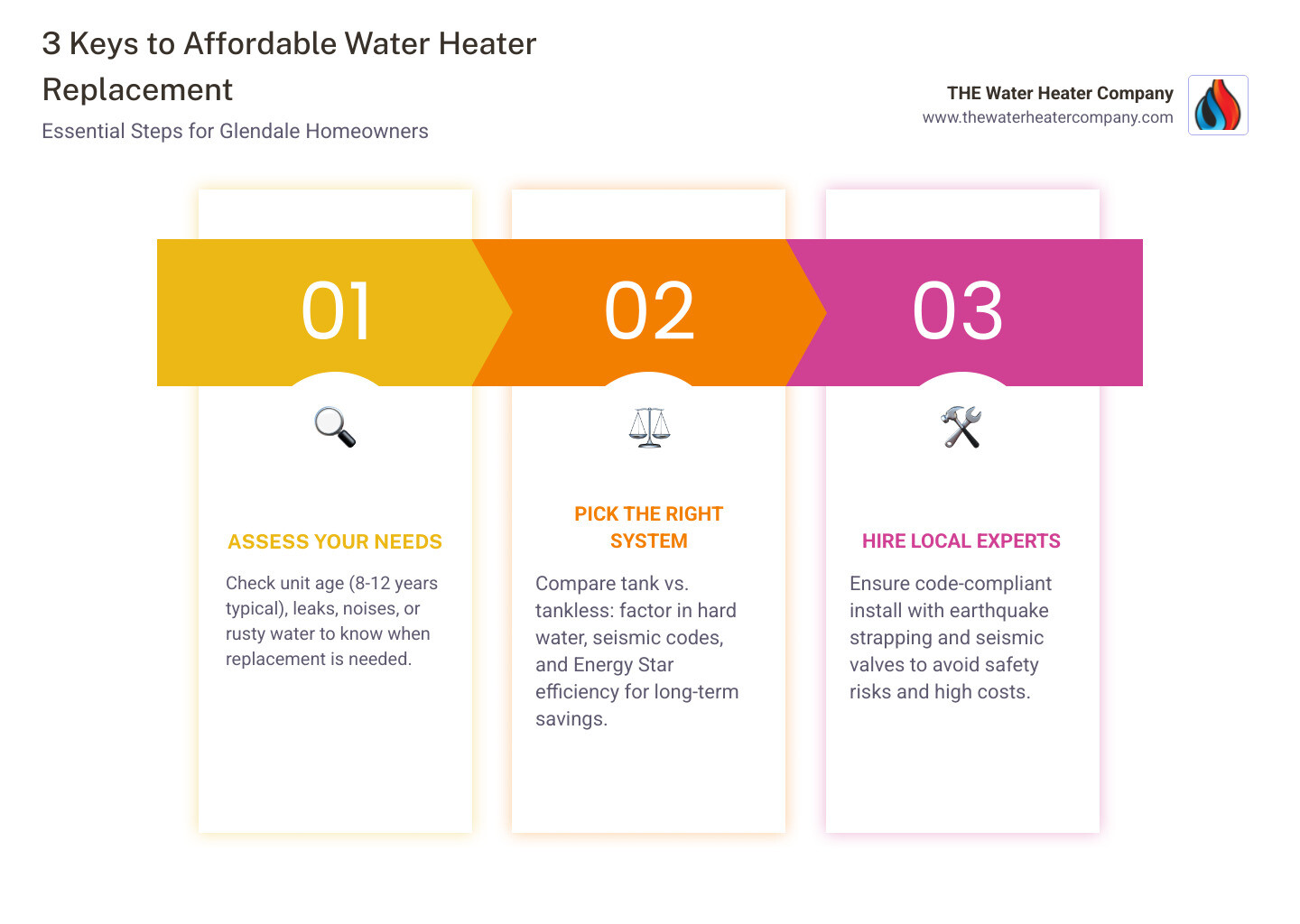
The Typical Installation Process

When you choose us for your hot water recirculating system in Burbank, CA, you can expect a seamless and professional experience:

  1. Personalized Consultation: We begin with a thorough assessment of your home’s plumbing system, hot water usage patterns, and your specific needs. We’ll discuss the different types of systems and controls to recommend the best solution.
  2. System Selection: Based on our consultation, we’ll help you select the ideal recirculating pump and control method (on-demand, timer, etc.) that best fits your home and lifestyle.
  3. Professional Integration: Our licensed technicians will expertly install the pump and any necessary valves or controls, ensuring all connections are secure and leak-free. We pride ourselves on clean, efficient work.
  4. Thorough Testing: After installation, we carefully test the entire system to confirm it’s operating correctly and delivering instant hot water as expected.
  5. Post-Installation Support: We’ll walk you through your new system, explain its features, and provide maintenance guidance. Our support doesn’t end when the installation is complete.

Finding Qualified Experts for hot water recirculating systems in Burbank, CA

Finding the right professionals for any home service is crucial, especially for specialized plumbing work like hot water recirculating systems. When you’re looking for experts in hot water recirculating systems in Burbank, CA, here’s what to consider:

  • Licensed Plumbers: Always ensure your chosen provider is fully licensed and insured. This protects you and guarantees the work meets professional standards.
  • Water Heater Specialists: Look for companies that specialize in water heating solutions. Our exclusive focus on water heaters means we have unparalleled expertise in these systems.
  • Local Experience: A company with local experience in Burbank understands the specific plumbing characteristics and regulatory environment of the area.
  • Positive Reviews: Check customer testimonials and reviews. Our 4.9-star rating from over 750 Google Reviews is a testament to our commitment to customer satisfaction.

System Comparisons, Maintenance, and Local Considerations

Understanding how hot water recirculating systems fit into the broader landscape of water heating, what it takes to maintain them, and how local regulations impact them, is key to making an informed decision for your Burbank home.

Recirculating Systems vs. Tankless and Traditional Water Heaters

It’s important to clarify that a hot water recirculating system is not a replacement for your water heater; rather, it’s a complementary technology designed to improve the performance of whatever water heater you currently have.

  • With Traditional Tank Water Heaters: Recirculating systems dramatically improve the comfort and water savings of tank heaters by ensuring hot water is always in the pipes, eliminating the wait time.
  • With Tankless Water Heaters: Even tankless heaters, which heat water on demand, can have a “lag” time as the water travels from the unit to the faucet. A recirculating system solves this by keeping hot water close to the tap, providing true instant hot water. It helps address the “wait for hot water” issue that some homeowners experience even with tankless units.

A recirculating system solves the “wait time” issue, making any water heating setup more efficient and convenient.

Maintenance and Potential Drawbacks

Like any home appliance, hot water recirculating systems benefit from occasional attention to ensure long-term performance.

Here are some simple maintenance tips:

  • Regular Pump Checks: Occasionally listen for unusual noises from the pump, which could indicate an issue.
  • Keep it Clean: Ensure the area around the pump is clean and free of debris.
  • Descaling (if applicable): If you live in an area with hard water, mineral buildup can affect efficiency. While less common for the pump itself, it’s a good idea to consider descaling your water heater as part of overall system maintenance.

While the benefits are numerous, it’s important to acknowledge potential drawbacks, primarily related to energy use if the system isn’t properly controlled. As our research highlights, “Recirculation systems can save water, but the energy impact can be very high in a poorly designed and/or controlled system.” This underscores the importance of choosing a demand-controlled system and professional installation to avoid unnecessary energy consumption. The initial cost of installation is also a consideration, though the long-term savings in water and energy often make it a worthwhile investment.

Burbank & California Regulations for hot water recirculating systems in Burbank, CA

California is a leader in energy efficiency, and its regulations significantly impact water heating systems, including hot water recirculating systems. For homeowners in Burbank, understanding these regulations ensures compliance and maximizes efficiency.

The California Energy Code (Title 24) sets stringent standards for building energy efficiency. These codes often mandate specific requirements for water heating and distribution systems to minimize energy and water waste. For example:

  • Demand-Controlled Systems: For central gas or propane-fired water heater systems in multifamily buildings, the Energy Code requires demand recirculation. This means the system must have a control that automatically shuts off the recirculation pump when it’s not needed, preventing continuous, wasteful operation.
  • Energy Efficiency Standards: The overall goal is to reduce distribution losses. Our research indicates that these losses can be as high as 30% in typical systems, and Title 24 aims to lower this significantly.
  • Air Release Valves: For central recirculation systems, mandatory requirements include an air release valve located no more than four feet from the inlet of the pump, or a vertical pump installation, to minimize cavitation due to air in the water.
  • Pipe Insulation Requirements: Title 24 also mandates specific insulation requirements for hot water piping, ensuring that heat loss from the pipes themselves is minimized. This is a crucial element for any efficient recirculating system.

These regulations are detailed in various documents, including those from the U.S. Department of Energy regulations and California’s Joint Appendix (JA) 13, which provides qualification requirements for demand management systems. While residential single-family homes may have different specific mandates than multifamily buildings, the emphasis on energy and water conservation applies broadly across California. Local utility companies may also provide guidance and sometimes offer incentives for energy-efficient upgrades.

Upgrade Your Home with Instant Hot Water Today

Say goodbye to the frustrating wait for hot water and hello to a new era of convenience, comfort, and conservation in your Burbank home. Installing a hot water recirculating system in Burbank, CA, is more than just a plumbing upgrade; it’s a smart investment that improves your daily life, saves precious resources, and contributes to a more sustainable household.

With instant hot water at your fingertips, you’ll enjoy smoother mornings, more efficient routines, and the satisfaction of knowing you’re significantly reducing water waste. These systems are designed to be energy-efficient, especially with modern on-demand controls, ensuring that your comfort doesn’t come at an exorbitant cost to your utility bills or the environment.

At The Water Heater Company, we pride ourselves on being the trusted authority in water heating solutions. Our expertise means we can guide you through every step, from selecting the perfect system for your home’s unique needs to professional installation that adheres to all California regulations. We’re a local, family-owned Southern California business dedicated to providing fast, reliable, expert service with fair pricing and industry-leading warranties.

Ready to experience the luxury of instant hot water? Don’t wait another minute (or another gallon!). Contact Us today for a personalized consultation. Let us help you make your Burbank home more comfortable, efficient, and environmentally friendly.

To learn more about our commitment to excellence and our specialized services, please visit our About Us page. For detailed information on how these systems can transform your home, explore our dedicated page: Learn more about our hot water recirculating systems.


hot water recirculating systems 24 hour in burbank, ca

No More Cold Showers with Same-Day Recirculating System Solutions in Burbank

Why Instant Hot Water Matters in Burbank, CA

Looking for hot water recirculating systems 24 hour in Burbank, CA? Here’s what you need to know for urgent service:

  • Same-Day Installation: Many services offer quick installation to get your system running fast.
  • Instant Hot Water: Enjoy immediate hot water at all taps, any time of day.
  • Save Water & Money: Reduce wasted water waiting for heat and lower your utility bills.
  • Expert Local Service: Connect with qualified professionals in Burbank for reliable setup.

Waiting for hot water can be frustrating, especially when you know gallons are going down the drain. For homeowners in Burbank, CA, dealing with cold pipes before a warm shower is a common issue. This happens because water sitting in your pipes cools down, requiring reheating every time you turn on the tap. Imagine eliminating this wait and enjoying instant hot water. This is exactly what hot water recirculating systems 24 hour in Burbank, CA offer. They bring comfort, convenience, and significant savings right to your home, ensuring hot water is there when you need it, around the clock.

Ready to stop waiting? Explore your options for Hot Water Recirculating Systems.

As Anthony Hamilton, Co-Founder and CEO of THE Water Heater Company, I’ve seen how crucial reliable hot water is. My team and I specialize in providing lasting water heater solutions, including hot water recirculating systems 24 hour in burbank, ca, ensuring homeowners get expert service and peace of mind.
infographic showing benefits of hot water recirculating systems: instant hot water, water savings (10,000+ gallons/year), energy efficiency (less than $2/year to operate on-demand), and 24/7 availability - hot water recirculating systems 24 hour in burbank, ca infographic 4_facts_emoji_blue

What is a Hot Water Recirculating System and How Does It Work?

Have you ever turned on your shower or kitchen faucet, only to wait what feels like an eternity for the water to warm up? That cold water that flows out before the hot water arrives isn’t just annoying; it’s a significant amount of wasted water. This common household scenario is due to the cold water purge – the water that has been sitting in your pipes, cooling down, and needs to be flushed out before the hot water from your water heater can reach your tap.

A hot water recirculating system is a clever plumbing solution designed to eliminate this waiting game and the associated water waste. At its core, it’s a pump that continuously or intermittently circulates hot water through your home’s plumbing system, ensuring that hot water is always near your faucets. This means when you turn on the tap, hot water is there almost instantly.

How does it work? Essentially, a small pump is installed, usually near your water heater. This pump creates a loop, moving hot water from the water heater through your hot water lines and then back to the water heater via either a dedicated return line or a crossover valve (which uses your cold water line for return). By keeping hot water circulating, the water in your pipes never gets a chance to cool down completely. When there’s no hot water in the line, the system detects this and kicks into action, bringing hot water to your fixtures on demand or on a schedule. This ingenious interaction with your water heater ensures you get instant hot water delivery without wasting valuable resources. You can explore various options for your home by checking out our Products.

The Two Main Types of Recirculating Systems

When considering a hot water recirculating system 24 hour in Burbank, CA, it’s important to understand the two primary types available:

  1. Traditional (or Continuously Running) Recirculating Systems: These systems typically use a timer or an aquastat (a temperature sensor) to run the pump at set intervals or when the water temperature in the return line drops below a certain point. While they provide instant hot water, they can be less energy-efficient because they run frequently, even when hot water isn’t needed. This constant operation can lead to your water heater cycling more often, consuming more energy.
  2. On-Demand Recirculating Systems: These are the modern marvels of hot water delivery, offering superior energy and water savings. Unlike traditional systems that might run for hours, on-demand systems operate only when you actually need hot water. They are activated by a push-button (wired or wireless), a motion sensor, or even smart home integration. When activated, the pump quickly moves hot water to the fixture and then shuts off. The beauty of an on-demand system is its intelligence: it only runs when there’s a demand for hot water and no hot water is currently in the line. If hot water is already present, it stays off. This “smart” operation means the pump run time is incredibly low, often less than 15 minutes per day, significantly reducing energy consumption.

On-demand systems are a fantastic choice for those looking to maximize efficiency and convenience, offering instant hot water without the constant energy expenditure of traditional systems.

Key Benefits for Your Burbank Home

For homeowners in Burbank, installing a hot water recirculating system 24 hour in Burbank, CA offers a multitude of advantages that go beyond just convenience. These systems are particularly beneficial in Southern California, where water conservation is always a top priority.

First and foremost, a major benefit is water conservation. Think about all the water that goes down the drain while you wait for your shower to heat up. With a recirculating system, that waste is virtually eliminated. Statistics show that these systems can save upwards of 10,000 gallons of water per year per household! In a city like Burbank, every drop saved contributes to a more sustainable future. This directly translates into lower utility bills, as you’re paying for less water being used.

Beyond conservation, the sheer convenience of instant hot water cannot be overstated. No more shivering in the shower or waiting impatiently for a sink full of hot water. Hot water is available as soon as you turn on your taps, enhancing your daily comfort and saving you valuable time.

Finally, these systems can contribute to reduced wear and tear on your plumbing. By maintaining a more consistent temperature throughout your hot water lines, you can prevent the constant expansion and contraction that occurs with fluctuating temperatures, potentially extending the life of your pipes and fixtures. To learn more about how these systems can benefit your home specifically in Burbank, visit our Burbank service page.

How On-Demand Systems Maximize Savings

While any recirculating system offers benefits, on-demand systems truly shine when it comes to maximizing savings. Their intelligent operation is key to their superior energy efficiency.

Unlike conventional systems that might run for hours, unnecessarily heating water and causing your water heater to cycle frequently, on-demand systems only activate when needed. This minimal pump run time—typically less than 15 minutes per day—drastically cuts down on electricity usage. In fact, the annual energy cost to operate an on-demand recirculation system can be less than $2.00! This is a stark contrast to older, continuously running pumps that can significantly increase your energy bill.

The smart technology in these systems ensures that your water heater fires up less often to reheat unused water, conserving both gas and electricity. This efficiency pairs perfectly with modern, energy-saving appliances like Tankless Water Heaters, creating an ultimate hot water solution for your home that is both eco-friendly and budget-conscious.

Your Guide to Hot Water Recirculating Systems 24 Hour in Burbank, CA

Choosing the right hot water recirculating system 24 hour in Burbank, CA involves a few key considerations to ensure optimal performance and satisfaction for your household. We want to help you make an informed decision for your home.

When selecting a system, think about your:

  • Home Size: Larger homes with longer pipe runs will require a more powerful pump to ensure instant hot water throughout. For example, a 55 Series pump might be suitable for homes up to ~2,500 sq ft with ~100 ft of piping, while a 99 Series could handle up to ~4,000 sq ft with ~200 ft of piping, and a 150 Series for 5,000+ sq ft with ~300 ft of piping.
  • Plumbing Configuration: Do you have a dedicated return line for hot water, or will the system need to use a crossover valve that integrates with your cold water line? This will determine the type of installation kit required.
  • Family Water Usage Habits: Do you need instant hot water at specific times, or do you prefer the convenience of on-demand activation? This will influence whether a timer-based or push-button/motion-sensor activated system is best for your lifestyle.

Our team can help you assess these factors and recommend the ideal system for your home. We offer comprehensive Services to guide you through the selection process.

The Installation Process for Hot Water Recirculating Systems 24 Hour in Burbank, CA

Once you’ve chosen the perfect system, the next step is professional installation. While the concept might seem simple, proper installation is crucial for efficiency and longevity. Here’s what you can typically expect when we install your hot water recirculating system 24 hour in Burbank, CA:

  1. Professional Assessment: Our technicians begin with a thorough assessment of your existing plumbing system, water heater, and home layout to determine the best placement for the pump and any necessary valves.
  2. Pump Mounting: The recirculating pump is then securely mounted, usually near your water heater or at the furthest fixture from the heater, depending on the system type.
  3. Valve Installation: If you don’t have a dedicated return line, a crossover valve will be installed, typically under the sink at the fixture furthest from the water heater. This valve allows cooled hot water to return to the water heater through the cold water line.
  4. Electrical Connection: The pump requires an electrical connection, which our licensed professionals will safely install, often plugging into a standard outlet or being hardwired.
  5. System Testing: After installation, the system is thoroughly tested to ensure it’s circulating hot water effectively, providing instant hot water to all designated fixtures, and operating silently and efficiently.

Our team ensures a seamless installation, leaving you with a perfectly functioning system. If your existing water heater is older, this might also be a great time to consider a Water Heater Replacement to maximize your overall system’s efficiency.

System Lifespan, Maintenance, and Local Incentives

A hot water recirculating system 24 hour in Burbank, CA is a durable investment designed to provide years of reliable service. The typical lifespan of a well-maintained recirculating pump can range from 10 to 15 years, often matching the lifespan of a standard tank water heater.

To ensure your system operates efficiently throughout its life, routine maintenance checks are recommended. This typically involves inspecting the pump for any leaks or unusual noises and ensuring all connections are secure. In areas with hard water, like parts of California, descaling the system might be necessary periodically to prevent mineral buildup, which can affect performance. While these systems generally require minimal maintenance, a quick check during your annual water heater service can help catch any potential issues early.

Burbank, and California as a whole, is proactive about water conservation and energy efficiency. While specific local regulations or incentives can change, it’s always worth checking for Burbank water conservation programs or energy efficiency rebates that might apply to the installation of a hot water recirculating system. These incentives can help offset the initial cost, making your investment even more appealing. We often have Specials available that can further improve your savings.

Finding a Qualified Professional for Hot Water Recirculating Systems 24 Hour in Burbank, CA

When it comes to installing or servicing hot water recirculating systems 24 hour in Burbank, CA, selecting a qualified professional is paramount. You want a team that not only understands the mechanics of these systems but also the unique needs of Burbank homeowners.

Here’s what to look for:

  • Licensed Plumbers: Always ensure the technicians are fully licensed and insured. This protects you and guarantees that the work meets professional standards.
  • 24/7 Emergency Service: For urgent needs, having access to 24/7 emergency support is crucial. Plumbing problems don’t always happen during business hours, and a reliable service provider will be there when you need them most.
  • Local Expertise: A company with local expertise will be familiar with Burbank’s specific regulations, water quality considerations, and common plumbing challenges in the area.
  • Upfront Communication: Choose a company that provides clear, upfront communication regarding the process, what to expect, and any potential options. Transparency builds trust.

We pride ourselves on offering fast, affordable, and professional plumbing services for residential customers in Burbank and surrounding areas. Our technicians are knowledgeable, professional, and provide expert advice, ensuring clear communication throughout the service process.

Why Trust a Water Heater Specialist?

When you’re dealing with something as integral to your home as hot water, it makes sense to trust a specialist. We, at The Water Heater Company, are not just general plumbers; we are experts singularly focused on water heaters and related systems, like hot water recirculating systems 24 hour in Burbank, CA. This specialization means we bring unparalleled knowledge and experience to every job.

With over 25 years of experience serving Los Angeles and Ventura Counties, our team has seen it all. We understand the nuances of different water heater types—from conventional tank water heaters to tankless models—and how recirculating systems integrate with them. This specialized knowledge allows us to offer the best solutions for your specific needs, ensuring your system is installed correctly and operates at peak efficiency.

Our commitment to customer satisfaction is reflected in our industry-leading warranties and our dedication to providing expert service. We believe in being transparent, professional, and going above and beyond. We have numerous customer testimonials that speak to the outstanding work provided by our technicians, who are often praised for their professionalism, efficiency, and clear explanations. For example, customers have highlighted how our technicians, like Evan and Jake, have walked them through new systems with ease, coordinated complex installations, or guided them to the best solutions for their homes. This is why our customers consistently choose us. Learn more about our commitment to excellence on our Why Choose Us page.
Conclusion

Say goodbye to the frustrating wait for hot water and the wasteful cold water purge. Investing in a hot water recirculating system 24 hour in Burbank, CA is a smart decision that brings immediate comfort, significant savings, and peace of mind to your home. You’ll enjoy instant hot water at every tap, conserve thousands of gallons of water annually, and benefit from reduced utility bills, especially with energy-efficient on-demand systems.

We understand that choosing and installing a new plumbing system can feel daunting, but with our expert guidance, it doesn’t have to be. Our team is ready to help you explore your options, from selecting the right system for your home’s size and plumbing configuration to ensuring a professional, seamless installation.

Don’t let cold showers be a part of your daily routine any longer. End the wait for good and enjoy the luxury of instant hot water, whenever you need it. We even offer flexible Financing options to make this essential home upgrade accessible.

Ready to transform your home’s hot water experience? Contact Us today to speak with one of our local experts. Explore your options for Hot Water Recirculating Systems and find how we can bring comfort and efficiency to your Burbank home.


water heater replacement in los alamitos, ca

Everything You Need to Know About Water Heater Replacement Services in Los Alamitos

Why Timely Water Heater Replacement Matters for Los Alamitos Homeowners

Water heater replacement in los alamitos, ca is a decision every homeowner will face eventually. Whether your current unit is aging, showing warning signs, or simply not keeping up with your household’s hot water needs, understanding your replacement options helps you avoid emergency breakdowns and choose the right system for your home.

Quick Answer: Key Replacement Options

  • Tank Water Heaters: Traditional storage models (40-75 gallons) with 8-12 year lifespan, lower upfront cost
  • Tankless Water Heaters: On-demand systems lasting 15-20+ years, higher efficiency, space-saving design
  • Hybrid (Heat Pump) Water Heaters: Ideal for Los Alamitos’ mild climate, up to 30% energy savings, moderate upfront investment
  • Professional Installation: Code-compliant setup with seismic strapping, proper venting, permits, and testing

When to Replace: Age over 10 years, frequent repairs, leaks, inconsistent temperatures, rising energy bills, or rusty water.

Upgrading before total failure gives you time to research options, compare models, and avoid the stress of emergency replacement. Los Alamitos’ mild Mediterranean climate makes this an ideal location for high-efficiency options like hybrid heat pump models, which perform best in moderate temperatures year-round.
I’m Anthony Hamilton, CEO of THE Water Heater Company, and I’ve spent years helping Southern California homeowners steer water heater replacement in los alamitos, ca with clarity and confidence. Our team specializes in matching the right system to your home’s specific needs, ensuring safe, code-compliant installation every time.
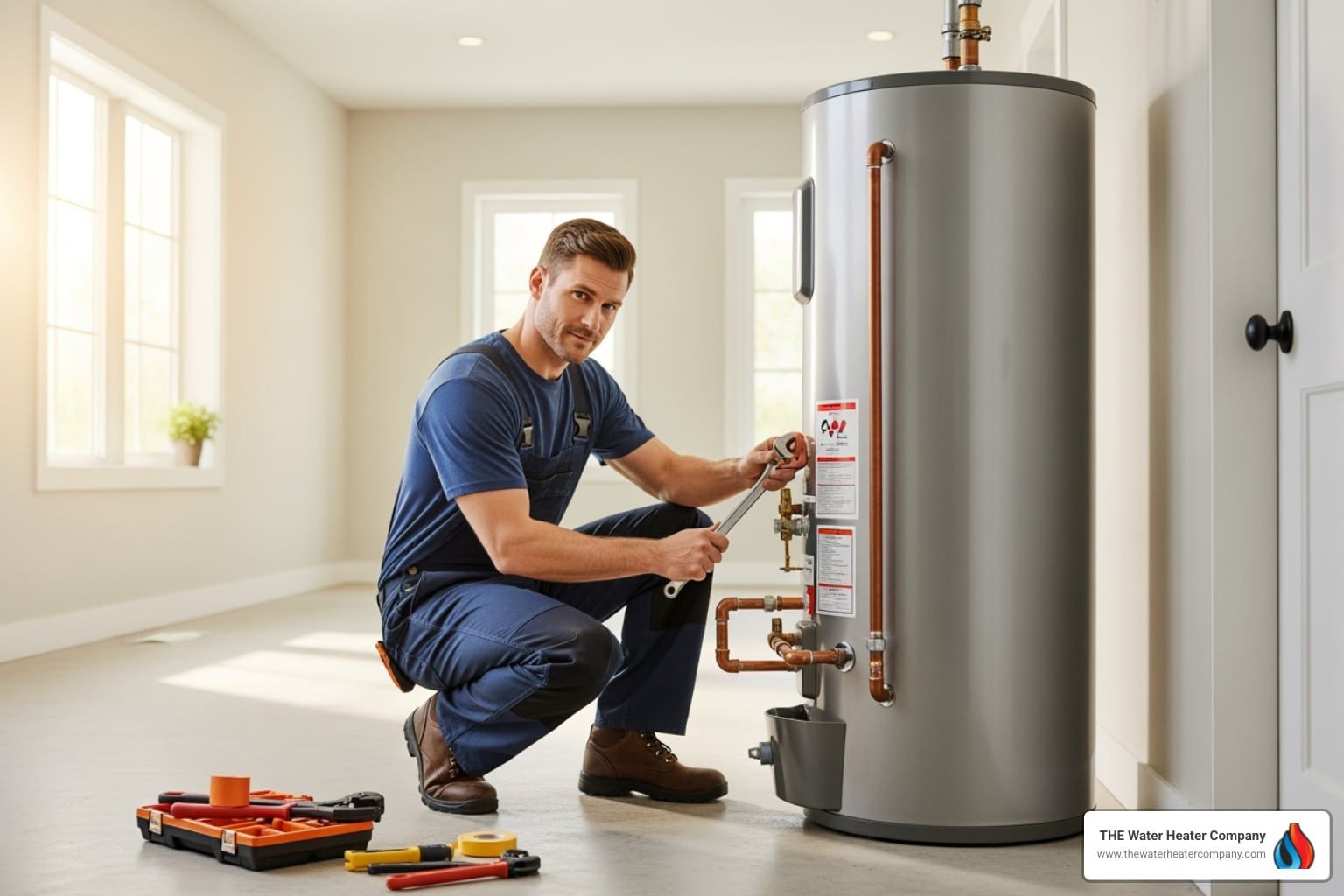
Ready to explore your options? Learn more about the benefits of replacing your old water heater before it fails, or schedule a consultation for professional water heater replacement.

Infographic showing warning signs your water heater needs replacement: age 8-12 years for tank or 15-20 years for tankless, inconsistent water temperature, strange rumbling or popping noises, visible leaks or water pooling, rusty or discolored hot water, frequent repair calls, and rising monthly energy bills - water heater replacement in los alamitos, ca infographic 4_facts_emoji_light-gradient

When to Consider a Water Heater Replacement

Knowing when to replace your water heater can save you from cold showers and costly emergencies. While many homeowners wait until their unit completely fails, being proactive allows for a smoother transition and more informed decision-making. Here are the common signs that indicate your water heater needs replacement in Los Alamitos:

  • Age of Unit: This is often the most straightforward indicator. Traditional tank water heaters typically last between 8 to 12 years. If your unit is approaching or has exceeded this age, it’s wise to start considering replacement, even if it’s still limping along. Tankless water heaters, on the other hand, boast a longer lifespan of 15 to 20 years or more.
  • Inconsistent Water Temperature: Are your showers starting hot and ending cold, or fluctuating wildly? This can signal a failing heating element, thermostat, or sediment buildup in a tank unit, all of which might point to the need for a new system.
  • Strange Noises: If your water heater sounds like it’s brewing a pot of coffee, it’s probably sediment buildup. Rumbling, banging, or popping noises are common in older tank units as mineral deposits harden and are reheated. While flushing can sometimes help, persistent noise often means the tank’s integrity is compromised, reducing efficiency and indicating a replacement is due.
  • Leaking Tank: Puddles around the base of your water heater are never a good sign. While minor leaks from connections might be repairable, a leak from the tank itself usually means internal corrosion has set in. Once the tank rusts through, replacement is the only solution.
  • Rusty or Discolored Water: If your hot water comes out rusty or discolored, but your cold water is clear, your water heater’s interior is likely corroding. This can lead to leaks and eventually unit failure.
  • Frequent Repairs: If you’re constantly calling for repairs, the costs can quickly add up. At some point, it becomes more economical to invest in a new, reliable unit than to keep patching up an old one. If repair costs over the last 12 months approach half the cost of a new unit, it’s time to research replacement.
  • Rising Energy Bills: An aging water heater loses efficiency over time. If your energy bills are creeping higher without a change in usage, your water heater might be working harder and less effectively, costing you more in the long run.

For any of these issues, especially in Los Alamitos, CA, our team is ready to help. We can assess your situation and provide expert advice on whether repair or replacement is the best path forward. You can learn more about our services for water heater repair in Los Alamitos, CA.

Signs Requiring Immediate Attention

Some water heater issues go beyond mere inconvenience and demand immediate action to prevent property damage or safety hazards. These are the critical signs of a failing water heater that might require immediate replacement:

  • Major Leaks from the Tank Body: While minor leaks from connections might be fixable, a significant leak directly from the tank itself is a clear sign of internal corrosion and structural failure. This can quickly lead to extensive water damage in your home.
  • Visible Corrosion on the Tank: Beyond just rust in the water, if you see significant rust or corrosion on the exterior of the tank, particularly around the connections or the base, it indicates internal issues that will likely lead to a catastrophic leak.
  • No Hot Water at All: If your water heater suddenly stops producing any hot water, and basic troubleshooting (like checking the pilot light or circuit breaker) doesn’t resolve the issue, it could be a major component failure that makes replacement a more sensible option than repair.
  • Gas Smell or Pilot Light Issues (for gas heaters): This is a serious safety concern. If you smell gas near your water heater or have persistent problems with the pilot light staying lit, it indicates a potential gas leak or combustion issue. Immediately turn off the gas supply and contact a professional.
  • Flooding from the Pressure Relief Valve: While the Temperature and Pressure (T&P) relief valve is designed to open and release pressure in extreme conditions, if it’s frequently opening and releasing water, it could indicate excessive pressure buildup, a faulty valve, or other dangerous internal issues.

In any of these urgent scenarios, our priority is your safety and preventing further damage. Our expert technicians are equipped to handle emergency water heater repair and replacement swiftly and safely.

Choosing the Right Water Heater for Your Los Alamitos Home

When it’s time for a water heater replacement in los alamitos, ca, you’re faced with more options than ever before. Choosing the right unit involves balancing your household’s needs, energy efficiency goals, and the specific characteristics of your Los Alamitos home. We’ll help you steer the types and factors to consider.

Key Factors for Your Los Alamitos Water Heater Replacement

Here’s a breakdown of what we consider when helping Los Alamitos homeowners select a new water heater:

  1. Household Size and Hot Water Demand: How many people live in your home? How many bathrooms do you have? Do you often run the dishwasher, washing machine, and take showers simultaneously? These questions help us determine the appropriate capacity (for tank units) or flow rate (for tankless units) to ensure you never run out of hot water.
  2. Energy Efficiency (UEF Rating): The Uniform Energy Factor (UEF) rating indicates how efficiently a water heater converts energy into hot water. Higher UEF ratings mean lower operating costs. With rising energy costs, investing in a more efficient unit can lead to significant long-term savings. Tankless water heaters can cut energy bills by up to 30%, while hybrid (heat pump) water heaters offer even greater efficiency.
  3. Fuel Type (Gas vs. Electric): Your home’s existing infrastructure often dictates the most practical fuel type.
    • Gas Water Heaters: If your home already has natural gas lines, gas water heaters often offer strong recovery rates and can be cost-effective. However, they require proper venting and carbon monoxide safety measures.
    • Electric Water Heaters: These are generally easier to install as they don’t require gas lines or venting. Operating costs depend heavily on local electricity rates. Hybrid heat pump water heaters are a highly efficient electric option.
      Conversions between fuel types are possible but may involve additional costs for electrical panel upgrades or new gas line installations.
  4. Los Alamitos’ Mild Climate: This is a significant advantage for homeowners here! Los Alamitos’ mild Mediterranean climate, with its year-round moderate temperatures, makes hybrid (heat pump) water heaters particularly attractive. Unlike colder climates where their efficiency can drop, hybrid units thrive in our environment, offering substantial energy savings. They are often less susceptible to freeze risks compared to other regions.
  5. Space Availability: Tank water heaters require a designated space for the large storage tank. Tankless units, being much smaller and often wall-mounted, are excellent for freeing up valuable floor space. Hybrid units require more space and good ventilation, typically needing at least 1,000 cubic feet of unconditioned space (like a garage or basement).

We provide comprehensive guidance on water heater installation in Southern California: what homeowners should know to help you make the best choice for your Los Alamitos home.

Understanding Different Water Heater Types

Let’s explore the types of water heaters available for your water heater replacement in los alamitos, ca and see how they stack up.

Feature Conventional Storage Tank Heater On-Demand Tankless Water Heater High-Efficiency Hybrid (Heat Pump) Water Heater
Lifespan 8-12 years 15-20+ years 10-15 years
Energy Savings Moderate, standby heat loss Up to 30% savings Up to 60% savings (in mild climates)
Upfront Cost Lower Higher Higher
Space Req. Large tank (40-75 gallons) Compact, wall-mounted Larger unit, requires adequate unconditioned space/ventilation
Hot Water Limited by tank size, can run out Endless supply on demand Ample supply, highly efficient
Best For Budget-conscious, lower hot water demand High hot water demand, space-saving, long-term savings High energy savings in mild climates, environmentally conscious

1. Conventional Storage Tank Heaters:
These are the most common type, featuring a large insulated tank that stores and heats water, keeping it ready for use.

  • Pros: Lower upfront cost, familiar technology, relatively simple installation. Excellent for homes with moderate, predictable hot water needs. We offer a range of reliable tank water heaters to suit various Los Alamitos homes.
  • Cons: Higher energy consumption due to standby heat loss (heating water even when not in use), takes up significant space, and can run out of hot water if demand exceeds capacity.

2. On-Demand Tankless Water Heaters:
As the name suggests, these units heat water only when you need it, directly as it flows through the device.

  • Pros: Endless supply of hot water, significant energy savings (up to 30% compared to tank models), longer lifespan, and a compact, space-saving design. They also eliminate the risk of catastrophic flooding from a leaking tank. For many Los Alamitos residents, tankless models are a modern, efficient upgrade. Explore our tankless water heaters in Los Alamitos, CA.
  • Cons: Higher upfront cost, and may require upgrades to gas lines or electrical systems during installation. Flow rates can be a consideration for very high, simultaneous hot water demands.

3. High-Efficiency Hybrid (Heat Pump) Water Heaters:
These innovative units use electricity to move heat from the surrounding air into the water, rather than generating heat directly.

  • Pros: Extremely energy efficient, especially in Los Alamitos’ mild climate where they don’t struggle with cold ambient air. They can save up to 60% on water heating costs compared to standard electric models. They offer a good balance of hot water availability and energy savings.
  • Cons: Higher upfront cost than conventional tank heaters, require more space and good ventilation (typically installed in a garage or utility room), and can be slower to recover than gas models.

Our team can help you weigh these options, considering your budget, lifestyle, and home’s specific requirements to ensure you get the best water heater replacement in los alamitos, ca.

The Professional Process for Water Heater Replacement in Los Alamitos, CA

A professional water heater replacement in los alamitos, ca is more than just swapping out an old unit for a new one. It’s a precise process that ensures safety, efficiency, and compliance with local codes. Here’s what you can expect when you choose our expert team:

  1. Comprehensive Site Assessment: Our process begins with a thorough evaluation of your current setup and your home’s specific needs. We’ll measure available space, inspect existing plumbing, gas, and electrical connections, and assess venting requirements. We also consider your household’s hot water demand to recommend the appropriately sized unit.
  2. Proper Sizing and Selection: Based on our assessment, we’ll guide you in selecting the ideal water heater type and size for your Los Alamitos home. Proper sizing prevents issues like running out of hot water or excessive energy waste from an oversized unit.
  3. Safe Disconnection, Removal, and Disposal of the Old Unit: Our technicians will safely disconnect your old water heater, drain any remaining water, and carefully remove it from your property. We handle the responsible disposal or recycling of the old unit, which can contain hazardous residues, ensuring it’s transported according to local regulations.
  4. New Unit Placement and Preparation: We’ll prepare the installation site, ensuring proper clearances, level surfaces, and any necessary modifications for the new unit. For tank water heaters, this includes installing a new drain pan.
  5. Water and Fuel Line Connections: Our experts will carefully connect the new water heater to your home’s water supply lines, ensuring watertight seals. For gas models, we’ll securely connect the gas line and ensure proper venting. For electric models, we’ll handle the electrical connections safely.
  6. Post-Installation Testing and Safety Checks: Once the new unit is installed, we conduct a series of rigorous tests. This includes pressure testing for leaks, verifying proper operation of the Temperature and Pressure (T&P) relief valve, and for gas units, performing combustion analysis and checking for gas leaks. We also energize the unit and perform efficiency checks to ensure it’s functioning optimally.
  7. Homeowner Orientation: Before we leave, we’ll walk you through the operation of your new water heater, explaining key features, maintenance points, and emergency shut-off procedures. We want you to feel confident and comfortable with your new system.

A typical tank-for-tank replacement usually takes our professional installers about two to three hours. If we’re transitioning to a tankless unit, or if the installation involves tight spaces or significant plumbing/gas line modifications, the process might take four to five hours or longer. Our goal is always a swift, efficient, and impeccably installed system. Learn more about our detailed process for water heater replacement and installation in Los Alamitos, CA.

Ensuring a Code-Compliant Water Heater Replacement in Los Alamitos

Compliance with local building codes is paramount for safety and to avoid potential issues down the line. In Los Alamitos and across Southern California, specific regulations govern water heater installations. Our team is well-versed in these requirements, ensuring every installation meets or exceeds standards.

Key considerations for a code-compliant installation include:

  • California Building Codes: California has strict building codes, especially concerning seismic safety and energy efficiency. We ensure all installations adhere to the latest state and local Los Alamitos codes.
  • Seismic Strapping Requirements: Due to our location in an earthquake-prone region, all water heaters must be properly secured with seismic straps. This prevents the unit from tipping over during an earthquake, which could lead to gas leaks, water damage, or electrical hazards.
  • Temperature & Pressure (T&P) Relief Valve: This crucial safety device prevents excessive temperature and pressure buildup inside the tank. It must be correctly installed with an approved discharge pipe, typically leading to a drain.
  • Drain Pans: For tank water heaters, a drain pan is required underneath the unit. In the event of a leak, this pan collects water and, if properly connected, channels it to a drain, preventing water damage to your home.
  • Expansion Tanks: If your home has a closed-loop plumbing system (which many do in Southern California), an expansion tank is often required. This tank absorbs excess water pressure created when water is heated, protecting your plumbing system and water heater from damage.
  • Proper Venting for Gas Models: Gas water heaters produce combustion byproducts that must be safely vented to the outside. Our technicians ensure proper sizing and installation of venting systems to prevent dangerous carbon monoxide buildup inside your home.

We understand the complexities of water heater replacement in Southern California and handle all permit submissions and coordinate required inspections, giving you peace of mind that your new water heater is installed safely and legally.

Post-Installation Maintenance for Longevity

Once your new water heater is installed, a little routine care can go a long way in ensuring its longevity, efficiency, and consistent performance. Think of it like taking care of a new car; regular check-ups keep it running smoothly. Here’s what we recommend for homeowners in Los Alamitos:

  • Annual Tank Flushing (for Tank Water Heaters): Sediment buildup is the enemy of tank water heaters. It reduces efficiency, causes noisy operation, and can shorten the unit’s lifespan. We recommend an annual flush to remove these mineral deposits.
  • Anode Rod Inspection and Replacement (for Tank Water Heaters): The anode rod is your tank’s sacrificial lamb, corroding before the tank itself. Inspecting it every 1-3 years and replacing it when significantly depleted is critical to preventing tank corrosion.
  • T&P Valve Testing: We recommend testing the T&P relief valve annually to ensure it’s functioning correctly. This involves carefully lifting the lever to release a small amount of water. If it doesn’t close properly, it needs replacement.
  • Keeping the Area Clear: Ensure the area around your water heater is free of clutter, especially flammable materials. This allows for proper ventilation (especially for gas models) and easy access for maintenance or service.
  • Insulate Accessible Hot Water Pipes: Insulating the first six feet of hot and cold water pipes connected to your water heater can reduce heat loss and improve efficiency, helping you save on energy bills.
  • Regular Inspections (for Tankless Water Heaters): While tankless units require less maintenance, they still benefit from periodic professional inspections and flushing every 1-2 years, especially in areas with hard water, to prevent mineral scale buildup in the heat exchanger.

Following these simple maintenance tips will help your new water heater provide reliable hot water for years to come. For more insights, check out our FAQs section.

Frequently Asked Questions about Water Heater Replacement

How long does a typical water heater last?

A standard tank water heater typically lasts 8-12 years, while a tankless model can last 15-20 years or more with proper maintenance. Lifespan is affected by water quality, usage, and maintenance frequency.

How long does the replacement process take?

A professional can typically complete a standard tank-for-tank replacement in 2-3 hours. Switching to a different type, like a tankless unit, may take longer due to potential plumbing or venting modifications.

What warranty should I expect with a new water heater?

Warranties vary by type and manufacturer but typically include 6-12 years for tank models and up to 15 years for major components on tankless units. Professional installation often comes with a separate labor warranty.

Your Trusted Partner for Water Heater Services

When it comes to water heater replacement in los alamitos, ca, choosing the right partner makes all the difference. Our commitment to excellence, deep understanding of Southern California homes, and focus on customer satisfaction set us apart. We believe that every homeowner deserves reliable, efficient hot water, installed safely and correctly the first time.

As a local, family-owned Southern California business, we specialize in water heater repair, installation, and maintenance, along with water filtration solutions. We pride ourselves on offering fast, reliable, and expert service with fair pricing and industry-leading warranties. Our goal is to be your trusted authority in water heating, providing solutions that improve your home’s comfort and efficiency.

The benefits of replacing an old water heater with a new one are numerous, especially when done professionally:

  • Improved Energy Efficiency: New models, particularly tankless and hybrid units, are significantly more efficient, leading to noticeable savings on your utility bills.
  • Consistent Hot Water Supply: Say goodbye to cold showers! A properly sized new unit ensures you have hot water when you need it.
  • Improved Safety: New installations adhere to the latest codes, including seismic strapping and proper venting, minimizing risks of leaks, gas hazards, or electrical problems.
  • Increased Home Value: A modern, efficient water heater can be an attractive feature for potential buyers, signaling a well-maintained property.
  • Peace of Mind: With a new unit and professional installation, you can enjoy years of worry-free hot water.

We are dedicated to helping Los Alamitos residents find the best solutions for their homes. While specific local rebates and incentives can vary, we actively monitor programs that might help you save on high-efficiency water heater upgrades. We encourage you to check our specials and rebates page regularly, and we also offer flexible financing options to make your upgrade more accessible.

A professional plumber from our team brings invaluable expertise to your water heater replacement in los alamitos, ca. We don’t just install; we assess, advise, ensure code compliance, and provide ongoing support, guaranteeing a safe, efficient, and long-lasting hot water solution custom to your needs. This comprehensive approach is why choose The Water Heater Company for your home.

For expert guidance and service, schedule your water heater replacement with us today. We’re here to ensure your Los Alamitos home enjoys the comfort and efficiency of a perfectly installed new water heater.


Water Heater Installation in Southern California: What Homeowners Should Know

When the time comes to replace your water heater, knowing what to expect during the installation process can save you time, stress, and unnecessary costs. Most homeowners only replace their water heater once or twice in their lifetime, so it’s not something people are usually familiar with. This guide explains the essentials of water heater installation in Southern California — from choosing the right system to understanding how long installation takes.

Choosing the Right Water Heater

The installation process starts with selecting the correct system for your home. The two most common types of water heaters are tank water heaters and tankless water heaters.

Tank Water Heaters

  • Pros: Lower upfront cost, quick installation, reliable for standard household needs.

  • Cons: Larger size, limited hot water before refilling, higher long-term energy use.

Tankless Water Heaters

  • Pros: Endless hot water, compact design, improved energy efficiency over time.

  • Cons: Higher initial investment, longer installation process, likely requires upgrades to gas and/or electrical systems.

Homeowner tip: The best system depends on your needs, household size, hot water demand, and budget. A professional evaluation ensures the right fit for you and your home.

What to Expect During Installation

A professional installation generally includes these steps:

  1. Evaluation – A licensed technician checks your plumbing, gas, electrical, and exhaust systems to confirm compatibility.

  2. Removal of the Old System – The old unit is drained, disconnected, and properly disposed of.

  3. Installation of the New Water Heater – The new unit is installed with basic connections (this is where most contractors stop).

  4. Building & Safety Code Updates – An installation done in accordance with California Plumbing Code will likely require new features and adjustments, such as: a thermal expansion tank, bonding, drain pan, sediment trap, etc., and in the case of a tankless water heater, new venting and a dedicated gas line are often required.

  5. Final Walkthrough – The Technician tests the system, reviews operation with the homeowner, and provides maintenance recommendations to keep the unit running smoothly for years to come.

How Long Does Installation Take?

  • Tank Water Heaters: Typically 2–4 hours.

  • Tankless Water Heaters: May take 6–10 hours or longer if upgrades are required.

Homeowner tip: Our specialized Technicians do this every day and their experience helps keep the installation time to a minimum. Ask your installer how long you’ll be without hot water so you can plan ahead.

Why Professional Installation Matters

Water heater installation involves plumbing, gas, exhaust, and electrical connections. Hiring a licensed, experienced company ensures:

  • Safety for everyone in the home.
  • Correct system sizing.

  • Compliance with California building and safety codes.

  • Reliable hot water and long-term efficiency.

  • Warranty protection on parts, labor, and equipment.

THE Water Heater Company Difference

At THE Water Heater Company, we specialize exclusively in water heaters. Homeowners across Southern California choose us because we provide:

  • Expert Evaluations: Every installation starts with a thorough inspection of your home.

  • Straightforward Guidance: We explain your options clearly, with pros and cons, and lay out all available solutions so you can make the right choice.

  • Upfront Pricing: No hidden fees, just transparent estimates.

  • THE Best Technicians: Our team is extensively trained to provide the best service.

Get Help With Your Water Heater Installation

If you need a new water heater, we can help you choose the right system and install it safely and efficiently. Call THE Water Heater Company today at (877) 798-7487 to schedule a professional evaluation.

The Real Cost of Cheap Water Heater Installations

The Real Cost of Cheap Water Heater Installations

Thinking about saving a few bucks on your water heater installation?
We get it—those bargain offers can sound like a steal.

But when it comes to water heaters, cheap upfront often means costly later. Your hot water system plays a major role in your home’s comfort and safety. Cutting corners can lead to big problems—and big bills.

Let’s look at what homeowners really risk when they go for the lowest bid.

Why “Cheap” Can Be a Bad Deal

That super low price might look good now… until something goes wrong.

Improper installations can lead to:

  • Gas leaks

  • Flooding from loose water connections

  • Carbon monoxide buildup

  • Electrical hazards

  • A system that fails in 2–3 years instead of lasting 10–15

And if any of these issues cause damage, your homeowner’s insurance may deny your claim, especially if the installer wasn’t licensed or the work didn’t meet code. That could leave you footing the bill.

Why Hiring a Handyman Could Cost You More

Hiring a handyman or “friend-of-a-friend” to save money sounds convenient, but water heaters aren’t casual home projects.

These systems involve gas, water pressure, exhaust (carbon monoxide), and in some cases, electricity. That’s a serious mix when handled incorrectly.

Here’s where handymen often fall short:

  • No permits or inspections

  • Poor or undersized venting

  • Loose gas line connections

  • Incorrect sizing for your home’s hot water needs

  • Missed code requirements

Think of it like this: You wouldn’t put off-brand tires on a high-performance car. The same applies to your water heater—a powerful, high-demand system that needs to be installed right.

Code Violations and Hidden Costs

What most homeowners don’t realize is that water heater installations must meet strict building and safety codes. Skipping these steps to save money can result in:

  • Failed home inspections if you sell or refinance

  • Fines or correction fees from local building departments

  • Voided manufacturer warranties if installed incorrectly

  • Denied insurance claims for water or fire damage

  • Higher energy bills due to poor efficiency or incorrect sizing

That “cheap” install? It could become a very expensive problem later.

Better Parts. Better Performance. Longer Life.

At THE Water Heater Company, we don’t just install the heater—we focus on the entire system, including the small parts that most people overlook.

We use premium-quality valves, fittings, and venting components, chosen for durability and performance. Most handymen and general plumbers use whatever’s cheapest or on hand.

It’s the difference between using:

  • A plastic wrench from a toy set,
    vs.

  • A professional-grade tool built to last.

Those small parts? They make a huge difference in performance, longevity, and safety.

Why Homeowners Choose Us

When you work with THE Water Heater Company, you’re getting more than a new water heater. You’re getting:

Peace of mind – Installed right the first time, up to code, and fully inspected
Time savings – No stress, no callbacks—we handle everything start to finish
High-quality components – Built for performance and longevity
Expert advice – We help you choose what’s right for your home
THE Best Service at THE Best Value – Not the cheapest, not the most expensive—just the best experience at a fair rate

Let’s Make Sure It’s Done Right

Your home deserves more than the cheapest option—it deserves a safe, efficient, long-lasting system that protects your family and your wallet.

Call THE Water Heater Company at (877) 798-7487 today to schedule your professional water heater installation. You’ll get THE Best Service at THE Best Value—and that’s a promise.

Understanding the Value of Paying for a Water Heater Repair/Replacement Estimate

When faced with water heater problems, homeowners often find themselves in a dilemma. Should they pay for a service call or estimate? It’s a valid question, and one that we, at THE Water Heater Company, aim to address. In this article, we’ll explain the reasons behind charging for estimates and highlight the value-added benefits that come with it. By understanding these factors, homeowners can make an informed decision and ensure a smooth and reliable repair experience for their water heater.

Expertise and Time

Assessing and diagnosing water heater issues requires the expertise of a professional technician. These skilled individuals possess the knowledge and experience necessary to accurately identify the problem and provide the most effective solutions. They invest their time in carefully evaluating the unit, examining its components, and determining the root cause of the issue. By charging a fee for estimates, we are compensating our technicians for their valuable time and expertise, ensuring that you receive the highest quality service.

Cost Recovery

Operating a home service company involves various expenses, including maintaining a fleet of service vehicles, carrying several types of insurance, employing skilled technicians, and acquiring specialized tools and equipment, to name a few. Charging for estimates helps us recover these costs and continue providing exceptional service. By supporting us through this process, homeowners contribute to the sustainability and reliability of our business, enabling us to offer the best solutions for water heater maintenance, repairs, and replacement.

Serious Inquiries

At THE Water Heater Company, we strive to prioritize our resources and provide prompt service to homeowners who genuinely require our assistance. Charging for estimates helps us distinguish between casual inquiries and customers who are committed to resolving their water heater issues. By investing in an estimate, homeowners demonstrate their seriousness about addressing the problem, ensuring that our skilled technicians can dedicate their expertise to the customers who need it most.

Value-Added Service

Beyond simply providing an estimate, we believe in delivering comprehensive value to our customers.

When you choose to pay for an estimate, you can expect a range of additional benefits:

  • Thorough Inspection: Our technicians conduct a detailed inspection of your water heater, examining its various components to identify any potential issues or underlying causes. This comprehensive assessment ensures that no problem goes unnoticed.
  • Assessment Report: With your paid estimate, you’ll receive a detailed assessment report that outlines the identified problems, recommended solutions, and an estimated cost for repairs. This report serves as a valuable reference and helps you make an informed decision about the necessary steps to resolve the issue.
  • Professional Advice: Our experienced technicians are more than just repair experts. They can provide professional advice on water heater maintenance, and energy efficiency improvements, and answer any questions you may have. This personalized guidance ensures that you have the knowledge needed to maintain your water heater effectively and extend its lifespan.

Understanding the reasons behind charging for estimates is essential for homeowners facing water heater problems. By appreciating the expertise and time invested by professionals, recognizing the need for cost recovery, and valuing the benefits of a paid estimate, homeowners can make an informed decision. At THE Water Heater Company, we are committed to providing exceptional service and ensuring that every customer receives the highest quality repairs or replacement for their water heater. Not only that, but we apply the cost of the estimate/assessment towards the project once you are ready to move forward.

What You Need to Know Before Buying and Installing a Water Heater

Before you buy and install a new water heater in your home, there are a few things you should know. It’s important to get this right because rookie errors can lead to unnecessary problems and that’s the last thing you want to be dealing with. Read on to find out how to get this process right and avoid any problems along the way.

Why it’s Best to Hire a Pro

Installing a water heater isn’t as easy as you might think and failing to hire a pro is something many people live to regret. If you do it yourself and make mistakes, they’re not easy to reverse and you could be putting your home at risk.

Work Should be Carried Out by a Qualified Gas Appliance Installer

For a complete and proper installation of your new water heater, it’s best to contact a qualified gas appliance installer. They’ll understand gas and oil-fired heaters and what’s required to install them safely better than anyone else.

Proper Venting

The necessity of good venting is another reason why it’s important to use the services of a pro. You can’t afford to make mistakes where carbon monoxide is concerned and that’s a real risk if you go it alone and get the venting wrong.

Electric Models Aren’t as Simple as They Appear

A lot of people wrongly assume that electric water heater models are easy to install but that’s not really true. A solid understanding of electrical wiring and components is required. It’s not something that should be carried out by an amateur.

An Installation Manual Won’t be Enough for DIY Installers

There’s nothing easy about installing a new water heater; you can’t just follow the instructions and hope for the best. There’s an endless list of very dangerous things that can go wrong if you don’t install your tank in the correct and proper way.

What Should You Do When the Water Heater is Leaking?

Call a Professional! A leak doesn’t mean that it’s time to give up on your water heater. A professional will be able to help you out and get to the bottom of the problem, hopefully finding a simple solution in the process.

What if Your Heater Won’t Produce Hot Water?

It can be frustrating when your water heater simply refuses to produce hot water. But, again, a professional will more than likely be able to find and fix the problem. Even small fixes are best carried out by the pros though.

How to Get the Most for Your Money

It’s not always possible to get the best water heaters from mainstream retail outlets. Professional installers often have the best and most cost-effective models to sell, and that’s why you should speak to them before buying anything.

How to Get More Water From Your Tank

It might sound impossible, but it’s actually very possible to get more hot water from the same size tank. High input models, high-performance models, and extra recovery models all provide you with more hot water than you’d otherwise get, so that’s something to consider.

Should You Go Bigger?

There are many reasons why you might need more output and capacity from your water heater. If your family grows or you have new demands placed on the heater by new fixtures, a bigger water heater might be what you require; but beware, there are some safety concerns regarding the exhaust so definitely speak to a professional before jumping into this.

How to Save Energy and Money

There’s a growing range of water heaters that carry the Energy Star certification and this means that they save energy and money for you. They’re much more efficient and a lot greener.

What if Something Goes Wrong?

Professional installers carry out work you can trust. You’re more likely to experience problems and things going wrong when you try to carry out the installation yourself.

Choosing Cheap Solutions is Usually a False Economy

Choosing a cheap or DIY installation route might seem appealing, but it’ll turn out to be a false economy. It’s worth paying for the security and peace of mind that comes with having your water heater installed professionally.

What’s the Best Water Heater for You?

The best water heater for you will depend on your home and family’s specific needs. Be sure to talk to a trained professional and rely on their expertise; that’s how you get the water heater that’s right for you.

If you’re looking to buy a new water heater and have it installed, don’t hesitate to get in touch with us here at THE Water Heater Company. We have the experience and expertise to ensure the process will be smooth and simple for you.

What Size Water Heater Tank Do I Need?

How to Size a Water Heater

If you’re looking to install a new tank water heater or replace an old one, it’s important to ensure you get a big enough tank to avoid the unpleasant surprise of a cold shower. You could just opt for the biggest possible size—but that comes with a bigger price tag, so why spend the extra money if you’ll never need to use a large heater to its full capacity? And if you get a tank that’s excessively large, you’ll just be wasting energy as it continuously heats water that sits unused.

To find a tank that’s not too big and not too small, but just right, here are some things you’ll need to consider.

1. Start with Your Household Size

As a rule of thumb, the more people that live in your house, the more water you will use. A general way to estimate how much water you may need is to factor 12 gallons of water for each person in your household.

The average family consists of two adults and 2.5 children. So, for a family of 4–5 people, you will need to get a tank that is able to hold at least 50–60 gallons. For a family that is bigger than 5, you will need to look for tanks ranging up to 80 gallons. However, the number of people in a home isn’t the only factor that will affect your water usage.

2. Calculate Your Water Usage Habits

Some families with multiple bathrooms may tend to all shower in the morning at the same time, which will of course drive water usage up. If your family does lots of small loads of laundry each day instead of a few bigger loads just a few times a week, that will also affect the rate at which you use water and what size of water heater tank you’ll need. And the frequency at which you do other activities such as washing dishes, washing hands or faces, mopping, etc., will all affect your hot water usage as well.

3. Estimate Peak Water Usage

To create an estimate that takes your usage habits into account, you’ll need to estimate the maximum amount of water you’ll use in an hour and measure it against your water heater’s first-hour rating. The first-hour rating is different from the size of your tank because it calculates how much hot water your heater can produce in an hour when starting with a fully heated tank of water, taking into account heat loss as unheated water fills the place of water being used. The first-hour rating should be listed in the top left corner of the EnergyGuide label on your water heater.

To estimate the maximum amount of water you’ll use in an hour, determine what time of day your household uses the hottest water. Then calculate the amount of water used.

Here’s a basic estimate of how much hot water some common tasks take:

  • Shower: 1-2 gallons per minute
  • Shaving: .05 gallons per minute
  • Food prep or hand-washing dishes: 4 gallons (2 gallons per minute)
  • Automatic dishwasher: 6 gallons
  • Clothes washer: 7 gallons

So if you’ll have 2 people showering in an hour with the dishwasher and clothes washer going, you’ll just add (minutes in the shower x 2) + (minutes in the shower x 2) + 6 + 7 to determine the peak hour usage. As long as your peak usage is lower than your water heater’s first-hour rating, you’re in the clear!

4. Keep Potential Constraints in Mind

Water tanks are a cost-effective hot water solution. Compared to other options, they don’t cost much to install or to maintain, and you can heat your water through either the use of gas or electricity. However, before you rush out and get a bigger water tank fitted, you will need to make sure that you have the space to store it. The location of your current tank may not have adequate space to hold a unit much bigger than your current one, so you may need to reevaluate.

Another factor to remember is that when you increase the size of your water heater, you may have to increase the size of the exhaust pipe. Having the proper size of the exhaust pipe will ensure that the unit drafts properly. A water heater that does not draft properly will have issues and could leak carbon monoxide, which is very dangerous.

If you need help estimating the size of the water heater tank you need, or determining which type of heater will be best for you and your home, an experienced water heater technician can help you decide.

Water Heaters for Big Families

What’s the Best Hot Water Heater for a Large Family?

If you have a big family, you know all about the constant war for the bathroom each day. It can be hard enough to get 5 minutes alone in the bathroom, let alone 5 minutes with enough hot water left to shower in, too!

Between family members who need to shower, loads of laundry that need to be cleaned, and dirty dishes that need to be washed, it’s easy for a family to go through large amounts of hot water without even realizing it.

So what can you do if your hot water is constantly running out? Some solutions might be to get a bigger water tank and a better water heater. Let’s evaluate your options so you can pick the right type of water heater for your family’s needs.

Water Heater Tank Size

You could opt to get a bigger tank so that it can hold more water. The advantage of getting a bigger tank is that it will be able to store more hot water at one time. You can use either gas or electricity to heat the water. The installation process is short, and tank water heaters are very cost-effective in terms of the cost of the unit as well as the cost to repair.

The downsides are that it will, however, take up more space, and it will take longer to heat up the water inside it; once that water’s gone, you’ll have to wait about 30–40 minutes for the average gas water heater to reheat, and twice that amount of time for the average electric water heater.

If you do decide to go with a tank water heater, the size of your family will be one factor that dictates the size of the tank that you go for. A general way to estimate what size of tank you’ll need is to add 12 gallons per family member. So a 50-gallon tank would be adequate for the average family of 2–3 children. Other estimates assign slightly more water for each person, saying you’ll need a 30–40-gallon tank for 1–2 people, 40–50 gallons for 3–4 people, and 60–80 gallons for 5 or more people.

However, the truth is, these estimates may be different from what your family’s water usage actually is since they fail to account for how frequently the members of your family shower, do laundry, and use water in other ways. An experienced water heater repair technician can help you take your family’s needs into account and select the size that will be best for you.

Are Tankless Water Heaters Good for Large Families?

If tank water heaters don’t seem to be doing the trick for your family, another option you may want to consider is to invest in a tankless water heater. There’s no bulky water tank, and you don’t have to wait for your water to heat up to the right temperature because the water is heated up almost immediately when you need it.

This can be a great option if you’re getting tired of running out of hot water since a tankless heater will never “run out” of water. However, you still need to take your family size, home size, and usage habits into account. If you’re running several showers or appliances at once and it overburdens your heater, your water still might not heat up to the desired temperature. Large families that would need the equivalent of an 80+ gallon tank water heater will probably need to install two tankless heaters to keep up with demand—but keep in mind that this option will be significantly more expensive.

It’s Personal

In the end, big families generally use more water than small ones because of the difference that the number of people in one house makes. But it’s still possible for a large family to get along with a smaller water heater if they take shorter showers, shower at different times instead of simultaneously, or do fewer loads of laundry—it all depends on your personal habits. Be sure to consider your options and needs when choosing a water heater for your family.

Water Heater Installation Codes in California

Your water heater is an important element of your home. But a water heater explosion or other malfunction could have serious consequences, which is why there are strict water heater installation codes in California and across the United States. So if you’re considering installing a water heater yourself, it’s important to be aware of the safety measures required, both to follow the legal procedures and to keep your home and family safe.

Water Heater Installation Codes

There are several California water heater installation codes that you’ll want to take note of to help you maintain a safe water heater in your home. Some of the requirements are as follow (keep in mind, there could be more depending on your specific area):

Earthquake Straps

California, like much of the West Coast, is vulnerable to earthquakes. For this reason, water heaters must be fitted with earthquake straps to keep the appliance safely in place in the event of an earthquake. Earthquake straps should be fitted to both the top third and the bottom third of the water heater.

Expansion Tanks

Expansion tanks help prevent pressure spikes and leaks by absorbing excess pressure that can get built up within a water heater. When water is heated, it expands, therefore increasing the pressure inside the tank. If you have a Pressure Regulator or a Backflow Preventer, a Thermal Expansion Tank is required by code.

Water Pressure Regulator

Having a water pressure regulator is recommended for water heaters with pressure above 80 PSI. An increase in water pressure can happen as a result of population increases and could lead to a damaged water heater if it isn’t addressed.

Water Shutoff

If, for any reason you need to turn off the water or gas to your water heater, such as in the event of a leak, no hot water, or for maintenance, you need to have a working shut-off valve on both the incoming cold water line, as well as the gas line. By having working shut-off valves for your water heater, you’ll be able to shut it down without affecting the rest of your home.

Drip Pans for Draining

A leaking water heater is a flood risk, but having a drip pan and drain underneath your unit can help prevent water damage in the event of a water heater leak.

P&T Valve

A P&T valve (pressure and temperature relief) should be piped to the outside of your home. The valve will release water if your water heater reaches either a temperature of 210°F or 150 PSI, which can be a signal that something is majorly wrong with your water heater. By connecting your heater to this release, you can prevent dangerous accidents that could happen if the extremely hot pressure were to be released in the home.

Where to Put Your Water Heater

The location of your water heater matters. Many people put their water heaters in the basement, garage, or in an outdoor enclosure, as this helps reduce the risk of potentially lethal CO poisoning. It should be installed somewhere safe and away from hazardous or explosive materials. Having easy access to your water heater is also important to make sure you can get to it in the event of a problem.

Do You Need a Permit to Replace a Water Heater in California?

Getting a water heater permit is essential, required by California law, and can be obtained from your local building and safety planning office. The permit acts as a request for inspection and can help to give you guidance on the appropriate codes for your area, as well as the installation itself. These permits can cost anywhere between $50 and $400. Secondary permits could be required in the event of some major work such as a renovation.

An inspector will come to check on the installation and make sure it has been done safely and correctly.

Benefits of Professional Installation

Safety is the most important consideration when it comes to installing your water heater. A water heater that isn’t installed correctly could be extremely dangerous for your home. An experienced professional can install your water heater quickly and safely while ensuring that all safety features adhere to California water heater codes.

Hiring a professional to make sure your water heater installation is done properly is a small price to pay for the safety of your home, and it also gives you the opportunity to ask questions about maintenance and potential problems to look out for.

For all of your water heater needs in the San Fernando Valley area, contact The Water Heating Company at . We provide professional water heater installation as well as maintenance services carried out to California water heater code.