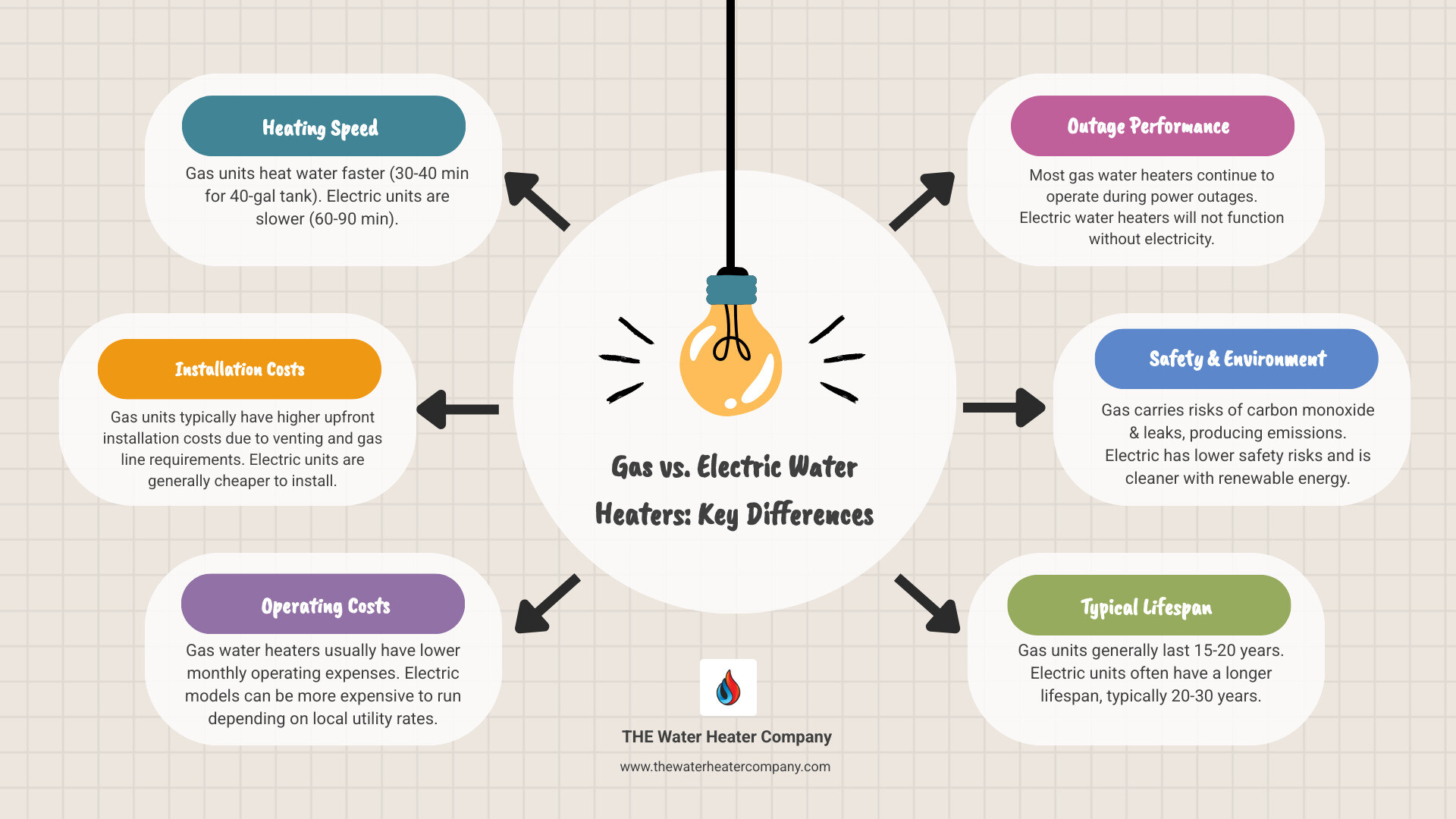
Call 877-798-7487 to speak with a live local agent today

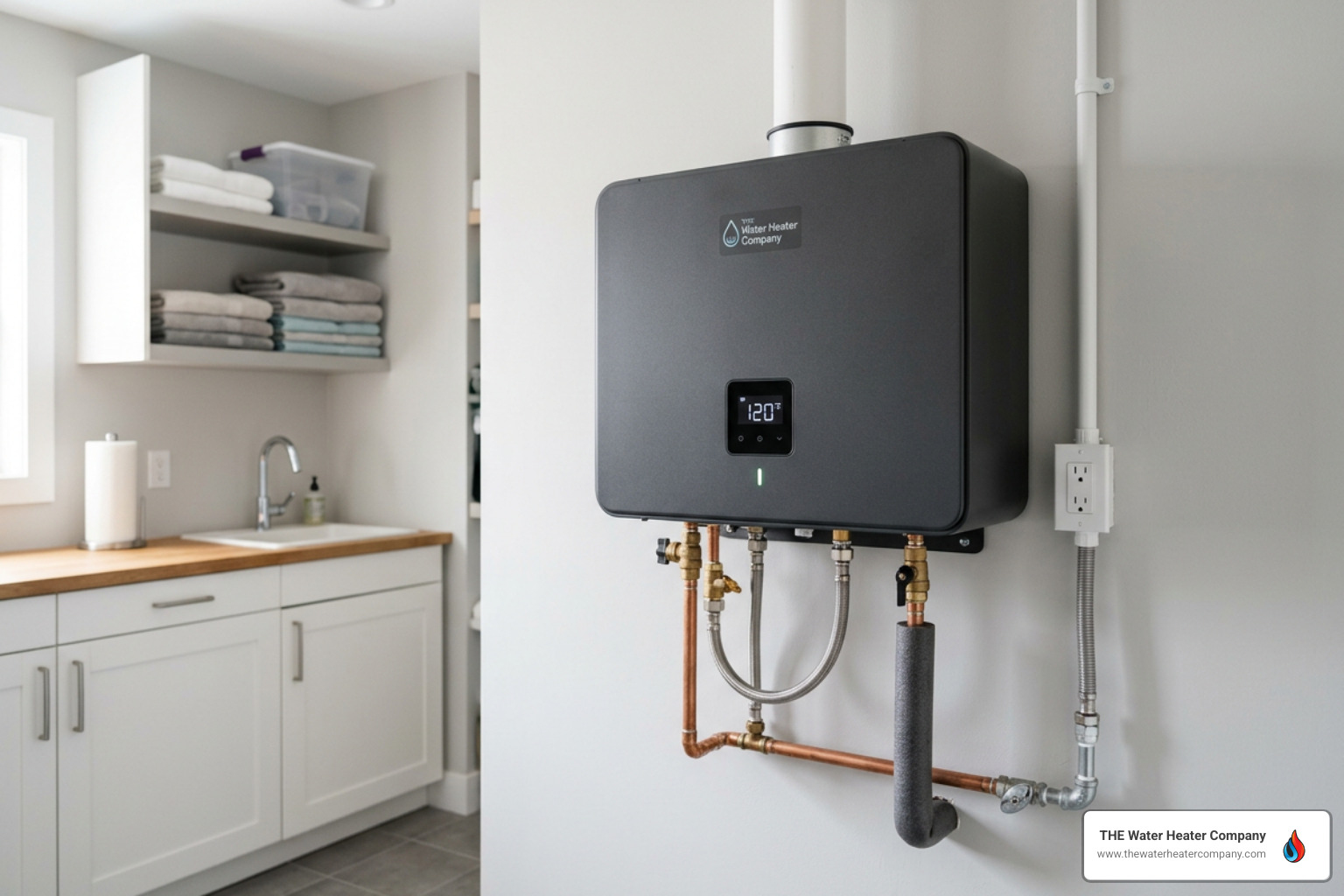
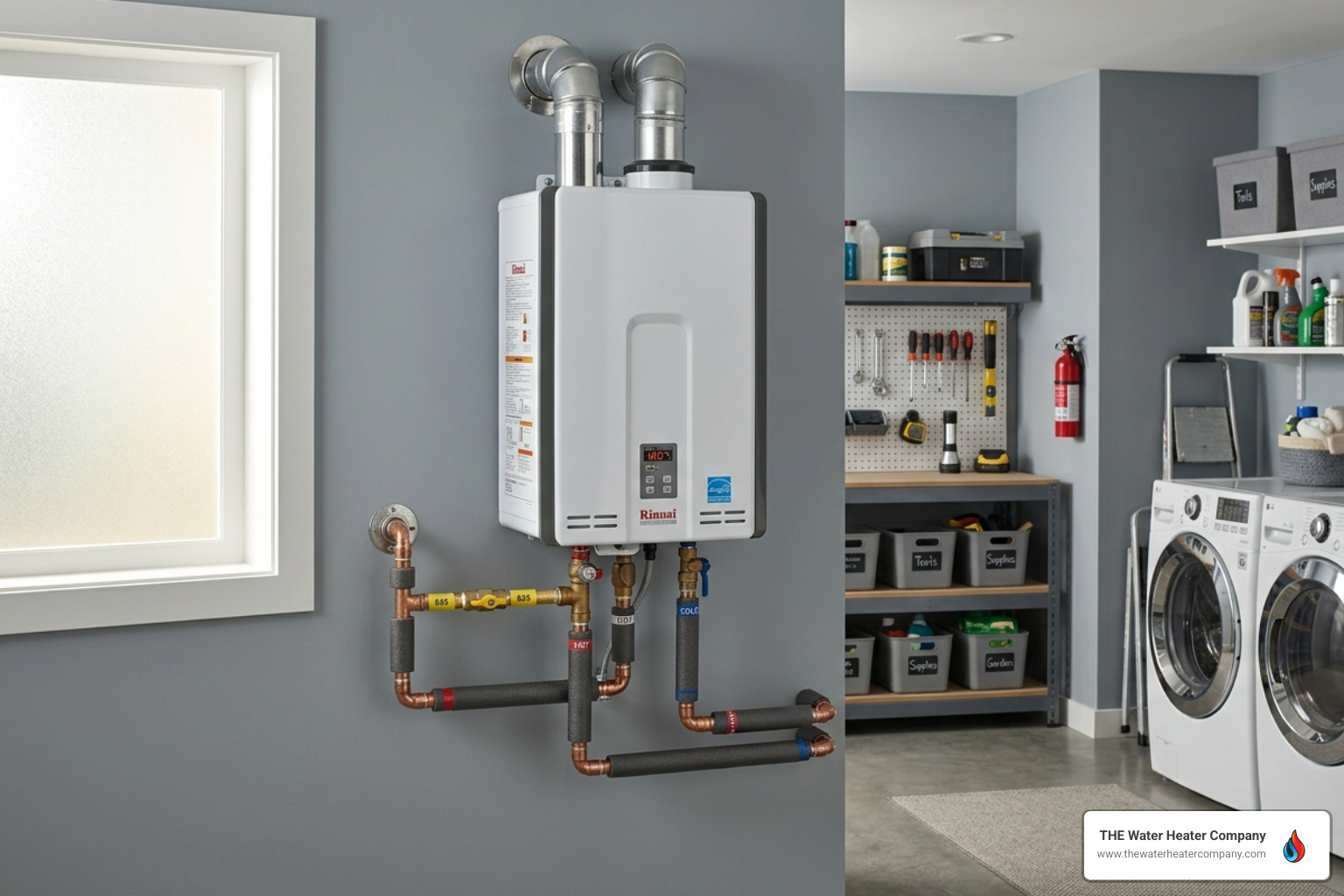
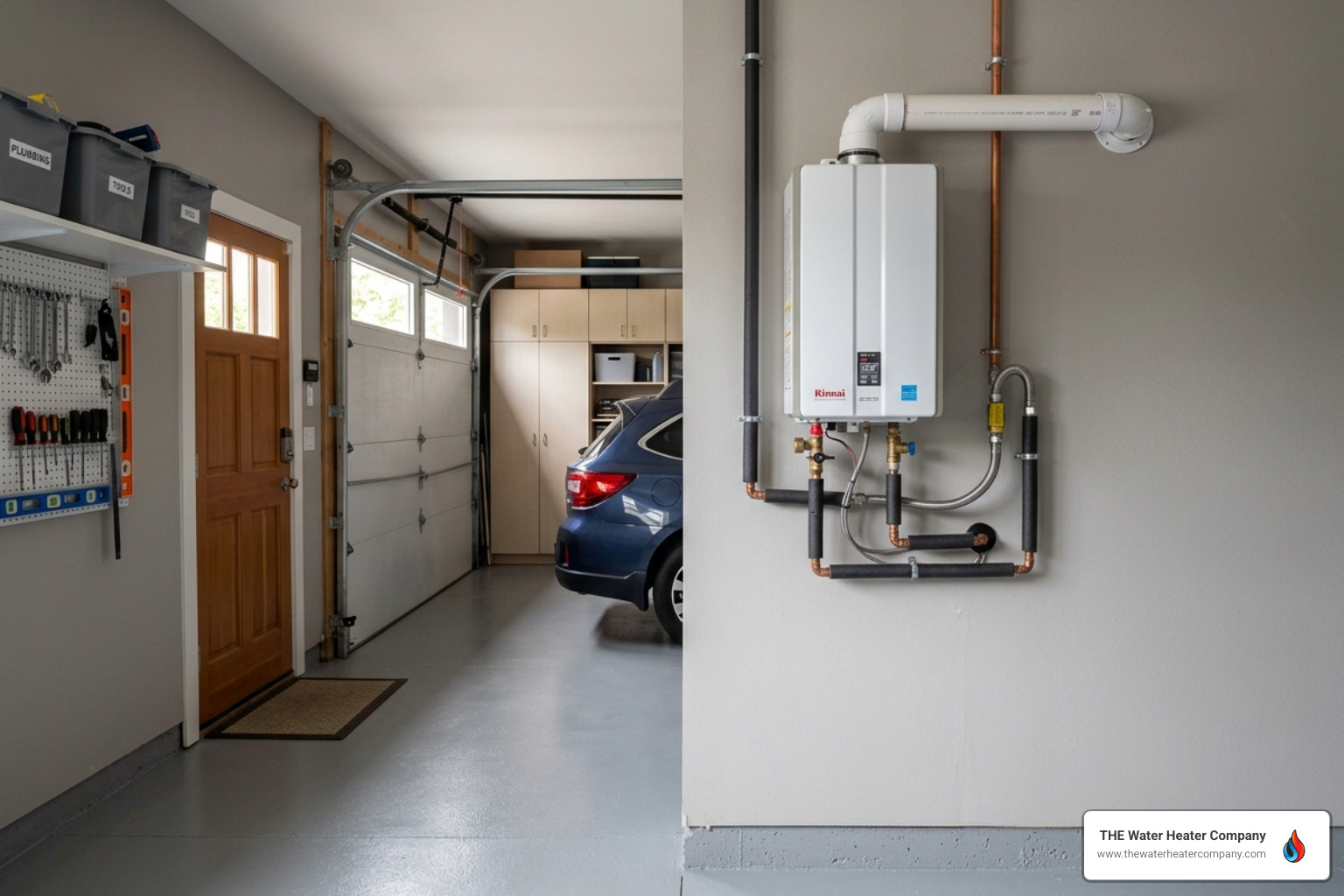
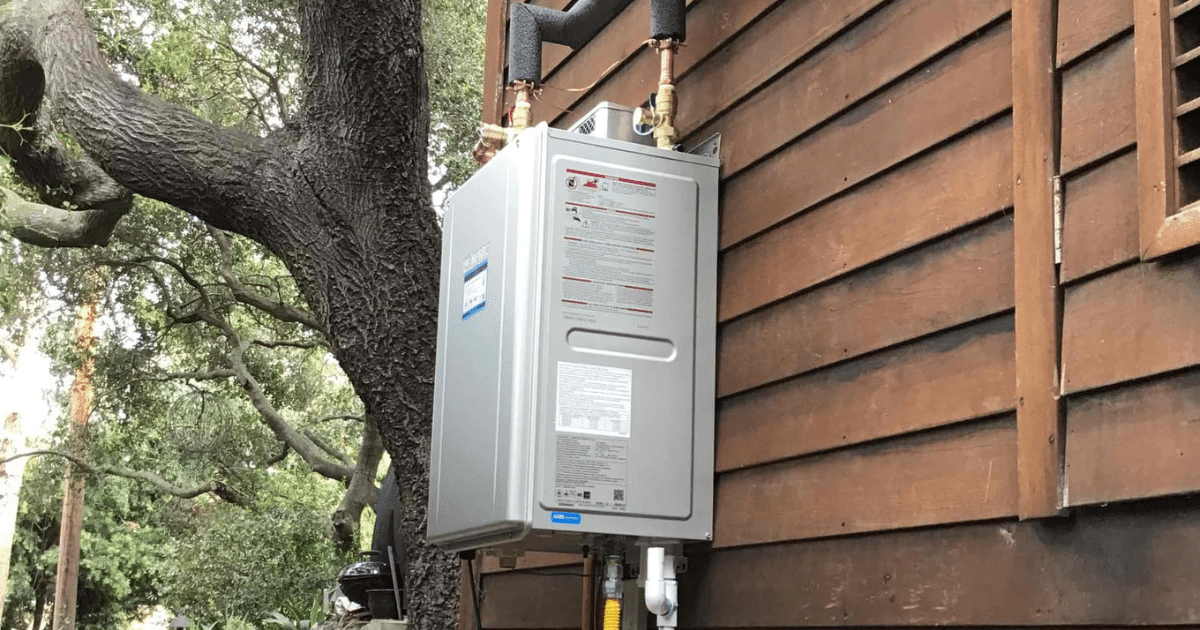
gas vs electric tankless water heater mounted on wall

Gas vs Electric Tankless Water Heaters: Costs and Efficiency Guide

Is Gas or Electric the Right Fuel for Your Tankless Water Heater?

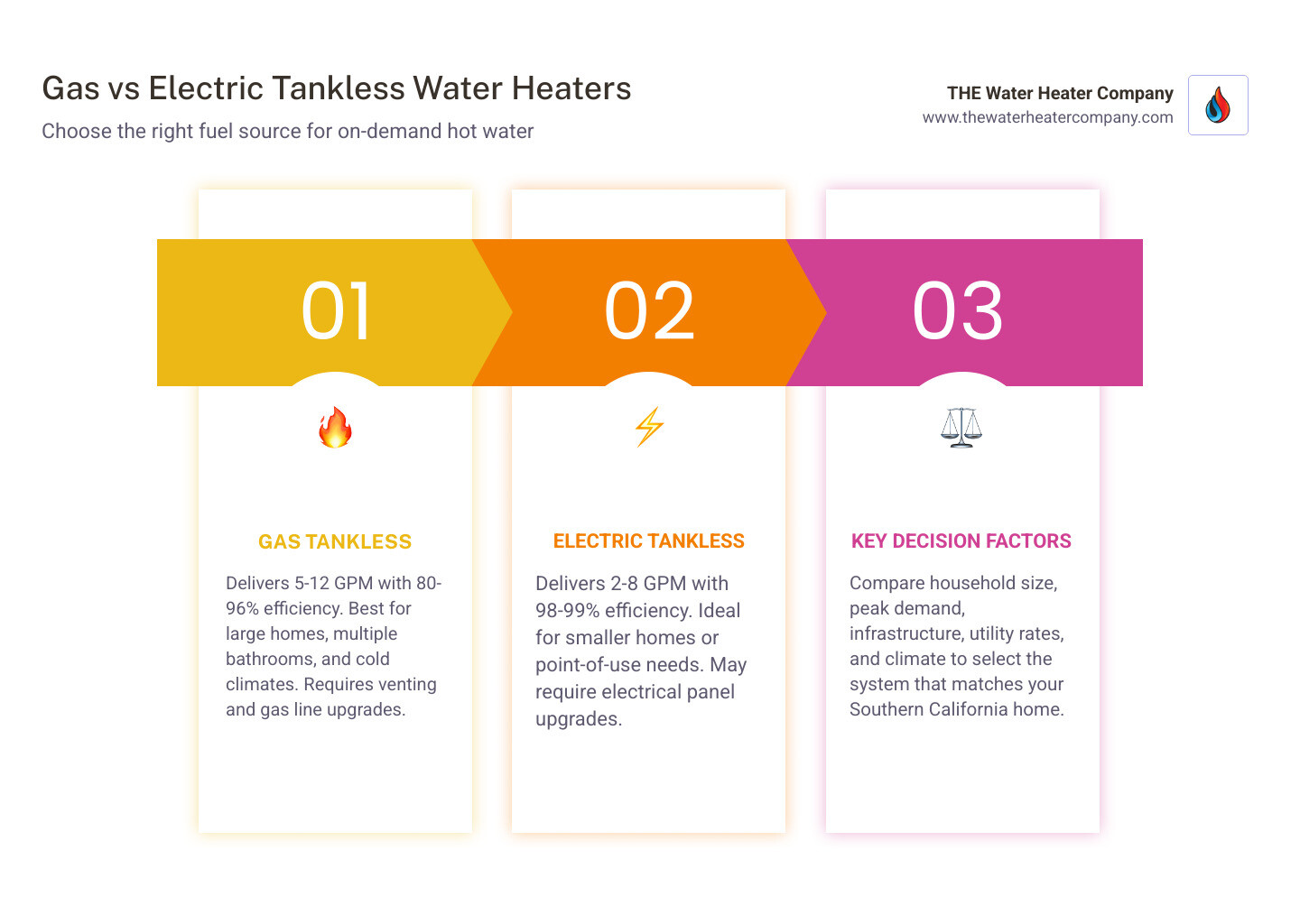
When comparing gas vs electric for tankless water heaters, the short answer is: gas is better for large homes with high hot water demand, while electric works well for smaller homes or single-point applications. Here’s a quick breakdown:

Factor Gas Tankless Electric Tankless
Flow Rate 5-12 GPM 2-8 GPM
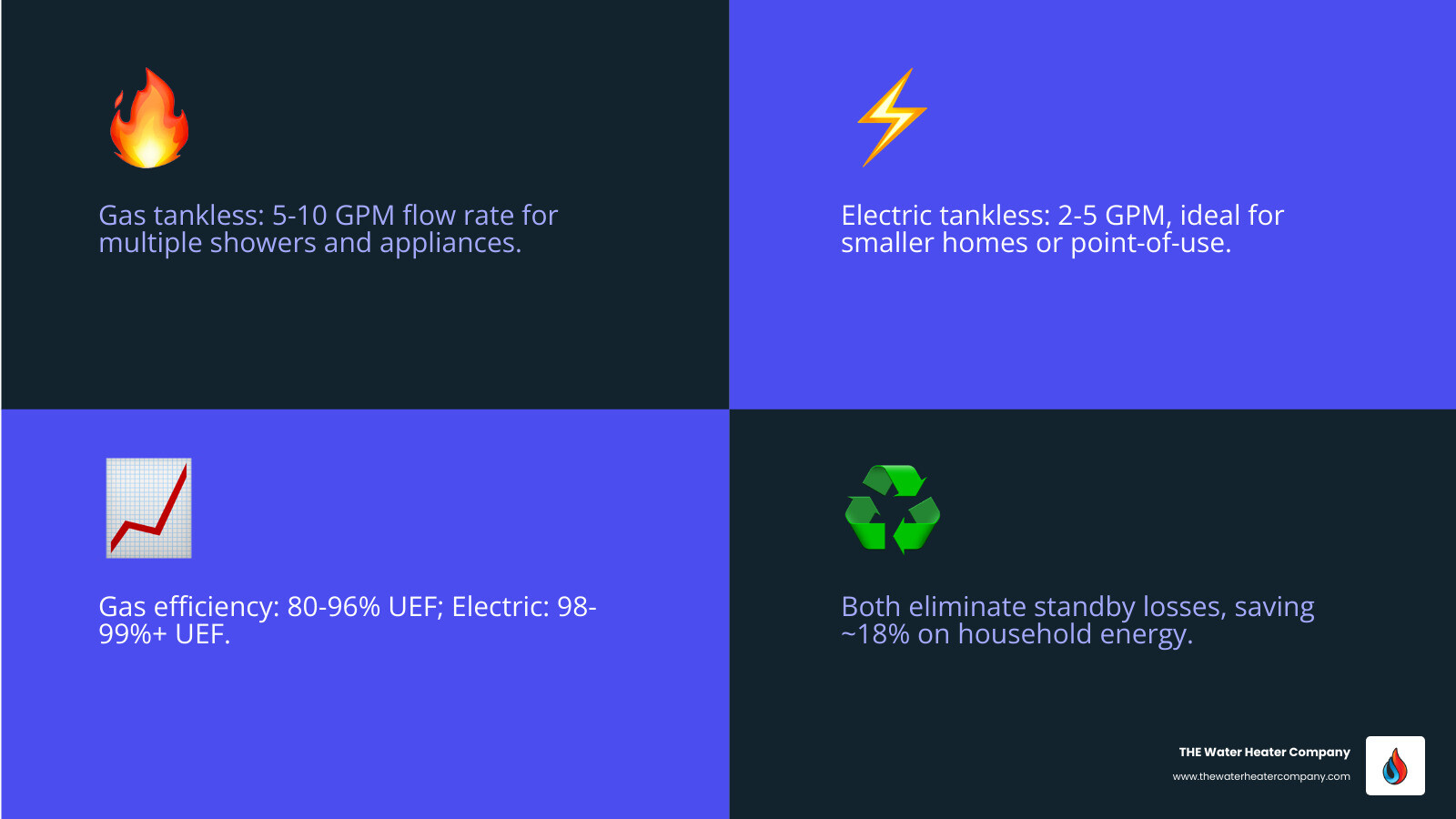
Energy Efficiency 80-96% UEF 98-99% UEF
Best For Large households, multiple bathrooms Smaller homes, point-of-use
Installation Complexity Higher (venting + gas line) Moderate (may need panel upgrade)
Cold Climate Performance Excellent Good
Maintenance More (venting, burner checks) Less (no combustion)

Replacing or upgrading a water heater is one of those decisions that feels simple on the surface — until you start weighing flow rates, utility bills, installation requirements, and long-term efficiency. For Southern California homeowners especially, the choice between gas and electric tankless systems has real consequences for your monthly energy costs, your home’s infrastructure, and whether your family actually gets hot water when everyone needs it at once.

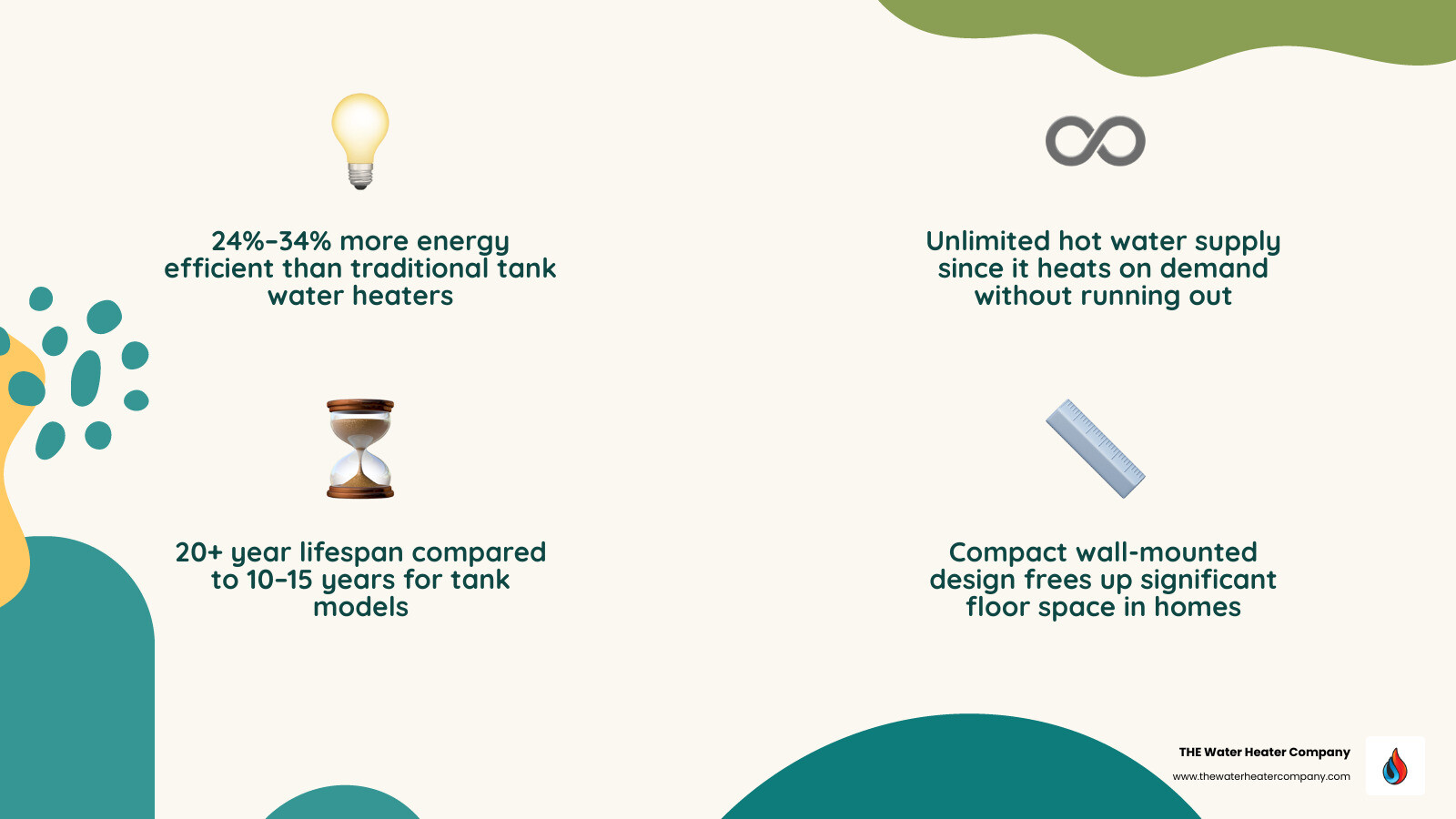
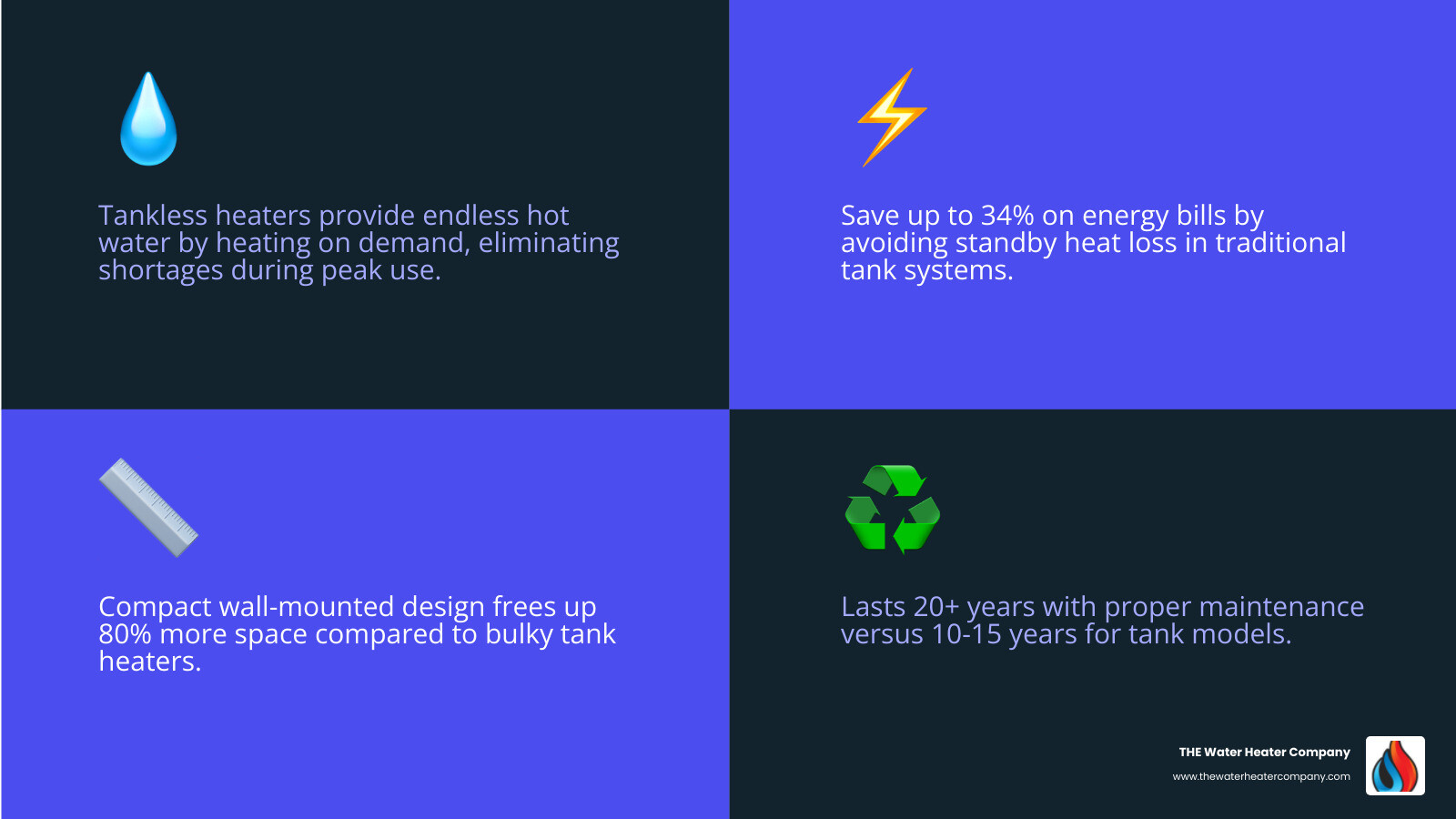
Tankless water heaters have become increasingly popular because they heat water on demand rather than storing it, eliminating the standby energy losses that come with traditional tank models. According to the U.S. Department of Energy, homes using 41 gallons or less of hot water daily can be 24-34% more energy efficient with a tankless system compared to a conventional storage tank heater. But once you decide to go tankless, you still face a major fork in the road: gas or electric?

The answer depends on your home’s existing infrastructure, your household’s peak hot water demand, and your local utility rates — not just the sticker price on the unit itself.

I’m Anthony Hamilton, Co-Founder and CEO of THE Water Heater Company, and I’ve spent years in the field helping Southern California homeowners navigate the gas vs electric for tankless water heaters decision — from Camarillo to Irvine and everywhere in between. In the sections ahead, I’ll break down everything you need to know so you can make a confident, informed choice.

Infographic comparing gas vs electric tankless water heaters: flow rate, efficiency, installation needs, and best use cases

Gas vs electric for tankless water heaters terms to learn:

Understanding the Basics of Gas vs Electric for Tankless Water Heaters

To make an informed decision, it helps to understand how these systems differ at a fundamental level. Both types provide on-demand heating, meaning they only consume energy when you turn on a hot water tap. This is a massive departure from traditional tank water heaters, which constantly keep dozens of gallons of water hot all day and night.

However, the mechanism used to transfer that heat to your water is entirely different depending on whether you choose gas or electric.

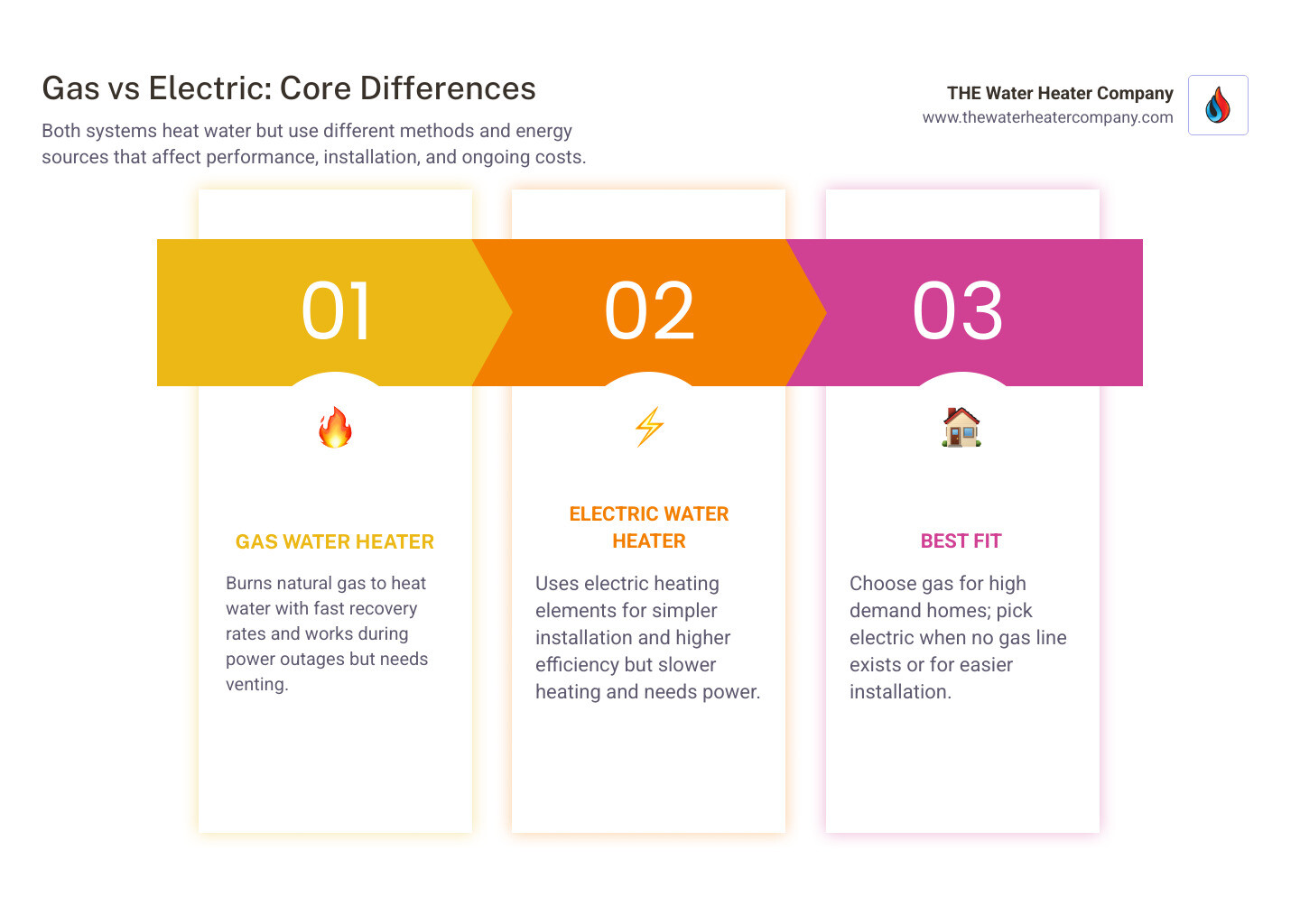
In a gas system, a powerful burner ignites natural gas or propane to heat a heavy-duty heat exchanger. As cold water passes through this exchanger, it absorbs the heat rapidly before flowing to your tap. In an electric system, the unit utilizes electric resistance heating elements. The water flows directly over these elements, which heat up instantly when water flow is detected.

Choosing the right option requires looking closely at your home’s physical layout and utility access. If you are trying to make choosing between gas and electric for your home made easy, the first step is checking what utilities are currently connected to your utility closet. For a deeper dive into these utility types, you can also consult our A-Z guide to gas or electric water heater to see how these power sources behave across different styles of equipment.

sleek tankless water heater installed on a wall

How Gas vs Electric for Tankless Water Heaters Generate Hot Water

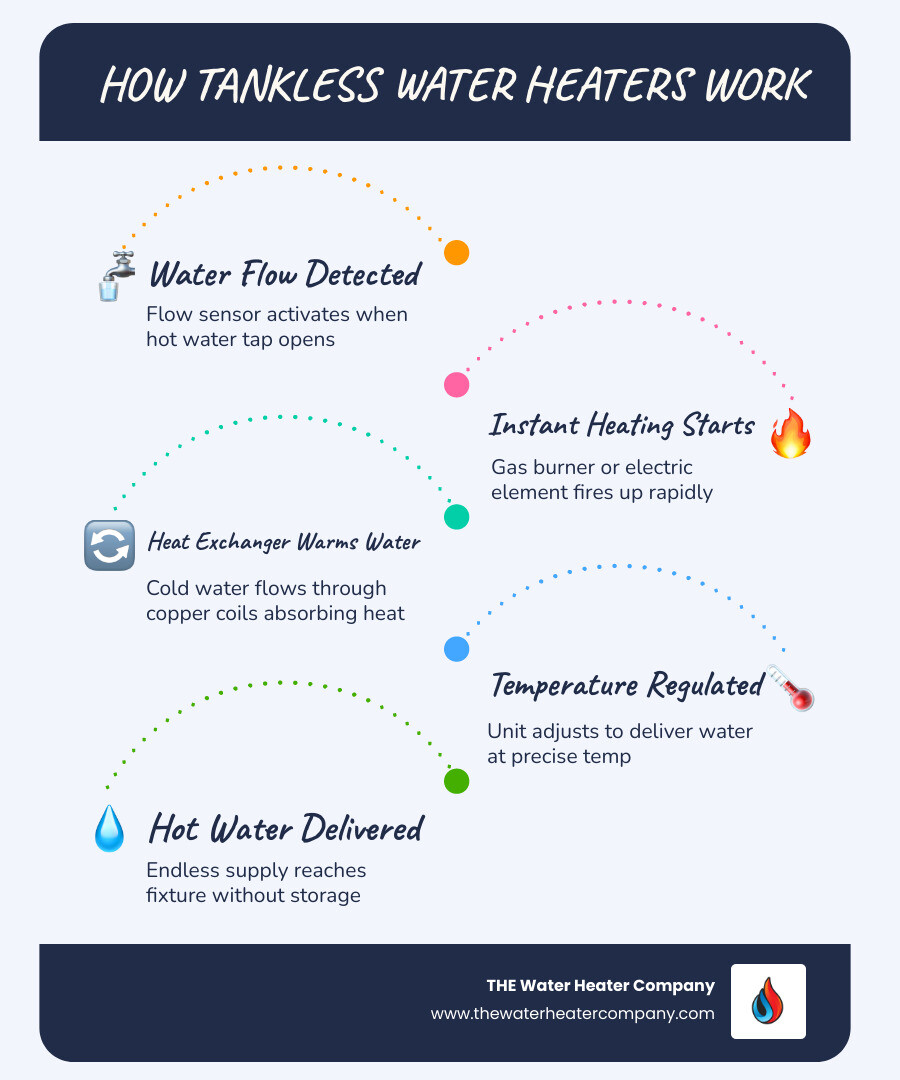
The physical process of heating water on demand is a marvel of modern home engineering. When you open a hot water faucet anywhere in your home, a flow sensor inside the tankless unit detects the movement of water and immediately activates the heating sequence.

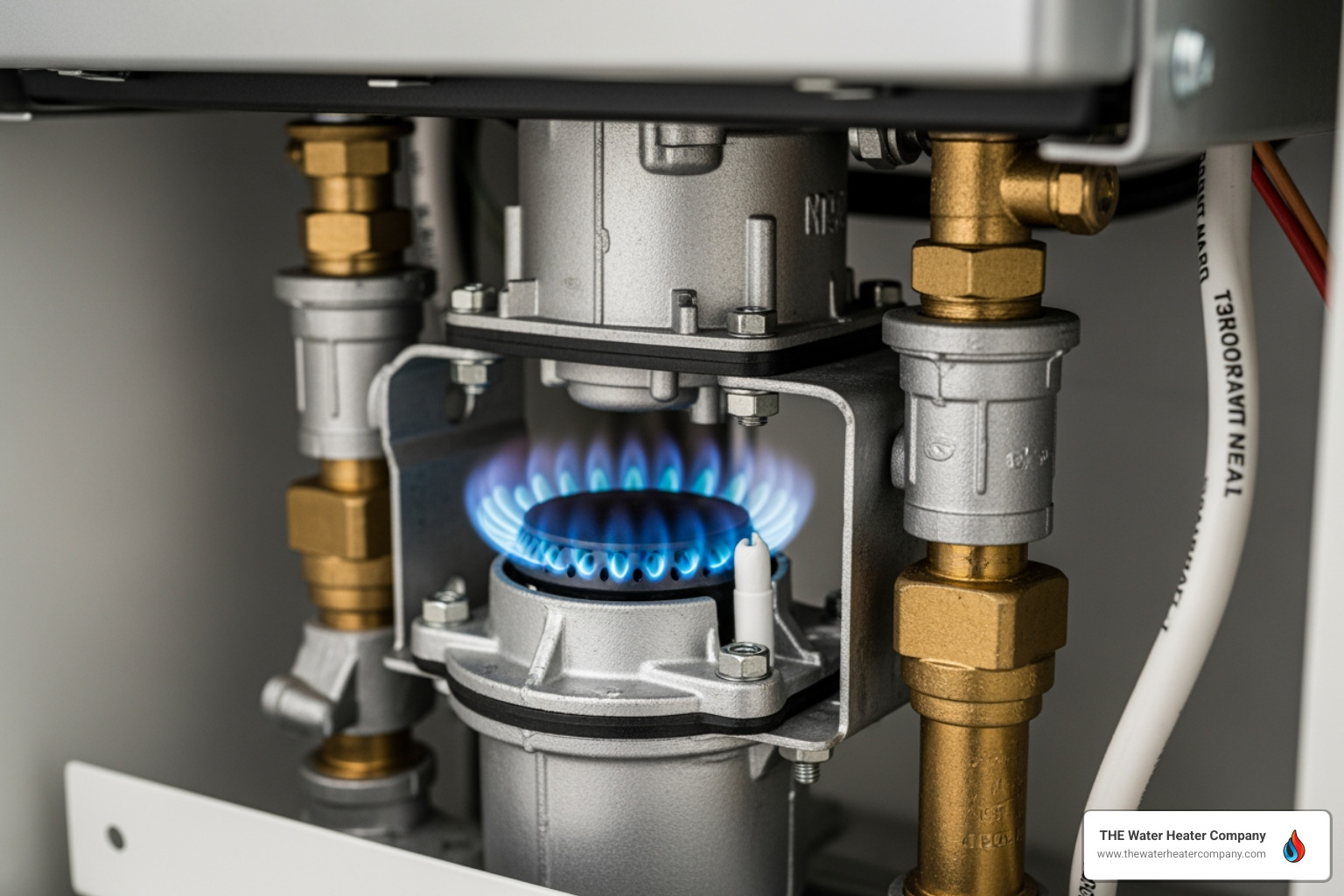
In a gas-powered tankless water heater, the electronic ignition lights a gas burner. This burner creates a high-BTU flame inside a combustion chamber. The heat from this flame is transferred to a copper or stainless steel heat exchanger. As the cold water winds through the tightly coiled pipes of the heat exchanger, the thermal energy is transferred into the water. The combustion process produces exhaust gases, which must then be safely vented outside your home.

An electric tankless water heater bypasses the combustion process entirely. Instead of a burner and heat exchanger, it uses heavy-duty electric resistance heating elements submerged directly in the water path. When the flow sensor is triggered, these elements instantly draw high-voltage electricity to heat up. The heat transfer is incredibly direct, requiring no venting, no air supply, and no flame.

Performance and Flow Rate Comparison

When we talk about performance in the tankless world, we are talking about flow rate — specifically, how many gallons per minute (GPM) of hot water a unit can produce at a consistent temperature. This is where the debate between gas vs electric for tankless water heaters gets highly practical.

If you have a busy household where multiple people are showering, running the dishwasher, or doing laundry at the same time, peak demand becomes your primary concern. If your system cannot keep up with simultaneous usage, you will experience sudden drops in temperature or water pressure.

In the match-up of choosing your power: gas vs electric tankless water heater performance, gas units generally come out on top for raw power. They can deliver flow rates ranging from 5 to 12 GPM, whereas electric models typically top out between 2 and 8 GPM under ideal conditions. To understand how this compares to traditional storage systems, you can read our breakdown of tank vs tankless water heaters.

Performance Metric Gas Tankless Water Heaters Electric Tankless Water Heaters
Average Flow Rate 5 to 10+ GPM 2 to 5 GPM (up to 8 in warm climates)
Simultaneous Showers 3 to 5 low-flow showers 1 to 2 showers
Heating Speed Extremely fast ramp-up Fast, but limited by electrical draw
Suitability Large family homes, high-demand Small homes, apartments, point-of-use

Flow Rates and Household Size Suitability

For large households with multiple bathrooms, a gas tankless water heater is almost always the superior choice. Because gas burners can output a massive amount of heat energy instantly, they can easily support several simultaneous hot water demands.

Electric models, on the other hand, are highly limited by the maximum electrical current they can safely draw from your home’s electrical panel. As a result, they are generally better suited for smaller households, apartments, or point-of-use applications (such as a dedicated unit for a detached guest house or an outdoor kitchen).

To help you visualize your household’s peak demand, here is a list of typical fixture flow rates:

  • Low-flow showerhead: 1.5 to 2.0 GPM
  • Standard showerhead: 2.0 to 2.5 GPM
  • Kitchen faucet: 1.0 to 2.2 GPM
  • Washing machine: 2.0 to 3.0 GPM
  • Dishwasher: 1.0 to 2.0 GPM

If you live in Santa Monica or Pasadena and have a home with three bathrooms, and two people are showering while the washing machine is running, your peak demand could easily reach 7 GPM. A gas unit can handle this with ease, whereas a standard electric unit would struggle, likely resulting in lukewarm showers.

Climate Impact on Performance

One of the most overlooked factors in choosing a tankless water heater is the temperature of the groundwater entering your home. A tankless water heater must raise the temperature of the incoming cold water to your desired thermostat setting (typically 120°F). The colder the incoming water, the more energy the system needs to achieve that temperature rise.

In cold climates, incoming groundwater temperatures can drop to near-freezing in the winter. This drastically reduces the GPM output of any tankless water heater, especially electric models, which simply do not have the raw heating capacity to handle a massive temperature rise at high flow rates.

Fortunately, here in Southern California — including our service areas like Santa Barbara, Camarillo, Santa Clarita, and Los Angeles — our groundwater remains relatively warm year-round. This gives both gas and electric tankless units a distinct performance advantage. However, even in milder climates, a gas unit provides more reliable, consistent water pressure during the cooler winter months when groundwater temperatures do dip slightly.

Energy Efficiency and Environmental Impact

Efficiency is a major selling point for tankless technology. By eliminating the constant energy usage required to keep a giant tank of water hot, you naturally lower your home’s energy footprint. When evaluating different models, you will want to look at the Uniform Energy Factor (UEF), which is the standard measure of water heater efficiency.

If you are wondering, is a tankless water heater right for your home and budget?, understanding the efficiency differences between gas and electric models is key to calculating your long-term utility impact.

Thermal Efficiency and Standby Losses

Electric tankless water heaters are incredibly efficient at converting energy into heat. In fact, they achieve nearly 98% to 99% thermal efficiency because the heating elements are fully submerged in the water, resulting in almost zero energy loss.

Gas tankless units typically achieve between 80% and 96% efficiency. Non-condensing gas models lose some heat through their metal venting systems, while high-efficiency condensing gas models capture that escaping heat to preheat incoming water, pushing their efficiency to the upper end of the spectrum. Additionally, older gas water heaters with standing pilot lights can waste energy, but modern gas tankless heaters utilize electronic ignitions to eliminate standby energy waste entirely.

While electric units win the pure thermal efficiency battle, your monthly operating costs will depend heavily on local utility rates. In many parts of Southern California, natural gas historically costs less per unit of energy than electricity, meaning a gas unit can still be highly cost-effective to run despite having a slightly lower efficiency rating on paper.

Choosing Gas vs Electric for Tankless Water Heaters Based on Carbon Footprint

For environmentally conscious homeowners in areas like Santa Ana and Irvine, the carbon footprint of their appliances is a major consideration.

Electric tankless units have no on-site emissions. If your home is powered by solar panels or if your local grid relies heavily on renewable energy sources like wind and solar, an electric tankless water heater can operate with a incredibly low carbon footprint.

Gas units burn fossil fuels, which naturally releases carbon dioxide and other greenhouse gases through the vent. However, because they are so much more efficient than old-fashioned gas tank heaters, upgrading to a gas tankless system still represents a major environmental step forward for homes that rely on gas infrastructure.

Infrastructure and Installation Requirements

Choosing between gas and electric is rarely just about the unit itself; it is about what your home is physically capable of supporting. The existing infrastructure in your utility closet or garage will dictate the complexity of your installation.

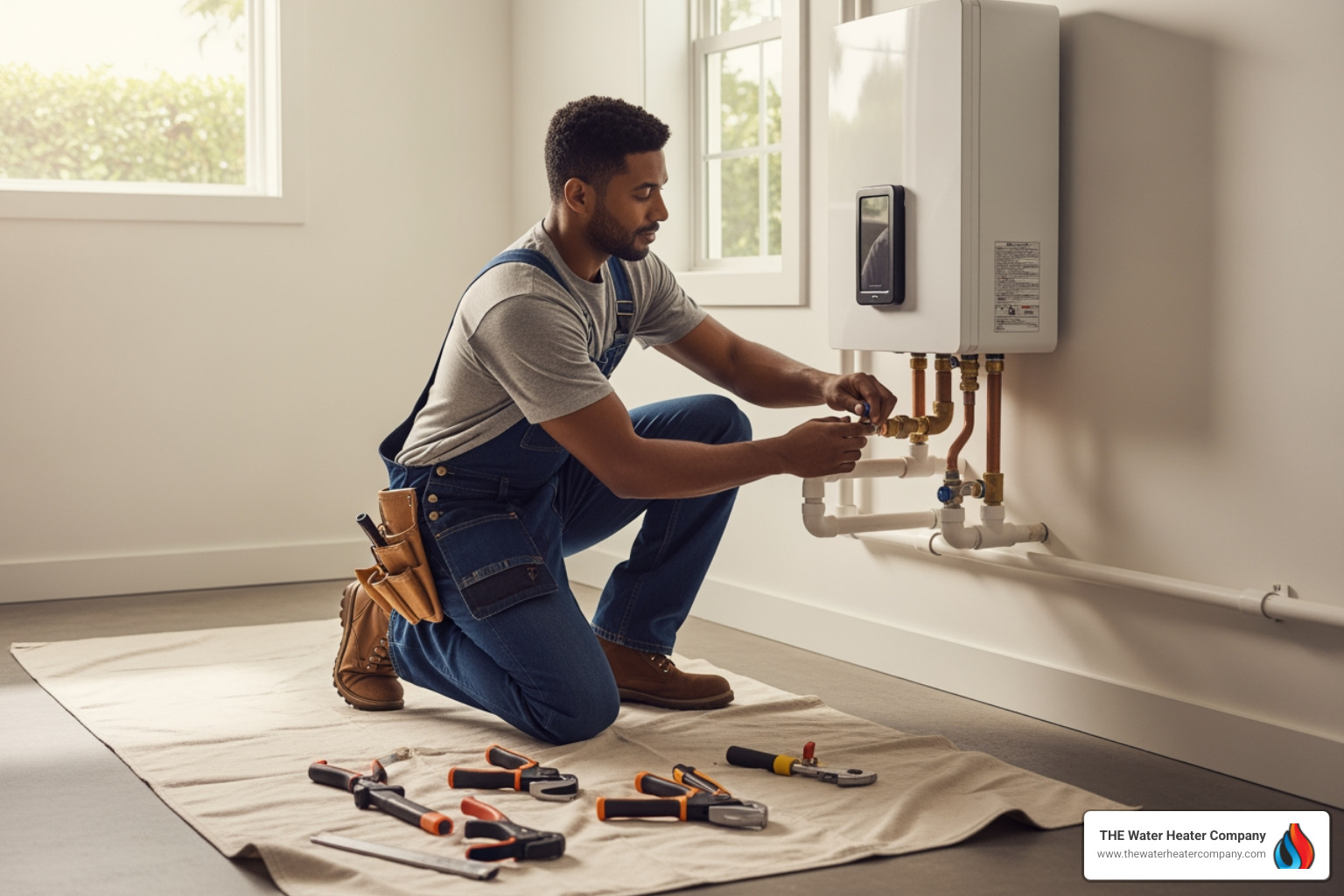
Before making a decision, it is essential to understand the unique requirements of each system. We recommend reading our guide on water heater installation in Southern California: what homeowners should know to get a sense of local building codes and permitting. Additionally, our article on how much does a new water heater cost in California? details the various installation factors that can impact your project without focusing on volatile equipment pricing.

Venting and Gas Line Upgrades

If you select a gas tankless water heater, you must have a way to safely vent the combustion byproducts out of your home. This typically requires specialized concentric venting made of stainless steel or, in the case of condensing models, durable PVC. This venting must run through an exterior wall or up through the roof.

Furthermore, gas tankless heaters require a massive amount of fuel instantly when they fire up. This means your existing gas line may need to be upgraded from a standard 1/2-inch pipe to a larger 3/4-inch or 1-inch line to ensure the unit gets enough fuel without starving your furnace or gas stove. In some cases, homeowners opt for an outdoor installation to simplify venting requirements, provided local safety codes allow it.

Electrical Panel Capacity

Electric tankless water heaters do not require any venting or gas lines, which makes their physical placement much more flexible. However, they place a massive demand on your home’s electrical system.

A whole-house electric tankless water heater typically requires a dedicated 240-volt circuit and can draw up to 120 to 150 amps of power. If your home in Santa Clarita or Van Nuys has an older 100-amp or even 150-amp electrical panel, you will almost certainly need to upgrade your entire electrical panel to 200 or 300 amps to support the unit. This infrastructure upgrade can add significant complexity to your installation project.

Maintenance and Lifespan Considerations

Investing in a tankless water heater is a long-term commitment. Fortunately, both gas and electric tankless units are built to last. While traditional tank heaters typically need replacement every 6 to 10 years, a high-quality tankless water heater can easily last 15 to 20 years or more with proper care.

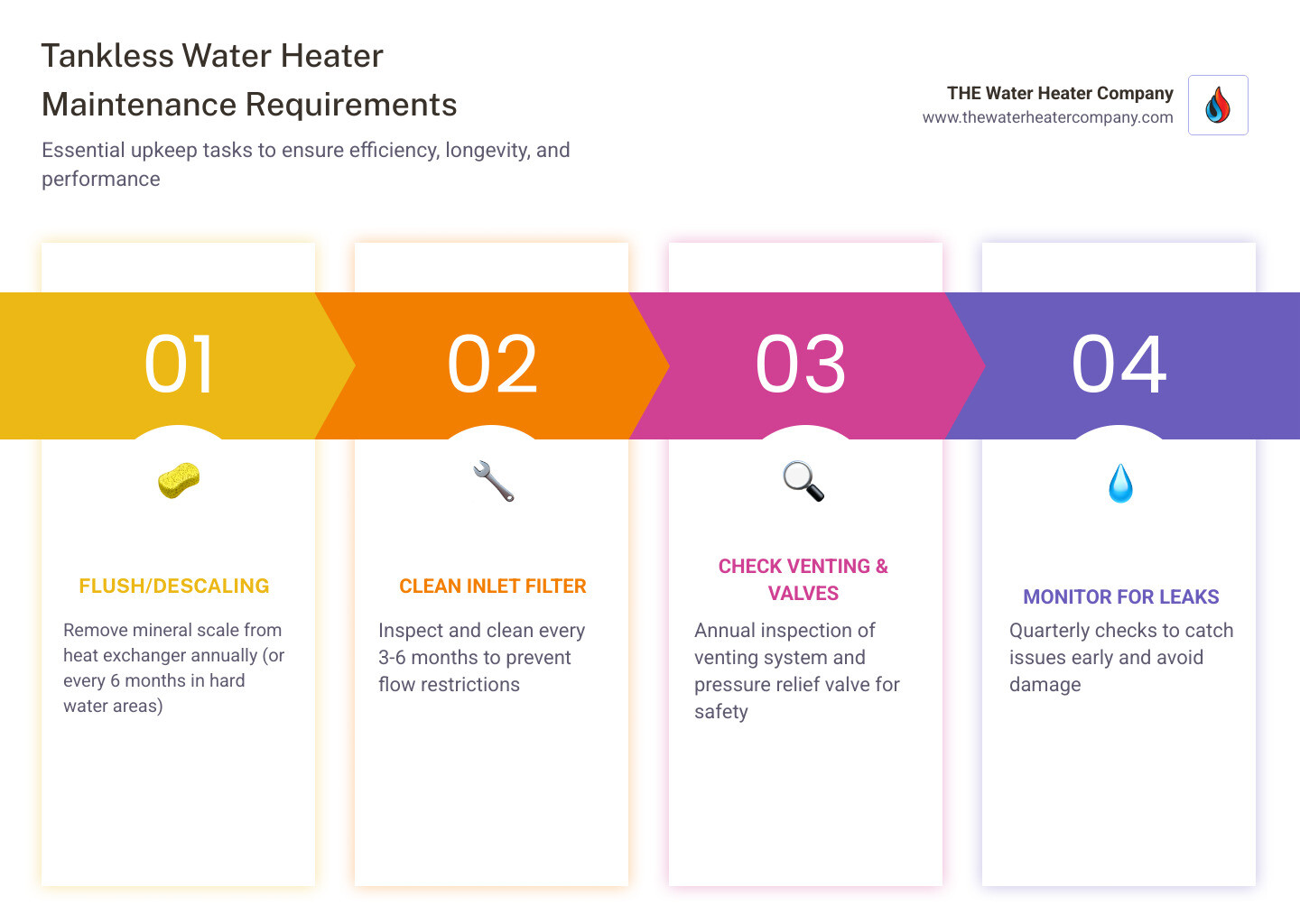
To maximize this lifespan, regular maintenance is non-negotiable. You can learn more about the long-term care of these systems on our dedicated tankless water heaters service page.

Descaling and Annual Flushing

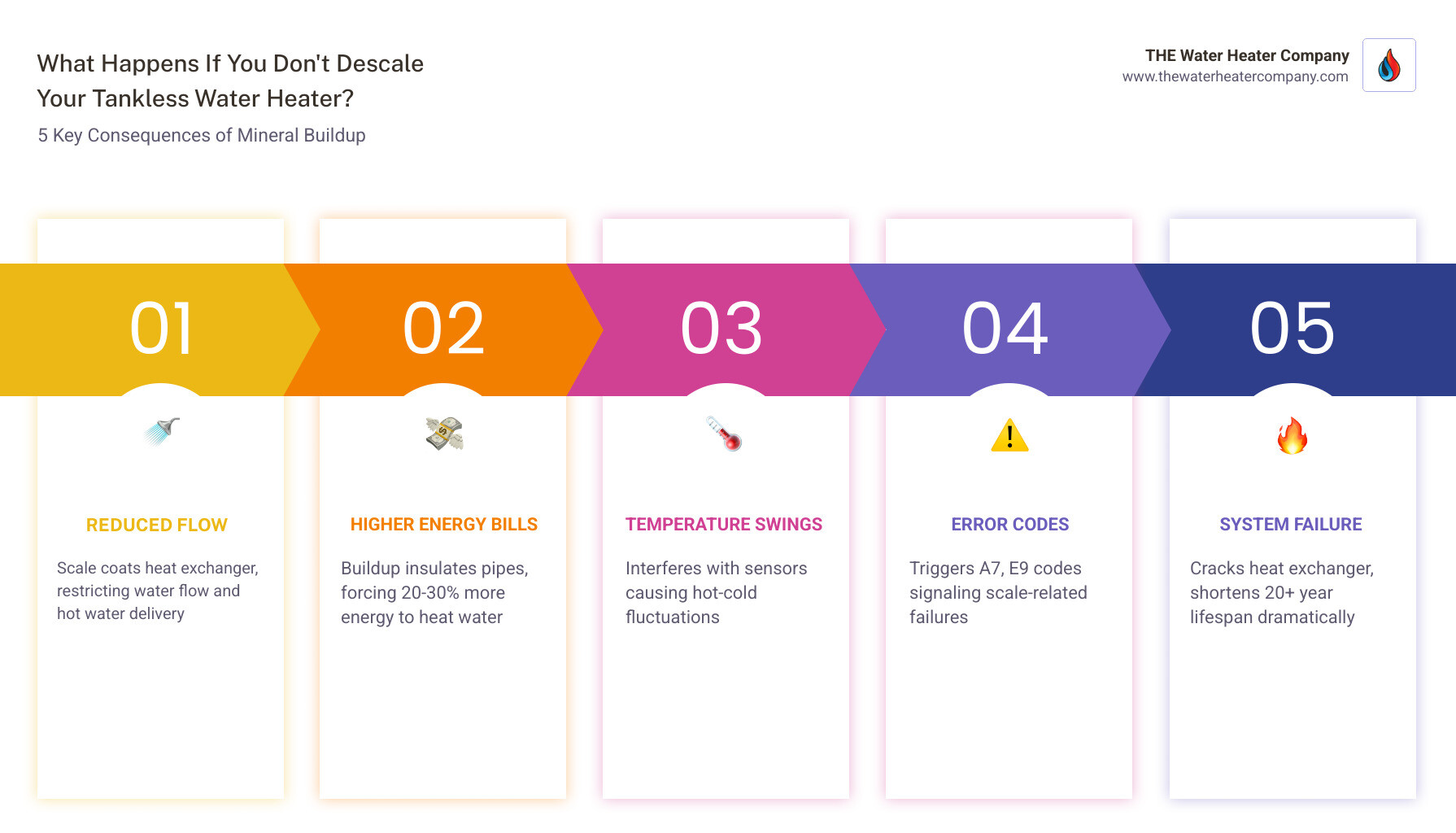
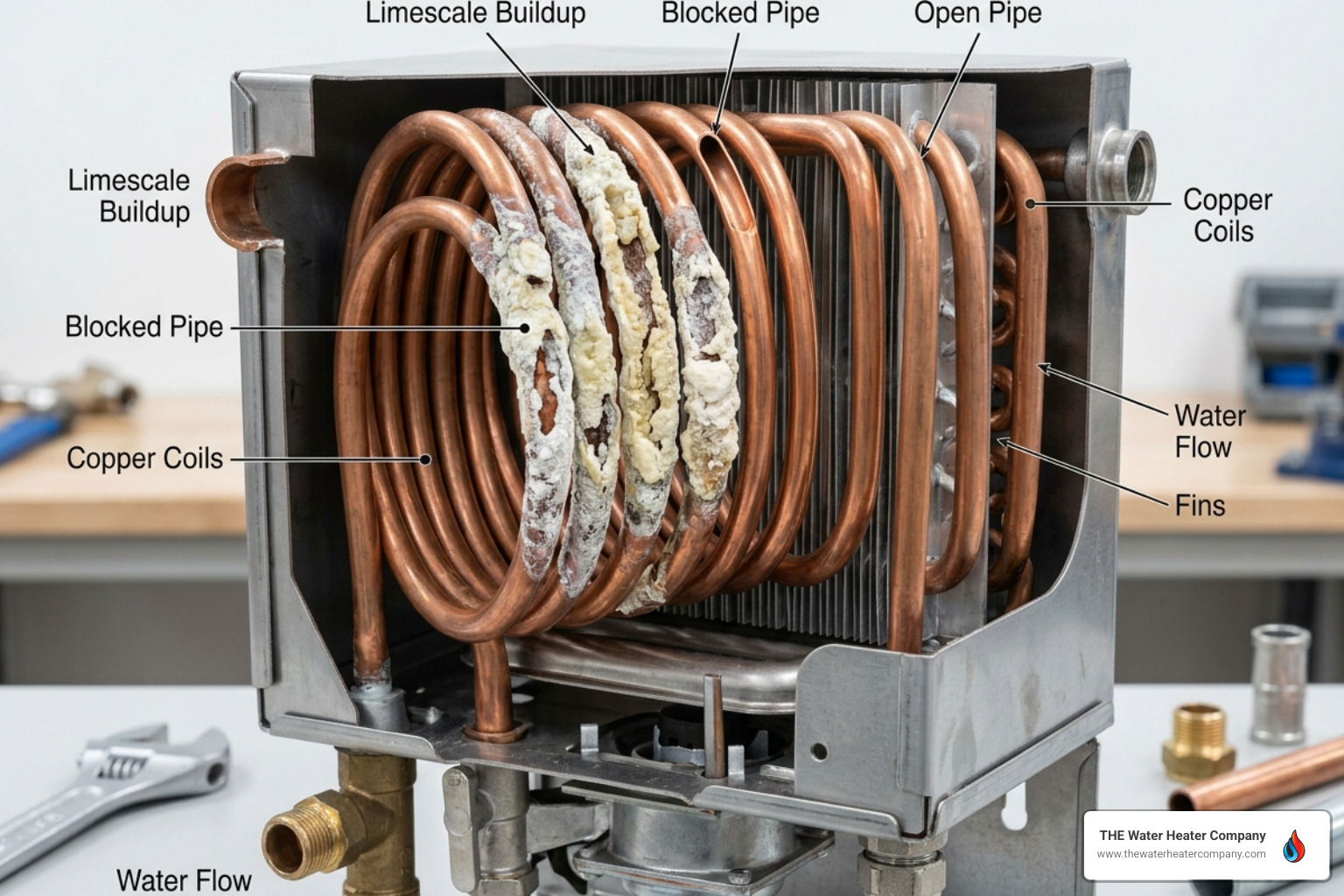
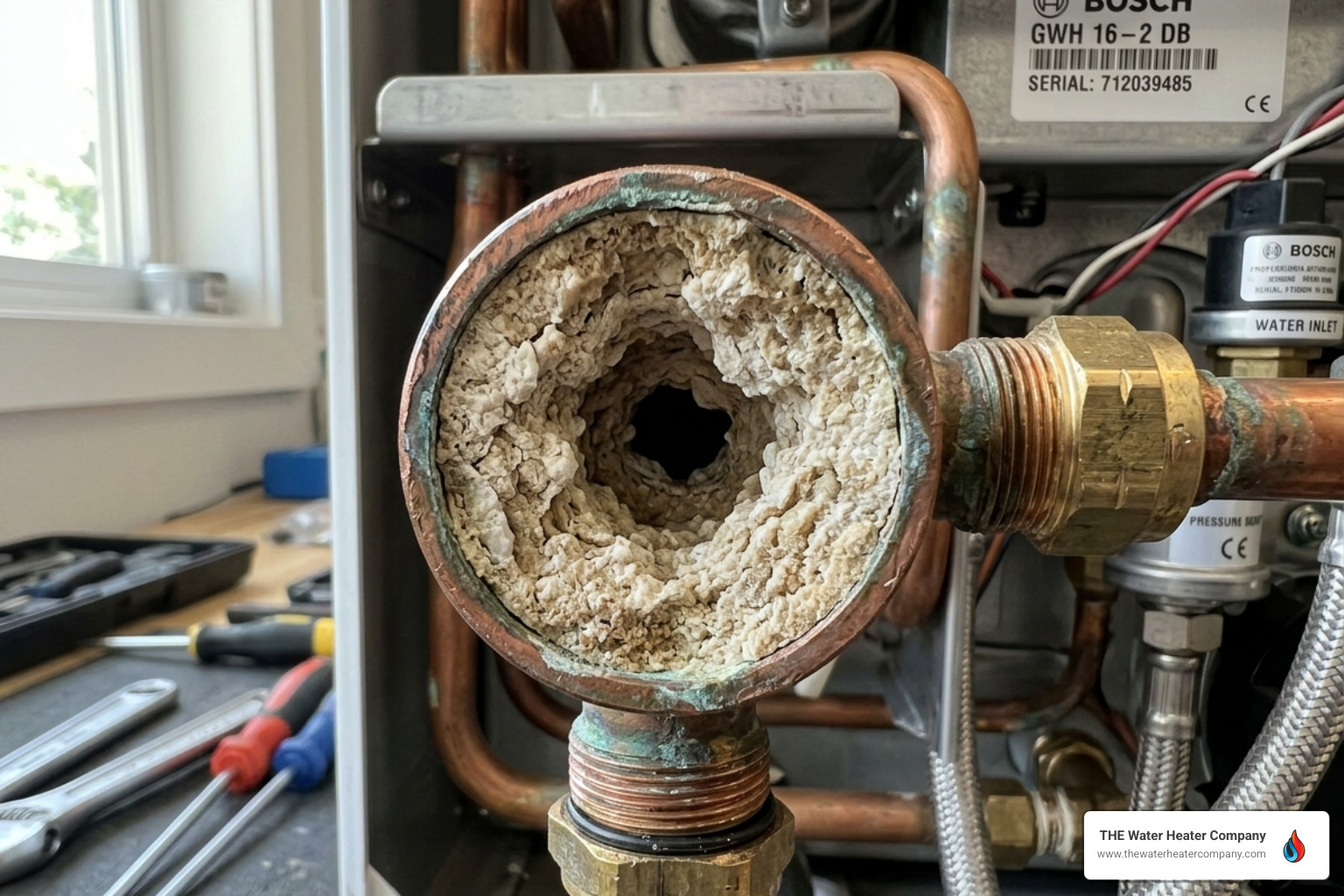
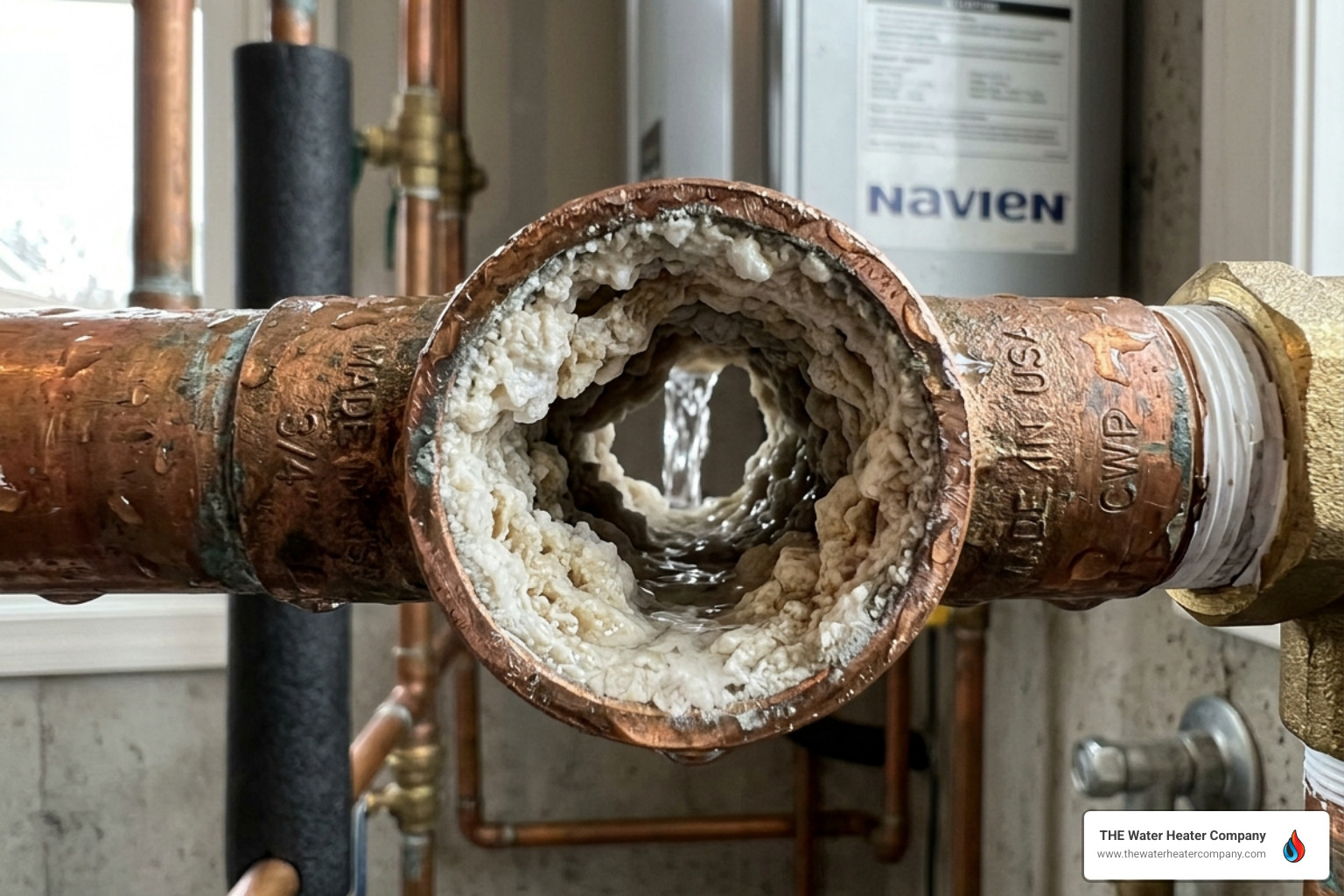
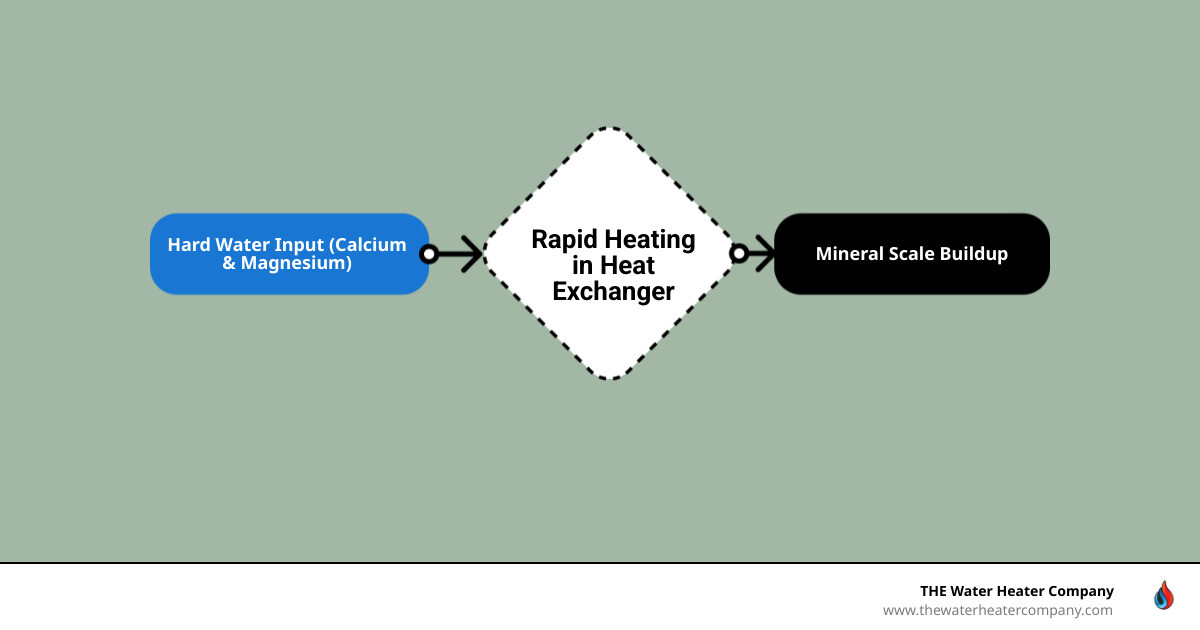
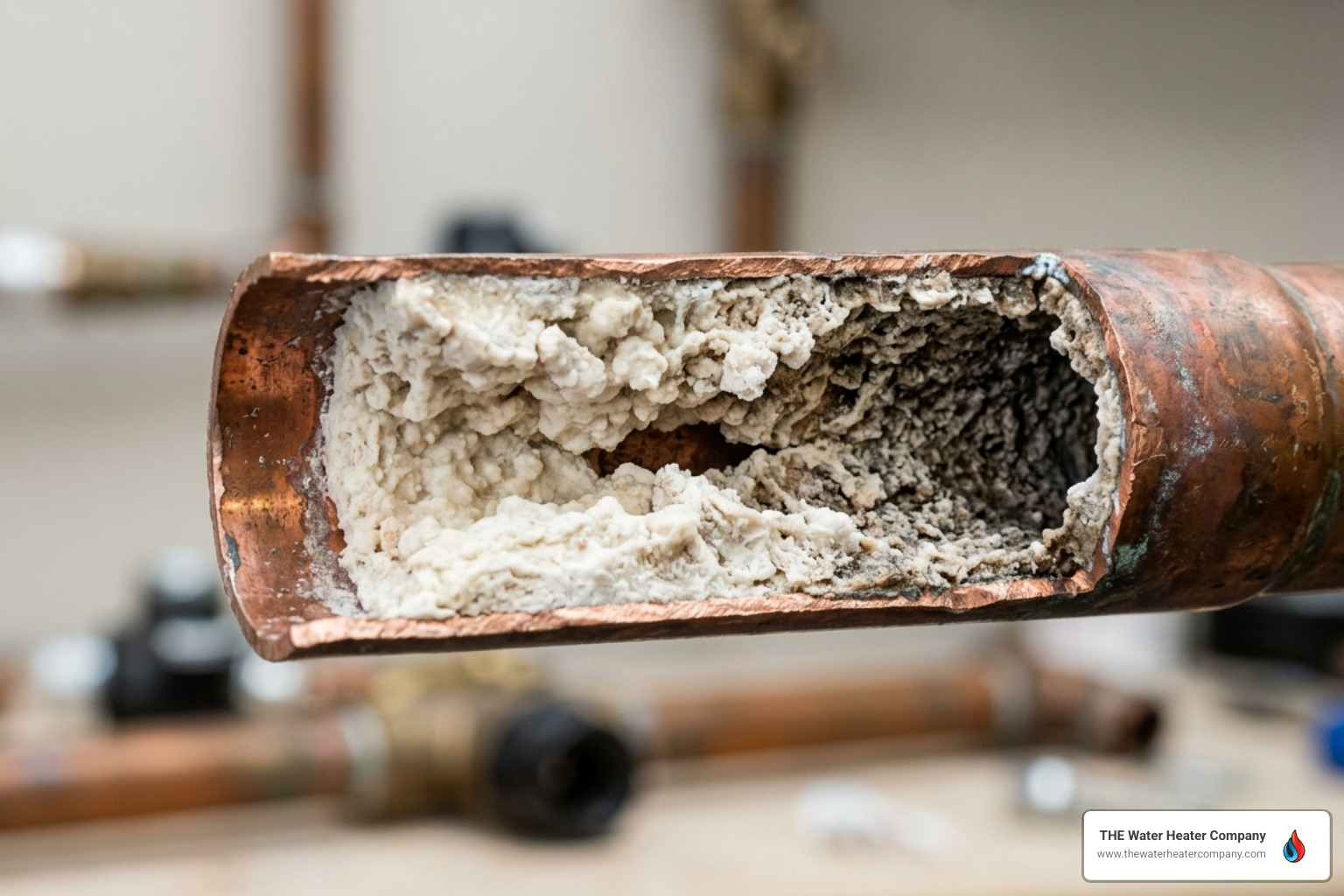
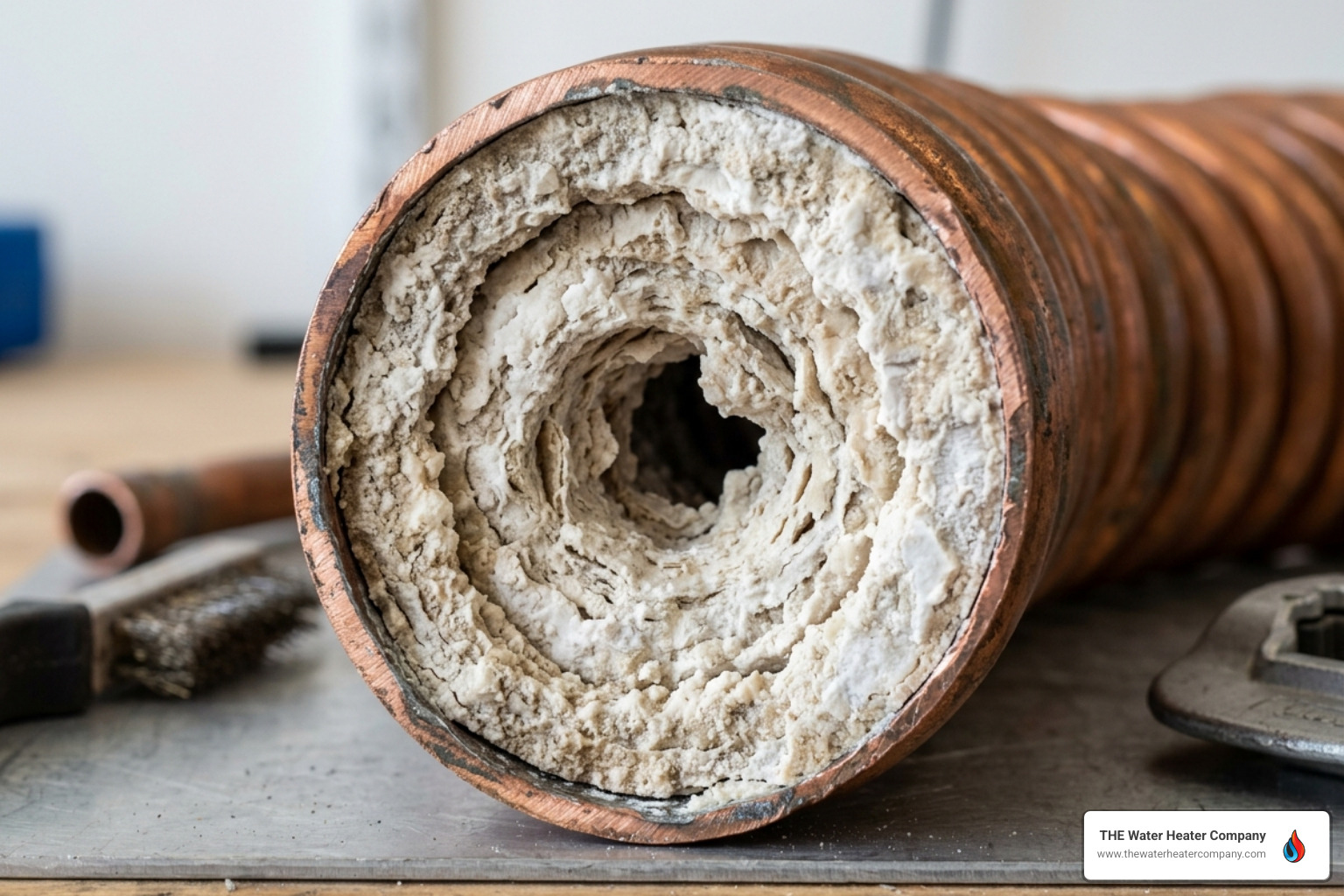
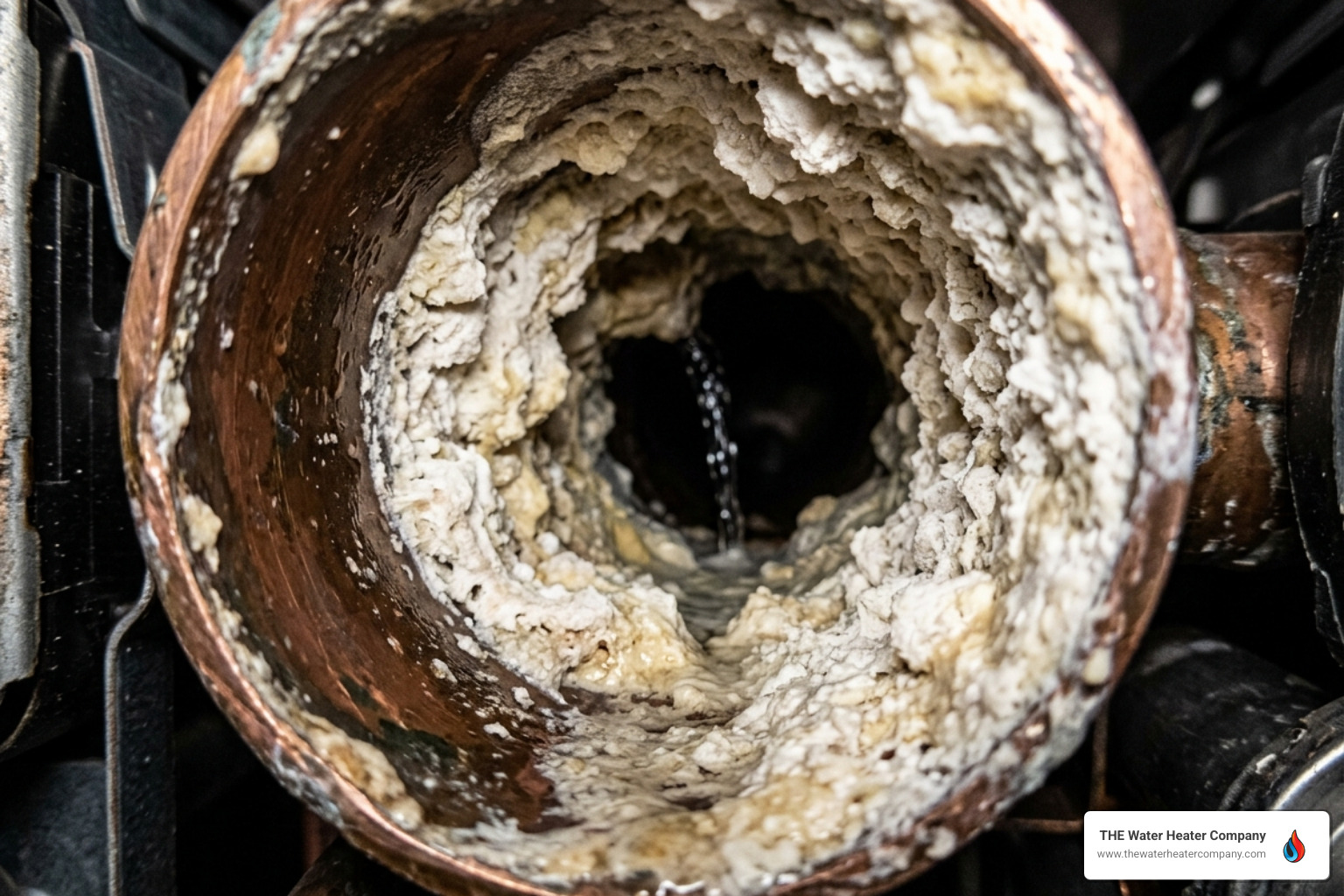
The single greatest threat to any tankless water heater is hard water. Southern California is notorious for high mineral content in our water supply. As water is heated, calcium and magnesium minerals precipitate out and cling to the heat exchanger or heating elements, creating a hard crust known as scale.

This scale acts as an insulator, reducing heat transfer efficiency and forcing your unit to work harder to heat the water. Over time, severe scale buildup can cause the system to overheat, throw error codes, or shut down entirely.

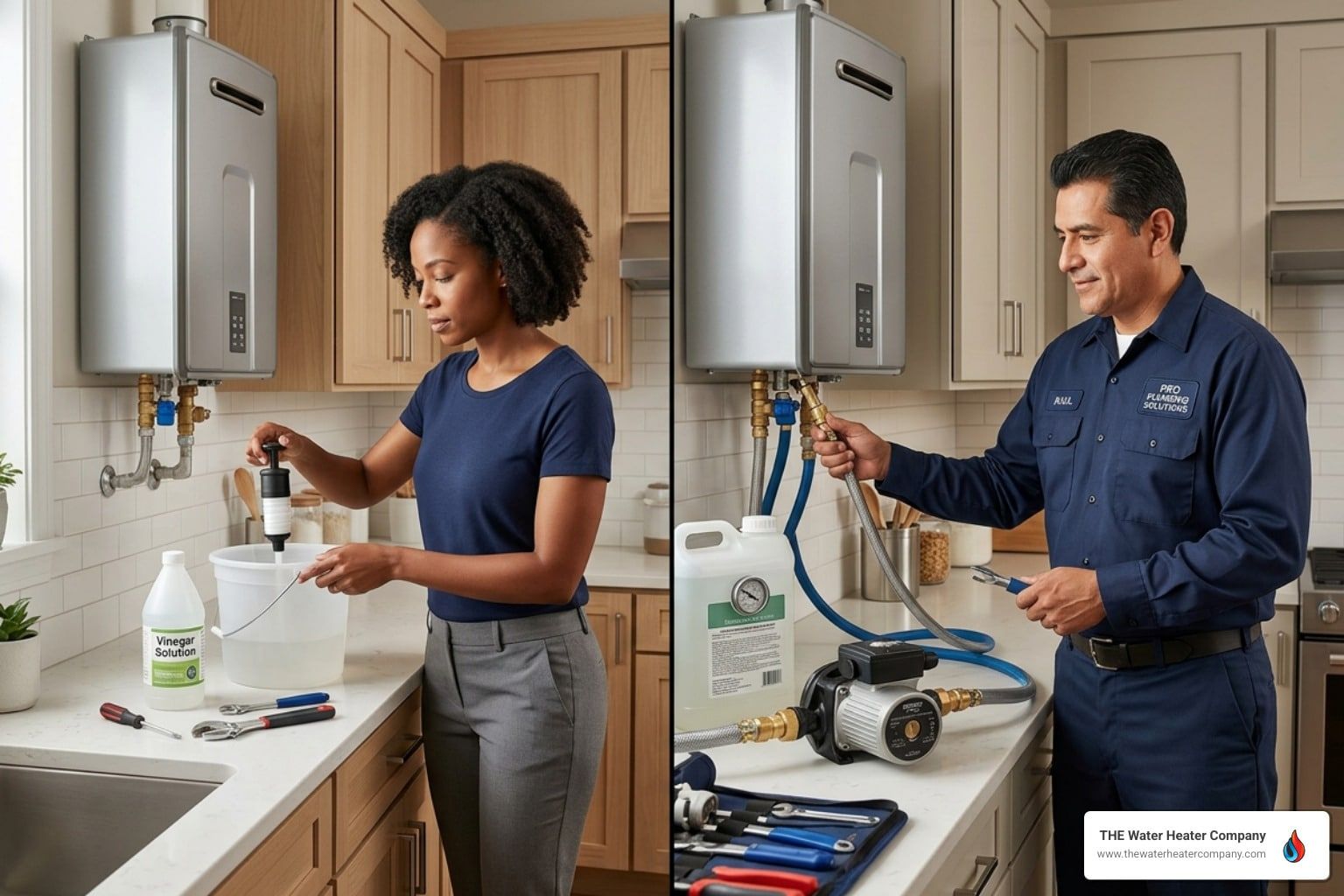
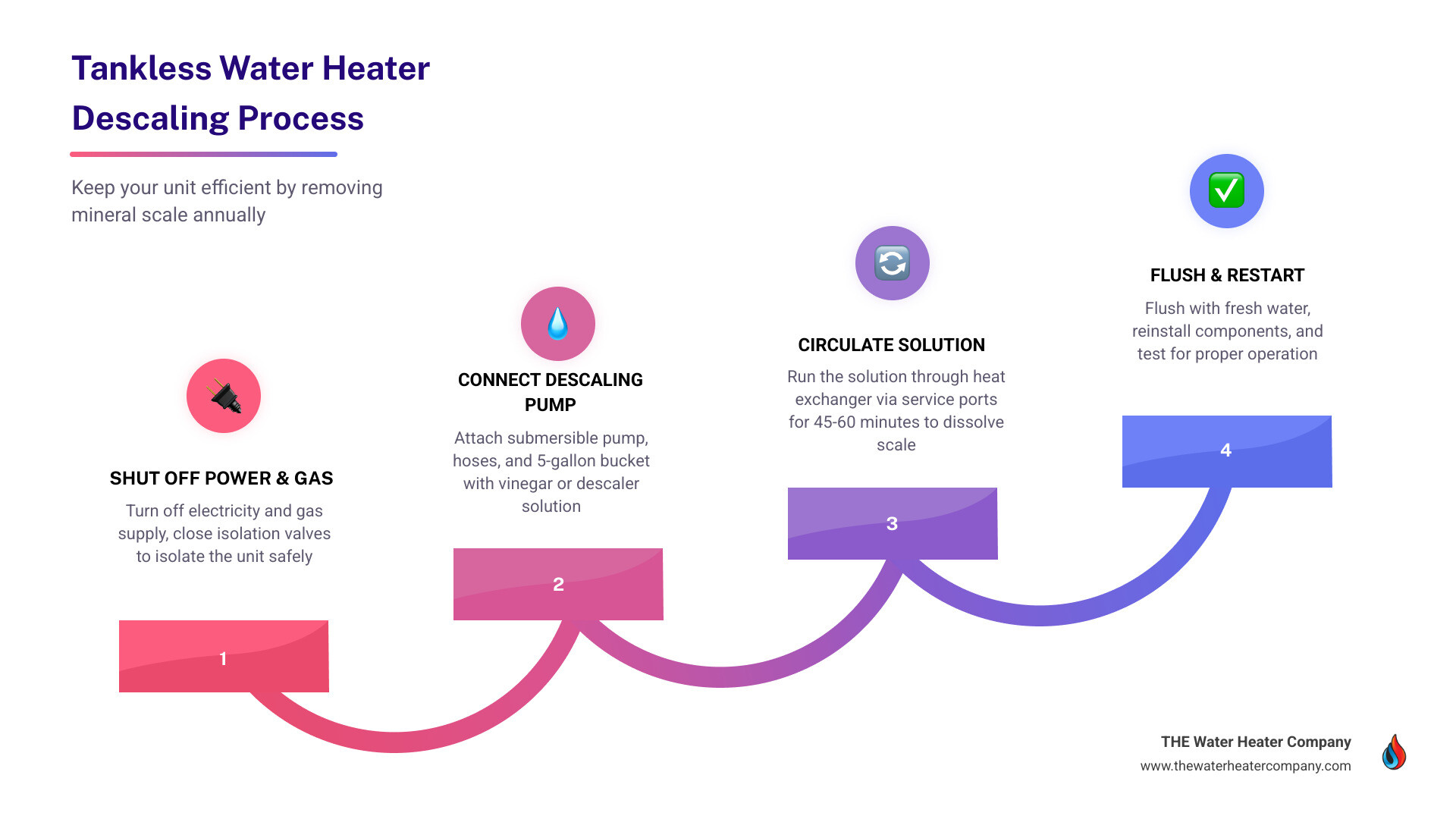
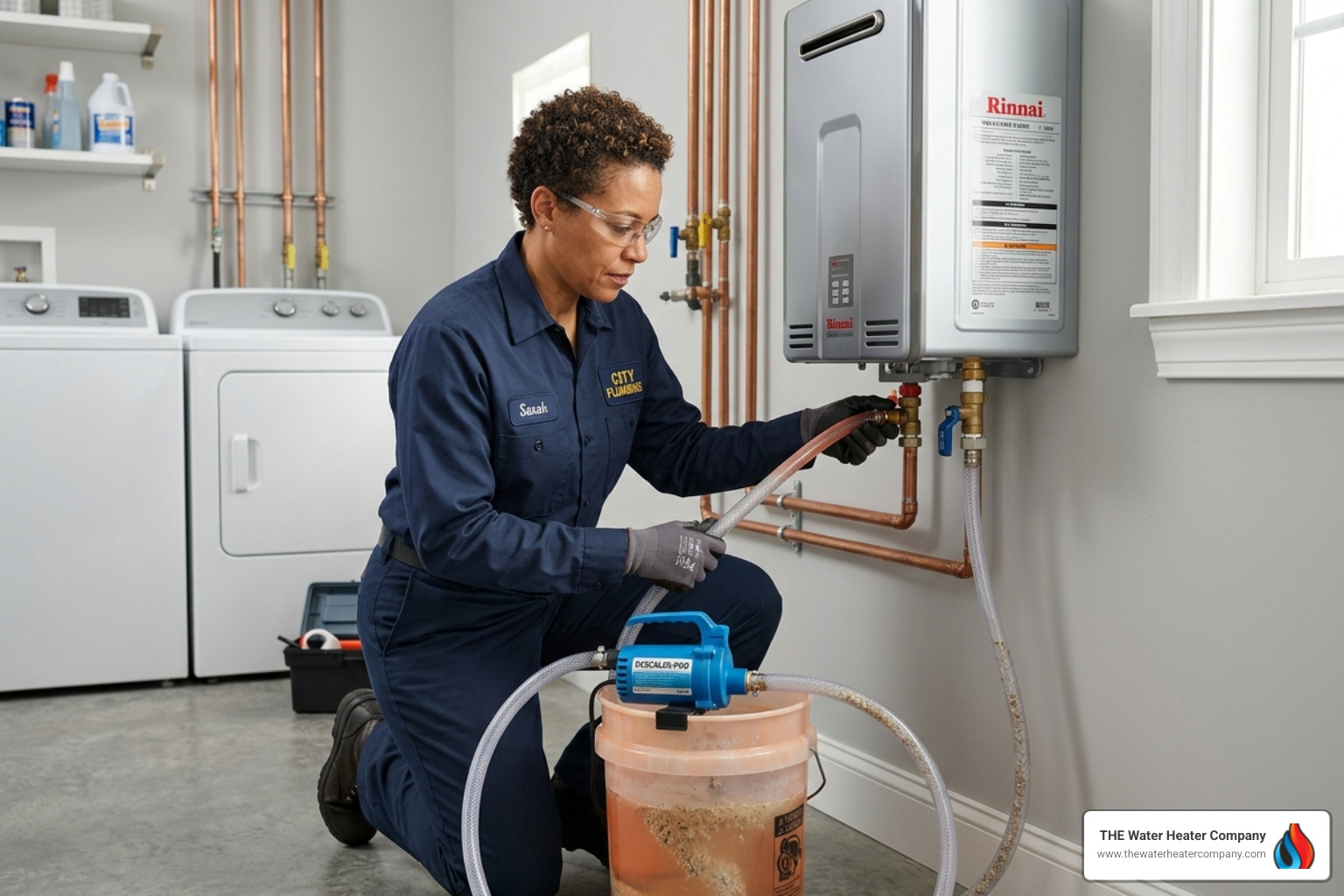
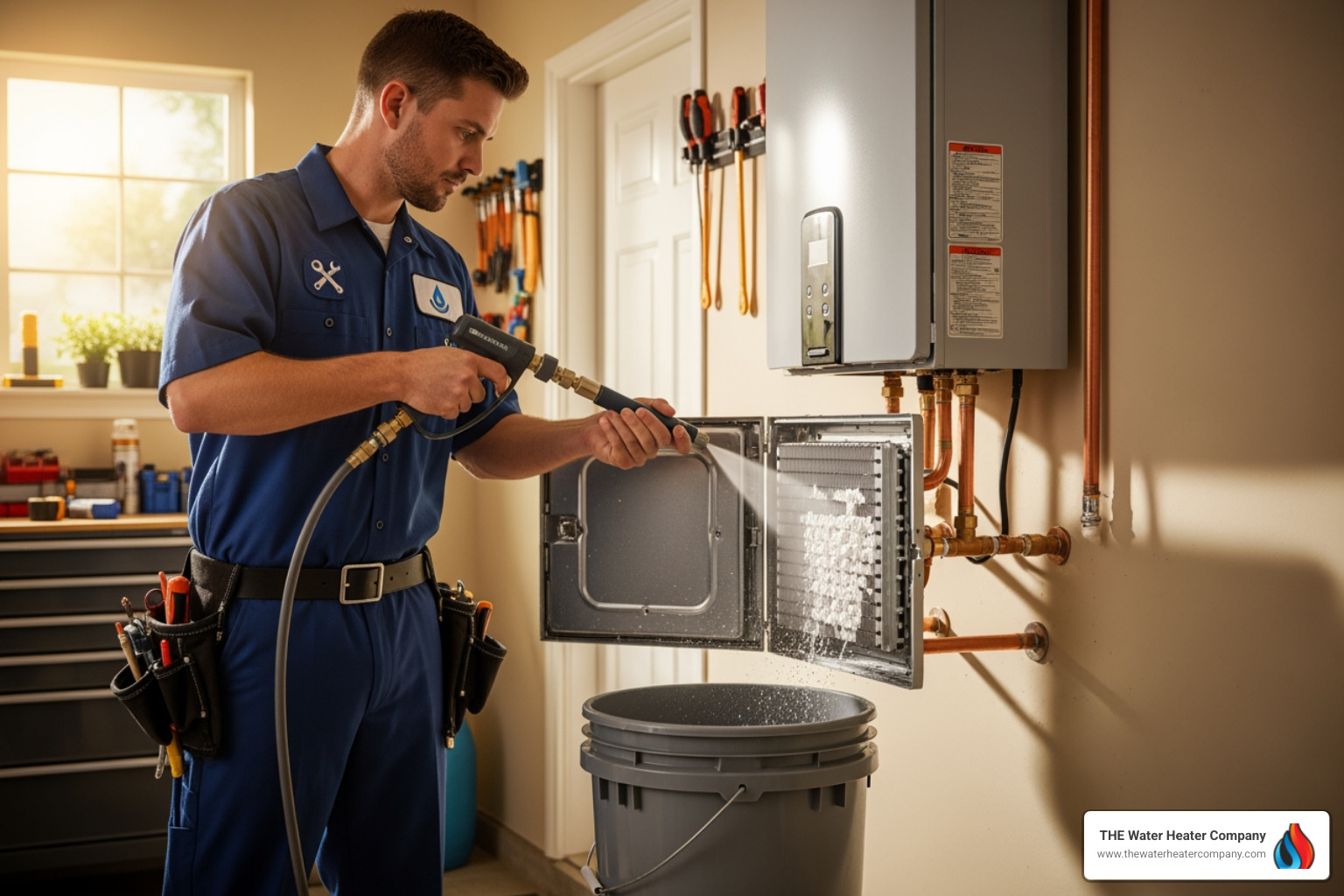
To prevent this, both gas and electric units require an annual flush and descaling using a food-grade vinegar solution. If you live in an area with exceptionally hard water, pairing your tankless unit with a whole-house water softener or water filtration system is an excellent way to protect your investment and extend its life.

Burner Inspections and Vent Checks

While electric units only need periodic descaling and filter cleaning, gas tankless water heaters have additional maintenance needs due to the combustion process.

An annual professional inspection for a gas unit should include:

  • Cleaning the burner assembly to ensure a clean, efficient flame.
  • Checking the combustion chamber for debris or soot.
  • Inspecting the venting system to ensure it is clear of obstructions (like bird nests) and properly sealed.
  • Testing safety sensors, fan operation, and the pressure relief valve.

Frequently Asked Questions about Tankless Water Heaters

Navigating water heating can be tricky. Here are some of the most common questions we hear from homeowners across Southern California.

Do tankless water heaters work during a power outage?

No. This is a common misconception, especially regarding gas units. While gas units use natural gas or propane as their primary fuel source, they still rely on electricity to power the electronic ignition, the digital control board, safety sensors, and the combustion fan. Unless you have your tankless unit connected to a backup generator or a dedicated battery backup system, neither a gas nor an electric tankless water heater will provide hot water during a power outage.

How long do gas and electric tankless water heaters last?

With regular professional maintenance, both gas and electric tankless water heaters can last 20 years or more. This is a massive upgrade over traditional storage tank models, which typically last only 10 to 15 years. If you are trying to decide between these two paths, we recommend reading our comparison guide: should I go tankless or stick with a traditional water heater?.

Can an electric tankless water heater support a large home?

In Southern California, a high-capacity electric tankless water heater can sometimes support a mid-sized home with two bathrooms because our groundwater is relatively warm. However, for truly large homes with high simultaneous hot water demands, electric units are generally limited by the maximum electrical amperage a home can safely allocate to a single appliance. For large households, a gas tankless water heater remains the most reliable option for uninterrupted, whole-house hot water.

Conclusion

The choice between gas vs electric for tankless water heaters comes down to your home’s unique layout, your household’s peak water usage, and your long-term efficiency goals.

If you have a large family with multiple bathrooms and already have a gas line in place, a gas tankless water heater is the clear winner for performance and reliability. If you live in a smaller home, condo, or are looking to install a point-of-use system — and your electrical panel has the capacity to support it — an electric tankless unit offers incredible efficiency, a simpler physical footprint, and zero on-site emissions.

At THE Water Heater Company, we specialize in helping Southern California homeowners find the perfect water heating solutions for their homes. Whether you are in Santa Barbara, Camarillo, Santa Clarita, Pasadena, Van Nuys, Los Angeles, Santa Ana, or Irvine, our family-owned team is here to provide expert diagnostics, seamless installations, and reliable maintenance.

Ready to make the switch to endless hot water? Contact us today to explore our professional water heater services and find the perfect fit for your home!

Rheem Tankless Water Heater Error Codes: The Ultimate Troubleshooting Guide

Encountering a flashing error code on your Rheem tankless water heater can be frustrating, especially when it interrupts your hot shower. Modern Rheem tankless units—including the latest smart, Wi-Fi-enabled models—are equipped with self-diagnostic systems designed to protect the appliance and keep your home safe.

While some minor issues can be cleared with simple maintenance like cleaning a filter or resetting the unit, others indicate complex mechanical faults. This comprehensive guide breaks down every common Rheem tankless error code, what it means, and exactly what steps to take next.

Complete Rheem Tankless Error Code Matrix

Use this scannable chart to identify the error code flashing on your digital remote or built-in controller.

Error Code What It Means Recommended Action
00 Continuous combustion (exceeding 1 hour) Check for leaking hot water fixtures or a continuous circulation pump.
05 Imperfect or incomplete combustion Clean the air inlet filter and inspect exhaust vents for obstructions.
10 False flame detection Call a technician to inspect the control board and flame rod.
11 No ignition / Ignition failure Ensure the gas supply valve is open; check the igniter wiring.
12 Flame failure (flame lost during operation) Verify adequate gas pressure; clean carbon build-up off the flame rod.
13 Gas supply or gas valve malfunction Check gas line pressure. Typically requires professional gas valve calibration.
14 Overheat wrap fault / Thermal fuse tripped Safety Risk: The unit is overheating. Turn off water and power; call a pro.
15 Boiling safety device / Inlet temp sensor fault Check for scaling inside the heat exchanger; scale causes localized boiling.
16 Over-temperature warning Outgoing water is too hot. Flush the system to remove mineral scale.
21 Air intake filter switch malfunction Ensure the front panel and air filter doors are properly seated and clean.
24 Water flow control valve or switch fault Check wiring to the flow sensor; may require a sensor replacement.
29 Heat exchanger outlet temp too low / Clogged neutralizer Clean the condensate neutralizer filter and check drain lines for blockages.
31 Water inlet temperature sensor fault Check sensor wiring connections or test sensor resistance with a multimeter.
32 Outgoing water temperature sensor fault Inspect and clean the sensor; replace if it fails to read temperature accurately.
33 Heat exchanger outlet temperature sensor fault Professional diagnostics required to test the sensor and control board.
35 Improper thermistor connections / Fan motor issue Ensure all wiring harnesses are securely attached to the main circuit board.
51 Gas inlet solenoid valve fault Requires a certified technician to test valve voltage and replace if faulty.
52 Modulating gas solenoid valve fault Call a specialist to test and replace the modulating gas valve.
61 Combustion fan motor failure Verify the fan spins freely and isn’t blocked by debris; check fan motor wiring.
70 / 72 Remote control communication fault Disconnect and reconnect remote wiring; reset the controller.
71 Gas inlet solenoid valve control fault Circuit board error relating to gas control; requires professional replacement.
88 Maintenance reminder (Combustion hours reached) The system needs to be flushed with a descaling solution to remove hard water scale.

Deep Dive: The Most Common Rheem Error Codes

Error Code 11 or 12: Ignition & Flame Failures

These are the most frequent codes homeowners encounter. They mean your system is trying to fire up but cannot light or maintain a flame.

  • The Cause: Often caused by a closed gas valve, an empty propane tank, or a dirty flame rod.

  • The DIY Fix: Double-check that your household gas supply is turned on. If it is, a technician will need to clean the carbon buildup off the internal flame rod.

Error Code 14: Thermal Fuse Tripped

Code 14 is a critical safety code. It indicates that the physical body of the heat exchanger has reached dangerous temperatures, prompting the thermal fuse to break to prevent a fire or total system meltdown.

  • The Cause: Heavy mineral scale buildup inside the unit forces it to work twice as hard to heat water, causing extreme internal temperatures.

  • The Action: Do not attempt to bypass this fuse. Turn off the water and gas supply immediately and call a certified technician.

Error Code 88: Time to Flush

If your tankless unit is flashing “88”, don’t panic. This isn’t a mechanical breakdown; it is an automatic maintenance alarm telling you that the system has logged a high number of combustion hours and is due for a flushing. Failing to flush the system soon will result in more severe efficiency drops and overheating codes.


How to Reset a Rheem Tankless Water Heater

Sometimes, an error code is a temporary glitch caused by a brief power surge or minor drop in gas pressure. You can attempt to clear the code with a simple system reset:

  1. Turn off all hot water faucets inside the home.

  2. Press the ON/OFF button on your digital remote control to turn the unit off.

  3. Wait approximately 1 to 2 minutes.

  4. Press the ON/OFF button again to turn the system back on.

  5. Open a hot water tap to see if the error code returns.

Important Safety Note: If a code reappears immediately or trips repeatedly, do not continue resetting the unit. Repetitive resetting can bypass safety diagnostics and cause permanent, expensive damage to your heat exchanger.


Need Professional Rheem Service? We Can Help!

Attempting to repair internal gas lines, electrical circuit boards, or venting systems on your own can be highly dangerous and will instantly void your manufacturer warranty.

THE Water Heater Company is a family-owned and operated team of tankless specialists. If you are in our service area and dealing with a stubborn error code, don’t risk a DIY headache. Give our team a call today, and we’ll have your hot water restored safely, efficiently, and quickly!

Noritz Tankless Water Heater Error Codes: The Complete Guide

By the Certified Technicians at THE Water Heater Company Noritz Authorized Service Providers | Three Locations Serving Ventura County, Los Angeles County, Orange County & Santa Barbara Since 2018 Last Updated: May 2026

As a proud owner of a Noritz tankless water heater, you can enjoy endless hot water on demand, energy savings, and a compact design that takes up less space than traditional tank water heaters. However, like any other appliance, your tankless water heater may experience occasional malfunctions or error codes that require troubleshooting and repair. Knowing what these error codes mean and how to fix them can help you avoid costly repairs and extend the life of your water heater. In this article, we’ll cover the most common Noritz tankless water heater error codes and their meanings.

Your Noritz Is Talking to You. Here’s How to Understand What It’s Saying.

You walked over to your Noritz tankless water heater and saw a code flashing on the display. Maybe you have no hot water. Maybe the unit is beeping. Either way, you want to know: What does this mean? Is it serious? And what do I do next?

You are in the right place.

This is the most complete guide to Noritz tankless water heater error codes available anywhere. We are THE Water Heater Company — a Noritz Authorized Service Provider with three locations across Southern California, serving Ventura County, Los Angeles County, Orange County, and the City of Santa Barbara. Our certified technicians work on Noritz units every single day from Camarillo to Van Nuys to Santa Ana. We wrote this guide using Noritz’s own official documentation, our factory training, and years of real-world field experience.

We will explain every error code in plain English — what it means, what is causing it, and what needs to happen next.

But before we get to the codes, there is something important you need to understand first.


⚠️ A Critical Safety Warning Before You Read Any Further

Noritz tankless water heaters are not simple appliances. They are sophisticated systems that sit at the intersection of four potentially dangerous forces inside your home:

  1. Natural Gas or Propane — A gas leak or improper gas pressure is not something you can safely troubleshoot without professional training and the right tools. Gas leaks can cause fires, explosions, and carbon monoxide poisoning.
  2. High-Voltage Electricity — Noritz units use electronic control boards, sensors, solenoids, and wiring that carry live electrical current. Working inside the unit without proper training can cause serious injury or death.
  3. Pressurized Water — The water moving through a tankless heater is under pressure. Incorrect handling of connections, valves, or components can cause water damage or scalding burns.
  4. Combustion Exhaust — Tankless water heaters produce exhaust gases, including carbon monoxide, that must be properly vented out of your home. A blocked or damaged vent is a life-safety emergency.

This combination of gas, electricity, water, and exhaust is why Noritz tankless water heaters should only be diagnosed and repaired by a licensed, trained professional. This is not a DIY appliance in the same way that changing a light switch might be. The consequences of a mistake are serious.

This guide is written to help you understand what is happening with your unit — not to guide you through a repair. Think of it the same way you would think of a medical reference guide: knowing what a diagnosis means is helpful and important, but it does not replace a trained doctor performing the actual procedure.

If you are in Ventura County, Los Angeles County, Orange County, or the Santa Barbara area and your Noritz unit is showing an error code, call THE Water Heater Company at (877) 274-1485. We are Noritz Authorized Service Providers with three locations across Southern California, and we are here to help.

How Do Noritz Error Codes Work?

When something goes wrong with your Noritz tankless water heater, the unit’s control system detects the problem and displays an error code on the remote controller or display panel. The code will appear where you normally see the water temperature setting — usually as “Er” followed by a number (for example, “Er:11”).

An audible beeping alarm usually accompanies the error code to get your attention.

These codes are actually a helpful feature. According to Randy Oshiro, Assistant Manager of Engineering at Noritz, “These codes can diagnose problems that otherwise might remain unnoticed until unit failure, thus saving on repair and replacement costs.” In other words, your Noritz is designed to tell you when something is wrong — before that something turns into a much bigger problem.

How to Check Your Error Code History

Your Noritz unit keeps a memory of past error codes even after they have been cleared. Here is how to access that history using your remote controller:

  1. Press the Power (On/Off) button to turn the remote off.
  2. Press the Up and Down arrow buttons at the same time until “03” appears on the display.
  3. Press the Down arrow to enter the error code history. Error codes are stored in maintenance monitors 91 through 98. The most recent code will be followed by “91.”
  4. Press the Up button to scroll through additional codes.
  5. Keep pressing Up until you see “000” on the display.
  6. Once you see “000,” press the Up and Down buttons together until the display goes blank.
  7. Press the Power button to turn the remote back on.

This history can be extremely helpful when your technician arrives — it tells the full story of what your unit has been experiencing, not just the most recent event.

The Most Important Thing to Understand: Soft Lockouts vs. Hard Lockouts

This is something most guides do not explain — and it is one of the most important things to understand about your Noritz unit.

Not all error codes are equal. Noritz officially classifies error conditions into two categories, and knowing the difference helps you understand how serious a situation is.

Here is the exact language directly from the official Noritz NRCP1112-DV Owner’s Manual:

“The water heater shall enter a soft lockout condition if the error is such that it can return to normal operation once the condition relieves itself (overheat conditions, temperature sensor open or shorts, etc.). The water heater shall enter a hard lockout if the condition indicates the unit detected a condition preventing safe operation.”

Let us break that down into plain English.

What Is a Soft Lockout?

A soft lockout means the unit detected a problem, but the problem may be temporary. In some cases, the unit may keep running. In other cases, you can unplug the unit, wait 30 seconds, plug it back in, and the unit may start working again — at least temporarily.

The critical thing to understand about soft lockouts: They do not go away on their own. The underlying problem is still there. If the same soft lockout error code happens repeatedly without being fixed, the unit will eventually lock itself out permanently.

Here is a real example: Error Code 90 is a soft lockout. It means there is a combustion abnormality — the unit is not burning gas the way it should. If your unit shows Error Code 90 three times without the problem being fixed, it will display Error Code 903 — and the unit will lock itself out completely and stop working.

The “3” at the end of 903 means the code 90 occurred three times. This escalation pattern is built into how Noritz units protect themselves from repeated unsafe conditions.

The takeaway: A soft lockout is a warning. Do not ignore it just because the unit seems to be working. Call a professional before it escalates into a full lockout.

What Is a Hard Lockout?

A hard lockout means the unit has detected a condition that Noritz has determined is unsafe for the unit to continue operating. The unit will shut itself down and will not restart until the problem has been diagnosed and fixed by a trained technician.

Hard lockout codes are Noritz’s built-in safety system. The unit is protecting you, your family, and your home by refusing to operate under dangerous conditions.

Examples of hard lockout conditions include ignition failure (Er.11), condensate line problems (Er.29), gas leakage detection (Er.40), and flame detection without ignition (Er.72).

The takeaway: A hard lockout means stop. Do not attempt to force the unit to restart by unplugging and replugging it repeatedly. Call a professional immediately.


The Complete Noritz Error Code Reference

Below is a comprehensive breakdown of every Noritz error code. Each entry includes:

  • What the code means in plain language
  • The official Noritz definition
  • Common causes that our technicians see in the field
  • Lockout type (soft or hard)
  • What you should do


🔧 Error Code 05 — Service Reminder

What does Noritz Error Code 05 mean?

Error Code 05 is not actually an error — it is a scheduled maintenance reminder. Your unit is telling you it is time for a professional service visit.

Lockout Type: Not a lockout. Unit continues to operate.

What causes it: This code appears automatically after a set number of operating hours, similar to the oil change reminder light in your car.

What you should do: Do not reset or ignore this code without scheduling a service visit. Resetting it without performing maintenance can shorten the life of your unit. Call a Noritz Authorized Service Provider to perform a full inspection, descale, and combustion cleaning.


🔴 Error Code 10 — Combustion Abnormality After Shutdown

What does Noritz Error Code 10 mean?

Error Code 10 means the unit detected combustion activity — flame or burning — even after the unit was supposed to shut down. In other words, something kept burning when it should have stopped.

Lockout Type: Soft lockout.

Common causes:

  • Foreign material on the burner that continued burning after the gas supply was cut
  • Debris, grease, or buildup inside the combustion chamber
  • A faulty gas valve that did not fully close

What you should do: Do not attempt to inspect the burner yourself. This code involves the gas combustion system and requires a licensed technician to safely inspect and clean the burner and verify the gas valve is functioning correctly.


🔴 Error Code 11 — Ignition Failure

What does Noritz Error Code 11 mean?

Error Code 11 means your unit tried to ignite and failed. There was no flame. The unit made an attempt to light the burner and nothing happened.

Three things are needed to ignite a tankless water heater: air, a spark, and gas. Error Code 11 means at least one of those three things was missing or not working.

Lockout Type: Hard lockout. Directly cited in Noritz’s official owner’s manual as a hard lockout condition.

Common causes:

  • No gas supply, or the gas valve is not fully open
  • Incorrect gas type (unit set for natural gas but connected to propane, or vice versa)
  • Low gas pressure
  • Debris or corrosion on the ignition rod or igniter plug
  • Blocked air intake or exhaust vent
  • A faulty igniter or gas valve

What you should do: This is a hard lockout — the unit will not restart on its own. A licensed technician will need to check gas pressure with a digital manometer, inspect the igniter and flame rod, verify the venting system, and confirm the correct gas type is being supplied.


🔴 Error Code 12 — Flame Loss During Operation

What does Noritz Error Code 12 mean?

Error Code 12 means the unit successfully ignited, but the flame went out while the unit was running. The burner lit, but could not stay lit.

Lockout Type: Hard lockout.

Common causes:

  • Low or inconsistent gas pressure (especially common with propane when the tank is running low)
  • Multiple gas appliances running at the same time competing for gas supply
  • A blocked or improperly sized exhaust vent
  • A dirty or corroded flame rod that cannot detect the flame
  • A tripped earthquake shutoff valve on the gas line

What you should do: A technician will measure incoming gas pressure, inspect the venting system, and clean or replace the flame rod as needed. If you have propane, check that your tank is not running low.


🔴 Error Code 13 — CO Alarm Device Malfunction

What does Noritz Error Code 13 mean?

Error Code 13 indicates a problem with an optional carbon monoxide (CO) alarm device connected to the unit.

Lockout Type: Hard lockout.

Common causes:

  • A fault or disconnection in the CO alarm wiring
  • A malfunctioning CO detection device
  • Improper installation of the CO alarm accessory

What you should do: Carbon monoxide is odorless, colorless, and deadly. Any issue with CO detection equipment should be treated as a serious safety matter. Do not attempt to reset or bypass this code. Call a licensed technician immediately.


🔴 Error Code 14 — Thermal Fuse Failure / Heat Exchanger Overheat

What does Noritz Error Code 14 mean?

Error Code 14 means the thermal fuse has blown. The thermal fuse is a safety device wrapped around the heat exchanger. When the outside surface of the heat exchanger gets dangerously hot, the fuse breaks to shut the unit down and prevent further damage — or worse.

Lockout Type: Hard lockout.

Common causes:

  • Scale and mineral buildup inside the heat exchanger (extremely common in areas with hard water, including much of Southern California)
  • Scale acts as an insulator, trapping heat inside the heat exchanger instead of transferring it to the water
  • Over time, the surface temperature of the heat exchanger rises until the thermal fuse trips
  • Blocked venting can also cause overheating

What you should do: The thermal fuse itself will need to be replaced. However, replacing just the fuse without addressing the underlying cause — usually scale buildup — means the same code will come back. A full descale and heat exchanger inspection is typically required. In severe cases, the heat exchanger itself may need to be replaced.

This is one of the most common codes we see in Ventura County. Southern California has notoriously hard water, and scale buildup is the number one reason Noritz units are taken out of service prematurely. Annual descaling maintenance is the single best investment you can make in your tankless water heater.


🟡 Error Code 16 — Outlet Water Temperature Too High

What does Noritz Error Code 16 mean?

Error Code 16 means the water leaving your unit spiked to an abnormally high temperature. The unit detected dangerously hot water at the outlet and shut down to protect you and the system.

Lockout Type: Soft lockout.

Common causes:

  • Scale buildup in the heat exchanger reducing heat transfer efficiency (same root cause as Code 14)
  • Incorrect gas type being supplied to the unit
  • Improperly adjusted gas manifold pressure
  • Very low water flow rate through the unit

What you should do: Do not dismiss this code. Scalding hot water is a real safety risk, especially in homes with children or elderly residents. A technician will descale the unit, verify the gas type and pressure, and ensure the water flow rate is adequate.


🔴 Error Code 20 — High Limit Switch Triggered

What does Noritz Error Code 20 mean?

Error Code 20 means the high limit switch was triggered. This switch is a safety device — it monitors water temperature inside the unit, and if the water temperature rises above a safe threshold (between 176°F and 205°F), the switch cuts power to the unit to prevent damage or injury.

Lockout Type: Hard lockout requiring a power reset (unplug the unit, allow it to cool, then restore power). However, if the underlying cause is not fixed, the code will return.

Common causes:

  • Scale buildup in the heat exchanger (again — this is a pattern in hard water areas)
  • Blocked venting restricting airflow
  • A loose or faulty wiring connection at the high limit switch

What you should do: While you can attempt a power reset (unplug for 60 seconds, then plug back in), the code will return if the root cause is not addressed. A technician needs to inspect the heat exchanger, perform a descale if needed, and verify the venting and wiring.


🔴 Error Code 29 — Condensate Drainage Problem

What does Noritz Error Code 29 mean?

Error Code 29 applies only to condensing tankless water heaters — the high-efficiency models that recover extra heat from exhaust gases. As part of that process, the unit produces condensate (water), which must drain out through a dedicated drain line. Error Code 29 means that drainage is not happening correctly.

Lockout Type: Hard lockout. Directly cited in Noritz’s official owner’s manual as a hard lockout condition.

Common causes:

  • A blocked or clogged condensate drain line
  • A drain line that is too small (must be at least ½ inch inner diameter)
  • A drain line that is not sloped correctly toward the drain point
  • A frozen condensate drain line (in cold weather conditions)

What you should do: Call a licensed technician. If the condensate cannot drain, it can back up into the unit and cause damage or flooding. Do not attempt to clear drain lines connected to the gas combustion system yourself.


🟡 Error Code 30 — Air Thermistor Abnormality

What does Noritz Error Code 30 mean?

Error Code 30 means there is a problem with the air thermistor — a sensor that measures the temperature of the incoming air. The sensor is either disconnected, shorted, or faulty.

Lockout Type: Soft lockout.

Common causes:

  • Loose or disconnected wiring at the thermistor
  • A failed thermistor sensor
  • Damage to the sensor from moisture or debris

What you should do: A technician will check the wiring connections and test the thermistor. If it has failed, it will need to be replaced.


🟡 Error Code 31 — Inlet (Cold Water) Thermistor Failure

What does Noritz Error Code 31 mean?

Error Code 31 means the inlet thermistor — the sensor that measures the temperature of the cold water coming into the unit — is not working properly.

Lockout Type: Soft lockout.

Common causes:

  • A damaged or failed thermistor
  • Loose or corroded wiring connections at the sensor

What you should do: The thermistor will need to be tested and replaced by a licensed technician. This sensor is important because it helps the unit calculate how much energy is needed to heat the water to your desired temperature.


🟡 Error Code 32 — Outlet (Hot Water) Thermistor Failure

What does Noritz Error Code 32 mean?

Error Code 32 means the outlet thermistor — the sensor that measures the temperature of the hot water leaving the unit — is not working correctly.

Lockout Type: Soft lockout.

Common causes:

  • A damaged or failed thermistor
  • Loose or corroded wiring connections

What you should do: A licensed technician will test and replace the thermistor as needed. Without an accurate outlet temperature reading, the unit cannot properly regulate water temperature.


🟡 Error Code 33 — Heat Exchanger Thermistor Failure

What does Noritz Error Code 33 mean?

Error Code 33 means the thermistor attached to the heat exchanger itself is malfunctioning. This sensor monitors the temperature of the heat exchanger to prevent overheating.

Lockout Type: Soft lockout.

Common causes:

  • A failed thermistor sensor
  • Loose or disconnected wiring

What you should do: A technician will test and replace the sensor. Because this sensor is part of the unit’s safety monitoring system, it should not be ignored.


🟡 Error Code 35 — Exhaust Thermistor Abnormality

What does Noritz Error Code 35 mean?

Error Code 35 means the sensor monitoring the temperature of the exhaust gases is not reading correctly.

Lockout Type: Soft lockout.

Common causes:

  • A faulty or disconnected exhaust thermistor
  • Wiring damage near the exhaust area

What you should do: A technician will verify connections and replace the sensor if needed. Exhaust temperature monitoring is an important safety function — do not ignore this code.


🔴 Error Code 40 — Gas Leakage Detected

What does Noritz Error Code 40 mean?

Error Code 40 means the unit has detected a gas leak. This is a serious safety emergency.

Lockout Type: Hard lockout. Directly cited in Noritz’s official owner’s manual as a hard lockout condition.

What you should do immediately:

  1. Do not try to find the leak yourself.
  2. Do not operate any electrical switches.
  3. Leave the area immediately.
  4. Call your gas utility’s emergency line from outside the home.
  5. Do not re-enter until the gas company has cleared the home.

Once the gas leak has been addressed by the gas utility, call a Noritz Authorized Service Provider to inspect the unit before it is put back into service.


🔴 Error Code 45 — Internal Water Leak Detected

What does Noritz Error Code 45 mean?

Error Code 45 means moisture or water has been detected inside the unit. This code is specific to Noritz NRCP and CB model units.

Lockout Type: Hard lockout.

Common causes:

  • A water leak from internal connections, fittings, or heat exchanger
  • Condensation buildup due to temperature differences
  • A faulty leak sensor

What you should do: A technician will remove the front cover, locate the leak sensor, and identify the source of moisture. If there is an active internal water leak, it must be repaired before the unit can be safely operated.


🔴 Error Code 51 — Gas Manifold Solenoid Failure

What does Noritz Error Code 51 mean?

Error Code 51 means there is a fault with the gas manifold solenoid valve — the component that controls how gas is delivered to the burner.

Lockout Type: Hard lockout.

Common causes:

  • A failed gas manifold solenoid valve
  • Damaged or loose wiring at the solenoid connections
  • In some cases, water dripping onto the manifold from a leak above it

What you should do: This is an internal gas component repair. A licensed technician will test the solenoid connections and, if needed, replace the gas manifold. If water is found on the manifold, the source of that leak must also be identified and repaired.


🔴 Error Code 52 — Exhaust Blockage

What does Noritz Error Code 52 mean?

Error Code 52 means the unit has detected a blockage in the exhaust venting system.

Lockout Type: Hard lockout.

Common causes:

  • A bird nest, debris, or foreign object in the exhaust vent pipe
  • Ice or frost blocking the vent in cold weather
  • A vent pipe that is too long or has too many bends, restricting airflow
  • A damaged or collapsed vent pipe

What you should do: Never operate a unit with a blocked exhaust. Carbon monoxide and other combustion gases must be able to safely exit your home. A technician will inspect and clear the venting system and verify it meets Noritz’s installation specifications.


🟡 Error Code 57 — Incoming Water Pressure Too Low

What does Noritz Error Code 57 mean?

Error Code 57 means the water pressure coming into the unit is too low for proper operation.

Lockout Type: Soft lockout.

Common causes:

  • Low water pressure in the home’s supply line
  • A partially closed water supply valve to the unit
  • A clogged inlet filter screen on the unit
  • A failing water pressure regulator on the home’s main line

What you should do: A technician will check the inlet water pressure, inspect the inlet filter, and verify the water supply valve is fully open. If your home has consistently low water pressure, a pressure regulator evaluation may also be recommended.


🟡 Error Code 59 — Combustion Abnormality / Low BTU Input

What does Noritz Error Code 59 mean?

Error Code 59 means the unit is not getting enough energy from combustion. It is burning, but not at the level needed to properly heat the water.

Lockout Type: Soft lockout.

Common causes:

  • Insufficient fresh air supply to the combustion chamber
  • Blockages in the exhaust or intake venting
  • A dirty fan motor or burner chamber
  • The unit’s elevation settings (DIP switches) not properly configured for your altitude

What you should do: A technician will clean the fan motor and burner, clear any venting obstructions, and verify the unit is configured correctly for your installation location.


🔴 Error Code 61 — Fan Motor Failure

What does Noritz Error Code 61 mean?

Error Code 61 means the fan motor inside the unit has failed or is not operating correctly. The fan is critical — it controls airflow through the combustion chamber, which is essential for safe and efficient burning.

Lockout Type: Hard lockout.

Common causes:

  • A failed fan motor
  • A fan motor not receiving proper voltage
  • A fan bearing that has worn out
  • A blockage preventing the fan from spinning

What you should do: A technician will test the incoming voltage to the fan motor, check for physical blockages, and replace the fan motor if it has failed. A unit should never be operated without a functioning fan — without proper airflow, combustion gases including carbon monoxide cannot be safely managed.


🟡 Error Code 63 — Recirculation Abnormality (Condensing Models)

What does Noritz Error Code 63 mean?

Error Code 63 indicates a problem with the recirculation system on condensing Noritz models (NRCR series). It can also appear on models with built-in recirculation pumps.

Lockout Type: Soft lockout.

Common causes:

  • A clogged return line filter
  • A problem with the crossover valve or its filter
  • In some cases, a failed PC control board

What you should do: A technician will check the return line filter, inspect the crossover valve, and evaluate the control board.


🔴 Error Code 65 — Main Water Servo Abnormality

What does Noritz Error Code 65 mean?

Error Code 65 means the main water servo valve is not functioning properly. This valve controls water flow through the unit.

Lockout Type: Hard lockout.

Common causes:

  • A blocked or stuck water servo valve
  • A failed servo motor
  • Loose or damaged wiring at the servo connections

What you should do: A licensed technician will inspect and test the servo valve and replace it if needed.


🔴 Error Code 66 — Bypass Flow Control Valve Failure

What does Noritz Error Code 66 mean?

Error Code 66 means the bypass flow control valve — which helps regulate water temperature by blending hot and cold water — is not working correctly.

Lockout Type: Hard lockout.

Common causes:

  • A blocked bypass servo valve
  • A failed bypass flow control valve
  • Wiring issues at the valve connections

What you should do: A technician will inspect the bypass servo for restrictions and replace the valve if it has failed.


🔴 Error Code 67 — Air Gas Mixer (AGM) Abnormality

What does Noritz Error Code 67 mean?

Error Code 67 means there is a problem with the Air Gas Mixer, or AGM. The AGM is an important component that precisely balances the mixture of air and gas going into the burner. If that balance is off, combustion is inefficient and potentially unsafe.

Lockout Type: Hard lockout.

Common causes:

  • Excessive debris or buildup inside the AGM housing, causing the dial to stick
  • Loose or damaged wiring at the AGM
  • A failed AGM unit

What you should do: A technician will remove and inspect the AGM, clean the housing, reset the air-gas calibration, and verify the wiring. This is an internal gas system component — it should only be handled by a trained professional.


🔴 Error Code 70 — Circuit Board Failure

What does Noritz Error Code 70 mean?

Error Code 70 means there is a fault with the unit’s main circuit board — the electronic brain that controls all of the unit’s operations.

Lockout Type: Hard lockout.

Common causes:

  • A failed circuit board
  • Power surge damage
  • Moisture intrusion into the control board

What you should do: A technician will diagnose the board and replace it if necessary. Circuit board replacement on a gas appliance involves working with both electrical and gas components and should only be performed by a licensed professional.


🔴 Error Code 71 — Gas Valve Drive Circuit Abnormality

What does Noritz Error Code 71 mean?

Error Code 71 means there is a problem with the circuit that drives the gas valve — the electrical system that tells the gas valve when to open and close. Without proper gas valve operation, the unit cannot safely control gas flow.

Lockout Type: Hard lockout.

Common causes:

  • A failed circuit board
  • Voltage fluctuations from a battery backup, generator, or solar power system
  • A faulty gas valve itself

What you should do: A technician will test the voltage output from the circuit board and inspect the gas valve. This code is particularly common on units connected to alternative power sources with inconsistent voltage output.


🔴 Error Code 72 — Flame Detected Without Ignition Sequence

What does Noritz Error Code 72 mean?

Error Code 72 means the unit’s flame sensor detected a flame when there should not have been one. In other words, the unit sensed fire without having started the ignition sequence. This is a serious safety condition.

Lockout Type: Hard lockout. Directly cited in Noritz’s official owner’s manual as a hard lockout condition.

Common causes:

  • A faulty flame detection circuit
  • A problem with the circuit board
  • Improper grounding of the unit
  • A failed flame rod

What you should do: This code indicates the unit’s safety systems are detecting a condition that should not exist. Do not attempt to reset or restart the unit. Call a licensed technician immediately.


🟡 Error Code 73 — Circuit Board Setting Error

What does Noritz Error Code 73 mean?

Error Code 73 means there is an error in the circuit board’s settings — specifically, the jumper connections or DIP switches that configure the unit for your specific installation.

Lockout Type: Soft lockout.

Common causes:

  • A jumper wire or DIP switch was changed while the unit was powered on (this should never be done)
  • The circuit board was programmed incorrectly during installation
  • A power issue caused the board to lose its settings

What you should do: Try unplugging the unit for 30 seconds and plugging it back in. If the code clears and does not return, the unit may have self-corrected. If the code returns, a technician will need to verify the circuit board programming and DIP switch settings match your installation requirements.


🟡 Error Code F76 — Multi-Unit Communication Error

What does Noritz Error Code F76 mean?

Error Code F76 means two Noritz tankless water heaters connected together using a Quick Connect Cord are having a communication problem. This code applies only to homes or buildings with a multi-unit setup.

Lockout Type: Soft lockout.

Common causes:

  • More than one remote controller is connected to the two-unit system (only one remote should be used when two units are connected)
  • A damaged or disconnected Quick Connect Cord
  • A wiring issue in the multi-unit setup

What you should do: Verify that only one remote controller is connected to the system. If the code persists after disconnecting the power and reconnecting, call a licensed technician to inspect the wiring and connection cord.


🟡 Error Code 90 — Combustion Abnormality (Soft Lockout — Escalates to 903)

What does Noritz Error Code 90 mean?

Error Code 90 is one of the most common Noritz error codes. It means the unit detected a combustion abnormality — the mixture of air and fuel inside the burner is not right. The unit is not burning gas the way it should.

Lockout Type: Soft lockout — but with a critical escalation warning.

Important: Error Code 90 is a soft lockout, which means the unit may continue to operate or can be temporarily reset by unplugging and replugging. However, if Error Code 90 occurs three times without the underlying problem being fixed, your unit will display Error Code 903 and lock itself out completely. The “3” in 903 indicates the code occurred three times. At that point, the unit will not restart until a licensed technician has diagnosed and resolved the issue.


Common causes:

  • Insufficient gas supply or low gas pressure
  • A blocked air intake or exhaust vent
  • A dirty or restricted fan motor
  • DIP switch settings that are not configured correctly for your elevation, pipe size, or vent length
  • Scale buildup affecting combustion efficiency

What you should do: Do not keep resetting this code and hoping it goes away. Every reset without a fix brings you one step closer to a full lockout. Call a Noritz Authorized Service Provider. A technician will measure gas pressure, inspect the venting, clean the fan motor and combustion chamber, and verify all settings.


🟡 Error Code 91 — Incorrect Gas Type

What does Noritz Error Code 91 mean?

Error Code 91 means the unit is detecting that it may not be receiving the correct type of gas, or that the gas manifold pressure is set incorrectly.

Lockout Type: Soft lockout.

Common causes:

  • The unit is configured for natural gas but connected to propane, or vice versa
  • The gas manifold pressure was set incorrectly during installation
  • A change in the gas supply characteristics

What you should do: A technician will check the rating plate on your unit to confirm what gas type it is configured for, verify the gas supply, and adjust manifold pressure to match manufacturer specifications.


🟡 Error Code 92 — Neutralizer Life Cycle Warning (First Notice)

What does Noritz Error Code 92 mean?

Error Code 92 is a maintenance warning specific to condensing Noritz models. It means the neutralizer — a component that treats the acidic condensate water produced by high-efficiency units — is approaching the end of its useful life.

Lockout Type: Soft lockout / maintenance warning.

Common causes: Normal wear. The neutralizer has a finite lifespan based on operating hours.

What you should do: Schedule a service visit soon. The neutralizer needs to be replaced before it reaches the end of its life (indicated by Error Code 93). After replacement, the burner timer must be reset by a technician.


🟡 Error Code 93 — Neutralizer End of Life (Final Warning)

What does Noritz Error Code 93 mean?

Error Code 93 means the neutralizer has reached the end of its life cycle. It needs to be replaced now.

Lockout Type: Soft lockout / urgent maintenance warning.

What you should do: Call a licensed technician immediately to replace the neutralizer and reset the system. Operating a condensing unit without a functional neutralizer can cause acidic condensate to drain improperly and damage your plumbing.


🔴 Error Code 94 / 941 / 942 — Exhaust Temperature Too High

What does Noritz Error Code 94 mean?

Error Code 94 (and its variants 941 and 942 on display window units) means the exhaust gases leaving the unit are too hot. Safe combustion produces exhaust at expected temperatures — when that temperature is excessively high, something is wrong with how the unit is burning or venting.

Lockout Type: Hard lockout.

Common causes:

  • A blocked or restricted exhaust vent
  • A combustion problem causing the unit to run at abnormally high temperatures
  • Scale buildup in the heat exchanger affecting combustion efficiency

What you should do: Do not operate the unit. High exhaust temperatures can damage venting materials and create a fire hazard. Call a licensed technician to inspect the vent system and combustion components.


🟡 Error Code 99 — Combustion Abnormality (Similar to Code 90)

What does Noritz Error Code 99 mean?

Error Code 99 is similar to Error Code 90 — it indicates a gas combustion problem. The flame color should be blue (yellow tips are acceptable in small amounts, but a predominantly yellow flame indicates a problem).

Lockout Type: Soft lockout.

Common causes: Similar to Code 90 — gas supply issues, venting blockages, or combustion system problems.

What you should do: Same as Code 90. Call a Noritz Authorized Service Provider for diagnosis. Do not continue to reset without addressing the root cause.


🔴 Error Code 108 — Flow Sensor Failure

What does Noritz Error Code 108 mean?

Error Code 108 means the flow sensor — which detects when water is running through the unit and triggers the heating process — has failed or is not reading correctly.

Lockout Type: Hard lockout.

Common causes:

  • A failed flow sensor
  • Debris blocking the flow sensor
  • Damaged wiring at the sensor

What you should do: A technician will inspect, clean, and test the flow sensor, and replace it if necessary. Without an accurate flow sensor reading, the unit cannot determine when to start heating water.


🔴 Error Code 903 — Combustion Lockout (Code 90 Occurred Three Times)

What does Noritz Error Code 903 mean?

Error Code 903 means that Error Code 90 — the combustion abnormality — occurred three times without being resolved. The unit has now locked itself out completely to prevent continued unsafe operation.

The “3” at the end of the code tells the story: this is a Code 90 that was ignored (or temporarily reset) two times too many.

Lockout Type: Hard lockout.

What you should do: The unit will not restart on its own. A licensed Noritz technician must diagnose the root combustion issue, make the necessary repairs, and clear the lockout. This code is the unit’s way of saying: “I tried to warn you three times. Now I need professional help before I run again.”

In our experience, Error Code 90 leading to a 903 lockout is almost always preventable with timely maintenance. If your unit shows Code 90, call us before it escalates.


🔴 Error Code 760 — Remote Controller Communication Error

What does Noritz Error Code 760 mean?

Error Code 760 means there is a communication problem between the unit and the remote controller.

Lockout Type: Soft lockout.

Common causes:

  • A disconnected or damaged communication wire between the unit and remote
  • More than one remote controller connected to a single unit
  • A faulty remote controller

What you should do: Try unplugging the unit, waiting 30 seconds, and replugging. If the code returns, check that only one remote is connected and that the wiring is intact. If the problem persists, a technician will inspect the wiring and the remote controller.


🟡 Error Code C1 — Scale Buildup Warning (Premix Models)

What does Noritz Error Code C1 mean?

Error Code C1 appears on Noritz premix model units and indicates that the heat exchanger has significant scale buildup that is affecting performance.

Lockout Type: Soft lockout / maintenance warning.

Common causes: Hard water mineral deposits accumulating inside the heat exchanger over time. This is extremely common in Southern California.

What you should do: Schedule a professional descale service immediately. Left unaddressed, scale buildup leads to more serious failures including thermal fuse failure (Code 14), high limit switch trips (Code 20), and ultimately heat exchanger failure.


Quick Reference: All Noritz Error Codes at a Glance

Code Description Lockout Type
05 Service reminder No lockout
10 Combustion after shutdown Soft
11 Ignition failure Hard
12 Flame loss during operation Hard
13 CO alarm device malfunction Hard
14 Thermal fuse failure Hard
16 Outlet water temp too high Soft
20 High limit switch triggered Hard (requires reset)
29 Condensate drainage problem Hard
30 Air thermistor abnormality Soft
31 Inlet thermistor failure Soft
32 Outlet thermistor failure Soft
33 Heat exchanger thermistor failure Soft
35 Exhaust thermistor abnormality Soft
40 Gas leakage detected Hard — Emergency
45 Internal water leak (NRCP/CB models) Hard
51 Gas manifold solenoid failure Hard
52 Exhaust blockage Hard
57 Incoming water pressure too low Soft
59 Combustion abnormality / low BTU Soft
61 Fan motor failure Hard
63 Recirculation abnormality Soft
65 Main water servo abnormality Hard
66 Bypass flow control valve failure Hard
67 Air Gas Mixer (AGM) abnormality Hard
70 Circuit board failure Hard
71 Gas valve drive circuit abnormality Hard
72 Flame detected without ignition Hard
73 Circuit board setting error Soft
F76 Multi-unit communication error Soft
90 Combustion abnormality Soft → becomes 903 after 3x
91 Incorrect gas type Soft
92 Neutralizer life warning (first notice) Soft
93 Neutralizer end of life Soft
94 / 941 / 942 Exhaust temperature too high Hard
99 Combustion abnormality Soft
108 Flow sensor failure Hard
760 Remote controller error Soft
903 Code 90 occurred 3 times — full lockout Hard
C1 Scale buildup (premix models) Soft


What Is the Difference Between a Soft Lockout and a Hard Lockout? (FAQ)

Q: Can I reset a soft lockout myself? You can unplug the unit, wait 30 seconds, and plug it back in to clear a soft lockout temporarily. However, this does not fix the underlying problem. The code will return — and if it returns three times on certain codes like Error Code 90, it will escalate into a full hard lockout. Always have a soft lockout professionally diagnosed, even if the unit seems to be working after a reset.

Q: Can I reset a hard lockout myself? Some hard lockouts allow a power reset (pressing the power button off and on, or unplugging and replugging the unit). However, the unit locked itself out for a reason. Forcing a restart without fixing the underlying problem is unsafe and can cause further damage. Hard lockouts should always be diagnosed and cleared by a licensed technician.

Q: My unit keeps resetting and the code keeps coming back. What does that mean? It means the underlying problem has not been fixed. Repeatedly resetting an error code without professional diagnosis is not a solution — it is a countdown to a larger failure or a safety event. Call a professional.

Q: How do I know if my Noritz error code is serious? Any error code related to gas, flame, ignition, exhaust, or CO detection should be treated as serious immediately. Temperature and sensor codes are less immediately dangerous but still require professional attention. When in doubt, call a licensed technician.

Q: Is it safe to use my Noritz while it is showing an error code? It depends on the code. Some soft lockout codes may allow the unit to keep running temporarily. However, continuing to use a unit that is showing any error code — without understanding what the code means — is not recommended. The safest approach is always to call a professional for diagnosis.


Why Annual Maintenance Prevents Most of These Error Codes

Looking at the list above, you will notice a pattern. A significant number of the most common Noritz error codes — including 14, 16, 20, 59, 90, 903, and C1 — are directly related to two preventable issues:

  1. Scale buildup from hard water minerals accumulating inside the heat exchanger.
  2. 2. Combustion problems related to dirty components, restricted airflow, or clogged venting.

Both of these issues develop slowly over time, and both are almost entirely preventable with annual professional maintenance.

A standard Noritz maintenance service performed by a Noritz Authorized Service Provider includes:

  • A full descale flush to remove mineral deposits from the heat exchanger
  • A combustion cleaning to clear the fan motor, burner, and combustion chamber
  • An inspection of all venting for blockages or damage
  • A check of gas pressure and manifold settings
  • An inspection of all sensors, wiring, and safety components
  • A review of the error code history for any patterns or developing issues

Think of it like an oil change for your water heater. You would not skip oil changes and wait for your engine to seize. The same logic applies here.

Annual maintenance typically costs a fraction of what a major repair or early unit replacement would cost. In Southern California — where hard water is a year-round reality — it is especially important.

How Much Does a Noritz Error Code Repair Cost?

Every repair is different, and the cost depends on which code is present, what is causing it, and what parts (if any) need to be replaced. What we can tell you is this:

  • A diagnostic visit will identify exactly what is wrong and give you a clear picture before any work begins.
  • Simple fixes like descaling, sensor replacements, or DIP switch corrections are generally less expensive than part replacements.
  • Catching a problem early — when it is still a soft lockout — is almost always less expensive than waiting until it escalates into a hard lockout or unit failure.
  • Investing in annual maintenance is almost always less expensive than emergency repair calls.

We believe in transparent, honest pricing — no surprises, no pressure. Call us and we will give you a clear explanation of what is happening and what it will cost to fix it.

Call THE Water Heater Company — Your Noritz Authorized Service Provider

If your Noritz tankless water heater is showing an error code, THE Water Heater Company is here to help.

We are a Noritz Authorized Service Provider with three locations across Southern California — Camarillo, Van Nuys, and Santa Ana — serving homeowners throughout Ventura County, Los Angeles County, Orange County, and the City of Santa Barbara. Our certified technicians work on Noritz units every day. We know these systems inside and out.

We are Your Trusted Water Heater Authority — and we are ready to get your hot water back.

Sources: Noritz NRCP1112-DV Owner’s Manual (ManualsLib); Noritz CB199-DV Owner’s Manual (ManualsLib); Noritz America Knowledge Base (help.noritz.com); Noritz Blog — “Common Noritz Tankless Error Codes: Updated” (noritz.com, June 2022); Noritz Blog — “How to Resolve the Seven Most Common Noritz Tankless Error Codes” (noritz.com, November 2015). Field experience provided by THE Water Heater Company, Noritz Authorized Service Providers — Camarillo, Van Nuys, and Santa Ana, CA.

gas or electric water heater in a Southern California garage

A – Z Guide to Gas or Electric Water Heater

Is a Gas or Electric Water Heater Better for Your Southern California Home?

Is a gas or electric water heater better for your home? Here’s the short answer:

Factor Gas Water Heater Electric Water Heater
Best for Large households, high hot water demand Smaller households, homes without gas lines
Heating speed Faster recovery rate Slower recovery rate
Installation Higher upfront cost Lower upfront cost
Lifespan 8–12 years (tank) 10–15 years (tank)
Works during power outage? Yes (pilot ignition models) No
Maintenance More complex, requires venting Simpler, fewer parts
Energy efficiency Lower efficiency rating Higher efficiency rating
Best upgrade option Gas tankless Hybrid heat pump

Bottom line: Gas water heaters tend to cost less to run month-to-month and heat water faster, making them a strong fit for larger households with high demand. Electric models are easier to install, safer, and last longer on average. The right choice almost always comes down to what your home is already set up for.

Neither type is universally better. Your existing home infrastructure — whether you have a gas line, your electrical panel capacity, and local Southern California utility rates — is usually the deciding factor.

Water heaters account for roughly 18% of a home’s energy use, so this isn’t a small decision. Whether you’re replacing an aging unit or planning a new installation, understanding the real differences between these two systems helps you avoid a costly mismatch between what you buy and what your home actually needs.

I’m Anthony Hamilton, Co-Founder and CEO of THE Water Heater Company, and after years of installing, diagnosing, and replacing both gas and electric systems across Southern California homes, I’ve seen how the answer to is a gas or electric water heater better almost always depends on the specific setup of the home rather than one type being universally superior. Let’s walk through everything you need to know to make the right call for your household.

Infographic comparing gas vs electric water heaters: heating method, efficiency, lifespan, installation, and best use cases

Understanding the Core Differences: How Gas and Electric Systems Work

To decide which system fits your lifestyle, it helps to understand what’s happening inside that metal cylinder in your garage or utility closet. While both units have the same goal—delivering a steaming hot shower—they use entirely different physics to get there.

Close-up of a gas water heater burner assembly showing the blue flame combustion process

Gas Water Heaters: The Power of Combustion

A gas water heater relies on a burner located at the bottom of the tank. When the thermostat senses the water temperature has dropped, it opens a gas valve and ignites the burner (using either a standing pilot light or an electronic ignition). The heat from this flame warms the bottom of the tank and rises through a central flue or “chimney.”

Because this process involves actual fire, gas units require specific infrastructure:

  • Ventilation: They must be vented to the outside to safely remove combustion byproducts like carbon monoxide.
  • Gas Lines: Your home must have an existing natural gas or propane line.
  • Pilot Lights: Traditional models use a small, constantly burning flame, though many modern units now use electronic starters to save energy.

Choosing Between Gas and Electric for Your Home Made Easy often comes down to whether these pipes and vents are already in place.

Electric Water Heaters: Resistance and Efficiency

Electric models are much simpler. Instead of a burner, they use one or two electric resistance elements that sit directly inside the water. Think of it like a giant electric kettle. When the water gets cold, electricity flows through these elements, which heat up and transfer that energy directly to the water.

This simplicity offers several advantages:

  • No Venting: Since there is no combustion, you don’t need a flue or chimney.
  • Installation Flexibility: They can be tucked into tight closets or crawl spaces where gas venting isn’t possible.
  • Electrical Requirements: These units typically require a dedicated 240V circuit, which may necessitate an electrical panel upgrade if you are switching from gas.

For a deeper dive into these technicalities, check out our Understanding My Water Heater Options A Homeowners Guide.

Evaluating Performance: Is a gas or electric water heater better for high-demand households?

When the kids are getting ready for school and the dishwasher is running, performance becomes the only thing that matters. This is where the “recovery rate” comes into play.

Is a gas or electric water heater better for large families in Santa Clarita?

In areas like Santa Clarita or Pasadena, where larger multi-generational homes are common, gas often wins the performance race. Gas burners are significantly more powerful than electric elements, allowing them to heat a full tank of water much faster. This is known as a higher “first-hour rating.”

If your family tends to take back-to-back showers, a gas unit can keep up with the demand more effectively. An electric unit, while efficient, takes longer to “recover” once the tank is drained, which could leave the last person in line with a lukewarm surprise.

Is a gas or electric water heater better when choosing a tankless model?

If you are considering going tankless, the fuel source matters even more. Choosing Your Power Gas vs Electric Tankless Water Heater Performance reveals that gas-fired tankless units generally provide much higher flow rates.

In Southern California, our groundwater isn’t freezing, but it still requires a massive “temperature rise” to reach 120°F. A gas tankless unit can often support two showers and a laundry load at once, whereas an electric tankless model may struggle to provide enough hot water for more than one fixture at a time in a typical residential setup. For more on the “tank vs. tankless” debate, see our guide on Tank vs Tankless Water Heaters.

Efficiency, Lifespan, and Reliability in 2026

As we move through 2026, energy efficiency has become a top priority for homeowners in Los Angeles and Ventura counties. However, “efficiency” can be a bit of a trick word.

Feature Standard Gas Tank Standard Electric Tank Tankless (Gas or Electric)
Energy Factor (UEF) 0.67 – 0.82 0.90 – 0.95 0.95+
Typical Lifespan 8 – 12 Years 10 – 15 Years 20+ Years
Maintenance Need Moderate (Flushing/Venting) Low (Anode Rod) Annual Descaling

Electric water heaters are technically more efficient at the point of use because they convert nearly all the energy they consume into heat. Gas units lose some heat through the ventilation flue. However, because natural gas has historically been cheaper than electricity in California, the gas unit often results in a lower monthly utility bill despite being “less efficient” on paper.

In terms of reliability, electric units have the edge. With fewer moving parts and no combustion process, they typically last 10 to 15 years. Gas units, dealing with the stress of fire and corrosive exhaust, usually see a lifespan of 8 to 12 years. Regardless of the type, sediment buildup is the “silent killer” of water heaters in Southern California’s hard water areas. Regular flushing and anode rod replacement (usually around year five or six) are essential to hitting these lifespan milestones.

Safety Considerations and Home Infrastructure

Safety is a major factor when asking is a gas or electric water heater better. While both are safe when professionally installed, they carry different risks.

Gas Safety and Codes

Gas units carry the risk of gas leaks and carbon monoxide poisoning if not vented correctly. This is why California plumbing codes are so strict about ventilation and the installation of carbon monoxide detectors. Additionally, in earthquake-prone areas like Irvine and Santa Barbara, seismic strapping is a legal requirement to prevent the unit from tipping and breaking a gas line during a tremor.

Electric Infrastructure

The primary “safety” hurdle for electric units is your home’s electrical capacity. Many older homes in Los Angeles were built with 100-amp panels. Adding a heavy-draw 240V electric water heater might require a panel upgrade to handle the load safely.

Power Outage Reliability

One unique advantage of gas: if the power goes out in Camarillo during a storm, you’ll still have hot water—provided you have a traditional pilot light model. Modern gas units with electronic ignitions and all electric units will stop heating water as soon as the grid goes down.

If you’re torn between these safety and infrastructure hurdles, our article on Should I Go Tankless or Stick With a Traditional Water Heater can help clarify your path.

Beyond the Tank: Considering Hybrid and Heat Pump Alternatives

If you want the absolute best efficiency available in 2026, you have to look at Hybrid Heat Pump water heaters. These are “electric” units, but they don’t just use resistance elements. Instead, they work like a refrigerator in reverse, pulling heat from the surrounding air and moving it into the water tank.

Why Hybrid is a game-changer:

  • Efficiency: They are 3 to 4 times more efficient than standard electric tanks.
  • Dehumidification: They naturally dehumidify the air around them, which is great for damp California garages.
  • Solar Integration: If you have solar panels, a hybrid unit is the ultimate way to “store” your solar energy as hot water.

While these units require more air space and a place to drain condensate, they often qualify for significant local rebates in Southern California. You can learn more about these advanced systems on our services page.

Frequently Asked Questions

What are the main disadvantages of an electric water heater?

The biggest drawbacks are the slower recovery time and the lack of hot water during power outages. If you have a large family taking sequential showers, an electric tank may struggle to keep up. Additionally, electricity rates in Southern California can make these more expensive to operate than gas models.

Is it worth switching from electric to gas in Los Angeles?

Generally, it is only worth the switch if a gas line is already very close to the installation site. The cost of running new gas lines and installing a ventilation system through the roof or wall can be substantial. However, if you have very high hot water demand, the long-term utility savings and performance of gas might justify the initial investment.

How can I tell if my current unit is gas or electric?

Look for these signs:

  1. Venting: If there is a metal pipe coming off the top of the unit, it’s gas.
  2. Energy Source: Look for a yellow gas valve and a flexible gas line at the bottom. Electric units will have a thick, metal-clad electrical cable (conduit) entering the top or side.
  3. Pilot Window: Gas units usually have a small access panel at the bottom where you can see a blue flame or a “status” light.

Conclusion

So, is a gas or electric water heater better? For most Southern California homeowners, the answer is written in the pipes and wires already in your walls. If you have gas, staying with gas—or upgrading to a gas tankless—is usually the most cost-effective move. If your home is all-electric, a high-efficiency hybrid heat pump is the gold standard for 2026.

At THE Water Heater Company, we don’t believe in one-size-fits-all solutions. Whether you’re in Santa Barbara, Santa Clarita, or Irvine, our expert technicians provide professional diagnostics to help you choose the system that fits your home’s infrastructure and your family’s needs. We specialize in everything from traditional tank repairs to the latest tankless and hybrid installations.

Schedule your expert water heater installation or repair today and let us help you find the perfect balance of comfort, efficiency, and reliability.

hot water recirculating systems contractors in Los Angeles CA

The X Best Hot Water Recirculating Contractors Compared

Why Finding the Right Hot Water Recirculating Systems Contractors in Los Angeles, CA Matters

If you’re looking for hot water recirculating systems contractors in Los Angeles, CA, here are the top factors to know before you hire:

  • Installation time: Most residential installs take 2 to 4 hours
  • Water savings: A properly installed system can save up to 10,000 gallons of water per year
  • Hot water delivery: Expect hot water at your tap in as little as 5 to 10 seconds
  • System types: Dedicated return line systems and retrofit comfort valve systems are the two main options
  • Energy efficiency: VFD-controlled pumps can reduce gas consumption by an average of 14.7% compared to constant-speed pumps
  • What to look for in a contractor: Valid C-36 plumbing license, experience with tankless water heaters, and familiarity with Southern California’s Title 24 compliance requirements

If you’ve ever stood at your shower waiting two or three minutes for hot water to arrive, you already know the frustration. In Los Angeles, where water is both precious and expensive, that wait adds up fast — the average household can waste close to 10,000 gallons per year just running the tap until hot water finally shows up. That’s not just an inconvenience. In a region that has faced persistent drought conditions, it’s a real problem worth solving.

Hot water recirculating systems fix this by keeping hot water continuously moving through your pipes, so it’s always ready the moment you need it. But the system is only as good as the contractor who installs it. In a city as large and diverse as Los Angeles — with homes ranging from compact bungalows in Silver Lake to sprawling multi-story properties in the hills — choosing the right contractor means the difference between a system that performs for decades and one that underdelivers from day one.

I’m Anthony Hamilton, Co-Founder and CEO of THE Water Heater Company, and with years of hands-on experience serving Southern California homeowners as a licensed C-36 plumbing contractor, I’ve worked directly alongside hot water recirculating systems contractors in Los Angeles, CA to help families get reliable, efficient hot water without the waste. In the sections below, I’ll walk you through what separates a great contractor from an average one, and what you should know before making your decision.

Infographic showing how hot water recirculating systems work in LA homes, key benefits, and contractor selection tips

Why Homeowners Seek Hot Water Recirculating Systems Contractors in Los Angeles, CA

The primary reason we see Los Angeles residents calling for a recirculating system is simple: they are tired of watching water—and money—go down the drain. In a typical home, you might waste 30 gallons of water every single day just waiting for the temperature to rise. Over a year, that adds up to roughly 10,000 to 12,000 gallons, which is equivalent to about 3,000 loads of dishes!

Technician inspecting a plumbing line for a recirculating system installation in a Los Angeles home

Beyond the sheer waste, there is the issue of energy efficiency. When you let the water run, your water heater has to work harder to replace that volume with fresh, cold water that it then must heat from scratch. By working with specialized hot water recirculating systems contractors in Los Angeles, CA, you can implement a solution that keeps the water in your pipes warm, reducing the strain on your heater and lowering your utility bills.

For those looking to dive deeper into the technical side of how these systems function, you can explore more about recirculating system services to see how we help homeowners achieve these savings.

Benefits of Professional Installation in Southern California

When we talk about professional installation, we aren’t just talking about connecting a pump. We’re talking about a complete lifestyle upgrade. The most immediate benefit is comfort. Imagine waking up in your Los Angeles home and having instant hot water for your morning shower without the “shiver wait.” This level of convenience is a major selling point in the local real estate market, often increasing property value because it signals a modern, high-efficiency plumbing infrastructure.

Many of our neighbors have already made the switch. For instance, Why Glendale homeowners love these systems often comes down to the perfect balance of environmental responsibility and personal luxury. In the climate of Southern California, where conservation is a way of life, being able to save thousands of gallons while enjoying a better shower experience is a “win-win.”

Comparing System Types Used by Hot Water Recirculating Systems Contractors in Los Angeles, CA

When you consult with hot water recirculating systems contractors in Los Angeles, CA, they will generally present you with two main paths: a dedicated return line or a retrofit “comfort” system.

  1. Dedicated Return Lines: This is the gold standard. It involves a separate pipe that carries unused hot water back to the heater. It is most easily installed during a remodel or new construction. It prevents temperature fluctuations and avoids mixing hot and cold water.
  2. Retrofit/Comfort Systems: These are perfect for existing homes where running a new pipe through the walls isn’t feasible. These systems use your existing cold water line as a temporary return path. While highly effective, they can sometimes cause the “cold” water to be slightly lukewarm for a few seconds.
Feature Dedicated Return Line Retrofit Comfort System
Best For New builds / Major remodels Existing homes / Quick upgrades
Installation Difficulty High (requires wall access) Low (uses existing pipes)
Performance Superior (Instant hot water) Great (5-10 second wait)
Property Value Significant increase Moderate increase

For a more detailed breakdown of these options, our residential recirculating systems guide provides excellent context for local homeowners.

Advanced Technology and Energy Savings in May 2026

As of May 2026, the technology behind these pumps has reached incredible new heights. In the past, recirculating pumps ran 24/7, which actually wasted a lot of electricity and gas. Today, we utilize Variable Frequency Drive (VFD) controlled pumps and “SmartPlus” technology.

These modern systems are designed to comply with California’s strict Title 24 requirements. Research shows that VFD-controlled pumps can achieve an average gas savings of 14.7%—saving about 1,303 therms annually in larger residential settings. These “smart” pumps actually learn your household’s habits. If you usually shower at 7:00 AM, the pump prepares the water just before you wake up and then shuts down when the house is empty, often running for less than 30 minutes a day total.

If you’re wondering which specific model is currently dominating the market, you might want to see Which system wins the LA popularity contest? to stay ahead of the curve.

Efficiency Gains with Variable Frequency Drives

The shift from constant-speed pumps to VFD technology is one of the biggest leaps in plumbing efficiency. VFD pumps reduce heat loss in the recirculation loop by an average of 39%. Because the pump isn’t forcing water through the pipes at maximum speed all day, the water retains its heat longer, and the pipes suffer less wear and tear.

While the initial setup for high-end VFD systems might be a bit more involved, the payback period is remarkably short—averaging just 2.2 years due to the significant reduction in gas and water costs. This makes it an ideal way to upgrade your Los Alamitos home or any property in the greater LA area.

What to Expect During Your Installation and Maintenance

One of the most common questions we get is: “How much of my day will this take?” For a standard residential home, the installation of a hot water recirculation pump typically takes between 2 to 4 hours.

During this time, your contractor will:

  • Assess your current water heater (tank or tankless).
  • Install the pump at the water heater or under the furthest sink.
  • Integrate sensors or timers to ensure the pump only runs when needed.
  • Test the flow rate to ensure it reaches your furthest bathroom in under 10 seconds.

For those in the San Fernando Valley area, you can find same day recirculating system solutions in Burbank that can have you enjoying hot water by dinner time.

Essential Maintenance for Los Angeles Systems

Once installed, these systems are relatively low-maintenance, but they aren’t “set it and forget it.” Because Los Angeles water can be “hard” (containing minerals like calcium), we recommend an annual checkup. This includes:

  • Descaling: Removing mineral buildup that can slow down the pump.
  • Sensor Checks: Ensuring the thermostatic sensors are accurately reading water temperatures.
  • Timer Optimization: Adjusting your “Smart” settings if your work or school schedule has changed.

Regular maintenance ensures you never wait for hot water again and keeps your warranty in good standing.

Key Considerations for Choosing Hot Water Recirculating Systems Contractors in Los Angeles, CA

Not every plumber is an expert in recirculation. When searching for hot water recirculating systems contractors in Los Angeles, CA, look for these specific credentials:

  • C-36 Plumbing License: This is non-negotiable in California.
  • Tankless Expertise: Many LA homes are switching to tankless heaters. Recirculation with tankless units requires specific flow rates to trigger the heater; if the pump is too weak, the heater won’t turn on, and you’ll be stuck with a cold shower.
  • Local Knowledge: A contractor who understands the specific water pressure issues in neighborhoods like Pasadena or the high-rise requirements in Downtown LA is invaluable.

If you are located further north, we also offer specialized Ventura hot water recirculating systems expertise to handle the unique needs of coastal properties.

Local Incentives and Rebates in Los Angeles

In May 2026, there are several ways to offset the cost of your installation. Many local water districts in Southern California offer rebates for water-saving devices. Additionally, because high-efficiency pumps reduce gas usage, you may qualify for energy-saving incentives through your utility provider.

Ask your contractor about “SmartPlus” technology or VFD pumps that meet Title 24 prescriptive requirements. Choosing the right equipment not only saves the planet but can also put money back in your pocket through these local programs.

Frequently Asked Questions about LA Recirculation Systems

How long does it take to get hot water with a recirculating pump?

With a professionally installed system, hot water should arrive at your tap in 5 to 10 seconds. Without a pump, it can take 2 to 3 minutes depending on how far your bathroom is from the water heater.

Can a recirculation pump be used with a tankless water heater?

Yes, but it requires careful planning. Tankless heaters need a minimum flow rate to “fire up.” Your contractor must ensure the pump is powerful enough to trigger the unit. Some modern tankless units even come with built-in recirculation pumps, which we highly recommend for new installations.

How do these systems help with the Los Angeles water crisis?

By eliminating the “wait time,” you stop wasting roughly 30 gallons of clean water every day. In a city of millions, if every household used a recirculating pump, we could save billions of gallons of water annually, significantly easing the strain on our local reservoirs.

Conclusion

Finding the right hot water recirculating systems contractors in Los Angeles, CA is the first step toward a more comfortable, sustainable, and cost-effective home. Whether you are looking to save 10,000 gallons of water a year or simply want to end the frustration of cold morning showers, a recirculating system is one of the smartest upgrades you can make to your plumbing.

At THE Water Heater Company, we are a local, family-owned Southern California business dedicated to being the trusted authority in water heating. Our team specializes in the repair, installation, and maintenance of these advanced systems across Los Angeles, Pasadena, Santa Clarita, and beyond. We offer fast, reliable service with the expertise required to handle both traditional tank and modern tankless systems.

Ready to stop waiting? Never wait for hot water again with expert recirculating system services from our dedicated team. Contact us today to schedule your in-home assessment and start saving water immediately.

choosing between gas and electric for your home

Choosing Between Gas and Electric for Your Home Made Easy

Gas vs. Electric for Your Home: What Southern California Homeowners Need to Know

Choosing between gas and electric for your home is one of the most practical decisions you’ll make as a homeowner — and it affects everything from your monthly utility bill to how quickly you get hot water in the morning.

Here’s a quick breakdown to help you decide:

Factor Gas Electric
Heating speed Faster Slower
Upfront installation cost Higher Lower
Monthly operating cost Generally lower Generally higher
Safety risks Carbon monoxide, gas leaks Electrical faults (lower risk overall)
Works during power outages Yes (most units) No
Environmental impact Produces emissions Cleaner with renewable energy
Lifespan 15-20 years 20-30 years
Best for Southern California Strong option where gas is available Competitive in mild climates

The honest answer is: there is no single right choice. What works best depends on your home’s existing infrastructure, your local utility rates, how much hot water your household uses, and your long-term priorities.

That said, in Southern California — where winters are mild and utility costs can run high — the decision carries some unique wrinkles that are worth understanding before you commit to a system.

Natural gas has been a staple of home energy for decades, and for good reason — it heats water fast, tends to cost less to run month-to-month, and keeps working even when the power goes out. Electric systems, on the other hand, have fewer safety risks, are often cheaper to install, and are becoming more viable as the grid gets cleaner.

Both options have real advantages. And both have trade-offs that could genuinely affect your comfort and your budget.

I’m Anthony Hamilton, Co-Founder and CEO of THE Water Heater Company, and I’ve spent years in the field helping Southern California homeowners navigate exactly these kinds of decisions — including choosing between gas and electric for your home’s water heating system. In the sections ahead, I’ll walk you through everything you need to know so you can make a confident, informed choice for your household.

Gas vs electric water heater comparison infographic for Southern California homeowners showing key differences - choosing

Key Performance Factors When Choosing Between Gas and Electric for Your Home

When we talk about performance, we are usually talking about one thing: how quickly can you get a hot shower when the kids have already used up half the tank? In water heating, this is known as the “recovery rate.”

Gas water heaters are the heavy lifters in this category. Because a gas burner creates an intense, immediate flame, it can heat a large volume of water much faster than an electric element. For a standard 40-gallon tank, a gas model can often recover in about 30 to 40 minutes, while an electric model might take 60 to 90 minutes to reach the same temperature. If you have a high-demand household in Los Angeles or Pasadena, that time difference matters.

High-efficiency tankless water heater installed in a modern home - choosing between gas and electric for your home

However, electricity has made massive strides in thermal efficiency. While gas units lose some heat through the venting process (exhausting combustion gases outside), electric units convert almost 100% of their energy directly into heat within the water. This is reflected in the Energy Factor (EF) rating. You’ll often see electric units with higher EF ratings than standard gas tanks.

For those looking for the ultimate performance, tankless water heaters are a game-changer. Whether gas or electric, these units provide “endless” hot water by heating it on demand. In Southern California, gas tankless units are incredibly popular because they can handle high flow rates — allowing you to run the dishwasher and the shower simultaneously without a drop in temperature.

Performance Benefits at a Glance:

  • Gas: Faster recovery times, better for large families, higher heat output (BTUs).
  • Electric: Higher point-of-use efficiency, quieter operation, more precise temperature control in some modern models.

Infrastructure and Installation Requirements for Southern California

One of the biggest hurdles in choosing between gas and electric for your home isn’t just what you want; it’s what your house can actually handle.

If you are looking into water heater replacement services, we first have to look at your existing “hookups.” A gas water heater requires a dedicated gas line and a proper venting system to safely move carbon monoxide and other combustion byproducts out of your home. If your home wasn’t built for gas, running a new line can be a significant project involving permits and potential wall or floor modifications.

Electric units, conversely, don’t need vents or gas lines, but they are “power hungry.” A standard electric tank usually requires a 240-volt dedicated circuit. If your electrical panel is already full — which we see often in older homes in Van Nuys or Santa Barbara — you might need a panel upgrade to support the new load.

Requirement Gas System Electric System
Venting Required (PVC or Metal) Not Required
Power Source Gas Line + 120v Outlet (for some) 240v Dedicated Circuit
Space Needs clearance for air/venting More flexible placement
Safety Code Earthquake strapping + Gas shutoff Earthquake strapping + Electrical disconnect

In cities like Santa Monica or Irvine, local building codes are very specific about how these units are installed, particularly regarding earthquake strapping and safety pans. We always ensure every installation meets these rigorous Southern California standards.

Safety, Maintenance, and Long-Term Reliability

Safety is a top priority for every family we serve. With gas appliances, the primary concerns are gas leaks and carbon monoxide (CO) exposure. This is why regular water heater maintenance services are so critical. We check the pilot light assembly, the burner, and the venting to ensure everything is airtight.

Electric water heaters are generally considered “safer” because there is no combustion happening inside the home. There is no risk of a gas leak or CO poisoning. However, they aren’t maintenance-free. Over time, the heating elements can burn out or become “calcified” due to the hard water we often have in Southern California.

Whether you choose gas or electric, sediment is the enemy of longevity. In areas like Santa Clarita or Camarillo, minerals in the water settle at the bottom of the tank. If you don’t perform regular sediment flushing, a gas burner will have to work harder to heat through that “mud,” eventually cracking the tank. In an electric unit, sediment can bury the lower heating element, causing it to burn out prematurely.

If you ever find yourself with a leak or a lack of heat, our water heater repair services can diagnose the issue quickly. For gas units, we often look at the thermocouple or gas valve; for electric, we check the thermostats and elements. We also highly recommend checking your anode rod every few years — this “sacrificial” rod prevents the tank from rusting from the inside out.

Environmental Impact and Performance During Outages

The “green” factor is becoming a major part of the conversation in 2026. Electric water heaters have the potential to be 100% carbon-free if your home uses solar panels or if your utility provider (like those serving Santa Ana or Irvine) pulls from renewable sources like wind or hydro.

Gas, while a fossil fuel, is often considered a “cleaner” burning option compared to other traditional fuels. In fact, natural gas households can sometimes have a lower carbon footprint than those using standard electric resistance heating if the local power grid still relies heavily on coal or older gas plants.

Another factor to consider is water quality. Many homeowners pair their new heater with water filtration services. By removing harsh minerals and chemicals before they reach the heater, you can extend the life of either a gas or electric unit significantly.

Power Outage Performance: This is where gas often wins. Most standard gas water heaters use a standing pilot light or a battery-powered ignition that doesn’t require electricity to heat water. If the power goes out during a Southern California storm, you can still take a hot shower. Electric units, however, will go cold as soon as the grid goes down unless you have a robust home battery backup system.

Conclusion

At THE Water Heater Company, we believe that the best system is the one that fits your lifestyle and your home’s specific needs. Whether you are leaning toward the fast recovery of gas or the simple, vent-free installation of electric, we are here to provide expert diagnostics and reliable service.

We are proud to be a local, family-owned business serving communities from Santa Barbara to Santa Ana and everywhere in between, including Los Angeles, Pasadena, and Van Nuys. We know the local codes, the local water conditions, and the local utility trends.

If you’re worried about the upfront investment, we also offer financing options to help make your home upgrade more manageable. Don’t spend another day with lukewarm water or worrying about an aging unit. Give us a call, and let’s make choosing between gas and electric for your home the easiest decision you make all year.


Which system heats water faster when choosing between gas and electric for your home?

Gas systems are the clear winners when it comes to speed. A gas burner can produce significantly more BTUs (British Thermal Units) than an electric heating element. This means that if you drain a 50-gallon tank, a gas unit will have it back up to temperature in roughly half the time it takes an electric unit. This makes gas the preferred choice for high-demand households or families who tend to take back-to-back showers.

How does the Southern California climate affect choosing between gas and electric for your home?

Our mild climate is actually a big advantage for tank water heaters. Because our “groundwater” (the water coming into your home) doesn’t get as cold as it does in the Midwest, your heater doesn’t have to work as hard to reach your desired temperature. This makes electric heat pumps particularly effective in Southern California, as they can pull heat from the warm ambient air to help heat your water, often reaching efficiencies that rival or beat gas in terms of monthly cost.

What are the typical lifespans for these systems?

Generally, electric water heaters last longer than gas models. Electric units typically last 20 to 30 years because they have fewer moving parts and no internal combustion chamber that experiences the “stress” of a constant flame. Gas units typically last 15 to 20 years. However, these lifespans are entirely dependent on routine maintenance. A gas unit that is flushed annually and has its anode rod replaced will easily outlast an electric unit that is neglected and allowed to fill with sediment.

modern tankless water heater installation in a Southern California home with mineral buildup on pipes - what happens if you

Why Descaling Is the Secret to a Long Tankless Life

What Happens If You Don’t Descale Your Tankless Water Heater?

What happens if you dont descale your tankless water heater is a question every Southern California homeowner should know the answer to — especially if you’re on hard water. Here’s the short version:

  • Reduced hot water flow — Scale coats the inside of your heat exchanger, restricting water from moving through freely
  • Higher energy bills — Mineral buildup acts as insulation, forcing your unit to burn more energy to heat the same amount of water
  • Fluctuating water temperatures — Scale interferes with sensors and flow rates, causing unpredictable hot and cold swings
  • Error codes and warning lights — Common scale-related codes like A7 and E9 signal your system is struggling
  • Unusual noises — Knocking, banging, popping, or boiling sounds are a red flag that scale is disrupting normal operation
  • Component damage — Over time, the heat exchanger can crack, sensors can fail, and ignition problems can develop
  • Shortened system lifespan — A tankless unit that should last 20+ years may fail years earlier without regular descaling

Mineral scaling is the number one cause of poor performance and early failure in tankless water heaters. It’s not a dramatic event — it’s a slow, quiet process that chips away at your system’s efficiency until the damage becomes hard to ignore or reverse.

I’m Anthony Hamilton, Co-Founder and CEO of THE Water Heater Company, and after years of diagnosing water heater problems across Southern California — one of the hardest-water regions in the country — I’ve seen what happens if you dont descale your tankless unit and let scale go unchecked. In the sections ahead, I’ll walk you through exactly what’s happening inside your system, what warning signs to watch for, and how to protect your investment before it becomes a costly repair.

Infographic showing consequences of not descaling a tankless water heater: efficiency loss, error codes, component damage

What is Scale and Why Does It Target Your Tankless System?

To understand the threat, we first have to look at the chemistry of your water. In regions like Los Angeles and Orange County, our water is “hard,” meaning it is packed with dissolved minerals—primarily calcium and magnesium.

When this hard water enters your tankless water heater, it hits the heat exchanger. This is where the magic happens: high-powered burners or electric elements transfer heat to the water instantly. However, minerals like calcium carbonate have a unique property called “inverse solubility.” Unlike sugar, which dissolves better in hot tea, calcium actually becomes less soluble as temperatures rise.

As the water heats up, these minerals drop out of the liquid and solidify, latching onto the hot metal surfaces of the heat exchanger. Over time, these microscopic crystals build up into a hard, chalky crust known as limescale. Because tankless systems rely on narrow copper or stainless steel passages to heat water quickly, even a small amount of scale can cause a major bottleneck.

What happens if you dont descale your tankless?

Cross-section of a scaled tankless heat exchanger showing narrow passages blocked by white mineral deposits - what happens

If you ignore the need for a flush, your unit begins a downward spiral. The primary victim is the heat exchanger. When scale coats these internal pipes, it creates a physical barrier between the heat source and the water. This leads to two major problems: flow restriction and overheating.

As the “pipes” inside the heater narrow due to buildup, you’ll notice a significant drop in water pressure at your showerhead or faucet. More dangerously, the heat exchanger itself begins to overheat. Because the scale is insulating the water, the metal of the heat exchanger gets much hotter than it was designed to be, leading to “hot spots” that can eventually fatigue the metal.

Efficiency loss and what happens if you dont descale your tankless

One of the most immediate impacts of neglecting maintenance is a spike in your utility bills. We often see homeowners wondering why their energy consumption is climbing in 2026, only to find a thick layer of scale inside their heater.

Think of scale as a thermal insulator—similar to the insulation in your attic. It is excellent at stopping heat from moving. When your heat exchanger is wrapped in this mineral “blanket,” the burners have to stay on longer and burn hotter just to get the water to your desired temperature. This wasted energy goes straight to the atmosphere through the vent rather than into your bathwater. For homes using hot water recirculating systems, this efficiency loss is amplified because the unit may be cycling more frequently to maintain temperature in the loops.

Component damage and what happens if you dont descale your tankless

Beyond the monthly bills, the physical integrity of the unit is at stake. When you skip descaling, the mechanical strain can lead to:

  1. Heat Exchanger Cracks: The constant overheating and cooling (thermal cycling) of a scaled exchanger can cause the metal to warp and eventually crack, leading to internal leaks that often require a full water heater replacement.
  2. Sensor Failure: Scale can coat the thermistors (temperature sensors) and flow sensors. If the computer can’t “see” how hot the water is or how fast it’s moving, it may shut down for safety or fail to ignite altogether.
  3. Ignition Issues: In gas models, scale can interfere with the burner’s ability to transfer heat, leading to ignition failure or “flame out” errors as the system struggles to stay within safe operating parameters.

If you are already experiencing these issues, you may need water heater repair to clear the sensors or assess the damage to the exchanger.

Warning Signs: How to Tell Your Heater is Struggling

Your tankless unit is smart—it will usually try to tell you when it’s choking on minerals. Keep an ear and an eye out for these symptoms:

  • Error Codes A7 or E9: These are common industry codes (varying slightly by brand) that typically point to flow blockage or overheating issues—both hallmarks of scale.
  • The “Knock and Bang”: If you hear sounds like popcorn popping or a tea kettle whistling inside the unit, that’s often the sound of water boiling trapped beneath a layer of scale.
  • The Cold Water Sandwich: This is when your shower starts hot, goes cold for a minute, and then gets hot again. While some of this is inherent to tankless design, heavy scaling makes the “sandwich” much worse by slowing down the ignition response time.
  • Reduced Pressure: If your hot water pressure is noticeably lower than your cold water pressure, the “arteries” of your heater are likely clogged.

Prevention Strategies for Southern California Homeowners

Living in Southern California means we have to be more proactive than homeowners in the Pacific Northwest. In our service areas, a “set it and forget it” mentality will lead to a dead heater in five to seven years.

Strategy Benefit Best For
Annual Flushing Removes existing scale using food-grade citric acid. Every tankless owner in SoCal.
Water Softeners Removes calcium/magnesium before it enters the home. Homes with high mineral content (10+ GPG).
Inline Filters Traps sediment and uses scale-inhibiting media. Targeted protection for the heater itself.
Professional Maintenance Includes internal cleaning, filter checks, and sensor tuning. Maximizing the 20-year lifespan.

To truly protect your system, we recommend a combination of regular descaling and water filtration and conditioning.

Local water quality in Santa Clarita and Pasadena

We pay special attention to our neighbors in the valleys. If you are looking for service areas in Santa Clarita or Pasadena, you likely know that the water here is exceptionally hard. It’s not uncommon to see water hardness levels exceeding 15 to 20 grains per gallon (GPG). In these conditions, a tankless unit can develop significant scaling in as little as six months. For these “high-risk” zones, we often recommend a bi-annual flush or the installation of a whole-home softener to prevent the minerals from ever reaching the heat exchanger.

Frequently Asked Questions about Tankless Maintenance

How often should I descale my unit in Southern California?

For most homes in Los Angeles and the surrounding counties, once a year is the gold standard. However, if you have a large family using a lot of hot water, or if you live in a particularly hard-water area like Santa Clarita, we recommend checking the unit every 6 to 9 months.

Can I use vinegar for descaling my tankless system?

While white vinegar is a popular DIY choice because it’s a mild acid, it isn’t always the best for modern units. It can sometimes take hours to dissolve heavy buildup and can leave a lingering odor. We prefer using concentrated, food-grade citric acid solutions. They are more effective at breaking down stubborn calcium deposits and are safer for the copper components inside your heater.

Does a whole-home water softener eliminate the need for flushing?

It dramatically reduces the frequency, but it doesn’t eliminate the need entirely. Even “soft” water can have trace minerals that precipitate at high temperatures. If you have a softener, you might be able to move to a 3-to-5-year flushing schedule, but you should still have a technician inspect the unit annually to ensure no “silent” scaling is occurring.

Conclusion

A tankless water heater is a high-performance machine, much like a fine European sports car. It offers incredible efficiency and endless comfort, but it requires specific care to stay at its peak. What happens if you dont descale your tankless isn’t just a matter of a little less hot water—it’s the difference between a system that lasts 25 years and one that ends up in a scrap heap after seven.

At THE Water Heater Company, our expert technicians specialize in the unique water conditions of Southern California. Whether you’re in Santa Barbara, Ventura, or the heart of Los Angeles, we’re here to help you maintain your warranty and keep your water hot.

Don’t wait for an error code to tell you there’s a problem. Schedule your professional tankless maintenance today and give your water heater the long, efficient life it deserves.

professional vs diy tankless descaling

DIY Descaling vs Hiring a Plumber for Your Tankless Unit

Is DIY Descaling Worth It — Or Should You Call a Pro?

Professional vs diy tankless descaling is one of the most common maintenance questions Southern California homeowners face — and the answer isn’t one-size-fits-all. Here’s a quick breakdown to help you decide:

Factor DIY Descaling Professional Service
Skill required Moderate None (handled for you)
Time investment 60–80 minutes 30–45 minutes
Warranty protection Risk if done incorrectly Fully protected
Thoroughness Descaling only Descaling + full inspection
Best for Confident, hands-on homeowners Most homeowners, especially in hard water areas

Bottom line: DIY descaling is a real option for capable homeowners — but in Southern California’s hard water regions, the risk of voiding your warranty or missing a deeper issue often makes professional service the smarter call.

If you’ve noticed your tankless water heater taking longer to deliver hot water, showing error codes, or running less efficiently than it used to, scale buildup is likely the culprit. Mineral-rich water — common across Southern California — causes calcium and magnesium deposits to coat the inside of your heat exchanger over time. That thin layer of scale acts like insulation in the worst possible way: it forces your unit to work harder, drives up energy costs, and shortens the lifespan of a system built to last 15–20 years.

The good news is that descaling is a well-understood maintenance task. The question is simply whether you should tackle it yourself or hand it off to a licensed professional — and that’s exactly what this guide will help you figure out.

I’m Anthony Hamilton, Co-Founder and CEO of THE Water Heater Company, and after years of hands-on work with tankless systems across Southern California, I’ve seen how the professional vs diy tankless descaling decision plays out for real homeowners. That experience shapes everything in this guide, so let’s get into it.

DIY vs professional tankless descaling comparison infographic showing scale buildup, maintenance steps, and decision factors

Why is my tankless water heater acting up in Santa Clarita?

If you live in Santa Clarita or the surrounding valleys, you likely know that our water is “hard.” But what does that actually mean for your plumbing? Hard water contains high concentrations of dissolved minerals, specifically calcium and magnesium. When this water is flash-heated inside the compact heat exchanger of tankless water heaters, these minerals precipitate out of the liquid and solidify.

Close-up of mineral scale buildup inside a copper heat exchanger pipe - professional vs diy tankless descaling

This solid material is known as “scale” or limescale. In April 2026, as we look at modern high-efficiency units, the tolerances for water flow are tighter than ever. Even a thin layer of scale — just 1.5 mm thick — can reduce your unit’s heat transfer efficiency by up to 12%. This forces the burner to stay on longer and run hotter to reach your desired temperature, which leads to:

  • Fluctuating Temperatures: You might experience the “cold water sandwich,” where the water goes from hot to cold and back again because the unit is struggling to maintain a steady flame.
  • Reduced Water Pressure: Scale doesn’t just coat the walls; it narrows the path for water. If your morning shower feels more like a light drizzle, buildup is likely the cause.
  • Error Codes: Many modern units from brands like Rinnai, Navien, or Rheem will display codes (such as “LC” or “11”) when they detect overheating or restricted flow.
  • Noises: You might hear rumbling or “kettling” sounds as water gets trapped behind scale deposits and turns to steam.

When these symptoms appear, it’s a sign that you need water heater repair or a deep descale to prevent the heat exchanger from cracking. Neglecting this maintenance can reduce the lifespan of your unit from a healthy 20 years to significantly less, potentially leading to an early water heater replacement.

The risks of professional vs diy tankless descaling

Deciding between professional vs diy tankless descaling often comes down to how much risk you are willing to take with a piece of equipment that costs thousands of dollars. While the process of flushing a unit is straightforward in theory, the execution carries several pitfalls.

Warranty Compliance

This is the single biggest “gotcha” for homeowners. Most major manufacturers, including Navien and Rinnai, specifically state in their warranty terms that the unit must be maintained according to their guidelines. In many cases, they require proof that a licensed professional performed the service. If you DIY the flush and a component fails six months later, the manufacturer may deny your claim if you cannot produce a professional service invoice.

Component Damage

A tankless unit is a precision instrument. During a DIY flush, it is easy to accidentally send debris into the flow sensor or get the check valve stuck. Furthermore, using the wrong concentration of descaling solution can lead to chemical corrosion of the copper or stainless steel heat exchanger. If the acid is too strong or left in too long, it can “pinhole” the metal, leading to internal leaks that cannot be repaired.

Isolation Valve Issues

To descale a unit, you must have isolation valves (service valves) installed. If your installer skipped these, a DIY job becomes nearly impossible for a novice, as it requires cutting into the lines. A professional plumber will check these valves for leaks and ensure they are functioning correctly before starting the process.

Comparing your maintenance options in Van Nuys and Irvine

Whether you are in the San Fernando Valley or down in Orange County, the technical requirements for descaling remain the same. However, the time and tools required differ significantly between a homeowner and a pro.

Feature DIY Approach The Water Heater Company Pro Service
Tools Needed Submersible pump, 2 hoses, 5-gallon bucket Commercial-grade high-flow pumping station
Solution White vinegar or consumer-grade kit Professional-grade virgin descaling solution
Time 60–80 minutes of active labor 30–45 minutes of efficient service
Inspection Visual check only Full diagnostic, leak check, and filter cleaning
Reliability Variable based on pump strength Guaranteed results with professional equipment

The step-by-step reality of professional vs diy tankless descaling

If you choose the DIY route, you’ll need to purchase a kit, which usually includes a 1/6 or 1/4 horsepower submersible pump. The process involves:

  1. Shutting off the gas, power, and water.
  2. Connecting hoses to the cold and hot service ports.
  3. Circulating a solution (either food-grade white vinegar or a commercial descaler) through the unit for 45 to 90 minutes.
  4. Flushing the unit with fresh water to remove any acidic residue.
  5. Cleaning the air intake filter and the water inlet screen.

While this sounds simple, a professional plumber does more than just “circulate liquid.” We monitor the flow rate to ensure the pump is actually overcoming the scale resistance. We also check the “bits” that homeowners often miss, such as the flame rod and the igniter, which can also be affected by the high heat caused by scale buildup. Unlike tank water heaters, which mostly deal with heavy sediment at the bottom, tankless units deal with “calcification” that bonds to the metal.

When to choose professional vs diy tankless descaling in Santa Ana

In areas like Santa Ana, where water hardness can be particularly aggressive, we often recommend professional maintenance services for a few key reasons. First, a professional has the technical troubleshooting skills to identify if a “no hot water” issue is actually scale or a failing gas valve or pressure regulator.

Second, there is the “mess factor.” If a hose pops off during a DIY flush, you are pumping acidic vinegar or chemicals all over your garage or utility closet. Our technicians use heavy-duty, reinforced hoses and sealed buckets to ensure your home stays clean. Finally, we provide a service record. If you ever sell your home in Irvine or Pasadena, having a documented history of professional maintenance adds value and provides peace of mind to the buyer.

Preventing future scale buildup in Southern California homes

While descaling is necessary, you can significantly reduce how often you need it by addressing the water quality entering your home. At THE Water Heater Company, we specialize in water filtration and conditioning systems that stop scale before it starts.

  • Water Softeners: By replacing calcium and magnesium ions with sodium or potassium, a softener prevents scale from ever forming. This protects not just your water heater, but also your dishwasher, laundry machine, and fixtures.
  • Scale Inhibitors: These are smaller, inline cartridges that don’t “soften” the water but change the chemical structure of the minerals so they can’t stick to the heat exchanger.
  • Recirculation Systems: If you have hot water recirculating systems, be aware that scale can build up even faster because hot water is constantly moving through the unit. These systems require even more diligent maintenance.

Living in a high-risk seismic zone like Los Angeles also means your water heater setup likely includes earthquake valves. During a professional descaling visit, our team can inspect these safety devices to ensure they haven’t been tripped or damaged, providing an extra layer of home safety.

Frequently Asked Questions about Tankless Maintenance

How often should I descale my unit in a hard water area?

In Southern California locations with very hard water (180+ mg/L), you should descale every 6 to 12 months. If you have a water softener, you can often push this back to every 3 to 5 years, though an annual inspection is still recommended to check the internal filters and sensors.

Will performing my own maintenance void the manufacturer warranty?

It depends on the brand. Manufacturers like Navien and Rinnai are very strict. If a DIY descaling is done incorrectly — for example, if the solution isn’t flushed out completely and causes corrosion — the warranty will almost certainly be voided. Hiring a licensed professional is the safest way to keep your warranty intact.

Is white vinegar as effective as commercial descaling chemicals?

White vinegar is a great, eco-friendly option for light, annual maintenance. However, for units that haven’t been serviced in years, vinegar may be too weak to dissolve heavy, hardened “pebble” scale. In those cases, a professional-grade commercial descaling solution is required to fully restore flow.

Conclusion

Choosing between professional vs diy tankless descaling ultimately comes down to your comfort level with home maintenance and your desire for long-term protection. While a DIY kit can save you a few dollars in the short term, the comprehensive inspection, warranty protection, and efficiency gains provided by a professional service often pay for themselves by extending the life of your water heater.

At THE Water Heater Company, we are a local, family-owned business dedicated to being the trusted authority for homeowners from Santa Barbara to Irvine. Our expert technicians understand the unique water challenges of Southern California and are ready to ensure your tankless unit runs at peak performance for years to come.

Ready to protect your investment and enjoy endless hot water without the stress? Schedule your professional maintenance today and let our family take care of yours.

tankless water heater pros and cons

Is a Tankless Water Heater Right for Your Home and Budget?

Is a Tankless Water Heater Right for Your Home? Here’s What You Need to Know First

The tankless water heater pros and cons every Southern California homeowner should understand come down to this: tankless units heat water on demand, save energy, and last longer — but they cost more upfront and have limits on how much hot water they can deliver at once.

Quick Answer: Tankless Water Heater Pros and Cons

Tankless Water Heater
Energy efficiency 24%–34% more efficient than tank models for average households
Hot water supply Unlimited — heats on demand, never runs out
Lifespan 20+ years (vs. 10–15 years for tank heaters)
Space Compact, wall-mounted — frees up significant floor space
Upfront cost Higher than traditional tank heaters
Flow rate Limited — gas models typically 5–10 GPM; electric 2–5 GPM
Installation More complex — may require gas line or electrical upgrades
Power outages No hot water available, even on gas models
Maintenance Annual descaling and filter cleaning required
Tax incentives 30% federal tax credit available for qualifying Energy Star gas models

Here’s the reality most homeowners face: your current water heater works fine — until it doesn’t. Maybe you’ve noticed lukewarm showers when the dishwasher runs at the same time. Maybe your unit is getting up there in age. Or maybe you’re just tired of paying more every month to heat water you’re not even using yet. Whatever brought you here, you’re asking the right question before making a decision that affects your daily comfort and your wallet for the next two decades.

Tankless water heaters have grown from a niche upgrade to a mainstream choice — and for good reason. But they’re not the perfect fit for every home or every budget. The goal of this guide is to help you cut through the noise and figure out whether one makes sense for your specific situation, especially as a Southern California homeowner.

I’m Anthony Hamilton, Co-Founder and CEO of THE Water Heater Company, and I’ve spent years in the field installing, repairing, and advising homeowners on exactly these kinds of decisions — including the full range of tankless water heater pros and cons across a wide variety of home types and household sizes. Let’s walk through everything you need to make a confident, informed call.

Infographic showing tankless water heater pros and cons side by side with efficiency stats and lifespan comparison

Understanding the Tankless Water Heater Pros and Cons

To truly grasp the tankless water heater pros and cons, we first need to look at how these systems differ from the big metal cylinders most of us grew up with. A traditional tank heater is essentially a giant kettle that stays on all day, keeping 40 to 80 gallons of water hot just in case you need it. This leads to “standby heat loss,” where energy is wasted heating water that sits idle while you’re at work or asleep.

Tankless units, often called “demand-type” or “instantaneous” heaters, ditch the tank entirely. When you turn on a hot water tap in your Pasadena or Irvine home, a flow sensor detects the movement of water. This triggers a high-powered gas burner or electric heating element. The cold water travels through a heat exchanger, reaching your desired temperature in seconds.

The primary advantage here is endless hot water. If you have a house full of guests in Santa Barbara, you don’t have to worry about the fifth person taking a cold shower. However, because they heat water on the fly, they have a limited “flow rate.” This means they can provide a steady stream of hot water forever, but they might struggle if you try to run the shower, the dishwasher, and the washing machine all at the exact same moment.

If you find your current system isn’t keeping up, it might be time for a professional water heater repair or an upgrade. Our team at THE Water Heater Company specializes in tankless water heater services to help you navigate these choices.

compact tankless water heater installed in a garage saving floor space - tankless water heater pros and cons

Evaluating Tankless Water Heater Pros and Cons for Energy Savings

As we move into April 2026, energy efficiency is more than just a buzzword for Southern California residents; it’s a necessity. One of the most significant tankless water heater pros and cons involves the impact on your utility bills.

According to the U.S. Department of Energy, for homes that use 41 gallons or less of hot water daily, tankless heaters can be 24% to 34% more energy-efficient than traditional tanks. Even in high-demand households, they remain 8% to 14% more efficient. This translates to an average annual saving of $70 to $80, though high-efficiency gas models can save even more over time.

Beyond monthly savings, there is the long-term ROI. While the initial investment is higher, the extended lifespan—often exceeding 20 years—means you won’t be paying for a replacement nearly as often as you would with a tank model. Furthermore, many homeowners can take advantage of a federal tax credit of 30% (averaging around $600) for Energy Star-certified gas tankless models. We always recommend checking our specials and rebates page to see what local incentives might apply to your installation in Los Angeles or Santa Ana.

Assessing Tankless Water Heater Pros and Cons for Multi-Bathroom Homes

In larger Southern California homes with multiple bathrooms, the “flow rate” becomes the most critical factor in the tankless water heater pros and cons debate. Flow rate is measured in Gallons Per Minute (GPM).

  • Gas Tankless Heaters: Typically offer 5–10 GPM, which is usually enough to run two showers and a faucet simultaneously.
  • Electric Tankless Heaters: Generally offer 2–5 GPM, which may only support one major fixture at a time.

For a household in Santa Clarita with four or more people, a single tankless unit might face challenges during the “morning rush.” You might experience the “cold water sandwich”—a brief burst of cold water if someone turns a tap on and off quickly, causing the heater to cycle.

To solve this, many homeowners opt for hot water recirculating systems which help deliver hot water to distant faucets faster, or they install “point-of-use” tankless units specifically for a kitchen sink or a master bath. Choosing the right size is a science, and our technicians are experts at calculating the peak GPM for your specific home layout.

Comparing Tankless vs. Traditional Tank Systems

When deciding between these two technologies, it helps to see them side-by-side. Traditional tank water heaters are familiar and have a lower entry cost, but they come with risks that tankless units largely avoid.

Feature Tankless Heater Traditional Tank
Lifespan 20+ years 10–15 years
Physical Footprint Small, wall-mounted Large, floor-standing
Water Damage Risk Low (no tank to burst) High (tank can leak or rupture)
Hot Water Supply Continuous/Endless Limited to tank capacity
Recovery Time Instant 20–60 minutes

One major “pro” for tankless in earthquake-prone areas like Van Nuys and Camarillo is safety. Because there is no 50-gallon tank of boiling water standing in your garage, the risk of a massive flood during a seismic event is significantly reduced. Regardless of which system you choose, we highly recommend installing earthquake valves to protect your home. If your old tank is already showing signs of rust or leaking, it’s likely time to consider a water heater replacement.

Selecting the Best Unit for Southern California Homes

Choosing the right tankless model involves more than just picking a brand. You need to consider fuel type and technology:

  1. Condensing vs. Non-Condensing: Condensing units are the gold standard for efficiency. They use a second heat exchanger to capture heat from exhaust gases that would otherwise be wasted. This allows them to use cheaper PVC venting instead of expensive stainless steel.
  2. Gas vs. Electric: Most Southern California homes are better suited for gas models due to their higher GPM output. However, electric models are compact and don’t require venting, making them popular for small condos.

We proudly install industry-leading brands tailored to our local climate. For high-performance condensing technology, we often recommend Navien systems or Noritz systems. For those looking for reliable, American-made durability, Bradford White models are a fantastic choice.

Maintenance and Local Water Quality

One of the “cons” often cited is the maintenance requirement. In areas like Los Angeles and Santa Ana, we deal with relatively hard water. Minerals like calcium and magnesium can build up inside the heat exchanger, reducing efficiency and potentially damaging the unit.

To keep your system running for its full 20-year lifespan, you should:

Regular water heater maintenance is the key to protecting your investment.

Frequently Asked Questions about Tankless Water Heaters

How long do tankless water heaters last compared to traditional tanks?

As of 2026, the data remains consistent: tankless units last about 20 years, nearly double the 10–12 year average of a tank model. This is partly because tankless units are built with replaceable parts. If a single component fails, we can often swap it out, whereas a leaking tank usually requires a total system replacement. Our professional water heater services ensure these components are checked and maintained properly.

Are tankless water heaters effective in colder climates?

While Southern California is generally warm, the temperature of incoming groundwater can drop in the winter, especially in areas like Santa Clarita. This requires the heater to work harder to reach your set temperature. In these cases, we recommend high-BTU gas models to ensure you don’t notice a drop in performance when the weather cools down.

Do tankless water heaters provide instant hot water at the tap?

This is a common misconception. While the heater creates hot water instantly, that water still has to travel through the pipes to reach your shower. If your heater is in the garage and your bathroom is on the second floor, you’ll still have a “lag time.” To get truly instant hot water, we often pair tankless units with hot water recirculating systems.

Conclusion

Navigating the tankless water heater pros and cons can feel overwhelming, but you don’t have to do it alone. Whether you prioritize the endless hot water for your family in Pasadena or the space-saving benefits for your home in Van Nuys, THE Water Heater Company is here to help.

We are a local, family-owned Southern California business dedicated to being the trusted authority in water heating. From Santa Barbara to Irvine, our expert technicians provide fast, reliable service with fair pricing and industry-leading warranties. We believe in providing solutions that fit both your household needs and your long-term budget.

Ready to see if a tankless system is the right fit for your Southern California home? Contact THE Water Heater Company today for a personalized assessment and expert installation.

gas vs electric tankless water heater comparison

Choosing Your Power: Gas vs Electric Tankless Water Heater Performance

Gas vs Electric Tankless Water Heater: Which One Is Right for Your Southern California Home?

A gas vs electric tankless water heater comparison comes down to a few key differences that matter most for Southern California homeowners: flow rate, efficiency, and what your home is already set up for.

Factor Gas Tankless Electric Tankless
Flow Rate 5-10 GPM (up to 12 GPM) 2-5 GPM (up to 8 GPM in warm climates)
Energy Efficiency 80-96% UEF 98-99%+ UEF
Best For Large households, high demand Smaller homes, point-of-use
Installation Complexity Higher (venting + gas line) Lower (electrical upgrade may be needed)
Cold Climate Performance Excellent Limited at high demand
Emissions Combustion gases (venting required) Zero on-site emissions
Lifespan 15-20+ years 15-20+ years

Heating water accounts for roughly 18% of your household’s energy use — so the choice between gas and electric isn’t just about hot showers. It affects your monthly bills, your home’s infrastructure, and how well your system holds up during a busy morning when the dishwasher, laundry, and two showers are all running at once. Both types eliminate the standby energy losses of traditional tank water heaters, but they handle demand, efficiency, and installation very differently. This guide breaks down exactly where they differ so you can make a confident decision for your home.

I’m Anthony Hamilton, Co-Founder and CEO of THE Water Heater Company, and with years of hands-on experience helping Southern California homeowners navigate a gas vs electric tankless water heater comparison, I’ve seen how the right choice depends on your specific home setup and daily hot water demands. Let’s walk through everything you need to know.

Side-by-side infographic comparing gas vs electric tankless water heater performance, efficiency, and installation - gas vs

How Gas and Electric Tankless Systems Generate Hot Water

To understand which system fits your home in Pasadena or Irvine, we first need to look at the “magic” happening inside the box. Unlike traditional tanks that keep 40 to 50 gallons of water hot all day long (wasting energy in the process), tankless units only spring into action when you turn on a tap.

In a gas tankless water heater, a sensor detects water flow and ignites a powerful combustion burner. This burner heats a component called a heat exchanger. As cold water travels through the exchanger’s coils, it picks up intense heat instantly before heading to your shower. Because gas can generate a massive amount of heat very quickly, these units are known for their high performance.

Electric tankless water heaters work similarly but swap the fire for electrical resistance elements—think of the coils in a toaster, but much more powerful and submerged in water. When you call for hot water, these elements glow white-hot, transferring energy directly to the water.

Both systems are incredible space-savers and eliminate “standby loss,” which is the energy wasted by a tank sitting idle. If you want to dive deeper into the mechanics of these systems, check out more info about tankless water heaters.

Gas vs Electric Tankless Water Heater Comparison: Performance and Flow Rates

A happy family in a Southern California home using multiple hot water fixtures simultaneously without running out - gas vs

When we talk about performance, we are really talking about Gallons Per Minute (GPM). This is the measure of how much hot water a unit can produce at a specific temperature. In Southern California, our groundwater is generally warmer than in the Midwest, which gives both gas and electric units a “head start.” However, the performance gap between the two is still significant.

Flow Rate Differences in a Gas vs Electric Tankless Water Heater Comparison

Gas tankless water heaters are the heavyweights of the industry. They typically deliver between 5 and 10 GPM, with some high-end condensing models reaching up to 12 GPM. To put that in perspective, a standard shower uses about 2 GPM. A gas unit can easily handle two showers, a dishwasher, and a load of laundry all at once.

Electric tankless units generally range from 2 to 5 GPM. While they can reach up to 8 GPM in very warm climates, they often struggle to keep up with multiple high-demand fixtures simultaneously. If you live in a smaller condo in Van Nuys with one bathroom, an electric unit might be perfect. But for a large family home in Santa Clarita, gas is often the more reliable choice for consistent pressure.

Fixture Type Average GPM Gas Capacity Electric Capacity
Low-Flow Shower 1.5 – 2.0 3-5 Fixtures 1-2 Fixtures
Kitchen Faucet 1.0 – 2.2 4-6 Fixtures 2-3 Fixtures
Washing Machine 2.0 – 3.0 2-3 Fixtures 1 Fixture

If your current water heater is struggling to keep up with your family’s needs, it might be time for an upgrade. You can find more info about water heater replacement to see how a tankless system can change your daily routine.

Climate Suitability in a Gas vs Electric Tankless Water Heater Comparison

Climate plays a massive role in how these heaters perform. Even in sunny Los Angeles or Santa Barbara, winter groundwater temperatures can drop. When the incoming water is colder, the heater has to work much harder to reach your desired output (usually 120°F).

Gas units excel in these “high-temperature rise” scenarios. They can ramp up their BTU (British Thermal Unit) output almost instantly to compensate for cold winter water. Electric units, however, have a hard ceiling on how much power they can draw from your home’s electrical panel. In the middle of a chilly Santa Barbara January, an electric unit that provides 5 GPM in the summer might drop to 3 GPM, potentially leaving you with a lukewarm shower if the dishwasher is running.

Efficiency and Environmental Impact for Southern California Homes

In April 2026, efficiency is more than just a buzzword—it’s a requirement for many Southern California residents looking to reduce their carbon footprint.

Electric tankless water heaters are the champions of thermal efficiency, often rated at 98% to 99%+. This means almost every bit of electricity you pay for goes directly into the water. They also produce zero on-site emissions, making them a “green” choice, especially if your home uses solar panels.

Gas tankless water heaters have Uniform Energy Factor (UEF) ratings between 0.81 and 0.96. While they are slightly less efficient than electric models due to heat lost through venting, they are still vastly superior to old-fashioned tank heaters. Condensing gas models are the most efficient in this category, as they use a secondary heat exchanger to capture heat from exhaust gases that would otherwise be wasted.

Beyond the heater itself, the quality of the water flowing through it matters. Hard water can scale up a tankless unit quickly. We recommend looking into more info about water filtration and conditioning to protect your investment.

Energy Efficiency in a Gas vs Electric Tankless Water Heater Comparison

While electric units are more efficient at the point of use, the “best” choice for your wallet depends on local utility rates. Historically, natural gas has been cheaper to operate than electricity in many parts of Southern California, though electricity prices have shown more stability over long periods compared to the volatility of gas.

One thing is certain: switching to any tankless model can save a significant amount of energy. Since water heating accounts for roughly 18% of a home’s energy use, moving away from a tank that heats water 24/7 is a major win for your utility bill.

Infrastructure Requirements and Long-Term Maintenance

Before you fall in love with a specific model, we have to look at your home’s “bones.” The gas vs electric tankless water heater comparison often ends right here based on what your house can actually support.

Infrastructure Needs

  • Electric Units: These require a massive amount of power. Most whole-home electric tankless units need a 200-amp or even a 300-amp electrical service. If your older home in Pasadena still has a 100-amp panel, you’ll need a significant electrical upgrade before you can go tankless.
  • Gas Units: These require specialized venting to safely move combustion gases out of your home. They also need a gas line that is large enough to supply the high BTU demand of the unit. If you are replacing a tank heater, your existing gas line may need to be upsized.

If you ever run into issues with your existing setup, our team is ready to help. You can find more info about water heater repair to keep your system running smoothly.

Maintenance Needs for a Gas vs Electric Tankless Water Heater Comparison

Both types of heaters can last 15 to 20 years—double the lifespan of a traditional tank—but only if they are maintained.

Southern California is known for hard water. Over time, calcium and magnesium can build up inside the narrow passages of a tankless heat exchanger. This “scaling” acts like insulation, forcing the unit to work harder and eventually leading to failure. We recommend an annual flush and descaling for all tankless units.

Gas units require a bit more attention because they involve combustion. A professional should inspect the burners and the venting system annually to ensure there are no blockages or safety hazards. In cities like Santa Clarita and Pasadena, where water mineral content can be high, staying on top of this maintenance is the difference between a system that lasts 20 years and one that fails in seven.

Frequently Asked Questions

Which type is better for large households in Southern California?

For most large households in our service areas—from Camarillo to Irvine—gas tankless water heaters are the superior choice. The high GPM flow rates (5-10+) allow for simultaneous hot water use in multiple bathrooms without a drop in temperature or pressure. If you have a family of four or more, gas provides the “endless” experience people expect from tankless technology.

Do tankless water heaters work during a power outage?

This is a common myth! Many people assume gas heaters will work during a blackout because they use gas. However, modern gas tankless heaters use electronic ignitions and digital control boards that require electricity. Unless you have a battery backup or a generator, neither a gas nor an electric tankless unit will provide hot water during a power outage.

How long do gas and electric tankless units last?

With proper professional maintenance, both types are designed to last 15 to 20 years or more. This is a significant upgrade over traditional tank heaters, which typically last only 6 to 10 years. Because tankless units don’t hold water, they aren’t prone to the same rust and corrosion issues that eventually cause tanks to leak and flood.

Conclusion

Choosing between a gas and electric tankless water heater is a big decision, but you don’t have to make it alone. Whether you are looking for the raw power and high flow rates of a gas system or the sleek, vent-free efficiency of an electric model, the right choice depends on your home’s infrastructure and your family’s lifestyle.

At THE Water Heater Company, we pride ourselves on being the local experts for Southern California. We serve Santa Barbara, Camarillo, Santa Clarita, Pasadena, Van Nuys, Los Angeles, Santa Ana, and Irvine with a commitment to quality and transparency. Our family-owned business is dedicated to ensuring you never have to worry about a cold shower again.

Ready to make the switch or need a professional opinion on your current system? We often have special offers to help our neighbors get the best value. Check out more info about our specials and rebates and give us a call today. We look forward to helping you find the perfect hot water solution for your home!

tankless water heater maintenance requirements

Everything You Need to Know About Tankless Water Heater Maintenance

Why Tankless Water Heater Maintenance Requirements Matter More Than You Think

Tankless water heater maintenance requirements include a core set of upkeep tasks every homeowner should know — here’s a quick overview:

Task Frequency
Flush / descale heat exchanger Annually (every 6 months in hard water areas)
Clean inlet water filter Every 3–6 months
Clean air intake filter Every 6–12 months
Inspect venting system Annually
Test pressure relief valve Annually
Check for leaks Quarterly
Clean condensate trap (condensing units) Every 3 months

Tankless water heaters are one of the best upgrades a Southern California homeowner can make. They deliver hot water on demand, take up less space, and can be 24%–34% more energy efficient than traditional tank-style units — but only when they’re properly maintained.

Here’s the problem: a lot of homeowners assume “tankless” means “maintenance-free.” It doesn’t. Without regular upkeep, mineral scale quietly builds up inside the heat exchanger, choking flow and forcing the unit to work harder. Over time, that leads to higher energy bills, inconsistent hot water, and — if left long enough — a premature breakdown that costs far more to fix than routine service ever would.

Think of it the way you’d think about oil changes for your car. Skip them long enough, and you’re not just dealing with a minor inconvenience — you’re looking at engine damage. The same logic applies here.

I’m Anthony Hamilton, Co-Founder and CEO of THE Water Heater Company, and after years of hands-on experience servicing tankless systems across Southern California — including homes dealing with some of the hardest water in the state — I’ve seen what proper attention to tankless water heater maintenance requirements can do to extend a unit’s life and protect a homeowner’s investment. In this guide, I’ll walk you through exactly what needs to be done, how often, and what you can handle yourself versus when to call a pro.

Infographic showing tankless water heater maintenance requirements: descaling steps, filter cleaning schedule, and service

Understanding Your Tankless Water Heater Maintenance Requirements

To understand why your unit needs attention, we have to look at what’s happening inside those sleek metal covers. Unlike a traditional tank that holds 50 gallons of water, a tankless unit uses a high-powered heat exchanger to flash-heat water as it flows through narrow copper or stainless steel tubes.

mineral scale buildup inside a pipe - tankless water heater maintenance requirements

In Southern California, our water is naturally high in minerals like calcium and magnesium. When this “hard water” is heated, these minerals crystallize and stick to the walls of the heat exchanger. This is known as scale. Even a tiny layer of scale—as thin as 1/16th of an inch—can reduce the thermal efficiency of your unit by up to 12%.

When scale builds up, it acts as an insulator. Your burner has to stay on longer and burn hotter to get the water to your desired temperature. This doesn’t just spike your energy bills; it physically stresses the metal. Eventually, the heat exchanger can overheat and crack. By staying on top of tankless water heaters maintenance, you ensure that your system hits that 24%–34% energy savings mark and lasts its full 20-year expected lifespan.

Essential Tasks for Your Tankless Upkeep Checklist

Maintaining a tankless system involves more than just the water lines. Because these units are precision-engineered machines, they have several “gatekeepers” that need to be kept clear to ensure safe and efficient combustion.

1. Cleaning the Inlet Water Filter

Most units have a small screen located where the cold water enters the heater. This screen catches pebbles, sediment, and debris from the city water main. If this gets clogged, your water pressure will drop significantly. We recommend checking this every 3 to 6 months. Simply shut off the water, unscrew the filter, rinse it under a tap, and pop it back in.

2. Cleaning the Air Intake Screen

Your water heater needs to “breathe” to burn gas efficiently. An air intake filter prevents dust, lint, and even small insects from entering the burner assembly. If this filter is dirty, the unit may struggle to stay lit or throw an error code. You can usually clean these with a soft brush or a quick rinse with cool water.

3. Flushing the Heat Exchanger (Descaling)

This is the most critical of all tankless water heater maintenance requirements. It involves circulating a food-grade descaling solution (like white vinegar or a specialized citric acid solution) through the unit for about 45 to 90 minutes. This dissolves the calcium deposits and restores full flow and heat transfer. If you notice your shower temperature fluctuating or “sandwiching” (going from hot to cold to hot), it’s likely time for a flush. If the unit is already acting up, you may need professional water heater repair services to clear the blockage.

4. Inspecting the Condensate Trap

If you have a high-efficiency “condensing” model, your unit produces a slightly acidic liquid as a byproduct of heating. This liquid collects in a condensate trap. If the trap or the drain line gets blocked by debris, the liquid can back up into the unit and cause a total system shutdown.

5. Pressure Relief Valve and Venting

Safety first! The pressure relief valve (PRV) should be tested annually to ensure it hasn’t seized up. Additionally, we always check the venting pipes. In Southern California, it’s common for birds or wasps to try and nest in the exhaust vents, which can lead to dangerous carbon monoxide buildup if not cleared.

How Water Hardness Affects Tankless Water Heater Maintenance Requirements

Water hardness is measured in grains per gallon (gpg). In many parts of Southern California, we see “very hard” water, often exceeding 10 or 15 gpg. The harder your water, the faster those minerals precipitate out and form scale.

If you have a water filtration and conditioning system installed, you might only need to flush your unit every 3 to 5 years. Without one, an annual flush is the bare minimum.

Water Hardness Level Grains Per Gallon (gpg) Recommended Flush Frequency
Soft 0–3 Every 4–5 Years
Slightly Hard 3–7 Every 2–3 Years
Hard 7–11 Annually
Very Hard 11+ Every 6 Months

Professional vs. DIY: Meeting Your Tankless Water Heater Maintenance Requirements

We often get asked: “Can I do this myself?” The answer is yes—if you are handy and have the right equipment. To DIY a flush, you’ll need a submersible pump, two heavy-duty hoses, a five-gallon bucket, and several gallons of food-grade white vinegar or descaling powder.

However, there are several reasons why homeowners in Santa Barbara, Pasadena, and across Los Angeles prefer to call us for water heater maintenance. A professional service isn’t just a flush; it’s a comprehensive health check.

When we come out, we don’t just run vinegar through the pipes. We:

  • Check the gas pressure to ensure the burner is firing correctly.
  • Inspect the electrical connections and torque them to factory specs.
  • Clean the flame rod and igniter (components that often fail if neglected).
  • Verify that the venting is sealed and sloped correctly to prevent leaks.
  • Check for tiny leaks that haven’t become “floods” yet.

Protecting Your Investment and Warranty

One of the most overlooked aspects of tankless water heater maintenance requirements is the fine print in your manufacturer’s warranty. Most major brands, including Navien, Noritz, and Rheem, explicitly state that damage caused by scale buildup is not covered under warranty.

Furthermore, many manufacturers require documented proof of annual professional maintenance to keep the heat exchanger warranty valid. If your unit fails in year seven, but you can’t show that it was ever serviced, you might be on the hook for a full water heater replacement.

By keeping a service log and having a factory-certified technician handle the heavy lifting, you aren’t just buying a flush—you’re buying an insurance policy for your home’s hot water. Regular maintenance can extend the life of your unit from 10 years to over 20, effectively doubling the value of your initial investment.

Frequently Asked Questions about Tankless Upkeep

How often should a tankless water heater be flushed?

For most Southern California homes, we recommend an annual flush. However, if you have a large family using a lot of hot water, or if you live in an area with particularly high mineral content (like parts of Santa Clarita or Santa Ana), every 6 months is much safer.

What are the signs that my tankless unit needs immediate service?

Keep an ear and an eye out for these “red flags”:

  • Error Codes: If you see numbers flashing on your display (like Code 11 or E003), your unit is telling you something is wrong.
  • The “Cold Water Sandwich”: Getting a burst of cold water in the middle of a hot shower.
  • Reduced Pressure: If the hot water side of your faucet is noticeably weaker than the cold side.
  • Noises: Banging, knocking, or screeching sounds coming from the unit during operation.

Can neglecting maintenance void my manufacturer warranty?

Yes. Almost every manufacturer considers “scale accumulation” a result of poor maintenance rather than a factory defect. If the heat exchanger fails because it’s choked with calcium, the warranty will likely be denied. Always keep your service receipts!

Conclusion

At THE Water Heater Company, we take pride in being Southern California’s go-to experts for all things hot water. Whether you’re in the coastal breeze of Santa Barbara and Camarillo, the valleys of Van Nuys and Santa Clarita, or the busy neighborhoods of Pasadena, Irvine, and Los Angeles, we understand the local water conditions that affect your appliances.

Meeting your tankless water heater maintenance requirements doesn’t have to be a headache. Our family-owned team is dedicated to providing fast, reliable, and expert service that keeps your showers hot and your energy bills low.

Why choose THE Water Heater Company?

  • Local Expertise: We know SoCal water and how to beat the scale.
  • Specialized Focus: We aren’t general plumbers; we are water heater specialists.
  • Transparent Service: We explain exactly what your unit needs and why.
  • Warranty Protection: Our professional documentation keeps your manufacturer coverage intact.

Don’t wait for an error code to leave you with a cold shower. Check out our current specials and rebates and schedule your maintenance visit today. Let us help you get the most out of your tankless investment!

tankless maintenance tips for southern california homes

How to Maintain Your Southern California Tankless Water Heater

Why Tankless Maintenance Tips for Southern California Homes Matter

Tankless maintenance tips for Southern California homes are something every local homeowner with an on-demand water heater needs to understand — because the conditions here make regular upkeep more critical than almost anywhere else in the country. Southern California is well known for its hard water, with elevated levels of calcium and magnesium dissolved in the supply. Over time, those minerals quietly build up inside your tankless water heater’s heat exchanger, restricting water flow, forcing the unit to work harder, and chipping away at both efficiency and lifespan. Left unchecked, that buildup is one of the leading causes of premature tankless water heater failure in the region.

Here is a quick overview of the core maintenance tasks SoCal homeowners should know:

Maintenance Task Recommended Frequency (Hard Water Areas)
Flush and descale heat exchanger Every 6-9 months
Clean inlet water filter Every 6 months
Inspect air intake and venting Annually
Test pressure relief valve Annually
Check for leaks and corrosion Every 3-6 months
Professional inspection Annually

The good news is that most of this is manageable with the right knowledge and a consistent schedule. This guide walks you through exactly what to do, how often to do it, and when to call in a licensed professional.

I’m Anthony Hamilton, Co-Founder and CEO of THE Water Heater Company, and after years of servicing tankless systems across Southern California, I’ve seen how the region’s hard water accelerates wear on these units — which is why I put together this practical guide on tankless maintenance tips for Southern California homes to help you protect your investment and keep hot water flowing reliably. Let’s get into everything you need to know.

infographic showing how mineral scale builds up in a tankless heat exchanger and reduces efficiency over time - tankless

In home appliances, tankless water heaters are the high-performance sports cars. They are sleek, incredibly efficient, and provide endless hot water on demand. However, just like a high-performance engine needs regular oil changes to avoid a breakdown, your tankless unit requires specific care to handle the unique environmental challenges of Southern California.

The primary “villain” in our local story is mineral buildup. While our water is safe to drink, it is packed with dissolved calcium and magnesium. When this water is heated rapidly inside the narrow copper or stainless steel pipes of your heat exchanger, these minerals solidify. They create a “scale” that acts like a layer of insulation between the burner and the water. This means your unit has to burn more gas and run longer just to reach the same temperature.

calcium deposits and mineral scale inside a plumbing pipe - tankless maintenance tips for southern california homes

Without following proper tankless maintenance tips for Southern California homes, you may notice your energy bills creeping up. Even worse, the scale can cause the heat exchanger to overheat, leading to cracks, leaks, or total system failure. By staying on top of maintenance, you ensure your system operates at peak energy efficiency, providing the “green” benefits you bought it for in the first place. For more details on how these systems work, check out our page on tankless water heaters.

The Impact of Local Water Quality

Water hardness is measured in “grains per gallon” (GPG). In many parts of Southern California, including Los Angeles, Santa Clarita, and Riverside, the water is classified as “hard” or even “very hard,” often exceeding 10 GPG.

When scale accumulation reaches a critical point, it doesn’t just reduce efficiency—it creates physical flow restriction. You might notice your shower pressure dropping or the water taking longer to get hot. In extreme cases, the unit’s internal sensors will detect the overheating caused by the scale and trigger a “nuisance shutdown,” leaving you with a face full of soap and a cold shower. To mitigate these issues at the source, many homeowners look into water filtration and conditioning systems to soften the water before it ever reaches the heater.

Lifespan and Warranty Protection

A well-maintained tankless water heater can easily last 15 to 20 years, whereas a neglected one in a hard-water area might fail in as little as 7 to 10 years. That is a massive difference in your return on investment.

Furthermore, as of April 2026, manufacturer requirements for warranties have become quite strict. Most major brands—such as Rheem, Navien, and Noritz—explicitly state that damage caused by scale buildup is not covered under warranty. If your heat exchanger fails and you cannot provide proof of regular professional descaling, you could be looking at a repair bill that costs nearly as much as a new unit. Regular maintenance is essentially an insurance policy for your equipment.

Consistency is the secret to a long-lasting unit. While some manuals suggest “annual” maintenance, the reality in Southern California is that our water hardness often demands a tighter schedule.

Water Hardness Level GPG Rating Recommended Flush Frequency
Soft 0–3.5 GPG Every 2 years
Moderately Hard 3.5–7 GPG Annually
Hard 7–10.5 GPG Every 6–9 months
Very Hard 10.5+ GPG Every 3–6 months

For most homes in Pasadena, Irvine, and Santa Ana, we recommend a 6-month interval for a quick check and an annual flushing as the absolute minimum. This ensures that sediment and scale never get the chance to harden into a rock-like substance that is nearly impossible to remove. If you aren’t sure where your home falls on this scale, our maintenance services include water testing to help set the perfect schedule for your specific neighborhood.

Adjusting for High-Usage Households

The more water you use, the more minerals pass through your system. If you have a large family, multiple bathrooms running simultaneously, or a high-demand laundry schedule, your “mineral throughput” is much higher than a single-person household.

This is also a critical consideration for property management and rental property care. Landlords in areas like Van Nuys or Camarillo should never leave tankless maintenance to the tenants. Because these units are more complex than traditional tanks, a “set it and forget it” mentality can lead to expensive emergency calls. We recommend property managers schedule professional service flushes as part of their semi-annual property inspections to keep tenants happy and protect the property’s infrastructure.

Step-by-Step Guide to Descaling and Flushing

Descaling is the process of circulating a cleaning solution through the unit to dissolve mineral deposits. Think of it as a “spa day” for your water heater.

To perform this, your unit must be equipped with service valves (also called isolation valves or purge ports). These are two sets of valves (usually color-coded red and blue) that allow us to shut off the house’s plumbing and create a “closed-loop” for the cleaning solution. If your unit doesn’t have these, you’ll need a professional to install them before maintenance can occur. For help with installations or repairs, see our water heater repair section.

DIY Tankless Maintenance Tips for Southern California Homes

If you are a handy homeowner and want to tackle the flush yourself, here is the general process:

  1. Safety First: Turn off the power supply (unplug the unit) and the gas supply valve.
  2. Isolate the Unit: Close the main cold water inlet and hot water outlet valves to the house.
  3. Connect the Gear: Attach two chemically resistant hoses to the service ports. Connect one hose to a small submersible pump placed inside a 5-gallon bucket. The other hose should lead from the heater back into the bucket.
  4. The Solution: Fill the bucket with about 4 gallons of food-grade white vinegar or a manufacturer-approved descaling solution.
  5. Circulate: Open the service port valves and turn on the pump. Let the vinegar circulate through the heat exchanger for 45 to 90 minutes. The harder your water, the longer you should let it run.
  6. Rinse: After the time is up, turn off the pump, discard the vinegar, and flush the unit with fresh water for 5 minutes to ensure no acidic residue remains.

Common Mistakes to Avoid

While DIY is possible, it’s easy to make mistakes that lead to bigger headaches:

  • Incomplete Rinsing: If you don’t flush the vinegar out thoroughly, it can continue to eat away at the copper pipes, leading to pinhole leaks.
  • Unapproved Chemicals: Never use harsh drain cleaners or bleach. Only use white vinegar or solutions specifically labeled for tankless water heaters.
  • Ignoring the Power: Forgetting to turn off the power or gas can cause the unit to try and fire up while there is no water flow, potentially damaging the internal sensors.
  • Cross-Contamination: Ensure your service valves are fully closed so you don’t accidentally pump vinegar into your home’s drinking water lines!

Cleaning Filters and Inspecting Critical Components

Flushing the heat exchanger is only half the battle. There are several other components that need attention to keep the unit running safely.

Most tankless units have a water inlet filter (usually a small screen) designed to catch pebbles or sediment from the city water lines. If this screen gets clogged, your water pressure will drop significantly. Simply unscrew it, rinse it under a faucet, and pop it back in.

Similarly, the air intake and venting system must be clear. In Southern California, it’s common for spiders, birds, or even wind-blown debris from Santa Ana winds to block these vents. A blocked vent can lead to carbon monoxide buildup or cause the unit to shut down due to poor combustion. If you suspect your venting is compromised, it may be time to discuss a water heater replacement or a professional vent reconfiguration.

Professional Tankless Maintenance Tips for Southern California Homes

While a homeowner can clean a filter, a professional inspection goes much deeper. When we visit a home in Santa Barbara or Santa Clarita, we perform a multi-point safety check:

  • Pressure Relief Valve (PRV): We test this valve to ensure it will open in an emergency to prevent the unit from exploding due to over-pressurization.
  • Gas Line Inspection: We check for tiny leaks and ensure the gas pressure is correct for the unit’s high-BTU demand.
  • Combustion Chamber: We inspect the burners for proper flame color and clean out any dust or carbon buildup.
  • Sensor Calibration: We verify that the flame sensors and thermistors are reading accurately so the unit doesn’t work harder than necessary.

Monitoring for Warning Signs

Your water heater is “smart”—it will often try to tell you when something is wrong. Pay attention to these red flags:

  • Error Codes: If you see a flashing number on your digital display, don’t ignore it. Look it up in your manual or call us for diagnostic services.
  • Temperature Fluctuations: If you experience a “cold water sandwich” (hot water, then a burst of cold, then hot again), it’s a sign of scale buildup or a failing flow sensor.
  • Strange Noises: Popping, banging, or screeching sounds usually indicate that mineral scale is breaking off or that the fan is struggling.
  • Discolored Water: Rusty or “milky” water during a flush is a sign that the unit is heavily scaled or the internal components are corroded.

Frequently Asked Questions about Tankless Upkeep

How often should I flush my tankless water heater in Los Angeles?

Because Los Angeles has notoriously hard water, we recommend flushing your unit every 6 to 9 months. If you have a whole-home water softener installed, you can likely stretch this to once a year.

Can I use regular vinegar for descaling?

Yes, standard food-grade white vinegar is effective for most routine maintenance. However, for units that haven’t been serviced in years, a professional-grade descaling solution may be required to break through heavy “stone” buildup.

Will skipping maintenance void my manufacturer warranty?

In many cases, yes. Most manufacturers require proof of annual maintenance to honor warranty claims on the heat exchanger. Keep your service receipts!

Conclusion

A tankless water heater is a fantastic investment for any Southern California home, but it isn’t a “set and forget” appliance. By following these tankless maintenance tips for Southern California homes, you can enjoy endless hot water, lower utility bills, and the peace of mind that comes with a reliable system.

At THE Water Heater Company, we pride ourselves on being the local experts in Santa Barbara, Santa Clarita, Pasadena, Los Angeles, and beyond. Whether you need a professional flush, a complex repair, or a brand-new installation, our family-owned team is here to provide dependable, expert service. Don’t wait for an error code to ruin your morning—view our current specials for Southern California homes and schedule your maintenance visit today!

how often should you descale a tankless water heater

Timing Your Tankless Descaling for Peak Performance

How Often Should You Descale a Tankless Water Heater for Longevity?

How often should you descale a tankless water heater depends primarily on your local water hardness, but here’s a quick reference to guide your schedule:

Water Hardness Recommended Descaling Frequency
Soft water (0-60 ppm) Once a year
Moderate hardness (61-120 ppm) Every 12-18 months
Hard water (121-180 ppm) Every 6-12 months
Very hard water (180+ ppm) Every 6 months or sooner

If you live in Southern California – where hard water is common across cities like Los Angeles, Pasadena, and Santa Clarita – your system is likely working harder than you think. Mineral-rich water passes through your tankless heater’s heat exchanger every time you run the tap, and over time, calcium and magnesium deposits build up on the internal surfaces. Research shows that scale layers as thin as 1.5 mm can reduce heat transfer efficiency by up to 12%. Left unchecked, that buildup quietly drives up your energy bills, weakens your hot water flow, and shortens the life of your unit.

The good news? Staying on top of descaling is straightforward once you know what to look for and when to act. This guide walks you through everything – from reading your water hardness to recognizing early warning signs and performing the service correctly.

I’m Anthony Hamilton, Co-Founder and CEO of THE Water Heater Company, and after years of hands-on work servicing tankless systems throughout Southern California, I’ve seen how often homeowners underestimate how often should you descale a tankless water heater – and what it costs them when they wait too long. Let’s break it all down so you can protect your investment with confidence.

Infographic showing descaling frequency by water hardness level and key benefits of regular tankless water heater

limescale deposits inside a copper pipe from a tankless water heater - how often should you descale a tankless water heater

When we talk about descaling—sometimes called “flushing”—we are referring to the process of removing calcium and magnesium deposits that bake onto the heat exchanger. Think of it like the “gunk” that builds up in a coffee maker. In a tankless unit, this “gunk” acts as an insulator, forcing the burner to work harder and longer to heat the water to your desired temperature.

So, how often should you descale a tankless water heater to ensure it reaches its full 20-year potential? While most manufacturers provide a baseline recommendation of once per year, the “real-world” answer is more nuanced.

If you have soft water or a high-quality water softener, you can usually stick to an annual schedule. However, in areas with high mineral content, such as many neighborhoods in Santa Barbara or Irvine, scale formation becomes significant within just 6 to 12 months of operation. If your water hardness exceeds 180 mg/L (classified as “very hard”), waiting a full year could lead to permanent damage.

For those who want to dive deeper into how these systems function and why they are so sensitive to minerals, you can find more info about tankless water heaters on our specialized service page. The goal is to prevent the scale from hardening into a rock-like substance that is nearly impossible to remove without corrosive chemicals that could harm the unit.

Factors That Determine Your Maintenance Schedule

Not every household uses hot water the same way, and not every city has the same water chemistry. Understanding these variables helps you move from a “guessing” schedule to a “precision” schedule.

Water Hardness (The #1 Factor)

The concentration of dissolved minerals in your water is the primary driver of scale. We often measure this in parts per million (ppm) or grains per gallon (gpg).

Hardness Level PPM Range Grains Per Gallon (gpg) Recommended Flush
Soft 0 – 60 0 – 3.5 Every 12-24 Months
Moderate 61 – 120 3.6 – 7.0 Every 12 Months
Hard 121 – 180 7.1 – 10.5 Every 6-9 Months
Very Hard 181+ 10.6+ Every 3-6 Months

Usage Volume and Temperature Settings

If you have a large family in Santa Clarita running multiple showers and the dishwasher simultaneously, your unit processes a higher volume of minerals daily. Furthermore, higher set temperatures (above 120°F) actually accelerate the precipitation of minerals out of the water and onto the heat exchanger. If you like your water extra hot, you should lean toward more frequent maintenance.

Unit Age and Design

Older units may have micro-cracks or surface irregularities on the heat exchanger that give minerals a “foothold” to grow faster. Newer models often feature improved designs, but they still require vigilance. If you aren’t sure where your system stands, our team provides professional maintenance services to assess your unit’s health and set a custom schedule.

Recognizing the Signs Your System Needs Service

Sometimes, your water heater will tell you it’s struggling before it completely shuts down. Being proactive can save you from a cold shower and a costly emergency call.

  1. Fluctuating Water Temperatures: If your shower goes from hot to lukewarm and back again, scale may be interfering with the unit’s internal sensors. This is often called the “cold water sandwich” effect, and it’s a classic sign of buildup.
  2. Reduced Water Pressure: Scale doesn’t just sit on the walls; it can physically narrow the pipes inside the heat exchanger. If your hot water pressure is noticeably lower than your cold water pressure, the system is likely “choked” by minerals.
  3. Unusual Noises: Have you heard popping, hissing, or rumbling sounds coming from the unit? These are often caused by air pockets forming within the scale layers as the water heats up.
  4. Error Codes: Modern units from brands like Navien or Rinnai will eventually display error codes (like “E3” or “LC”) when flow is restricted or the unit is overheating.
  5. Increased Energy Bills: If your gas or electric bill is creeping up without a change in usage, your heater is likely burning more fuel to “fight” through the scale.

If you are experiencing any of these symptoms, it’s time to call for expert water heater repair to clear the system before the heat exchanger fails entirely.

Step-by-Step Guide to Descaling Your System

For the DIY-inclined homeowner, descaling is a manageable task that takes about 60 to 90 minutes. You will need a submersible pump, two heavy-duty hoses, a 5-gallon bucket, and about 4 gallons of food-grade white vinegar.

  • Step 1: Isolate the Unit. Turn off the power (unplug it) and shut off the gas valve. Close the main cold water inlet and hot water outlet valves to isolate the heater from your home’s plumbing.
  • Step 2: Connect the Hoses. Attach your hoses to the service ports (usually red and blue). Connect the “cold” hose to your submersible pump and the “hot” hose to drain back into your bucket.
  • Step 3: Circulate the Solution. Submerge the pump in the bucket filled with vinegar. Open the service port valves and turn on the pump. Let the vinegar circulate through the heat exchanger for at least 45–60 minutes.
  • Step 4: The Fresh Water Flush. After the hour is up, turn off the pump. Close the cold service port and open the main cold water inlet to flush the vinegar and remaining sediment out through the hot service hose for 10–15 minutes.
  • Step 5: Clean the Filter. Don’t forget to unscrew and clean the cold water inlet filter screen, which often catches larger sediment particles.
  • Step 6: Restart. Close all service ports, open the main valves, restore power and gas, and test the water.

If your unit is older or has been neglected for several years, a simple vinegar flush might not be enough to restore performance. In those cases, you might want to explore water heater replacement options to upgrade to a more efficient, modern system.

Preventing Scale Buildup in Southern California Homes

While descaling is a necessary part of maintenance, you can significantly reduce how often you have to do it by addressing the water quality at the source. Southern California is notorious for hard water. In cities like Camarillo, Pasadena, and Van Nuys, the mineral content can be double or triple what is considered “soft.”

The most effective way to protect your tankless investment is through water filtration and conditioning. By installing a water softener or a scale inhibitor system, you can neutralize the calcium and magnesium before they ever enter the heater.

  • Santa Barbara & Santa Clarita: These areas often deal with very high mineral counts. A dedicated water softener can extend the time between flushes from 6 months to 2 years.
  • Los Angeles & Irvine: While water quality varies by neighborhood, we generally recommend at least a scale prevention filter to keep the unit running at peak efficiency.

Investing in water conditioning doesn’t just help your water heater; it protects your dishwasher, washing machine, and even your skin and hair from the harsh effects of hard water.

Frequently Asked Questions

How often should you descale a tankless water heater in Southern California?

In the Southern California region—including Los Angeles, Pasadena, and Santa Ana—we strongly recommend descaling at least once every 12 months. However, because our local water is often on the “hard” to “very hard” side of the spectrum, many of our customers find that a 6-month interval provides much better performance and lower energy bills. If you notice white, chalky residue on your showerheads, your water heater is likely scaling up at the same rate.

How often should you descale a tankless water heater with a water softener?

If you have a properly maintained water softener, you can typically scale back to once every 18-24 months. However, you should still perform an annual inspection. A water softener prevents the “hard” scale, but it doesn’t always stop all sediment from entering the system. Regular pressure regulator maintenance and sediment flushes will ensure that your “softened” system remains in top-tier condition for its entire lifespan.

Can I use regular white vinegar for descaling?

Yes! Standard food-grade white vinegar (5% acetic acid) is the most common and safest solution for residential descaling. It is effective enough to dissolve calcium deposits but gentle enough not to damage the copper or stainless steel components of your heat exchanger. Avoid using harsh chemical cleaners like CLR unless specifically recommended by your manufacturer, as they can be too corrosive for the thin walls of a tankless unit.

Conclusion

Maintaining your tankless water heater shouldn’t be a source of stress. By understanding how often should you descale a tankless water heater based on your specific location and usage, you can ensure your home always has a steady supply of hot water while keeping your utility costs in check.

At THE Water Heater Company, we pride ourselves on being the local Southern California experts. Whether you are in Santa Barbara, Camarillo, or the heart of Los Angeles, our experienced technicians are ready to provide the dependable service you need to keep your system running like new. Don’t wait for an error code to pop up—be proactive and protect your home today.

Ready to schedule your annual maintenance? View our current specials and rebates to see how you can save on your next service visit. We look forward to helping you achieve peak performance from your tankless system!

tankless water heater benefits and how they work

How Tankless Water Heaters Provide Endless Hot Water for Your Home

Why Understanding Tankless Water Heater Benefits and How They Work Can Transform Your Home’s Hot Water

Tankless water heater benefits and how they work is something every Southern California homeowner should understand before making a decision about their home’s hot water system. The core idea is simple: instead of keeping a large tank of hot water on standby 24/7, a tankless unit heats water instantly, only when you need it. No storage, no standby energy waste, no running out mid-shower.

Here’s a quick snapshot of what you need to know:

  • How it works: When you turn on a hot water tap, cold water flows through the unit and is heated instantly by a gas burner or electric element — then delivered directly to your fixture.
  • Energy efficiency: According to the U.S. Department of Energy, tankless heaters can be 24–34% more energy efficient than traditional tank models for homes using 41 gallons or less of hot water per day.
  • Endless hot water: Because water is heated on demand, you won’t run out — even with multiple people in the house.
  • Longer lifespan: Tankless units typically last more than 20 years, compared to 10–15 years for standard storage tank heaters.
  • Space savings: These units are compact and wall-mounted, freeing up significant floor space in your garage, utility closet, or basement.
  • Lower leak risk: Without a large tank holding 30–80 gallons of water, the risk of a catastrophic burst or flood is dramatically reduced.

For Southern California homeowners dealing with limited space, rising energy costs, and hard water conditions, those benefits add up fast.

I’m Anthony Hamilton, Co-Founder and CEO of THE Water Heater Company, and after years of hands-on experience installing and servicing tankless systems across Southern California, I’ve helped hundreds of homeowners understand exactly how these units work and whether they’re the right fit. In this guide, I’ll walk you through tankless water heater benefits and how they work — from the mechanics to sizing, maintenance, and everything in between.

Infographic showing step-by-step flow of water through a tankless water heater unit - tankless water heater benefits and how

Understanding Tankless Water Heater Benefits and How They Work

To truly appreciate tankless water heater benefits and how they work, we have to look at the “standby loss” problem inherent in traditional systems. In a standard tank-style heater, 40 to 50 gallons of water are heated and kept hot all day and night, regardless of whether you are sleeping, at work, or on vacation in Santa Barbara. This constant reheating cycles energy and money away.

Tankless systems, often called “demand-type” or “instantaneous” water heaters, eliminate this cycle. They utilize a process called “flash heating.” When a hot water faucet is opened anywhere in your home—from Pasadena to Irvine—a flow sensor inside the tankless unit detects the movement of water. This sensor triggers the heating element (either a gas burner or electric coils). As the cold water travels through a serpentine path in the heat exchanger, it picks up heat rapidly and exits the unit at your desired temperature.

The moment you turn off the tap, the unit shuts down. There is no pilot light wasting gas (in modern models) and no energy being used to keep a giant vat of water warm. This fundamental shift in technology is why many of our customers in Los Angeles are seeing their energy bills drop significantly after a tankless water heater service or installation.

Key Tankless Water Heater Benefits for Southern California Homeowners

In our local service areas, including Santa Clarita and Camarillo, we see specific advantages that make tankless systems particularly attractive:

  • Endless Supply of Hot Water: This is the “holy grail” for large families. If you have back-to-back showers, a load of laundry, and a dishwasher running, a traditional tank will eventually run out, leaving the last person with a cold surprise. A tankless unit provides hot water for as long as the tap is open.
  • A 20-Year Lifespan: While a standard tank heater might last 10 to 12 years, a well-maintained tankless unit can easily exceed 20 years. This longevity makes it a superior long-term investment for your home.
  • Significant Utility Savings: Because these units can be up to 34% more efficient for lower-usage homes, the monthly savings on gas or electricity add up. Some estimates suggest a 60% reduction in energy costs compared to old 50-gallon electric tanks.
  • Solar Panel Compatibility: For our customers in sunny Van Nuys or Santa Ana who have invested in solar panels, electric tankless heaters are a perfect match. They allow you to utilize your own renewable energy to heat your water, moving your home closer to total electrification.
  • Reduced Flood Risk: Statistics show that nearly 75% of tank heaters eventually burst or leak, which can dump 30 to 80 gallons of water into your home. Since a tankless unit doesn’t store water, the risk of a major flood is virtually eliminated.

How the On-Demand Process Differs from Traditional Tanks

The primary difference is the “storage” factor. Traditional tanks rely on a large reservoir. Once that reservoir is depleted, you have to wait for the “recovery time”—the period it takes the heater to warm up another 50 gallons.

In contrast, the tankless process is built on speed and precision. Modern units use sophisticated computer boards to modulate the heat. If you only turn the faucet on halfway, the unit uses less energy. If you open three showers at once, the unit ramps up to maximum power. This responsiveness is why we often recommend water heater replacement to tankless for homeowners who are tired of “timing” their showers around the dishwasher’s schedule.

technician explaining tankless water heater controls to homeowner - tankless water heater benefits and how they work

The Mechanics of On-Demand Heating: Gas vs. Electric Models

When we discuss tankless water heater benefits and how they work, it is important to distinguish between the two primary power sources. Both are effective, but they operate differently and have different installation requirements.

Feature Gas Tankless Heaters Electric Tankless Heaters
Heating Element High-output gas burner Copper or stainless electric coils
Efficiency ~80% to 97% (Condensing models) Up to 99%
Flow Rate Higher (5–10 GPM) Lower (2–5 GPM)
Venting Requires exhaust venting to the outside No venting required
Common Use Whole-house systems in SoCal Point-of-use or solar-integrated homes

Gas-fired models are the most common choice for whole-home systems in Southern California. They use a combustion chamber where a flame heats a copper or stainless steel heat exchanger. Because they produce exhaust gases, they require dedicated venting. Modern “condensing” gas units are even more efficient because they use a second heat exchanger to capture heat from the exhaust before it leaves the house.

Electric models are incredibly simple and compact. They don’t require venting, making them easier to tuck into a small cabinet. However, they require a significant amount of electrical amperage. If your home in Pasadena has an older electrical panel, we may need to perform an upgrade to support the high draw of an electric tankless unit. If you’re experiencing issues with an existing unit, our team is always ready to provide water heater repair to get your system back to peak efficiency.

Maximizing Your Tankless Water Heater Benefits and How They Work with Professional Care

A tankless water heater is a high-performance machine. To get the most out of it, the installation must be precise. For example, a gas tankless unit requires a much larger volume of gas than a standard tank. If the gas line is too small, the unit will “starve” and fail to reach the correct temperature.

Similarly, venting is critical for safety. We ensure that all gas units are vented according to strict California building codes to prevent carbon monoxide buildup. By choosing a professional installation, you ensure that the thermal efficiency ratings promised by the manufacturer are actually achieved in your home.

Sizing Your System: Will It Provide Enough Hot Water for Everyone?

One of the most common questions we hear from homeowners in Camarillo and Santa Barbara is: “Will a tankless unit actually keep up with my family?” The answer depends entirely on “sizing.”

Unlike tank heaters, which are sized by gallons (e.g., a 50-gallon tank), tankless heaters are sized by Flow Rate and Temperature Rise.

  • Flow Rate (GPM): This is the total amount of hot water you need at any given moment. A standard showerhead uses about 2.0 to 2.5 gallons per minute (GPM). A kitchen faucet uses about 1.5 GPM. If you want to run two showers and the kitchen sink at the same time, you need a unit that can handle at least 6.0 GPM.
  • Temperature Rise: This is the difference between the cold water coming into your house and the hot water coming out of your tap. In Southern California, our groundwater is relatively warm—usually around 60°F to 65°F. To get a comfortable 120°F shower, we need a “rise” of about 55°F to 60°F.

Because our groundwater doesn’t get as cold as it does in the Midwest, tankless units in Los Angeles and Irvine perform exceptionally well, providing higher flow rates than they would in colder climates.

Determining the Right Capacity for Your Household

To determine the right capacity, we look at your “peak demand” period. This is usually the morning rush when multiple people are getting ready for work and school.

  1. Count your fixtures: How many showers, sinks, and appliances might run at once?
  2. Calculate the total GPM: Add up the flow rates of those fixtures.
  3. Check the climate: Factor in our local groundwater temperatures.

For very large homes, we sometimes install “point-of-use” units—small tankless heaters dedicated to a specific master suite or a far-off guest house—to ensure there is no “lag time” while waiting for hot water to travel through long pipes. To see how you can upgrade your home’s system, be sure to view our current service specials.

Essential Maintenance for Longevity and Efficiency

While tankless units are durable, they are not “set it and forget it” appliances. In Southern California, our water is notoriously “hard,” meaning it contains high levels of minerals like calcium and magnesium.

As water is flash-heated in the heat exchanger, these minerals can solidify and create “scale.” Over time, this scale acts as an insulator, forcing the unit to work harder and use more energy to heat the water. If left unaddressed, scale can eventually damage the heat exchanger beyond repair.

To protect your investment and maintain your tankless water heater benefits and how they work, we recommend the following:

  • Annual Descaling (Flushing): Once a year, the unit should be flushed with a food-grade descaling solution. This dissolves the mineral buildup and keeps the heat exchanger clean.
  • Filter Cleaning: Most units have a small screen filter to catch debris from the water line. This should be checked and cleaned regularly.
  • Water Filtration Integration: The best way to protect a tankless unit is to stop the minerals before they enter the system. We often pair tankless installations with water filtration and conditioning systems. This not only protects your water heater but also your pipes, fixtures, and even your skin and hair.

Frequently Asked Questions about Tankless Systems

Do tankless water heaters work during a power outage?

Most modern tankless units—even gas-fired ones—require a small amount of electricity to power the computer board and the ignition system. If the power goes out, the unit will not produce hot water. However, many homeowners choose to install a small battery backup or integrate the unit into their home’s generator system to ensure they have hot water during outages.

How long does a tankless water heater typically last?

With proper annual maintenance, a high-quality tankless water heater can last 20 to 25 years. This is nearly double the lifespan of a traditional tank, which typically starts to show signs of failure or rust after 10 years.

Can a tankless unit handle a shower and dishwasher at the same time?

Yes, provided it is sized correctly. A typical whole-house gas tankless unit can easily handle two or three simultaneous hot water demands. If you have a very large household with four or more bathrooms, we may recommend installing two units in parallel to ensure everyone has a consistent experience.

Conclusion

Switching to a tankless system is one of the smartest upgrades you can make for your Southern California home. From the endless hot water and space-saving design to the long-term energy savings and reduced risk of leaks, the tankless water heater benefits and how they work offer a clear path to a more comfortable and efficient household.

At THE Water Heater Company, we are proud to be a family-owned, local business serving neighbors from Santa Barbara and Camarillo down to Santa Ana and Irvine. We understand the unique needs of Southern California homes—from managing hard water to maximizing energy efficiency in high-cost areas.

Whether you are looking to replace an aging tank or want to explore the latest in condensing tankless technology, our expert technicians are here to provide fast, reliable, and honest service. We don’t just install equipment; we provide long-term solutions that give you peace of mind and the luxury of never running out of hot water again.

Ready to see the difference for yourself? Schedule your tankless water heater consultation today and let us help you find the perfect system for your home and family.

tankless water heater descaling and maintenance

How to Keep Your Tankless Water Heater Happy and Healthy

What Every Southern California Homeowner Should Know About Tankless Water Heater Descaling and Maintenance

Tankless water heater descaling and maintenance is the regular process of removing mineral buildup from your unit’s heat exchanger and keeping all its components in good working order. Here’s a quick overview of what it involves:

  • Descaling frequency: Once a year for most homes; every 6 months in hard water areas
  • Why it matters: Mineral scale reduces heat transfer efficiency and can shorten your unit’s lifespan from 20 years down to 12
  • Core process: Circulate a descaling solution (white vinegar or commercial descaler) through the system for 45–60 minutes, then flush with clean water
  • Beyond descaling: Clean the inlet filter, test the pressure relief valve, and inspect venting regularly
  • When to call a pro: Persistent error codes, pressure drops, unusual noises, or if your unit is still under warranty

Tankless water heaters are one of the best investments a Southern California homeowner can make — delivering hot water on demand and lasting up to 20 years with proper care. But like any appliance, they have a natural enemy: hard water. Southern California is known for its mineral-heavy water supply, and those minerals — mainly calcium and magnesium — quietly build up inside your unit’s heat exchanger over time. Left unchecked, that buildup acts like an insulator, forcing your heater to work harder, use more energy, and eventually wear out well before its time.

This guide walks you through everything you need to know to keep your system running cleanly and efficiently — from recognizing the early warning signs to performing a full descale yourself.

I’m Anthony Hamilton, Co-Founder and CEO of THE Water Heater Company, and I’ve spent years in the field helping Southern California homeowners navigate exactly these kinds of tankless water heater descaling and maintenance challenges. Let’s get into what you need to know to protect your investment.

Infographic showing tankless water heater descaling process steps, frequency by water hardness, and key maintenance tasks

Why Regular Maintenance is Essential for Your System

In April 2026, as we look at the modern landscape of home appliances, tankless technology stands out for its efficiency. However, that efficiency is entirely dependent on the cleanliness of the heat exchanger. Think of your tankless unit like a high-performance sports car; it’s designed for speed and precision, but if you never change the oil, the engine will eventually seize.

In a tankless system, water travels through narrow copper or stainless steel pipes within the heat exchanger. As the water is flash-heated, minerals like calcium and magnesium “precipitate” out of the water and stick to the walls of these pipes. This is known as “scale.”

Close-up of mineral deposits inside a copper pipe restricting water flow - tankless water heater descaling and maintenance

Research shows that scale layers as thin as 1.5 mm can reduce heat transfer efficiency by up to 12%. Because scale acts as an insulator, the burner has to stay on longer and burn hotter to get the water to your desired temperature. This doesn’t just spike your utility bills; it physically stresses the metal components. While a well-maintained unit can easily reach a 20-year lifespan, neglected systems often falter as early as 12 years due to heat exchanger cracks or total blockages.

More info about tankless water heater services

Signs Your Unit Requires Immediate Attention

Your water heater is usually tucked away in a garage or closet, but it will try to “talk” to you when scale starts to take over. If you notice any of the following, it’s time to prioritize tankless water heater descaling and maintenance:

  • Reduced Water Flow: If your shower feels more like a drizzle than a downpour, mineral deposits may be physically narrowing the path water takes through the heater.
  • Fluctuating Temperatures: Known as the “cold water sandwich,” this happens when scale interferes with the unit’s ability to maintain a steady flame or accurate temperature readings.
  • Unusual Noises: Clanging, rumbling, or “kettling” sounds occur when water gets trapped behind scale deposits and turns into steam bubbles that pop violently.
  • Error Codes: Most modern units from manufacturers like Navien, Noritz, or Rinnai will display specific codes when they detect a problem. For example, an “LC” code (Lime Condition) is a direct request for descaling.
  • Burner Issues: If the unit struggles to ignite or stays on for only a few seconds, the sensors might be coated in white mineral dust, preventing a proper reading.

More info about water heater repair

Step-by-Step Guide to Tankless Water Heater Descaling and Maintenance

Performing a flush is a mechanical process that involves circulating a mild acid through the unit to dissolve the rock-like calcium deposits. If your unit is equipped with “service valves” (usually red and blue handles located directly beneath the unit), you are in luck—this makes the DIY process much simpler.

The Basic Process:

  1. Isolate the Unit: Turn off the gas and the power. Close the main hot and cold water valves (the ones leading to the rest of the house).
  2. Connect the Hoses: Attach your circulation hoses to the service ports.
  3. The Circulation Loop: Place a submersible pump in a 5-gallon bucket filled with your descaling solution. Connect the pump to the cold water service port and run a return hose from the hot water service port back into the bucket.
  4. Run the Pump: Open the service port valves and turn on the pump. Let it circulate for 45 to 60 minutes. You may notice the solution turning milky or yellowish—that’s the scale dissolving!
  5. The Flush: After descaling, turn off the pump. Close the service valves and disconnect the hoses. Open the cold water main valve and let fresh water run through the unit and out of the hot service port for at least 5 to 10 minutes to remove any remaining chemicals.

Tools Required for Tankless Water Heater Descaling and Maintenance

To do this right, you’ll need a “Flush Kit,” which we recommend keeping on hand:

  • Submersible Pump: A 1/5 or 1/6 horsepower pump is ideal.
  • 5-Gallon Bucket: To hold your cleaning solution.
  • Circulation Hoses: Standard color-coded washing machine hoses work well.
  • Distilled White Vinegar: You’ll need about 4 gallons of food-grade white vinegar.
  • Commercial Descaler: For heavy buildup, a citric-acid-based commercial descaler is often more effective than vinegar.

Safety Precautions During Tankless Water Heater Descaling and Maintenance

Safety is paramount. Always ensure the gas supply is completely shut off before you begin. If you have an electric tankless unit, flip the breaker.

  • Pressure Relief: Carefully pull the tab on the Temperature and Pressure (TPR) valve to ensure there is no built-up pressure before disconnecting hoses.
  • Protective Gear: Wear rubber gloves and eye protection. Even though vinegar is food-grade, it is still an acid that can irritate your eyes and skin, especially when mixed with mineral dust.
  • Ventilation: Ensure the area is well-ventilated, particularly if you are using stronger commercial descaling chemicals.

More info about our professional services

How Southern California Water Hardness Impacts Your System

In Southern California, we live in a “very hard water” zone. According to the U.S. Geological Survey (USGS), water hardness at or above 180 mg/L is classified as very hard. In cities like Santa Clarita, Pasadena, and Santa Ana, mineral content often exceeds this threshold.

Hard water accelerates scale formation because there are simply more minerals available to “fall out” of the water during the heating process.

Region Typical Hardness Level Recommended Maintenance
Santa Barbara High Every 6-12 Months
Santa Clarita Very High Every 6 Months
Pasadena High Every 12 Months
Santa Ana / Irvine Very High Every 6 Months
Los Angeles / Van Nuys Moderate to High Every 12 Months

If you are in a particularly “crunchy” water area, you cannot afford to skip your annual service. Waiting three or four years between flushes in Santa Clarita could result in a permanent blockage that requires a full heat exchanger replacement.

Beyond Descaling: Routine Maintenance and Prevention

While descaling is the “heavy lifting” of tankless water heater descaling and maintenance, there are several other smaller tasks that keep the unit healthy:

  • Inlet Water Filter: Most units have a small screen on the cold water inlet. This catches sand, grit, and pipe scale before it enters the heater. Unscrew it, rinse it under a faucet, and put it back once a month.
  • TPR Valve Test: Once a year, lift the lever on your pressure relief valve. Water should discharge freely and then snap shut without leaking. If it drips afterward, the valve needs replacement.
  • Visual Inspection: Look for “weeping” at the pipe connections or white, crusty deposits (efflorescence) around the venting. If you see soot or discoloration near the exhaust, call a professional immediately, as this indicates a combustion issue.
  • Venting: Ensure the outdoor exhaust vent is clear of bird nests, spider webs, or debris. A blocked vent can cause the unit to shut down or, worse, leak carbon monoxide into your home.

The best way to prevent scale in the first place is to stop the minerals before they reach the heater. Installing a whole-house water softener or a scale-prevention system can significantly reduce the frequency of descaling and protect all your plumbing fixtures.

More info about water filtration and conditioning

Frequently Asked Questions

Can I use white vinegar for descaling?

Yes! Distilled white vinegar is the “gold standard” for DIY maintenance. Its acetic acid content is strong enough to dissolve moderate calcium buildup but gentle enough not to damage the internal copper components. However, for units that haven’t been serviced in several years, a commercial descaler (which often uses citric or phosphoric acid) may be necessary to break through heavy “rock” formations.

How often should I perform this service?

For most Southern California homes, we recommend an annual service. However, if you have a large family using a high volume of hot water, or if you live in a “very hard” water area like Irvine or Camarillo, bi-annual (every 6 months) service is much safer for the unit’s longevity. Always check your manufacturer’s manual, as skipping scheduled maintenance can actually void your warranty.

What happens if I skip maintenance?

If you ignore tankless water heater descaling and maintenance, the scale will eventually bridge the gaps in the heat exchanger, causing the unit to overheat. This triggers error codes and “lockouts” where the unit refuses to provide hot water for safety reasons. Long-term neglect leads to “hot spots” on the heat exchanger, which eventually cause the metal to fatigue and leak, requiring an expensive replacement rather than a simple repair.

Conclusion

Your tankless water heater is a marvel of engineering, providing endless hot water while saving space and energy. But in the mineral-rich environment of Southern California, it needs a little TLC to reach its full 20-year potential. Whether you are in Santa Barbara, the San Fernando Valley, or Orange County, staying on top of your maintenance schedule is the best way to ensure you never have to face a surprise cold shower.

At THE Water Heater Company, we are proud to be your local, family-owned experts. We understand the specific water challenges of our community and are here to help with everything from routine flushes to advanced diagnostics. We offer fast, reliable service across Los Angeles, Ventura, and Orange Counties, backed by industry-leading warranties.

Don’t wait for an error code to pop up on your screen. Keep your system happy, healthy, and efficient for years to come.

Schedule your tankless water heater maintenance today

Who is the most reliable tankless water repair company in los alamitos, ca for emergency service?

Ultimate Guide to Reliable Tankless Water Heater Repair in Los Alamitos, CA

What Defines Reliability in Emergency Tankless Water Heater Repair Services?

When a tankless water heater suddenly stops providing hot water, especially during an emergency, identifying a truly reliable repair service is paramount. Reliability in this context extends far beyond a quick fix; it encompasses a comprehensive set of factors that ensure peace of mind, safety, and a lasting solution. For us, promptness, specialized expertise, and unwavering customer satisfaction are the foundational pillars of reliable emergency service.

Key Indicators of a Reliable Service Provider

To us, a reliable tankless water heater repair company in Los Alamitos, CA, demonstrates several critical characteristics. These indicators help homeowners discern who can genuinely deliver when hot water is urgently needed:

  • Proper Licensing and Insurance: We ensure our team is fully licensed and insured, providing not only proof of professional qualification but also protection for our customers and our technicians. This commitment to industry standards means we adhere to all local codes and safety regulations.
  • Specialized Expertise in Tankless Systems: Tankless water heaters are sophisticated appliances, often requiring specialized knowledge that goes beyond general plumbing. We focus on continuous training for our technicians, ensuring they are experts in the unique diagnostics, repair, and maintenance needs of various tankless models and brands.
  • Strong Customer Reviews and Ratings: Positive feedback from previous customers is a powerful testament to a company’s reliability. We pride ourselves on the positive experiences shared by our clients, particularly regarding our emergency response and the quality of our tankless repairs.
  • Transparent Communication: During a stressful emergency, clear and honest communication is vital. We believe in providing upfront explanations of the issue, the proposed solution, and the repair process, ensuring our customers are fully informed every step of the way.
  • Guaranteed Workmanship: We stand behind our work. Offering guarantees on parts and labor demonstrates our confidence in the quality of our repairs and provides our customers with assurance that the job is done right.
  • Fully Stocked Mobile Units: Our service vehicles are equipped with a comprehensive inventory of common tankless water heater parts and specialized tools. This preparation often allows us to complete repairs on the first visit, minimizing inconvenience and downtime for our customers.

The Importance of Emergency Availability and Response Times

In an emergency, every minute without hot water can feel like an hour. This is why 24/7 availability and rapid response times are not just conveniences—they are necessities for a reliable emergency service provider.

We understand that tankless water heater emergencies don’t adhere to a 9-to-5 schedule. That’s why we explicitly offer 24/7 emergency water heater replacement and repair services in Los Alamitos, CA. Our commitment to rapid response means our average response time for emergencies is often under 90 minutes, and we strive to provide same-day service for most repairs. This immediate diagnosis and action are crucial for quickly restoring comfort and preventing further issues. Our fully stocked mobile units are a cornerstone of this efficiency, enabling our technicians to arrive prepared to address most problems on the spot.
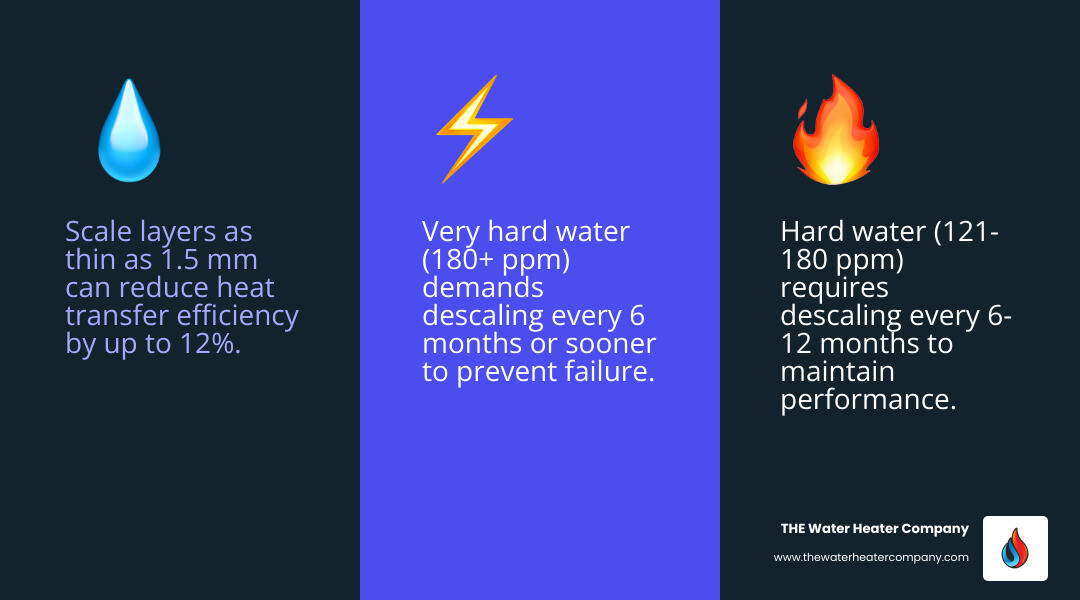
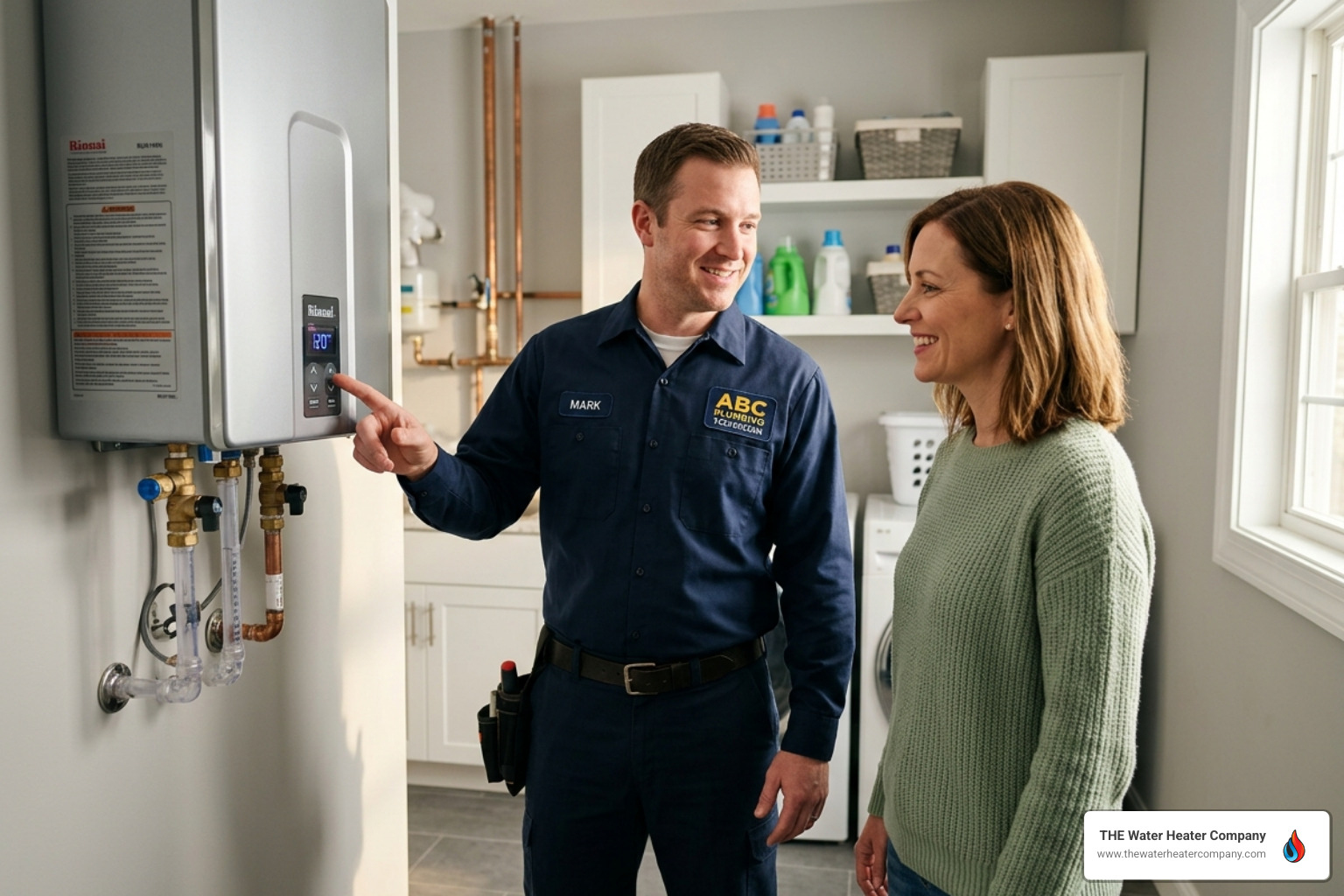
What Are the Critical Factors for Emergency Tankless Repair Services?

When your tankless water heater malfunctions, especially during off-hours, the criteria for selecting a repair service become critically focused. Beyond general reliability, we prioritize rapid response, highly specialized knowledge, and the capability to resolve complex issues efficiently. These factors are essential for minimizing disruption and quickly restoring your hot water supply.

Understanding Emergency Service Capabilities

Our emergency service capabilities are designed to meet the immediate and urgent needs of Los Alamitos homeowners. This means:

  • Around-the-Clock Technician Availability: We ensure that skilled technicians are available 24/7 to address any tankless water heater emergency, day or night, weekends or holidays.
  • Rapid Dispatch: Our dispatch system is optimized for speed, allowing us to quickly send a technician to your location as soon as an emergency call comes in.
  • Equipped for Immediate Solutions: Our technicians arrive with the necessary tools, diagnostic equipment, and common replacement parts to perform immediate repairs or implement temporary solutions if a more extensive fix is needed.
  • Focus on Minimizing Disruption: We understand the inconvenience of a hot water outage. Our goal is to work efficiently and effectively to get your system back online with minimal disturbance to your daily routine. We prioritize rapid response for all emergency situations, ensuring that your hot water crisis is addressed promptly.

The Role of Specialization in Tankless Water Heaters

The advanced technology within tankless water heaters demands a level of specialization that general plumbing services may not always possess. Our dedicated focus on water heaters, particularly tankless systems, provides a distinct advantage:

  • Deep Expertise in Tankless Technology: Unlike general plumbers who might handle a wide array of plumbing issues, our technicians are extensively trained and experienced specifically with tankless water heaters. This specialization means they are intimately familiar with the intricate workings of these energy-efficient units.
  • Understanding of Specific Brands and Models: We work with numerous tankless water heater brands and models, understanding the unique specifications, common issues, and recommended repair procedures for each. This brand-specific knowledge is crucial for accurate diagnostics and effective repairs.
  • Advanced Diagnostic Capabilities: Tankless systems often involve complex electronic controls and sensors. Our specialists are equipped with advanced diagnostic tools to pinpoint issues quickly and accurately, preventing unnecessary repairs or part replacements.
  • Proper Descaling and Maintenance Procedures: We are experts in the specialized maintenance required for tankless units, such as professional descaling and flushing, which are vital for performance and longevity, especially in areas with hard water.

More info about tankless water heaters

How Do Local Los Alamitos Factors Impact Tankless Water Heater Needs?

Los Alamitos, CA, like much of Southern California, presents unique environmental and infrastructural characteristics that can significantly influence the performance and repair needs of tankless water heaters. Understanding these local factors is crucial for effective maintenance and ensuring the longevity of your system.

The Impact of Hard Water and Coastal Conditions

Two primary local factors in Los Alamitos that affect tankless water heaters are hard water and coastal conditions:

  • Hard Water: The water in Orange County, including Los Alamitos, typically has a hardness level of 5-7 grains per gallon. This “hard water” contains elevated levels of minerals like calcium and magnesium. Over time, these minerals can lead to significant mineral buildup and scale deposits within the heat exchanger of a tankless water heater. This buildup restricts water flow, reduces heating efficiency, and can cause premature wear and tear on components.
  • Coastal Humidity: While tankless units don’t store water in a tank, coastal environments can still impact their external components. The humidity can contribute to accelerated corrosion of certain parts, potentially shortening their lifespan if not properly maintained.

Because of these local conditions, tankless water heaters in Los Alamitos, CA, typically last 12-15 years with proper maintenance, compared to the 7-10 years often seen for traditional tank heaters in similar coastal environments without diligent care.

Maintenance Requirements for Longevity

Given the challenges posed by local water quality and climate, proactive maintenance is not just recommended—it’s essential for extending the life and efficiency of your tankless water heater in Los Alamitos.

  • Bi-Annual Maintenance Recommendations: We often recommend bi-annual maintenance for tankless water heaters in coastal areas like Los Alamitos. This more frequent schedule helps combat the effects of hard water and humidity more effectively.
  • Importance of Regular Descaling and Flushing: The most critical maintenance task for tankless units in hard water areas is regular professional descaling and flushing. This process removes mineral deposits from the heat exchanger, restoring efficiency and preventing blockages.
  • Preventing Sediment Buildup: Consistent maintenance helps prevent the accumulation of sediment, which can otherwise lead to reduced hot water output, fluctuating temperatures, and increased energy consumption.
  • Extending Unit Lifespan Through Proactive Care: By adhering to a tailored maintenance schedule, homeowners can significantly extend the operational life of their tankless water heaters, avoiding costly repairs or premature replacements. We emphasize the importance of regular maintenance specifically tailored to local conditions, ensuring your system performs optimally for years to come.

technician performing descaling on a tankless water heater - Who is the most reliable tankless water repair company in los

What Should Los Alamitos Residents Look For When Choosing an Emergency Tankless Repair Service?

When faced with a tankless water heater emergency in Los Alamitos, making an informed choice about your repair service is crucial. Focusing on specific criteria will help ensure you select a truly reliable company that can resolve your issue efficiently and effectively.

Essential Qualities of a Top-Tier Provider

A top-tier emergency tankless repair service will consistently demonstrate these essential qualities:

  • Verification of Licensing and Insurance: Always confirm that the company you choose is properly licensed and insured. This protects you from liability and ensures that the technicians are qualified to perform the work. We are proud to operate with all necessary credentials, providing peace of mind to our customers.
  • Checking Customer Reviews and Testimonials: Look for companies with a strong track record of positive customer feedback, specifically mentioning their emergency response times and the quality of their tankless repairs. These real-world experiences offer valuable insights into a company’s reliability and service standards.
  • Transparent Communication and Upfront Explanations: A reliable provider will communicate clearly and honestly, explaining the problem, the repair process, and any associated considerations before work begins. This transparency builds trust and avoids unexpected surprises.
  • Guarantees on Parts and Labor: A company that stands behind its work with guarantees on both parts and labor demonstrates confidence in its service and commitment to customer satisfaction.
  • Local Presence and Understanding of Los Alamitos Regulations: Choosing a company with a strong local presence means they are familiar with Los Alamitos’ specific plumbing codes, building regulations, and environmental factors (like hard water), which can impact tankless water heater performance and repair.

Questions to Ask Before Hiring

To help you make the best decision during an emergency, we recommend asking these key questions:

  • Do you offer 24/7 availability for tankless water heater emergencies?
  • What is your average response time for emergency calls in Los Alamitos?
  • Are your technicians specifically trained and specialized in tankless water heater repair, or are they general plumbers?
  • Can you explain your diagnostic process for tankless units?
  • How do you address the impact of Los Alamitos’ hard water on tankless water heaters during repairs and maintenance?
  • Do you provide a written estimate before starting any work?
  • What warranties do you offer on your repairs and replacement parts?
  • Are your technicians licensed and insured?

What Services Beyond Basic Repair Do Top Companies Provide?

A truly reliable tankless water heater repair company offers a comprehensive suite of services that extends beyond merely fixing immediate breakdowns. For us, providing long-term performance and ensuring customer satisfaction means offering a full spectrum of support for your tankless system throughout its lifespan.

Comprehensive Tankless Water Heater Services

Our commitment to being a trusted authority in water heating means we offer a complete range of services designed to address every aspect of your tankless water heater’s needs:

  • Routine Maintenance and Descaling: We provide scheduled maintenance services, including the crucial descaling and flushing necessary to combat hard water buildup in Los Alamitos. This proactive care helps prevent emergencies and extends the life of your unit.
  • Preventative Inspections: Our detailed inspections can identify potential issues before they escalate into costly repairs or unexpected breakdowns, ensuring your system operates efficiently and reliably.
  • New Tankless Water Heater Installation and Replacement: When repair is no longer the most economical or practical option, we offer expert installation and replacement services. We guide you through selecting the right unit for your home’s needs and ensure a seamless, code-compliant installation.
  • Water Filtration Solutions: Recognizing the impact of hard water in Los Alamitos, we also offer water filtration solutions that can significantly improve water quality, protect your tankless water heater, and enhance the overall comfort of your home.
  • Advanced Diagnostics for Complex Issues: Our specialized expertise allows us to perform in-depth diagnostics for even the most complex tankless water heater problems, ensuring accurate identification of the root cause and effective resolution.

We offer a full range of water heater services, including repair, installation, maintenance, and water filtration, demonstrating our dedication to comprehensive care.

Long-Term Support and Customer Care

Our relationship with our customers doesn’t end after the repair is complete. We believe in fostering lasting relationships through ongoing support and education:

  • Warranties on Repairs and Installations: We provide robust warranties on both our repairs and new installations, giving you peace of mind and protecting your investment.
  • Follow-Up Services: We are available for any follow-up questions or concerns you may have after a service, ensuring your continued satisfaction.
  • Customer Education on Maintenance: We empower homeowners with knowledge, offering practical advice and tips on how to best maintain their tankless water heaters between professional services.
  • Building Lasting Relationships with Clients: Our goal is to be your go-to partner for all your water heating needs, building trust through consistent, high-quality service.
  • Commitment to Being a Trusted Authority in Water Heating: We strive to be the most knowledgeable and reliable source for tankless water heater information and services in Los Alamitos and surrounding areas.

happy homeowner with a newly installed tankless water heater - Who is the most reliable tankless water repair company in los

Frequently Asked Questions about Emergency Tankless Water Heater Repair

How quickly can an emergency tankless repair service respond in Los Alamitos?

For emergency tankless water heater repairs in Los Alamitos, we typically respond within 90 minutes. Our goal is to provide same-day service for most repairs, understanding the urgency of restoring hot water to your home. Our technicians are available 24/7 and our mobile units are fully stocked to facilitate quick diagnosis and immediate action.

What are the most common signs that my tankless water heater needs emergency repair?

Several signs indicate your tankless water heater may need emergency repair. These include a complete lack of hot water, fluctuating water temperatures that are either too hot or too cold, unusual noises coming from the unit (like banging or rumbling), error codes displayed on the unit’s panel, or any visible leaks around the system. If you notice any of these, it’s best to call for professional help immediately.

Is it better to repair or replace an older tankless water heater in an emergency?

The decision to repair or replace an older tankless water heater in an emergency often depends on several factors, including the unit’s age, the severity of the problem, and the cost of the repair. Tankless water heaters typically have a lifespan of 12-15 years in areas like Los Alamitos with proper maintenance. If your unit is nearing or beyond this age, requires frequent repairs, or if the repair cost approaches 50% of the cost of a new unit, replacement might be the more economical and reliable long-term solution. We can assess your specific situation and provide an honest recommendation, outlining the pros and cons of both options.

Conclusion

When faced with a tankless water heater emergency in Los Alamitos, CA, reliability is non-negotiable. By prioritizing companies that demonstrate 24/7 availability, specialized tankless expertise, strong local reviews, and a deep understanding of Los Alamitos’ unique environmental factors, you can ensure a swift and effective resolution. Look for providers committed to transparent communication, guaranteed workmanship, and comprehensive services that extend beyond just the immediate fix. Choosing wisely means restoring your hot water quickly and confidently, knowing your system is in expert hands.

tankless water replacement best in los angeles, ca

Finding the best tankless water replacement in Los Angeles for your home

Why Homeowners Seek the tankless water replacement best in los angeles, ca

In a city as dynamic as Los Angeles, the last thing you want to worry about is whether your water heater can handle the morning rush. Traditional tank models have served us for decades, but they come with a significant drawback: they heat a large volume of water and keep it hot 24/7, regardless of whether you’re using it. This “standby heat loss” is like leaving your car running in the driveway all day just in case you need to run an errand.

Switching to Tankless Water Heaters changes the game entirely. These units heat water only when you turn on a tap, providing an endless supply of hot water. Whether you have a teenager taking a 20-minute shower or you’re running the dishwasher and laundry simultaneously, the hot water simply doesn’t run out.

Beyond the luxury of “endless” showers, the space-saving design is a major draw for LA residents. In neighborhoods where square footage is at a premium—like Santa Monica or West LA—reclaiming the 10 to 15 square feet occupied by a bulky 50-gallon tank is a massive benefit. Tankless units are roughly the size of a carry-on suitcase and mount directly to the wall, often freeing up entire closets for storage.

When comparing Tank vs Tankless Water Heaters, the environmental and financial impact is also striking. Research shows that tankless units can be up to 34% more energy-efficient for homes using 41 gallons or less of hot water daily, and they can reduce energy consumption by 30% or more overall. While the initial investment is a consideration, the long-term ROI is bolstered by a lifespan that often exceeds 20 years—nearly double that of a traditional tank. If you are currently facing frequent repairs or rising utility bills, it is worth asking, Should I Repair or Replace My Water Heater? Often, the “best” replacement is the one that stops the cycle of emergency repairs and starts reducing your monthly SoCalGas bill.

Critical Factors for a Successful System Upgrade

Professional plumbing technician installing a high-efficiency tankless water heater in a Los Angeles home - tankless water

A successful Water Heater Replacement is not a “plug-and-play” operation. Because tankless units heat water instantly, they require a much higher burst of energy than a tank that heats slowly over time. This means the infrastructure of your home must be carefully assessed before the first pipe is cut.

Our Services always begin with a thorough evaluation of your home’s existing systems. For gas-powered units, we must ensure your gas line capacity is sufficient. A tankless unit might require a 3/4-inch gas line to provide enough BTUs, whereas your old tank might have only used a 1/2-inch line. Similarly, venting is a critical safety factor. Traditional tanks often vent through the roof using natural convection, but modern high-efficiency tankless units typically require specialized stainless steel or PVC power-venting that exits through a side wall to safely move exhaust gases out of the home.

Sizing the tankless water replacement best in los angeles, ca for Your Home

Sizing is the most common mistake homeowners make when shopping for the tankless water replacement best in los angeles, ca. Unlike tank heaters, which are sized by “gallons,” tankless units are sized by Flow Rate, measured in Gallons Per Minute (GPM).

To find the right size, we calculate your “Peak Demand.” This is the total GPM of every fixture you might realistically use at the same time. For example:

  • Shower: 2.5 GPM
  • Kitchen Sink: 1.5 GPM
  • Dishwasher: 1.0 GPM

If you want to run all three at once, you need a unit that can handle at least 5.0 GPM. However, in Los Angeles, we also have to consider “Temperature Rise.” This is the difference between the temperature of the groundwater coming into your home and your desired output temperature (usually 120°F). While Southern California groundwater is warmer than in the Midwest, it still fluctuates. A professional assessment ensures your unit has the “muscle” to maintain that 120°F even when the ground is cold in January.

Operating within the Los Angeles Service Area means adhering to some of the strictest building codes in the country. Safety isn’t just a suggestion; it’s the law. In California, earthquake safety is paramount. All water heaters, including wall-mounted tankless units, must be properly secured. This usually involves specific mounting brackets or straps to ensure the unit doesn’t shift or rupture a gas line during seismic activity.

Furthermore, Los Angeles County requires a permit for all water heater replacements. This ensures that a city inspector verifies the venting is safe, the gas connections are leak-free, and the unit meets local Title 24 energy efficiency standards. We handle the permit process for our clients because we know that an unpermitted installation can lead to major headaches when you eventually try to sell your home—or worse, safety hazards like carbon monoxide leaks.

Maximizing Performance and Longevity in Southern California

Technician descaling a tankless water heater to remove mineral buildup from hard water - tankless water replacement best in

Once your new system is installed, the goal is to keep it running at peak efficiency for the next two decades. In Southern California, the biggest threat to your investment isn’t mechanical failure—it’s the water itself.

Los Angeles is notorious for “hard water,” which is packed with minerals like calcium and magnesium. When this water is heated, those minerals solidify into “scale” inside the heat exchanger. Over time, this scale acts like insulation, forcing the unit to work harder and burn more gas to heat the water. If left unaddressed, this can lead to Water Heater Repair needs or even a total system “lockout” where the unit refuses to fire to protect itself from overheating.

Maintaining the tankless water replacement best in los angeles, ca for Long-Term Efficiency

To ensure the tankless water replacement best in los angeles, ca stays that way, we recommend a consistent maintenance schedule. Think of it as a “spa day” for your appliance.

  1. Annual Flushing/Descaling: This involves circulating a food-grade descaling solution through the heat exchanger for about an hour to dissolve mineral deposits.
  2. Inline Filter Cleaning: Most tankless units have a small screen that catches sediment before it enters the heater. This needs to be checked and rinsed regularly.
  3. Air Filter Inspection: Gas units need to breathe. We check the air intake to ensure it’s clear of dust and debris.
  4. System Diagnostics: Modern units like those in our Products catalog track error codes. We review these to catch small issues before they become big repairs.

For homes with particularly high mineral content, we often suggest installing a whole-home water softener or a dedicated scale-prevention filter. This can extend the time between flushes and keep your pipes clear.

Choosing the Right Technology for Your Household

Not all tankless heaters are created equal. We specialize in top-tier brands that have proven their reliability in the Southern California climate.

  • Navien Water Heaters: Known for their high-efficiency condensing technology and built-in recirculation pumps, which provide hot water to your tap even faster.
  • Noritz Water Heaters: A pioneer in the industry, offering incredibly durable commercial-grade heat exchangers in residential models.
  • Bradford White Water Heaters: A staple in American plumbing, offering robust support and reliable performance for homeowners who prefer a traditional brand name.
Feature Gas Tankless Electric Tankless
Heating Speed Very Fast (High BTU) Slower (Limited by Amperage)
Max Flow Rate High (Ideal for 3+ baths) Lower (Best for small homes/ADUs)
Energy Source Natural Gas Electricity
Installation Requires Venting & Gas Line Requires Heavy Electrical (100-150 Amps)

In most Los Angeles homes, gas tankless units are the preferred choice because they offer higher flow rates and lower monthly operating costs. However, for a small studio ADU or a remote pool house, an electric model can be a smart, vent-free solution.

Frequently Asked Questions about Tankless Replacement in LA

How do I switch from a tank to a tankless system?

The conversion from Tank Water Heaters to a tankless system is one of the most rewarding home upgrades you can make. The process involves removing the old 40-80 gallon tank, capping the old vent (if it’s a chimney-style vent), and mounting the new unit to the wall.

Plumbing modifications are usually required. We’ll reroute the water lines to the new unit’s location and often upgrade the gas line to ensure it gets the fuel it needs. Once the unit is mounted and the new venting is installed through an exterior wall, you’ve officially reclaimed your floor space. Most conversions can be completed in a single day (6-8 hours), meaning you won’t be without hot water overnight.

What rebates are available for Los Angeles residents?

One of the best parts of choosing the tankless water replacement best in los angeles, ca is that the government and utility companies often help you pay for it. Because these units are so much more efficient, SoCalGas frequently offers significant cash-back rebates for qualifying ENERGY STAR-certified models. Some high-efficiency condensing units can qualify for substantial rebates, depending on current promotions.

Additionally, federal tax credits are often available for energy-efficient home improvements. We stay up-to-date on these programs and provide our customers with the necessary documentation and model numbers to make the rebate application process as simple as possible.

How does hard water affect my new system?

As mentioned earlier, hard water is the “silent killer” of water heaters in Southern California. Without maintenance, mineral deposits can reduce the efficiency of a tankless unit by 10-20% in just a few years. However, this shouldn’t scare you away from going tankless.

Modern units are designed with maintenance in mind. They feature service valves that allow us to flush the system without disconnecting any pipes. If you are diligent about annual or bi-annual descaling (depending on your neighborhood’s water quality), your tankless system will continue to provide 0.90+ UEF (Uniform Energy Factor) efficiency for its entire life. In areas like Santa Clarita or Pasadena where the water is particularly hard, we often recommend a water softener as a companion to your new heater to protect all your home’s appliances.

Conclusion

Finding the tankless water replacement best in los angeles, ca doesn’t have to be a stressful experience. By focusing on proper sizing, professional installation, and local code compliance, you can transform your home’s comfort and efficiency for decades to come.

At THE Water Heater Company, we are more than just plumbers—we are specialists. As a local, family-owned Southern California business, we understand the specific challenges of LA homes, from earthquake safety to hard water management. Our expert technicians are trained to handle the most complex conversions, providing you with fair pricing, industry-leading warranties, and the peace of mind that comes with a job done right.

Don’t settle for lukewarm showers or bulky, inefficient tanks. Experience the luxury of endless hot water and the savings of a high-efficiency system. Schedule your tankless water heater replacement today and let us help you find the perfect solution for your Los Angeles home.

tankless water replacement in glendale, ca

Finding the Best Tankless Water Replacement in Glendale

Is Tankless Water Replacement in Glendale, CA Right for Your Home?

Tankless water replacement in Glendale, CA is one of the smartest upgrades a homeowner can make — especially when an aging tank system starts failing, driving up energy bills, or leaving your family with lukewarm showers. Here’s a quick snapshot of what you need to know:

  • Who needs it: Homeowners with water heaters older than 10–15 years, frequent hot water shortages, or rising energy costs
  • What to expect: A licensed plumber assesses your home, removes the old unit, and installs a properly sized tankless system — typically completed in one day
  • Key benefit: Tankless units heat water on demand, eliminating standby energy loss and lasting 20+ years with proper maintenance
  • Glendale-specific note: Hard water in Glendale causes mineral buildup in tankless heat exchangers — annual descaling is essential to protect your investment
  • Bottom line: A professional replacement from a licensed, experienced plumber ensures code compliance, correct sizing, and lasting performance

Glendale’s combination of hard water, older housing stock, and energy-conscious homeowners makes tankless water heater replacement a particularly practical and popular choice in this area. Whether your current system is leaking, making strange noises, or simply past its prime, this guide walks you through everything you need to make a confident decision.

I’m Anthony Hamilton, Co-Founder and CEO of THE Water Heater Company, and with years of hands-on plumbing experience and authorized provider status for leading tankless brands, I’ve helped countless Southern California homeowners navigate tankless water replacement in Glendale, CA with clarity and confidence. Let’s break down exactly what the process looks like — and how to get it right.

Infographic showing steps and benefits of tankless water replacement in Glendale CA including hard water tips and lifespan

Why Consider Tankless Water Replacement in Glendale, CA?

If you are still relying on a large, metal cylinder to store and pre-heat 50 gallons of water all day long, you are essentially paying to heat water you aren’t using. In a city like Glendale, where we value both efficiency and modern convenience, switching to a tankless model is a game-changer.

Feature Traditional Tank Heater Tankless Water Heater
Hot Water Supply Limited to tank size Endless (On-Demand)
Energy Efficiency Lower (Standby loss) High (Up to 50% more efficient)
Lifespan 8–12 Years 20+ Years
Space Required Large floor footprint Compact (Wall-mounted)
Flood Risk High (40-80 gallon burst) Low (Minimal water storage)

The most immediate benefit we hear from our customers is the end of the “hot water race.” You know the one—where the first person in the shower gets a spa experience, and the last person gets an ice bath. Because tankless units heat water as it flows through the heat exchanger, the supply never runs out.

Beyond the comfort, there is the massive space-saving advantage. Many Glendale homes, especially those in historic neighborhoods or those with limited utility closet space, benefit from reclaiming the square footage occupied by a bulky tank. By mounting the unit on the wall, you open up room for storage or simply a cleaner-looking garage. Furthermore, because there isn’t a massive reservoir of water sitting in your home, the risk of a catastrophic flood due to a tank burst is significantly reduced. To learn more about how these systems integrate into local homes, check out our Glendale services page.

Signs Your Current System Needs an Upgrade

Knowing when to pull the trigger on tankless water replacement in Glendale, CA can save you from an emergency Saturday night plumbing disaster. While some units fail spectacularly, most give you “warning shots” first.

  • Inconsistent Temperatures: If your water goes from hot to cold and back again during a single shower, your heating elements or heat exchanger are likely failing.
  • Strange Metallic Noises: Popping, banging, or rumbling sounds usually indicate a heavy layer of sediment at the bottom of a tank or scale buildup inside a tankless unit.
  • Visible Leaks: Any moisture around the base of the unit is a red flag. For tank models, a leak often means the internal lining has corroded, and a total burst is imminent.
  • Frequent Error Codes: If your current tankless unit is constantly flashing “Service Required” or ignition error codes, the internal components may be reaching the end of their functional life.
  • System Age: If your tank is over 10 years old or your tankless unit is pushing 20, you are living on borrowed time. Proactive replacement is always cheaper than emergency cleanup.
  • Rusty Water: If the “hot” side of your tap produces discolored water while the “cold” side is clear, your heater is rusting from the inside out.

Addressing Glendale’s Hard Water Challenges

We love Glendale, but we have to be honest: our water is “hard.” This means it contains high levels of dissolved minerals like calcium and magnesium. While safe to drink, these minerals are the natural enemy of water heaters.

When hard water is heated, the minerals “precipitate” out, forming a hard, crusty layer known as scale. In a tankless system, this scale coats the narrow passages of the heat exchanger. This creates several problems:

  1. Mineral Insulation: The scale acts as an insulator, meaning the burner has to work much harder and run longer to heat the water through the crust.
  2. Reduced Efficiency: As the unit works harder, your energy bills climb, and the efficiency rating of your high-tech heater drops.
  3. Overheating and Failure: If the scale gets thick enough, the heat exchanger can overheat and crack, leading to an expensive and premature replacement.

To combat this, we recommend annual flushing and descaling. This involves circulating a food-grade solution through the unit to dissolve the calcium deposits. In Glendale, skipping this maintenance is the fastest way to void your warranty and cut your unit’s lifespan in half. We often suggest pairing a new tankless unit with a water conditioning or filtration system to stop the scale before it ever reaches your heater.

The Professional Installation and Replacement Process

Replacing a water heater isn’t just a “plug and play” job. It requires a deep understanding of gas pressure, venting physics, and local safety codes. When we perform a tankless water replacement in Glendale, CA, we follow a rigorous process to ensure your home is safe and your hot water is reliable.

The process typically begins with a home assessment. We don’t just look at the old heater; we look at your family’s needs. How many showers run at once? Do you have a high-flow rain showerhead or a giant soaking tub? This helps us determine the correct GPM (Gallons Per Minute) flow requirement.

Professional Tankless Water Replacement in Glendale, CA

For larger families in Glendale, we often recommend high-efficiency condensing models. These units use a second heat exchanger to capture extra heat from the exhaust gases, making them incredibly efficient (sometimes up to 0.98 UEF). We only use contractor-grade equipment, which features more durable internal components than the “big box store” models, ensuring a much longer service life.

Ensuring Compliance with Glendale Codes

Glendale has specific building codes designed to keep you safe. Any professional installation must include:

  • Proper Permits: We handle the paperwork to ensure the city knows the work was done to code.
  • Earthquake Strapping: Even though tankless units are wall-mounted, they must be secured properly to withstand seismic activity, a must in Southern California.
  • Proper Exhaust Venting: Tankless units produce hot exhaust that must be vented through dedicated stainless steel or specialized PVC piping to prevent carbon monoxide buildup.
  • Gas Line Evaluation: Tankless units require a high volume of gas to heat water instantly. We check your gas meter and pipe diameter to ensure the unit won’t “starve” for fuel when it kicks on.

Maximizing Efficiency and Longevity

Once your new system is in place, you want it to stay efficient for the next two decades. Modern units, especially Energy Star certified models, are incredibly resilient, but they aren’t “set it and forget it” appliances.

  • Routine Maintenance: Aside from the descaling we mentioned, we also clean the air intake filters. If the unit can’t “breathe,” it can’t burn gas efficiently.
  • System Monitoring: Many of our recommended units come with Wi-Fi connectivity. This allows you to monitor your energy usage and receive alerts on your phone if the unit detects a minor issue before it becomes a major repair.

Long-Term Benefits of Tankless Water Replacement in Glendale, CA

The financial benefits of going tankless go beyond monthly bill savings. Homeowners can often qualify for local utility rebates or federal tax credits for installing high-efficiency appliances. Additionally, a tankless system is a selling point. When it comes time to put your Glendale home on the market, having a modern, energy-efficient “on-demand” system can increase your property value and appeal to eco-conscious buyers.

Frequently Asked Questions

How long does a tankless water heater last compared to a tank?

A standard gas tank water heater typically lasts between 8 and 12 years. In contrast, a well-maintained tankless water heater can easily last 20 to 25 years. Because tankless units don’t store water, they aren’t subject to the same internal corrosion that eventually kills every tank heater. By choosing tankless, you are essentially buying two “lifetimes” of a traditional heater.

Do I need to upgrade my gas line for a tankless unit?

It depends on your current setup. A traditional tank heater uses a small burner (about 34,000 to 40,000 BTUs) to heat water slowly over time. A tankless unit needs to heat water instantly, requiring a much larger burner (often 150,000 to 199,000 BTUs). During our initial assessment, we check your gas line’s diameter and the capacity of your gas meter to ensure it can handle the load. If an upgrade is needed, we can handle that as part of the installation.

How often should I flush my tankless water heater in Glendale?

Because of Glendale’s hard water, we strongly recommend a professional flush once every year. If you have a whole-home water softener installed, you might be able to stretch this to every 18–24 months, but an annual checkup is the best insurance policy for your equipment.

Conclusion

Making the switch to a tankless system is an investment in your home’s efficiency and your family’s comfort. At THE Water Heater Company, we pride ourselves on being the local, family-owned experts that Glendale residents trust. We understand the specific challenges of Southern California plumbing, from earthquake safety to hard water management.

If you’re tired of cold showers or worried about an aging tank in your garage, we’re here to help. Our team of licensed professionals provides fast, reliable, and expert service backed by industry-leading warranties. We don’t just install a unit; we ensure it’s the right fit for your lifestyle and that it’s set up to last for decades.

Ready to experience endless hot water? Schedule your tankless water replacement in glendale, ca today and let us help you upgrade your home with confidence.

Why Noritz Tankless Water Heaters Are a Game-Changer for Southern California Homes

If you’ve ever run out of hot water in the middle of a shower or noticed your energy bills creeping up, you’re not alone. Many Southern California homeowners struggle with traditional tank-style water heaters that can’t always keep up with daily household demands. This is where Noritz tankless water heaters have made a noticeable difference—but how do they actually work, and are they the right choice for your home? Let’s break it down.

What Is a Tankless Water Heater?

Unlike a conventional water heater that stores a set amount of hot water in a tank, a tankless water heater heats water on demand. When you turn on a faucet or start a shower, cold water flows through the unit, is heated instantly, and delivered directly to your tap.

Why it matters for homeowners:

  • You don’t run out of hot water during busy mornings or evening showers.

  • Energy is used only when water is needed, which can lower utility costs.

Benefits of Noritz Tankless Water Heaters for Southern California Homes

1. Endless Hot Water

One of the biggest frustrations with traditional tanks is running out of hot water during peak usage. With a tankless system, multiple showers, laundry loads, and dishwasher cycles can often run consecutively without interruption.

2. Energy Efficiency

Tankless water heaters heat water only when needed, rather than maintaining a full tank at a constant temperature. For Southern California homeowners, this can translate to noticeable savings on gas bills over time.

3. Space-Saving Design

Noritz tankless units are compact and wall-mounted, freeing up valuable space in closets, garages, or utility rooms—something many California homes can benefit from, especially those with limited storage.

4. Longevity and Reliability

Traditional water heaters usually last around 8-12 years, while tankless systems like Noritz can often last 15-25 years or more with proper maintenance. This longevity can make them a smart long-term investment for your home.

Things to Consider Before Switching

While Noritz tankless water heaters offer many advantages, they aren’t perfect for every home. Here are some important factors to weigh:

  • Initial Cost: Tankless units generally cost a bit more upfront than traditional tanks due to the retrofitting requirements. However, many homeowners find the energy savings and longer lifespan offset this over time.

  • Flow Rate Limits: Tankless water heaters heat water as it flows, so very high simultaneous demand may require multiple units or careful planning for larger households. We can help size the system properly to avoid this.

  • Maintenance: Regular maintenance, like descaling for hard water, helps preserve efficiency and performance. Southern California’s varying water quality makes this an important consideration and an additional annual expense.


Let’s Keep It Real…

Traditional tank water heaters work well and are relatively easy to maintain, but they’re limited by capacity, consume more energy, and usually need replacement within a decade.

Tankless units are more complex and require professional installation and annual service — but when properly installed and maintained, they outperform tanks in both efficiency and longevity, often lasting twice as long.


Call THE Experts Today! 

Noritz tankless water heaters can be a game-changer for Southern California homes, offering endless hot water, energy efficiency, and a compact design. But as with any home upgrade, it’s important to evaluate your household’s needs and budget.

At THE Water Heater Company, we help homeowners navigate these decisions with total transparency and expertise. We don’t push one solution over another; we educate and guide you so you can make the choice that fits your home best.

Ready to explore whether a Noritz tankless water heater is right for your home? Call THE Water Heater Company at 877-798-7487 for a professional evaluation today.

Tank vs. Tankless Water Heaters

Tank vs. Tankless Water Heaters: What’s the Right Choice for Your Home?

Choosing a new water heater can feel overwhelming. Tank or tankless? What’s the difference? Which one is better?

The truth is—they both have great benefits. The best choice depends on you, your home, and how your family uses hot water.

Let’s break it down simply, so you can feel confident and informed.

What’s the Difference Between a Tank and a Tankless Water Heater?

It all comes down to how they heat and store water:

Tank Water Heaters (Traditional)
These systems come with a large tank—usually between 30 and 100 gallons—that stores hot water 24/7 and reheats it after each use.

Tankless Water Heaters
These units don’t store water. Instead, they heat water on demand, only when you turn on a tap, shower, or appliance.

Why Choose a Tank Water Heater?

Tank water heaters are still the most common in homes. Here’s why homeowners love them:

Lower cost upfront – Retrofitting for a tankless system typically costs 2–3x more than swapping in a new tank.
Simple to install – Often a like-for-like replacement that just needs to be brought up to code.
Easier to service – With just 3–4 components, parts are widely available and repairs are straightforward.
Consistent hot water – If a tank has worked for you before, it’ll keep working just the way you’re used to.

Things to consider:

  • Uses more energy by keeping water hot 24/7—even when you’re not using it. 
  • Once the tank runs out, you may wait 30–60 minutes for more hot water. 

Why Choose a Tankless Water Heater?

Tankless systems are becoming the go-to for modern and upgraded homes. Here’s why:

Energy efficient – They only run when you use hot water, making them about 30% more efficient than tanks.
Endless hot water – Perfect for long showers, big families, and oversized bathtubs.
Saves space – Wall-mounted and more compact (though space savings are often modest).
Longer lifespan – With proper maintenance, they can last 15–25 years (vs. 8–12 for tanks).

Things to consider:

  • Higher upfront costs due to the need to retrofit. 
  • Larger gas lines may need to be run from your meter to meet the system’s higher BTU demands. 
  • Repairs can be more technical, and parts may be more expensive. 
  • Annual maintenance is required, and skipping it can lead to costly repairs.

How to Know Which Is Right for You

Before choosing, ask yourself:

  • How many people live in your home? 
  • How many bathrooms do you have? 
  • Do you ever run out of hot water? 
  • Do you want a “set-it-and-forget-it” water heater, or are you okay with annual maintenance? 
  • Do you take lots of baths or have an oversized tub? 
  • Are you planning to stay in your home long-term? 

Need help thinking it through?
Check out our helpful guide:
Should I Go Tankless or Stick With a Traditional Water Heater?

We Don’t Pick Favorites—We Pick What’s Best for YOU

At THE Water Heater Company, we’re not here to tell you which water heater is better—we’re here to help you figure out which one is better for your home.

Our experienced technicians take the time to visit your home, ask the right questions, and perform a full evaluation. Then, we guide you to the option that best fits your comfort, budget, and long-term plans.

It’s not about what we like—it’s about what works for you.

Want to schedule a home evaluation? We’re happy to help.

Let’s Find Your Perfect Fit

Whether you go tank or tankless, the right water heater will:

  • Keep your showers hot 
  • Lower your energy bills 
  • And keep your home running smoothly 

Need help deciding?
Call THE Water Heater Company at (877) 798-7487 to speak with a real expert who cares.

loading water heater into service van

Should I Go Tankless or Stick with a Traditional Water Heater?

When it comes to choosing between a tankless and traditional water heater, California homeowners often face a tough decision. Both types have their pros and cons, and understanding the differences in installation, energy efficiency, space requirements, and long-term performance can help you make the best choice for your home, budget, and lifestyle. Here’s a comparison of tankless and traditional water heaters to guide your decision.

Traditional Tank Water Heaters

A traditional tank water heater stores and preheats a large volume of water, usually between 30 and 80 gallons. The water is heated continuously, keeping it ready for use. This setup is widely used due to its lower initial cost and straightforward installation.

Pros of Traditional Water Heaters

  • Lower Upfront Cost: Tank water heaters are generally less expensive to purchase and install than tankless models.
  • Consistent Supply for High Demand: With a large tank of heated water on standby, traditional models can serve multiple outlets simultaneously, making them a good option for households with frequent hot water needs.
  • Simple Installation and Maintenance: Since traditional water heaters are more common, finding replacement parts and repair services is generally easier and more affordable.

Cons of Traditional Water Heaters

  • Higher Energy Costs: Traditional tanks continuously heat water to maintain the set temperature, resulting in energy loss even when you’re not using hot water (standby heat loss).
  • Limited Hot Water Supply: Once the hot water in the tank is depleted, there’s a delay while it refills and reheats, which can be inconvenient for larger households.
  • Larger Space Requirements: These water heaters take up more space, which can be a drawback if storage is limited.

Tankless Water Heaters

Tankless water heaters, also known as on-demand units, heat water only when needed. This eliminates standby heat loss and can make tankless models more energy-efficient. These compact units are becoming popular in California due to their efficiency and space-saving design.

Pros of Tankless Water Heaters

  • Energy Efficiency: Without a tank to keep heated, tankless units can be up to 30% more energy-efficient, especially in households with lower daily hot water usage.
  • Unlimited Hot Water Supply: Tankless models heat water on demand, meaning you’ll never run out of hot water as long as the unit meets your household’s flow rate needs.
  • Space Savings: Their compact design allows them to be installed in smaller spaces, even on walls, freeing up valuable floor space in your home.

Cons of Tankless Water Heaters

  • Higher Upfront Cost: Tankless water heaters typically have a higher purchase and installation cost than traditional models, although the energy savings may offset this over time.
  • Limited Flow Rate for High Demand: If multiple outlets require hot water simultaneously, the flow rate may limit performance. Larger households may need more than one unit to meet demand.
  • Complex Installation Requirements: Installation can be more complex, often requiring upgrades to gas lines or electrical capacity, which can increase initial costs.

Which Option Is Right for You?

The best choice depends on your household’s needs and priorities:

  • If you prioritize lower upfront costs and have frequent simultaneous hot water needs, a traditional tank water heater may be best.
  • If energy savings, endless hot water, and space efficiency are key, and you’re willing to invest in a higher initial cost, a tankless water heater could be a better fit.

Installation Costs and Long-Term Performance

The cost to install a traditional water heater is generally lower due to simpler installation. Tankless models, though more expensive upfront, often deliver long-term savings on utility bills. Tankless units also tend to have longer lifespans (up to 20 years) compared to tank models (10-15 years), adding to their long-term value.

Contact THE Water Heater Company for Expert Guidance!

If you’re still unsure which water heater option is best for you, THE Water Heater Company is here to help! Our experienced technicians can assess your home’s hot water needs and guide you toward the right solution. Call us today for expert advice and reliable installation, ensuring your water heater meets your family’s needs now and in the future.

The Difference Between Tank vs. Tankless Water Heaters

If you’re in the market for a new water heater, it’s important to understand the difference between the two main options you can choose from. Those options are tank water heaters and tankless water heaters. They both function in different ways and come with their own unique pros and cons.

In this guide, we’ll help you take a closer look at what each of these options offers and what the advantages and disadvantages are to using them:

Tankless Water Heaters

As the name suggests, tankless water heaters don’t store hot water in a tank for it to be used later. Instead, they heat water on-demand. The water is not stored in a tank, so it doesn’t need to be continually reheated to combat heat loss the way tank water heaters need to. Tankless heaters are becoming more popular because of their efficiency, but they aren’t as common or tried-and-true as tank heaters just yet.

Pros

Durability: When your new tankless water heater is installed, it will last for up to 20 years and often longer than that. They’re highly durable and their parts can be replaced easily. On the other hand, tank water heaters typically last only 10–15 years, and replacement parts can be more difficult to find, depending on your model.

Size: Because there is no storage unit in a tankless heater, they also take up less space in the home. If your storage space is limited, a tankless water heater is a great option

Energy and Cost Efficiency: As mentioned, tankless heaters provide hot water on-demand, meaning they save money in standby heat loss and lower your energy bills

Safety: Tankless water heaters can be much safer than regular tank water heaters because they don’t include a tank that can be overpressurized or overheated, thus eliminating these risks altogether.

Cons

Higher Upfront Costs: When you first buy your tankless water heater and have it installed, it will cost you more money than if you were to choose a tank water heater. The higher costs are a result of the more advanced systems and technology used by tankless water heaters. They can also be a little more complicated to install and maintain.

Limits to Simultaneous Usage: While tankless heaters do provide on-demand hot water, they also have limitations on their flow rate. This means that simultaneous usage, such as showering and running the dishwasher at the same time, could push a tankless heater to its limit

Home Accommodations: Some homes will require considerable changes to their electrical systems or gas line to ensure they can accommodate the tankless heater. You have to be aware of the voltage and amperage requirements of the tankless heater and, if you’re switching from a tank water heater, reconfigure the space surrounding the unit to accommodate a tankless one.

Who Should Buy a Tankless Water Heater?

Anyone looking for a fast and convenient source of hot water in the home should opt for a tankless water heater. They will be able to provide you with the hot water you need, when you need it, although simultaneous usage should be considered. You’re also far less likely to have to deal with breakdowns early in the water heater’s lifespan, and that gives you some peace of mind.

Tank Water Heaters

Tank water heaters store water in a tank and heat it so that it’s ready to be used when needed. The water reheats while on standby and the tank regularly fills and heats after the water in it has been used. Tank water heaters come in a variety of sizes. Small tanks hold 30 to 60 gallons of water at a time, while medium- and large-sized tanks hold around 80 gallons.

Pros

Cheaper Installation Costs: Tank water heaters are cheaper and easier to install than tankless heaters, reducing your upfront costs.

Cheaper Maintenance: When something goes wrong with your water heater, chances are it will be cheaper to fix in a tank water heater. Generally speaking, the cost of replacement parts is lower for tank water heaters than for tankless water heaters.

Dependability: Tank water heaters have been around for years, and models continuously upgrade to ensure you have a dependable heater in your home with the necessary safety features. Tankless heaters are newer and not as common, meaning many manufacturers are still testing different features that could make tankless heater models better.

Cons

Heating Times: Waiting for the tank to refill and reheat can be frustrating, whereas tankless water heaters provide instantaneous hot water

Standby Heat Loss and Higher Energy Bills: Because a tank water heater continuously heats up water in the tank until it is used, more energy is wasted on standby heat loss. This also increases the cost of your energy bill

Shorter Lifespan: Tank water heaters tend to last for an average of 10–15 years before they need to be replaced. Tankless water heaters tend to last up to 5 years longer.

Who Should Buy a Tank Water Heater?

The simplicity and dependability offered by tank water heaters is what makes them appealing to many people. They’re easy to install, operate, maintain, and repair. Problems can be easier to diagnose than a tankless water heater. Tank heaters also have cheaper water heater installation costs than tankless water heaters, which can be beneficial to those looking for lower upfront costs.

If you want to learn more about the tank and tankless water heaters to decide which one is best for your home, contact THE Water Heater Company today.

Understanding the Value of Paying for a Water Heater Repair/Replacement Estimate

When faced with water heater problems, homeowners often find themselves in a dilemma. Should they pay for a service call or estimate? It’s a valid question, and one that we, at THE Water Heater Company, aim to address. In this article, we’ll explain the reasons behind charging for estimates and highlight the value-added benefits that come with it. By understanding these factors, homeowners can make an informed decision and ensure a smooth and reliable repair experience for their water heater.

Expertise and Time

Assessing and diagnosing water heater issues requires the expertise of a professional technician. These skilled individuals possess the knowledge and experience necessary to accurately identify the problem and provide the most effective solutions. They invest their time in carefully evaluating the unit, examining its components, and determining the root cause of the issue. By charging a fee for estimates, we are compensating our technicians for their valuable time and expertise, ensuring that you receive the highest quality service.

Cost Recovery

Operating a home service company involves various expenses, including maintaining a fleet of service vehicles, carrying several types of insurance, employing skilled technicians, and acquiring specialized tools and equipment, to name a few. Charging for estimates helps us recover these costs and continue providing exceptional service. By supporting us through this process, homeowners contribute to the sustainability and reliability of our business, enabling us to offer the best solutions for water heater maintenance, repairs, and replacement.

Serious Inquiries

At THE Water Heater Company, we strive to prioritize our resources and provide prompt service to homeowners who genuinely require our assistance. Charging for estimates helps us distinguish between casual inquiries and customers who are committed to resolving their water heater issues. By investing in an estimate, homeowners demonstrate their seriousness about addressing the problem, ensuring that our skilled technicians can dedicate their expertise to the customers who need it most.

Value-Added Service

Beyond simply providing an estimate, we believe in delivering comprehensive value to our customers.

When you choose to pay for an estimate, you can expect a range of additional benefits:

  • Thorough Inspection: Our technicians conduct a detailed inspection of your water heater, examining its various components to identify any potential issues or underlying causes. This comprehensive assessment ensures that no problem goes unnoticed.
  • Assessment Report: With your paid estimate, you’ll receive a detailed assessment report that outlines the identified problems, recommended solutions, and an estimated cost for repairs. This report serves as a valuable reference and helps you make an informed decision about the necessary steps to resolve the issue.
  • Professional Advice: Our experienced technicians are more than just repair experts. They can provide professional advice on water heater maintenance, and energy efficiency improvements, and answer any questions you may have. This personalized guidance ensures that you have the knowledge needed to maintain your water heater effectively and extend its lifespan.

Understanding the reasons behind charging for estimates is essential for homeowners facing water heater problems. By appreciating the expertise and time invested by professionals, recognizing the need for cost recovery, and valuing the benefits of a paid estimate, homeowners can make an informed decision. At THE Water Heater Company, we are committed to providing exceptional service and ensuring that every customer receives the highest quality repairs or replacement for their water heater. Not only that, but we apply the cost of the estimate/assessment towards the project once you are ready to move forward.

How Long Should a Tankless Water Heater Last?

If you’re about to buy a new water heater and you’re currently comparing the options, one of the things you’ll want to take into account is the durability and long-term performance of each type of water heater. You want your heater to last a long time and provide the security that comes with durability.

Tankless water heaters are known to last longer and offer greater durability than regular tank water heaters. But how long should your tankless water heater last? And what makes them more durable than other options? Here’s what you need to know:

Lifespan

Most tankless water heaters will last for up to 20 years or more, which is a long lifespan in comparison to tank water heaters, which last around 10–15 years.

Tankless water heaters use new technology that helps them to stay functional and operational for much longer than some of the alternatives out there. They’re at the cutting edge of water heating technology and many of the newer models are even increasing their lifespans years past the expected 20 years.

The longer lifespans of tankless water heaters can be highly beneficial. Not having to worry about replacing a failing water heater for a couple of decades offers both peace of mind and a lower overall cost.

Easily Replaceable Parts

If a problem does occur with your tankless water heater before its 20-year lifespan is complete, it can usually be fixed relatively easily. Most replacement parts for tankless heaters are very easy to find, and keeping up on regular maintenance can increase the lifespan of your heater.

Keep in mind that some parts are more expensive compared to parts for tank water heaters, but they’re very easy to install, meaning experts won’t have to spend a lot of time resolving issues that occur.

Fewer Corrosion Problems

Another benefit that tankless water heaters have is that they don’t suffer from the same corrosion problems often associated with tank water heaters. This is because many issues with water heaters tend to be associated with the tank itself, whether it be a leak, rust, or sediment buildup.

Installation

The durability and lifespan of a tankless heater can depend on how it is installed, so if you’re currently looking to purchase a tankless water heater, be sure to have the necessary work carried out by a professional who knows what they’re doing. Even though professional installation costs are more expensive on a tankless heater than on a tank type heater, it’s worth the extra cost to ensure your heater works properly and lasts longer to save you money down the road.

It’s also important to know that tankless water heaters need to be located correctly in the home. They’re quite small because there is, of course, no tank taking up space in the home, which can be advantageous for smaller homes. Keep this in mind as you work with a professional to make accommodations in your home that will allow your tankless heater to last as long as possible.

Overall, tankless water heaters are a great option for those who are seeking greater durability and a longer lifespan for their water heater. They can also save you a lot of money in energy bills and replacement costs down the road, and they are more environmentally friendly.

If you need installation service for a new tankless heater or a repair service to ensure your current tankless heater lasts as long as possible, reach out to THE Water Heater Company today.

How to Care for and Troubleshoot Your Noritz Tankless Water Heater

Noritz tankless water heaters present you with error codes when something is wrong, and knowing how to understand these error codes and troubleshoot them appropriately is truly vital. That’s what we’re going to cover for you today. We know how frustrating it can be when you’re faced with what seems like a random code that you’ve never seen before. But we’re about to clear things up for you.

We’ll first discuss how to take care of your Noritz tankless water heater and then move onto the common problems and the error codes attached to them. That way, you’ll know what the problem is and what to do about it next time your water heater displays an error code. Read on now to find out more.

How to Care for Your Noritz Tankless Water Heater

One thing you can and should do regularly to maintain your Noritz tankless water heater in the right way is to purge the port valves. You do this by attaching hose lines and opening the relevant purge port valves. As long as you prepare properly and have a safe discharge location, this should be an easy process and it’ll remove waste from the heater system.

You can also use undiluted white vinegar to clean out the water heater now that you’ve purged its lines. There’s a range of draining and flushing procedures recommended by the manufacturer so be sure to follow these when cleaning out the water heater. Whatever you do, don’t use harsh chemicals during the cleaning process because these will only cause damage.

When all that’s done, you’ll want to turn the water on again. This is something that you should do slowly in order to remove any trapped air from the system. Do it by finding the faucet furthest away from the heater and turning it on slowly because this will remove the air safely.

Noritz Tankless Water Heater Troubleshooting Guide

When you see an error code, it means there’s something wrong with your Noritz tankless water heater. Most of these problems can be fixed pretty easily with a basic set of tools, even if you’re no expert. Find out about some of the most common error codes and how to troubleshoot them below.

Error Code 05

This is an automatic service reminder telling you that your system is due to a service. When you see this, call a licensed technician and book a service.

Error Code 10

If the combustion continues or the power drops even after the unit has been turned off, you’ll see this error code. Look for foreign objects and materials like oil and grease on the burner that might still be burning.

Error Code 11

Error Code 11 signals a problem with the ignition. When there’s an ignition failure in your water heater, you should check the gas pressure and see if there’s anything obstructing the air supply. Any such obstructions should be removed.

Error Code 12

When the water isn’t being heated properly, it’s often because of a weak flame. Check the airflow is correct and make sure the flame sensor isn’t being covered by any debris. Cleaning it might fix the problem too.

Error Code 14

This error code means the thermal flame has failed for some reason. It might be necessary for you to replace the thermal flame. Flushing the heat exchanger and checking the water quality is important because this can cause it to clog up.

Error Code 16

This error code is telling you that the water temperature is too high. This is usually caused by scale buildup or hard water, so descaling the system is a good idea. The maintenance process described above can be used.

Error Code 20

This error code shows when the high limit switch has been activated. Checking the switch and replacing it if necessary is one thing you can do. If that’s not necessary, descaling the water heater might be the answer.

Error Code 29

When the water level in the neutralizer isn’t draining correctly, you’ll see Error Code 29. To overcome the problem, you’ll need to ensure the condensate drain line is correctly routed and no obstructions are causing problems.

Error Code 59

This error code means that there’s low gas BTU input and that combustion problem are being caused as a result. Ensure air is flowing to the combustion chamber and set the correct gas pressure to address the problem. Cleaning the fan and burner chamber might help too.

Be sure to follow the advice outlined above next time you have a problem with your Noritz tankless water heater. Just find the error code that’s being displayed and take the actions we’ve described here.

Water Heaters for Big Families

What’s the Best Hot Water Heater for a Large Family?

If you have a big family, you know all about the constant war for the bathroom each day. It can be hard enough to get 5 minutes alone in the bathroom, let alone 5 minutes with enough hot water left to shower in, too!

Between family members who need to shower, loads of laundry that need to be cleaned, and dirty dishes that need to be washed, it’s easy for a family to go through large amounts of hot water without even realizing it.

So what can you do if your hot water is constantly running out? Some solutions might be to get a bigger water tank and a better water heater. Let’s evaluate your options so you can pick the right type of water heater for your family’s needs.

Water Heater Tank Size

You could opt to get a bigger tank so that it can hold more water. The advantage of getting a bigger tank is that it will be able to store more hot water at one time. You can use either gas or electricity to heat the water. The installation process is short, and tank water heaters are very cost-effective in terms of the cost of the unit as well as the cost to repair.

The downsides are that it will, however, take up more space, and it will take longer to heat up the water inside it; once that water’s gone, you’ll have to wait about 30–40 minutes for the average gas water heater to reheat, and twice that amount of time for the average electric water heater.

If you do decide to go with a tank water heater, the size of your family will be one factor that dictates the size of the tank that you go for. A general way to estimate what size of tank you’ll need is to add 12 gallons per family member. So a 50-gallon tank would be adequate for the average family of 2–3 children. Other estimates assign slightly more water for each person, saying you’ll need a 30–40-gallon tank for 1–2 people, 40–50 gallons for 3–4 people, and 60–80 gallons for 5 or more people.

However, the truth is, these estimates may be different from what your family’s water usage actually is since they fail to account for how frequently the members of your family shower, do laundry, and use water in other ways. An experienced water heater repair technician can help you take your family’s needs into account and select the size that will be best for you.

Are Tankless Water Heaters Good for Large Families?

If tank water heaters don’t seem to be doing the trick for your family, another option you may want to consider is to invest in a tankless water heater. There’s no bulky water tank, and you don’t have to wait for your water to heat up to the right temperature because the water is heated up almost immediately when you need it.

This can be a great option if you’re getting tired of running out of hot water since a tankless heater will never “run out” of water. However, you still need to take your family size, home size, and usage habits into account. If you’re running several showers or appliances at once and it overburdens your heater, your water still might not heat up to the desired temperature. Large families that would need the equivalent of an 80+ gallon tank water heater will probably need to install two tankless heaters to keep up with demand—but keep in mind that this option will be significantly more expensive.

It’s Personal

In the end, big families generally use more water than small ones because of the difference that the number of people in one house makes. But it’s still possible for a large family to get along with a smaller water heater if they take shorter showers, shower at different times instead of simultaneously, or do fewer loads of laundry—it all depends on your personal habits. Be sure to consider your options and needs when choosing a water heater for your family.

Rinnai Tankless Water Heaters: Error Codes

Rinnai tankless water heaters are known for their energy efficiency and long-lasting performance. However, like any appliance, they can experience issues from time to time. If you own a Rinnai tankless water heater, it’s important to be aware of the various error codes that may appear on the display screen.

Here’s a comprehensive list of Rinnai error codes and what they mean:

  • Rinnai Error Code 00 –This error code indicates a communication problem between the remote control and the water heater. Check the remote control wiring connections and replace any faulty components as necessary.
  • Rinnai Error Code 01 –This error code indicates a problem with the ignition or flame detection system. Check the gas supply, gas pressure, and the ignition and flame sensors, and clean or replace them as necessary.
  • Rinnai Error Code 02 –This error code indicates a problem with the combustion chamber temperature sensor. Check the sensor and wiring connections, and replace or repair them as necessary.
  • Rinnai Error Code 03 –This error code indicates a problem with the ignition or flame detection system. Check the gas supply, gas pressure, and the ignition and flame sensors, and clean or replace them as necessary.
  • Rinnai Error Code 05 –This error code indicates a problem with the combustion air sensor. Check the sensor and wiring connections, and replace or repair them as necessary.
  • Rinnai Error Code 06 –This error code indicates a problem with the exhaust temperature sensor. Check the sensor and wiring connections, and replace or repair them as necessary.
  • Rinnai Error Code 07 –This error code indicates a problem with the heat exchanger temperature sensor. Check the sensor and wiring connections, and replace or repair them as necessary.
  • Rinnai Error Code 10 –This error code indicates a problem with the combustion chamber temperature sensor. Check the sensor and wiring connections, and replace or repair them as necessary.
  • Rinnai Error Code 11 –This error code indicates a problem with the gas supply or gas pressure. Check the gas supply and gas pressure, and repair or replace any faulty components as necessary.
  • Rinnai Error Code 12 –This error code indicates a problem with the flame failure or improper flame detection. Check the ignition and flame sensors, and clean or replace them as necessary.
  • Rinnai Error Code 14 –This error code indicates a problem with the thermal fuse or overheating. Check the thermal fuse, ventilation system, and heat exchanger, and clean or replace them as necessary.
  • Rinnai Error Code 16 –This error code indicates a problem with the temperature controller or wiring connections. Check the controller and wiring connections, and replace or repair them as necessary.
  • Rinnai Error Code 18 –This error code indicates a problem with the water flow rate. Check the water flow rate and pressure, and repair or replace any faulty components as necessary.
  • Rinnai Error Code 19 –This error code indicates a problem with the high-limit switch or overheating. Check the ventilation system, heat exchanger, and high-limit switch, and clean or replace them as necessary.
  • Rinnai Error Code 25 –This error code indicates a problem with the inlet thermistor or wiring connections. Check the thermistor and wiring connections, and replace or repair them as necessary.
  • Rinnai Error Code 31 –This error code indicates a problem with the inlet water supply or pressure. Check the water supply and pressure, and repair or replace any faulty components as necessary.
  • Rinnai Error Code 32 –This error code indicates a problem with the outlet water temperature sensor or wiring connections. Check the sensor and wiring connections, and replace or repair them as necessary.
  • Rinnai Error Code 33 –This error code indicates a problem with the heat exchanger or overheating. Check the heat exchanger and ventilation system, and clean or replace them as necessary.
  • Rinnai Error Code 34 –This error code indicates a problem with the combustion air pressure sensor. Check the sensor and wiring connections, and replace or repair them as necessary.
  • Rinnai Error Code 51 –This error code indicates a problem with the mixing valve or mixing valve wiring connections. Check the valve and wiring connections, and replace or repair them as necessary.
  • Rinnai Error Code 52 –This error code indicates a problem with the outlet thermistor or wiring connections. Check the thermistor and wiring connections, and replace or repair them as necessary.
  • Rinnai Error Code 61 –This error code indicates a problem with the fan or fan wiring connections. Check the fan and wiring connections, and replace or repair them as necessary.
  • Rinnai Error Code 63 –This error code indicates a problem with the electronic control board or wiring connections. Check the control board and wiring connections, and replace or repair them as necessary.
  • Rinnai Error Code 65 –This error code indicates a problem with the water flow sensor or wiring connections. Check the sensor and wiring connections, and replace or repair them as necessary.
  • Rinnai Error Code 71 –This error code indicates a problem with the gas valve or wiring connections. Check the valve and wiring connections, and replace or repair them as necessary.
  • Rinnai Error Code 72 –This error code indicates a problem with the bypass servo or wiring connections. Check the servo and wiring connections, and replace or repair them as necessary.
  • Rinnai Error Code 73 –This error code indicates a problem with the modulating valve or wiring connections. Check the valve and wiring connections, and replace or repair them as necessary.
  • Rinnai Error Code 74 –This error code indicates a problem with the mixing valve or mixing valve wiring connections. Check the valve and wiring connections, and replace or repair them as necessary.
  • Rinnai Error Code 75 –This error code indicates a problem with the mixing valve or mixing valve wiring connections. Check the valve and wiring connections, and replace or repair them as necessary.
  • Rinnai Error Code 76 –This error code indicates a problem with the combustion air pressure sensor or wiring connections. Check the sensor and wiring connections, and replace or repair them as necessary.

By understanding these error codes and their meanings, you can troubleshoot and repair your Rinnai tankless water heater quickly and effectively. It’s important to note that attempting to diagnose or repair your Rinnai tankless water heater on your own can be dangerous and can potentially cause further damage to the unit.

It’s recommended to contact a professional Water Heater Technician if you encounter any error codes or issues with your water heater. With regular maintenance and timely repairs, your Rinnai tankless water heater can provide years of reliable, energy-efficient service for your home or business.

THE Water Heater Company is a small family-owned and operated business. If you are in our service area and need assistance with your tankless water heater, give us a call. We look forward to helping you with your water heater repair and maintenance needs!

Navien Tankless Water Heaters: Error Codes

Navien is a leading brand in the tankless water heater market, providing energy-efficient and reliable solutions for homes and businesses. However, like any mechanical device, Navien tankless water heaters can experience errors and malfunctions that require troubleshooting and repair. In this article, we’ll cover the most common Navien tankless water heater error codes and their meanings, so you can identify and resolve any issues quickly and efficiently.

Navien Tankless Water Heaters Error Codes Explained

  • Navien Error Code 001 –This error code indicates an ignition failure, which can be caused by a gas supply problem, a blocked or dirty air filter, or a damaged ignition device. Check the gas supply, air filter, and ignition device, and clean or replace them as necessary.
  • Navien Error Code 002 –This error code indicates an overheating problem, which can be caused by a faulty temperature sensor or a clogged heat exchanger. Check the temperature sensor and heat exchanger, and clean or replace them as necessary.
  • Navien Error Code 003 –This error code indicates a circulation pump problem, which can be caused by faulty pump or wiring connections. Check the pump and wiring connections, and replace or repair them as necessary.
  • Navien Error Code 004 –This error code indicates a flow sensor problem, which can be caused by a faulty sensor or wiring connection. Check the sensor and wiring connections, and replace or repair them as necessary.
  • Navien Error Code 006 –This error code indicates a fan motor problem, which can be caused by faulty motor or wiring connections. Check the motor and wiring connections, and replace or repair them as necessary.
  • Navien Error Code 010 –This error code indicates an exhaust blockage or improper venting, which can be caused by a clogged vent pipe or flue, insufficient ventilation, or incorrect installation. Check the venting system and installation, and clean or replace components as necessary.
  • Navien Error Code 012 –This error code indicates a flame loss, which can be caused by insufficient gas supply, low gas pressure, or a dirty burner. Check the gas supply and pressure, and clean the burner as necessary.
  • Navien Error Code 013 –This error code indicates a thermistor problem, which can be caused by a faulty sensor or wiring connection. Check the thermistor and wiring connections, and replace or repair them as necessary.
  • Navien Error Code 016 –This error code indicates a communication error between the circuit board and other components, which can be caused by a faulty circuit board or wiring connections. Check the circuit board and wiring connections, and replace or repair them as necessary.
  • Navien Error Code 021 –This error code indicates a problem with the water inlet thermistor, which can be caused by a faulty sensor or wiring connections. Check the thermistor and wiring connections, and replace or repair them as necessary.
  • Navien Error Code 022 –This error code indicates a problem with the outgoing water thermistor, which can be caused by a faulty sensor or wiring connections. Check the thermistor and wiring connections, and replace or repair them as necessary.
  • Navien Error Code 027 –This error code indicates an overvoltage problem, which can be caused by a power surge or faulty electrical components. Check the electrical system and components, and replace or repair them as necessary.
  • Navien Error Code 029 –This error code indicates a problem with the air pressure sensor, which can be caused by a faulty sensor or wiring connections. Check the sensor and wiring connections, and replace or repair them as necessary.
  • Navien Error Code 038 –This error code indicates a problem with the combustion chamber or flame rod, which can be caused by a dirty or damaged flame rod or improper combustion
  • Navien Error Code 040 –This error code indicates a problem with the air intake filter, which can be caused by a dirty or clogged filter. Check the air intake filter and clean or replace it as necessary.
  • Navien Error Code 048 –This error code indicates a problem with the mixing valve, which can be caused by a faulty valve or wiring connections. Check the valve and wiring connections, and replace or repair them as necessary.
  • Navien Error Code 055 –This error code indicates a problem with the heat exchanger, which can be caused by a dirty or clogged heat exchanger. Check the heat exchanger and clean or replace it as necessary.
  • Navien Error Code 057 –This error code indicates a problem with the water pressure sensor, which can be caused by a faulty sensor or wiring connections. Check the sensor and wiring connections, and replace or repair them as necessary.
  • Navien Error Code 060 –This error code indicates a problem with the gas valve or regulator, which can be caused by a faulty valve or regulator or wiring connections. Check the valve or regulator and wiring connections, and replace or repair them as necessary.
  • Navien Error Code 069 –This error code indicates a problem with the fan or fan motor, which can be caused by a faulty fan or fan motor or wiring connections. Check the fan or fan motor and wiring connections, and replace or repair them as necessary.

By understanding these error codes and their meanings, you can troubleshoot and repair your Navien tankless water heater quickly and effectively. However, it’s always best to contact a professional Water Heater Technician for assistance. With regular maintenance and timely repairs, your Navien tankless water heater can provide years of reliable, energy-efficient service for your home or business.

THE Water Heater Company is a small family-owned and operated business. If you are in our service area and need assistance with your tankless water heater, give us a call. We look forward to helping you with your water heater repair and maintenance needs!

Most Common Problems With Tankless Water Heaters

What Are the Most Common Problems With Tankless Water Heaters?

As advanced and convenient as they are, all tankless water heaters are susceptible to problems as they experience wear and tear. No appliance is without the risk of fault throughout its lifetime. Unlike traditional tank water heaters, tankless water heaters come with their own set of common problems.

Tankless water heaters offer excellent energy efficiency, space-saving in the property, and the potential to save money. Those benefits can be undermined by certain issues, however, so it’s important to understand what common problems are and how to avoid or resolve them.

Overload

Every tankless water heater has a flow rate capacity that should give you a good idea of how much hot water can be used simultaneously. If you go over that capacity, then you could overload the system and cause problems. This is a common issue because many homeowners don’t realize that tankless water heaters have limitations for simultaneous hot water usage.

If your tankless water heater is overloaded, then you might find that some of the users are getting hot water and others aren’t. In some cases, a system overload can lead to the heater shutting down entirely.

The best way to prevent a system overload is to understand your heater’s capacity and how many different appliances can use it at the same time. If you’re running into a consistent issue, however, call a professional. You may need to consider upgrading your heater or even getting a second heater to make up the deficit.

Cold Water Sandwich Effect

You may not be familiar with the term “cold water sandwich”, but if you live in a home where back-to-back showers are frequent, you will likely be familiar with the sensation.

A cold water sandwich is when one person finishes showering and another person gets in right after. The water starts off hot but soon turns cold for a few seconds up to a minute before starting to heat up again.

This happens because when the shower is turned off, the water is no longer heated, but there’s still some hot water in the pipes. This hot water comes out first before the cold water follows. The tankless water heater will be working to get the water heated back to a normal temperature, so it shouldn’t be cold for too long.

This effect isn’t so much an issue with your heater as it is part of its design. While tankless heaters are known for quick heat times, the fact that hot water cannot be stored makes it impossible for the system to ensure hot water immediately after it has been turned off and turned on again.

However, if you notice that these cold spells during your shower are longer than a minute or so, you may be experiencing other issues, and it would be wisest to consult a professional.

Mineral or Sediment Buildup

The water heater and the pipes could be susceptible to becoming blocked partially or fully due to a buildup of minerals or sediment. Systems with iron pipes and components can rust and lead to iron sediment building up throughout. Meanwhile, homes with hard water could see minerals like calcium and magnesium resulting in a scale buildup.

Over time, these minerals and sediment can become stuck in place, leading to a gradually growing buildup that narrows the passage that the water moves through. This can affect the pressure and temperature of the water and make it potentially unsafe.

If you are experiencing problems relative to buildup, you’ll need to call a professional to flush your system. This should be a part of your regular annual maintenance so as to avoid more damaging issues caused by mineral or sediment buildup.

Flame or Ignition Failure

“My tankless water heater doesn’t get hot enough”. This may be a question you are asking, it could be that the flame fails to hold or ignite, then it is likely due to an electrical issue or a gas line issue. Either way, your heater will be unable to heat the water. First, check to see if your propane tank is low or if your gas supply has been cut due to a late bill.

If your gas supply is fine, see that your water and gas valves are fully open, and open them if they aren’t. If this doesn’t help, then you should get in touch with a professional who is qualified to work safely with gas appliances, as the issue could be anything from regulator failure to an undersized gas line and could pose dangers to your home.

Call THE Water Heater Company Today

Dealing with hot water appliances can be dangerous, so if you’re uncomfortable with any step of troubleshooting or maintaining your tankless water heater, contact a professional right away. Our experts at THE Water Heater Company can safely handle any issues you’re experiencing and offer you the right tankless water heater services for your needs.